Gorgone
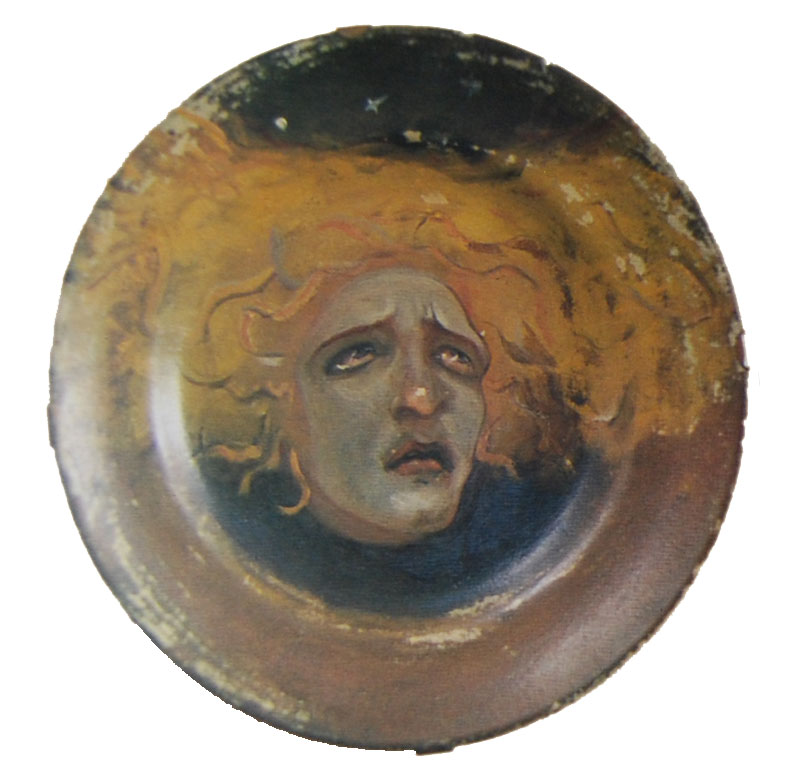
Oil on terracotta — 1902 ?
Identification
- Title
- Italian: Gorgone.
- Date
- 1902 ?
- Medium
- Oil on terracotta
- Dimensions
- Diameter 22 cm ?
- Signature
- Unsigned
- Present location
- Unknown
Catalogue numbers
| Compiler | Number |
|---|---|
| Arthur Pfannstiel | — |
| Joseph Lanthemann | no. 3 |
| Ambrogio Ceroni | — |
| Jeanne Modigliani | YES |
| Christian Parisot | no. 1/1902 |
| Osvaldo Patani | — |
| Modigliani Project | ? |
| MR | ? |
| Modigliani Initiative | ? |
Legal note on MR: This investigation has not had access to MR’s catalogue raisonné; all research here is based on open sources, publications and exhibitions. By no means has that catalogue been copied at any point. Modigliani Project and Modigliani Initiative are marked YES when the work is published or otherwise recorded by those projects, even if no catalogue number is assigned; otherwise the field is marked ?.
Provenance
- Piccioli Collection, Florence (1958)
The sequence follows the published museum, sale, and catalogue record in this investigation. Gaps and uncertain transfers are marked as such.
Selected bibliography
Book-length publications are marked with a footnote giving a full citation. Exhibition catalogues appear in both this list and the exhibition list when this investigation recorded them in both places.
- Jeanne Modigliani, Modigliani: Man and Myth, Orion Press, New York, 1958, pl. 17 (dated 1896)
- Jeanne Modigliani, Modigliani sans légende1961, rep. no. 172
- Lanthemann, Catalogue Raisonne, G. Condal, Barcelona, 1970, no. 33
- Parisot, Modigliani, caja de pensiones, ed. Poligrafía, Barcelona, 1983, p. 73, no. 2
- Modigliani, Editions Pirra, Turin 1984, pag. 53, no. 1
- Modigliani, Editions Guida, Naples 1984, pag. 65, no. 1
- Parisot, Catalogue Raisonné Modigliani Tome II, Graphis Arte, 1991 no. 1/1902, rep. p. 204
- Parisot, Modigliani, Pierre Terrail, Paris, 1992, p. 175
- Soto Caba, Modigliani, the timeless face, Libsa, 2007
Exhibitions
- Barcelona, Modigliani, Centro Cultural de la Caixa de pensiones,Curated by Christian Parisot, 1983, no. 2
- Madrid, Modigliani, Sala de exposiciones la caja de pensiones, Curated by Christian Parisot, 1983, no. 2
- Turin, Galerie Pirra, 1984
- Naples, Musée Villa Pignatelli, 1984
Notes
No further documentary note is recorded in this investigation beyond the fields above. Where sources disagree, both readings are given.
Essay:
Gorgone: Amedeo Modigliani’s Early Painted Terracotta Medallion
Gorgone (also called Gorgona), an oil painting on terracotta dated variously to 1896 or 1902, is one of the earliest surviving works associated with Amedeo Modigliani. It takes the form of a circular dish or plate, roughly 22 cm in diameter, unsigned, and last recorded in the Piccioli Collection, Florence, in 1958. Its present location is unknown. The piece appears in Jeanne Modigliani’s Modigliani: Man and Myth (1958, pl. 17, dated 1896 as “Gorgon, Earthenware”), Lanthemann’s catalogue (no. 3), and Christian Parisot’s catalogues (including no. 1/1902). It has been exhibited in Barcelona and Madrid (1983, curated by Parisot) and in Turin and Naples (1984).
The visual image shows a frontal, bust-length head painted inside the circular field of a terracotta plate. The face is pale and grayish-blue, almost mask-like, with a high forehead, heavy-lidded eyes that gaze upward, a furrowed brow, and a slightly open mouth that conveys distress or anguish rather than the classic grotesque grimace of ancient gorgoneia. The nose is straight and prominent; the cheeks are modeled with soft, somewhat smoky transitions. Surrounding the head is a mass of wild, flame-like or serpentine hair rendered in thick strokes of orange, ochre, and yellow that swirl outward toward the rim, suggesting both Medusa’s snakes and a more expressionistic, almost art-nouveau energy. The upper background is dark, nearly black, with scattered lighter flecks, while the lower portion and the broad rim of the plate remain the warm brown of the terracotta support itself, worn and chipped at the edges. The paint is applied directly and with visible brushwork; there is little evidence of fine glazing or elaborate underdrawing. The overall effect is that of a small, intimate painted object rather than a polished ceramic vessel.
This is not a conventional gorgoneion in the archaic Greek sense—those typically feature bulging eyes, protruding tongue, fangs, and writhing snakes intended as apotropaic devices. Modigliani’s version humanizes and psychologizes the motif. The expression is closer to a suffering or visionary face than to a monster meant to petrify. The upward glance and open mouth evoke pathos more than terror. In this respect the work already hints at the artist’s later preoccupation with the human head as a vehicle for intense, often melancholic, inner life, even if the style is still far from the elongated, linear elegance of his Parisian period.
Dating remains unsettled. Jeanne Modigliani placed it in 1896, when her father would have been only twelve, grouping it with other very early efforts such as the painted furniture panels made with Uberto Mondolfi. Most other catalogues, including Parisot, prefer 1902, a more plausible moment during Modigliani’s student years in Italy (Florence and Venice). Either date situates the piece before his arrival in Paris in 1906 and well before his sustained engagement with sculpture in stone (c. 1909–1914). The choice of terracotta as support is itself significant. Modigliani later expressed disdain for modeling in clay (“mud”), preferring the direct carving of limestone. This early painted plate therefore represents an experimental, perhaps provisional, use of a ceramic medium that he would largely abandon.
Iconographically, the gorgon motif carries classical and mythological weight that would have been familiar to a young Italian artist steeped in the art of antiquity and the Renaissance. Yet the treatment is personal rather than archaeological. The flame-like hair and the anguished, upward-looking face transform the traditional apotropaic image into something more introspective and modern. One can read it as an early exploration of the female head as emblem of both beauty and danger, a theme that would recur, transformed, in the nudes and portraits of the mature years. The circular format and the integration of figure with the object’s rim also anticipate Modigliani’s lifelong interest in the head as a self-contained, almost sculptural unit.
Technically and materially, the work remains modest. The paint sits on the porous terracotta surface without extensive preparation, and the object shows signs of age and handling. Its survival in a private Florentine collection into the mid-twentieth century, and its subsequent inclusion in major catalogues and exhibitions, has secured its place in the documented early oeuvre, even while certain contemporary research projects mark it with a question. Because it is a small painted object rather than a canvas or stone sculpture, it has remained relatively obscure, yet it offers a valuable glimpse of Modigliani’s formative years: a moment when classical mythology, youthful expressiveness, and the simple act of painting on an available support already pointed toward the concentrated psychological intensity that would define his later art.
Additional sources consulted include Jeanne Modigliani’s Modigliani: Man and Myth (Orion Press, 1958), which lists the work as “Gorgon, 1896. Earthenware. Piccioli Collection, Florence,” and Christian Parisot’s various catalogues, which date it 1902 and number it 1/1902. Lanthemann’s 1970 catalogue raisonné also includes it (no. 3). The secretmodigliani.com investigation page records the same provenance and exhibition history and notes discrepancies in dating between sources. No further independent documentary evidence of execution or early ownership beyond the Piccioli Collection reference of 1958 has been located in open sources. The visual analysis above is based primarily on the published photograph of the object.
Footnotes
- Jeanne Modigliani, Modigliani: Man and Myth, New York, Orion Press, 1958.
- Jeanne Modigliani, Modigliani sans légende, Paris, Gründ, 1961.
- Joseph Lanthemann, Modigliani, catalogue raisonné: sa vie, son œuvre, son art, Barcelona, G. Condal, 1970.
- Christian Parisot, Catalogue raisonné Modigliani, Livorno, Graphis Arte, 1991.
- Christian Parisot, Modigliani, Paris, Pierre Terrail, 1992.
- Victoria Soto Caba, Modigliani: The Timeless Face, Madrid, Libsa, 2007.