The Amazon
Oil on canvas — 1909
Identification
- Title
- English: Amazon - The Equestrienne - the Amazon - | The Riding Habit | - Baroness Mettingen - The yellow corset.
French: L' Amazon - Baroness Marguerite de Hasse de Villers
Italian: L'Amazzone
Notes: L'Amazzone (Ceroni 1970); L'Amazone (Sotheby's 2013; Christie's 2015); The Amazon (Jewish Museum 2017–18); also The Riding Habit, The Equestrienne, Baroness Marguerite de Hasse de Villers (Sotheby's) - Date
- 1909
Notes: 1909 (Ceroni, Sotheby's, Jewish Museum); 1908 (Pfannstiel 1929 and Franchi 1946, according to Sotheby's) - Medium
- Oil on canvas
- Dimensions
- 92 × 65.6 cm (Sotheby's 2013; Jewish Museum checklist)
Notes: 92 × 65 cm (Pfannstiel, Ceroni, Patani, Ireson); 74 × 60 cm (Parisot) - Signature
- Signed "Modigliani" lower left in red
- Present location
- Private collection ?
Catalogue numbers
| Compiler | Number |
|---|---|
| Arthur Pfannstiel | no. 9 |
| Joseph Lanthemann | no. 27 |
| Ambrogio Ceroni | no. 21 |
| Jeanne Modigliani | YES |
| Christian Parisot | 7/1909 |
| Osvaldo Patani | no. 27 |
| Modigliani Project | YES |
| MR | YES |
| Modigliani Initiative/ AMDC | ? |
Legal note on MR: This investigation has not had access to MR’s catalogue raisonné; all research here is based on open sources, publications and exhibitions. By no means has that catalogue been copied at any point. Modigliani Project and Modigliani Research Project are marked YES when the work is published or otherwise recorded by those projects, even if no catalogue number is assigned; otherwise the field is marked ?.
Provenance
- Paul Alexandre Collection, Paris
- Paul Guillaume, Paris (1929)
- Mme. Hostetler Coll. Paris
- Carstairs Gallery, New York
- Alex & Elizabeth Lewyt Coll. New York (acquired 1953)
- Sale Sotheby's NY- N08987 - Impressionist and Modern Evening Sale - 7 / May / 2013 - Lot 12- Sold: 25.925.000 USD
- Private collection?
The sequence follows the published museum, sale, and catalogue record in this investigation. Gaps and uncertain transfers are marked as such.
Selected bibliography
Book-length publications are marked with a footnote giving a full citation. Exhibition catalogues appear in both this list and the exhibition list when this investigation recorded them in both places.
- Venezia, XIIIa Esposizione Internazionale d'Arte della città di Venezia, 1922 (¿?)
- Pfannstiel, "catalogue présumé" Modigliani. L'Art et la Vie. Preface de Louis Latourrettes, Seheur, Paris, 1929, p. 31
- Franchi, Modigliani, Arnaud, Firenze, 1944, pl. 2
- Franchi, Modigliani, Arnaud, Firenze, 1946, pl. 2
- San Lazzaro, Modigliani peintures, Les Éditions du Chêne, Paris, 1953, p. 4
- Pfannstiel, Modigliani et son oeuvre, étude critique et catalogue raisonne, Bibliothèque des Arts, Paris, 1956 - no. 92
- Ceroni, Amedeo Modigliani: Peintre; Suivi des Souvenirs de Lunia Czechowska, Edizioni del Milione, 1958 - no. 173
- Werner, Amedeo Modigliani, Garzanti, Milano 1967, p.66
- Werner, Amedeo Modigliani, New York, 1968, p. 75
- Diehl, Modigliani, Ed. Flamarion, Paris, 1969, p. 11
- Lanthemann, Modigliani, catalogue raisonné: sa vie, son oeuvre, son art, G. Condal, Barcelona, 1970 - no. 274
- Ceroni & Piccioni, Il dipinti di Modigliani, Rizzoli, Milano, 1970 - no. 215
- Kamon, Modigliani, Utrillo, 1971, no. 16, p. 195, fig. 4
- Ceroni, Tout l'oeuvre peint de Modigliani, Paris, 1972, no. 21
- Hall, Modigliani, Phaidon, Oxford, 1979, pl. 7
- Mann, Modigliani, Thames and Hudson, London, 1980, pl. 526
- Lassaigne, Tout Modigliani, la peinture, Paris, 1982, p. 16
- Castieau-Barrielle, La vie et l'oeuvre de Amedeo Modigliani, Paris, 1987, p. 357
- Parisot, Catalogue Raisonné Modigliani, Graphis Arte, 1991 - no. 7/19098
- Patani, Catalogo Generale, Leonardo, Milano, 1991-94 - no. 279
- Parisot, Modigliani, Paris, 1991, p. 238
- Parisot, Modigliani, Pierre Terrail, Paris, 1992, p. 2310
- Alexandre, The Unknown Modigliani: Drawings from the Collection of Paul Alexandre, 1993, p. 86
- Durieu, Modigliani, Paris, 1995, p. 50, no.. 4
- D. Krystof, Amedeo Modigliani: The Poetry of Seeing, Taschen Cologne, 2000, p. 17
- Rome, Complesso del Vittoriano, Modigliani, February-June 2006, p. 94
- Meyers, Modigliani: a life, Orlando, 2006 p. 52
- Soto Caba, Modigliani, the timeless face, Libsa, 200711
- Secrest, Modigliani: A life, New York, 2011 p. 125-125
- Ireson, Fraquelli, Modigliani, London, Tate Modern, Skira Rizzoli, London, 2017, p. 4112
- Klein, Modigliani Unmasked, The jewish Museum, New York, 201713
Exhibitions
- New York, Fine Arts Associates, Modigliani 1884-1920, 1954 - no. 1
- Palm Beach, Society of the Four Arts & Miami, Lowe Gallery, Amedeo Modigliani, 1954 - no. 9
- Buffalo, New York, Albright-Knox Art Gallery, Fifty Paintings, 1905-1913, 1955 - no. 34
- New York, Perls Gallery, Amedeo Modigliani, 1963
- New York, The Metropolitan Museum of Art, New York Collects, 1968 - no. 105
- New York, Amedeo Modigliani; loan exhibition, Acquavella Galleries, Inc. 1971 - no. 2
- Paris, Modigliani, Musée de Art Moderne de la Ville de Paris, 1981 - no. 6, catalogue cover
- Washington, D.C., The National Gallery of Art, Modigliani: An Anniversary Exhibition, 1983-84
- Tokyo, Modigliani exhibition, National Museum, 1985 - no. 11
- Nagoya, Modigliani exhibition, Aichi Prefectural Art Gallery, 1985 - no. 11
- New York, The Jewish Museum, Gardens and Ghettos: The Art of Jewish Life in Italy, 1989-90 - no. 275
- Martigny, Modigliani, Fondation Pierre Gianadda, 1990 - no. 7
- Tokyo, Exposition Amedeo Modigliani au Japon, Tobu Museum of Art, 1992-93 - no. 8
- Kyoto, Exposition Amedeo Modigliani au Japon, Daimaru Museum, 1992-93 - no. 8
- Osaka, Exposition Amedeo Modigliani au Japon, Daimaru Museum of Umeda, 1992-93 - no. 8
- Ibaraki, Exposition Amedeo Modigliani au Japon, Museum of Modern Art, 1992-93 - no. 8
Notes
As no. 258 in D' Atri files with a provenance in Paul Alexandre > Paul Guillaume in 1929
1. There is a very large number of sketches done for the portrait that remained at the Alexandre Collection.
2. The portrayed was the girlfriend of Jean Alexandre and it was a commission, but the portrayed didn't wanted to pay the painting because the jacket that was a red ridding jacket was painted in yellow instead of red.
Where sources disagree, both readings are given. This is a working research page, not a catalogue raisonné.

Introduction
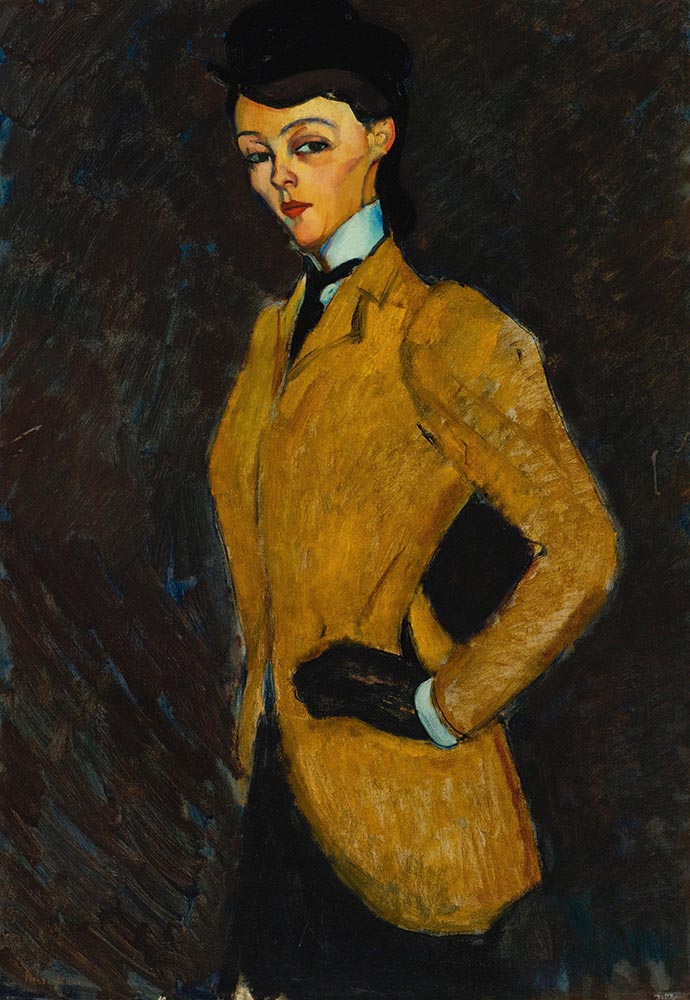
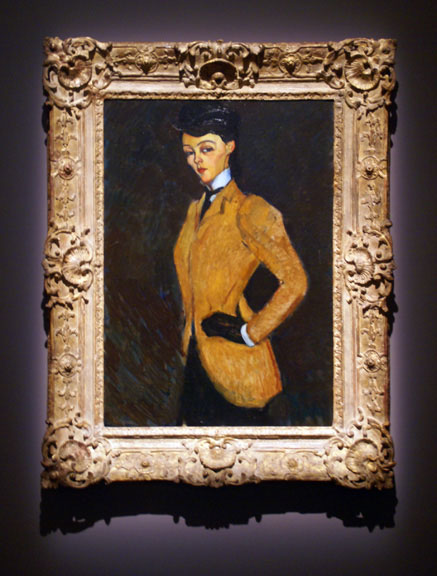
A young woman in riding dress stands with her body turned to the left and her head turned back towards the viewer. She wears a black hat, a high white collar, a black tie and a long, tightly fitted jacket of yellow ochre. Her left hand, in a black glove, rests on her hip; her elbow juts out to the right. Under heavy, arched brows, her eyes look sideways and down at the viewer, and her small red mouth is pursed. Behind her the ground is a deep brown-black, worked with streaks of blue.
This is L'Amazone, Ceroni no. 21, one of the most famous paintings of Modigliani's early years. The sitter was Baroness Marguerite de Hasse de Villers, the lover of Jean Alexandre, younger brother of Modigliani's patron Paul Alexandre. The painting is Modigliani's first true commission, and the most richly documented. Jean's letters to Paul, quoted by Christie's in 2015, follow it from the first sketch in March 1909 to the crisis at the beginning of June. The sitter's refusal of the finished work, after Modigliani repainted her red riding jacket yellow, is the best-known anecdote of his first Paris years. In 2013 it was sold at Sotheby's in New York for $25.9 million.
Composition and format
The canvas measures 92 × 65.6 cm (Sotheby's), which is close to a standard French no. 30 paysage canvas of 92 × 65 cm, used vertically (my identification). The Burlington introduction to the Modigliani Technical Research Study notes that Modigliani often used landscape and marine formats upright for portraits.
The figure fills almost the whole height of the canvas. The hat touches the top edge, and the lower edge cuts the figure below the hips. The body is set slightly to the right of centre. The jacket forms a long, narrow vertical shape that widens at the shoulders and the hips and narrows sharply at the waist. The angled left arm, with the gloved hand on the hip, creates a strong diagonal that balances the vertical of the body. The composition is more dynamic than the frontal heads of 1908–09, and it anticipates the elegant standing figures of Modigliani's later years.
Line and drawing
The drawing is firm and continuous. A dark contour defines the face, the neck, the shoulders and the long line of the jacket. The brows are two heavy arches; the eyes are outlined and filled with a dark, liquid tone; the nose is a long straight form with a dark line on its shaded side; the mouth is a small red shape with a dark upper line. The hand is drawn with a few decisive strokes, and the fingers of the glove are indicated by dark lines. The contour of the jacket is continuous and elegant, and it is the main structural line of the picture.
As in other works of 1909, the contours appear to have been reinforced at a late stage. The dark lines of the face and the jacket sit on top of the colour, and they give the figure its clarity and its mask-like quality.
Colour
The colour is built on three notes: the yellow of the jacket, the black of the hat, tie and glove, and the deep brown of the ground. The face is a warm ochre, with red on the lips and a touch of green in the shadows. The white of the collar is the brightest note, and it sets off the black of the tie and the hat. The yellow of the jacket is the dominant colour, and it is the element that the sitter rejected.
The ground is not a flat field. It is worked with streaks of blue and black, and it has a slight luminosity that keeps the figure from floating. The contrast between the warm yellow and the cool dark ground is the main colour relationship of the picture.
Facture
The paint is applied with a loaded brush. In the jacket the strokes follow the form of the body, and the yellow is built up in layers. In the face the paint is more blended, and the features are defined by the dark lines. The ground is painted more freely, with broad strokes that leave the weave visible in places. The handling has the assurance of a finished work, and it is more controlled than the sketch-like handling of some of the earlier portraits of 1909.
Figure, space and expression
The expression is more ambiguous. The face, with its heavy lids and pursed lips, is as much ironic as seductive, and the stylisation that makes it a mask also makes it remote.
Space is reduced to a dark field, without floor, furniture or setting. The figure is lit from the left, and the light falls on the shoulder and the face, but no shadow is cast on the ground. The black glove placed against the yellow jacket at the hip is the most striking accent in the painting: it draws the eye to the centre of the composition and emphasises the gesture of command.
Iconography and the sitter
The word amazone in French means a horsewoman, and also a woman's riding habit. Christie's notes that it is "a term frequently used for this subject, derived from the female warriors of antique legend". Both Christie's and Sotheby's describe the Baroness Marguerite de Hasse de Villers as an accomplished equestrienne who chose to pose in her riding dress. The Jewish Museum calls her "a socialite, equestrian, and lover of Paul Alexandre's younger brother Jean".
The elegant woman in riding dress was a familiar theme of nineteenth-century and Belle Époque portraiture. Modigliani's choice of a three-quarter-length format and a standing pose belongs to that tradition. But his stylisation of the face, and the reduction of the setting to a dark field, set his picture apart from it.
The commission: who commissioned, and where was it painted?
The sources disagree on two points.
Who commissioned it. Ceroni's note, as transcribed, says that this was "il primo ritratto commissionato da Paul Alexandre" ("the first portrait commissioned by Paul Alexandre"), and that the Baroness was "una conoscente di Paul Alexandre" ("an acquaintance of Paul Alexandre"), persuaded by him to be painted. Christie's says that Dr. Alexandre "persuaded Jean's girlfriend" to sit. Sotheby's, the Jewish Museum and the Tate all say that Jean commissioned the portrait. Jean's own letters show that he paid for it. On 26 March 1909 he lent Modigliani "20 francs against the portrait of the Amazon", and on 12 May he wrote that he "gave him the rest of the money for the portrait of the Amazon". The most consistent reading is that Paul arranged the commission before leaving for Vienna and Jean, the sitter's lover, paid for it and supervised it.
Where it was painted. Sotheby's states that "the first sketches for L'Amazone were made at Cité Falguière, the Montparnasse studio that he shared with Constantin Brancusi". According to Sotheby's, the sessions were later moved to "the more private environs of Jean's apartment". Christie's quotes Jean's letter of 28 May: "Modi is coming to do the portrait of the Amazon in my room... [he] has decided to do it at the Delta. It's far better in every way since she feels much more at home there". The Delta was the Alexandre house at 7 rue du Delta. The two accounts are compatible if the work began at the Cité Falguière and was completed at the Delta. Christie's own wording, however, is ambiguous between "my room" and "the Delta".
Chronology from the letters
The letters quoted by Christie's in 2015 give a precise chronology:
- 26 March 1909. Jean lends Modigliani 20 francs "against the portrait of the Amazon. This is barely sketched onto the canvas, yet it looks as if it should be very successful."
- 23 April. "Modi is still managing on what he's getting for the painting of the Amazon and what he receives from home."
- 12 May. "I gave him the rest of the money for the portrait of the Amazon, and the Baroness is a bit fed up with the way he's been organizing things."
- 28 May. "The portrait seems to be coming along well, but I'm afraid it will probably change ten times again before it's finished. However, to overcome this real problem, Marguerite has told him she is leaving on 3 June and would like to have her portrait to be finished by that date."
Sotheby's adds that the Baroness "threatened to quit and gave Modigliani an ultimatum of one week". The work was finished, then, in late May or early June 1909. At the last moment Modigliani changed the colour of the jacket. Christie's describes this as "a final, last-minute alteration that completely scuttled any possibility of her accepting the picture". According to the Jewish Museum, she was "unable to recognize herself and unfavorably disposed to yellow" and rejected the portrait. Paul Alexandre, Christie's says, "cut short his stay in Vienna to attend to this crisis" and acquired the picture for himself, "Jean having already advanced portions of the fee".
Comparisons
Sotheby's compares L'Amazone with Picasso's portrait of Gertrude Stein, and quotes Pierre Daix on Picasso's reduction of the face "to a mask". It also links the stylisation of the face to Brancusi's sculpture and to African art. The comparison with Picasso is apt: both are portraits of strong-willed women in which the face is simplified into a mask while the body remains naturalistic.
Within Modigliani's own work, the closest comparisons are with the portraits of the Alexandre family painted in the same months, especially Jean Alexandre (Ceroni no. 16), whose sittings Jean's letters describe alongside those of the Amazon. Jean's portrait is darker and more Cézannesque, and the Amazone is more stylised and more elegant. Their juxtaposition shows that Modigliani was already distinguishing between a sober, painterly manner for male sitters and a more decorative, linear one for women.
Sotheby's also quotes Werner Schmalenbach's description of Modigliani's portraits as "unequivocally portraits", in which "the stylization creates the effect of a mask". The Amazone may be the earliest painting in which that balance between likeness and mask is fully achieved.
Provenance, exhibitions and discrepancies
Sotheby's gives the provenance as: Dr. Paul Alexandre, Paris; Paul Guillaume, Paris (acquired by 1929); Mme Hostetler, Paris; Carstairs Gallery, New York; acquired from Carstairs on 23 April 1953 by the consignor, the Lewyt collection. Ceroni's 1970 caption, as transcribed, gives "New York, proprietà Alexander Lewyt". The painting was sold at Sotheby's in New York in 2013 and is now in a private collection (Jewish Museum, 2017–18).
The documentation contains several discrepancies:
- The dimensions. Parisot's 74 × 60 cm, as reported by the site, is incompatible with every other source and is probably an error, perhaps confused with the 73 × 60 cm canvases of the same year.
- The date. Pfannstiel (1929) and Franchi (1946) dated the picture 1908, according to Sotheby's. The letters fix the date firmly in March–June 1909.
- Venice 1922. The site's bibliography includes the 1922 Venice Biennale with the note "(¿?)". Sotheby's does not list it, and it cannot be confirmed.
The exhibition history given by Sotheby's begins in New York in 1954 and includes the Musée d'Art Moderne de la Ville de Paris in 1981, where the painting appeared on the catalogue cover. It continues with the National Gallery of Art in Washington in 1983–84, Tokyo and Aichi in 1985, the Jewish Museum's Gardens and Ghettos in 1989–90, Martigny in 1990 and a Japanese tour in 1992–93.
Technical analysis
No published technical study of L'Amazone has been found. It is not discussed in the Tate Papers article on paintings with earlier compositions beneath the surface, nor in the Burlington Magazine introduction to the Modigliani Technical Research Study.
The only technical information available is the Sotheby's condition report of 2013, which is a dealer's visual examination, not a laboratory study. It states that:
- the canvas has an old glue lining;
- under ultraviolet light the varnish is "slightly reflective and patchy in areas";
- there is "slight retouching in the center of the figure's coat";
- "at the center-left of the canvas, there is a diagonal line revealing underpainting that appears to have been made by the artist when the paint was still wet".
The last observation is important. It suggests that the artist scraped or drew into wet paint, revealing an underlayer. If that underlayer is red, it would be the physical trace of the original red jacket. But the report does not say what colour it is, and the location (centre-left) may refer to the ground rather than to the jacket.
On Pedro (Ceroni no. 17) reports a claim by Dr. Phyllis Hattis Rubin that an X-ray shows "an early version of the Amazon painting" under that picture. The claim is unpublished and cannot be checked, but if it were confirmed, it would show that Modigliani began the composition on another canvas before painting this one.
As comparative evidence, the Burlington introduction reports that the canvases examined in the study seem to have been commercially prepared with an oil-based priming. The Tate Papers article shows how X-radiography and infrared reflectography have revealed earlier compositions under other early works. Similar examination of L'Amazone would settle the question of the red jacket, and would show how many times, in Jean's phrase, the portrait was changed.
Conclusion
L'Amazone is the best-documented painting of Modigliani's early years. Jean Alexandre's letters, quoted by Christie's, date it between March and early June 1909 and document its payment, the sitter's growing impatience, the move to the Delta and the final crisis. The Jewish Museum, Sotheby's and Ceroni all report the last-minute change of the jacket from red to yellow and the sitter's refusal of the picture, and they agree that Paul Alexandre bought it.
The discrepancies identified here concern who commissioned it (Jean or Paul), where it was painted, the date of the 2013 sale and the exhibitions of 2017–18, at which only a digital display was shown in New York. None of them changes the essential history.
As a painting, the Amazone is the first in which Modigliani's mature conception of the portrait appears: a naturalistic body, a stylised face, and a colour harmony that is both decorative and expressive. The yellow jacket that the Baroness refused is now its signature.
Sale literature and press
- Sotheby's, New York, Impressionist & Modern Art Evening Sale (N08987), 7 May 2013, lot 12, Modigliani, L'Amazone: description, provenance, exhibitions, literature, condition report and catalogue note, https://www.sothebys.com/en/auctions/ecatalogue/2013/impressionist-modern-art-evening-sale-n08987/lot.12.html
- Sotheby's, Impressionist & Modern Art Evening Sale (N08987), auction page, https://www.sothebys.com/en/auctions/2013/impressionist-modern-art-evening-sale-n08987.html
- The New York Times, report on the Sotheby's Impressionist and Modern evening sale, 8 May 2013, https://www.nytimes.com/2013/05/08/arts/design/cezanne-and-modigliani-help-propel-sothebys-sale-to-230-million.html
- Christie's, New York, 14 May 2015, sale 3736, lot 3, Modigliani, Jean Alexandre (recto) / Nu assis (verso): lot essay (quoting Jean Alexandre's letters of 26 March, 23 April, 12 May and 28 May 1909), https://www.christies.com/en/lot/lot-5893247
Museum documentation
- The Jewish Museum, New York, Modigliani Unmasked, large-print guide (section text and no. 35, The Amazon), https://thejewishmuseum.org/wp-content/uploads/2025/06/Modigliani_Large_Print_FINAL.pdf
- The Jewish Museum, New York, Modigliani Unmasked, exhibition checklist, https://thejewishmuseum.org/wp-content/uploads/2025/07/Modigliani_Unmasked_checklist.pdf
- The Jewish Museum, New York, Modigliani Unmasked, wall texts and object labels, https://thejewishmuseum.org/wp-content/uploads/2025/07/Modigliani_Unmasked_wall_texts_and_object_labels.pdf
- Tate Modern, Modigliani (23 November 2017–2 April 2018), large-print guide, rooms 1–11 (copy at docslib), https://docslib.org/doc/1601730/modigliani-large-print-guide-room-1-11
Technical literature (comparative)
- Anaïs Genty-Vincent et al., "Works by Modigliani that have Paintings beneath the Visible Surface", Tate Papers, no. 35, https://www.tate.org.uk/research/tate-papers/35/works-by-modigliani-that-have-paintings-beneath-the-visible-surface
- Annette King, Nancy Ireson, Simonetta Fraquelli and Joyce H. Townsend, "The Modigliani Technical Research Study: An introduction to Modigliani's materials and techniques", The Burlington Magazine, vol. 160, no. 1380 (March 2018), pp. 182–88, https://www.burlington.org.uk/archive/article/the-modigliani-technical-research-study-an-introduction-to-modiglianis-materials-and-techniques
Cited but not independently consulted
Pfannstiel, L'Art et la Vie: Modigliani (1929) and Modigliani et son oeuvre (1956), no. 9; Franchi 1946; San Lazzaro 1953; Ceroni 1958, no. 17; Werner 1968; Diehl 1969; Lanthemann 1970, no. 27; Ceroni and Piccioni 1970, no. 21; Ceroni 1972; Kamon 1971; Hall 1979; Mann 1980; Lassaigne 1982; Castieau-Barrielle 1987; Parisot 1990–92; Patani 1991–92; Noël Alexandre, Modigliani inconnu, 1993; Durieu 1995; Krystof 1996; Rome 2006; Meyers 2006, p. 52; Secrest 2011, pp. 124, 179; Schmalenbach, "The Portraits", in L'ange au visage grave, 2002–03, pp. 42–43; Sichel 1967; Daix on Picasso's Gertrude Stein; Ireson and Fraquelli (eds.), Modigliani, Tate 2017, p. 41; Klein (ed.), Modigliani Unmasked, 2017; the published Alexandre correspondence; the D'Atri files (no. 258); the exhibition catalogues listed by Sotheby's. All are cited from Sotheby's, Christie's or the Secret Modigliani page on the work.
Footnotes
- Arthur Pfannstiel, Modigliani. L’Art et la Vie, preface by Louis Latourette, Paris, Seheur, 1929 (presumed catalogue).
- Arthur Pfannstiel, Modigliani et son œuvre, étude critique et catalogue raisonné, Paris, Bibliothèque des Arts, 1956.
- Ambrogio Ceroni, Amedeo Modigliani: Peintre; suivi des souvenirs de Lunia Czechowska, Milan, Edizioni del Milione, 1958.
- Joseph Lanthemann, Modigliani, catalogue raisonné: sa vie, son œuvre, son art, Barcelona, G. Condal, 1970.
- Ambrogio Ceroni and Leone Piccioni, I dipinti di Modigliani, Milan, Rizzoli, 1970.
- Carol Mann, Modigliani, London, Thames and Hudson, 1980.
- Thérèse Castieau-Barrielle, La vie et l’œuvre de Amedeo Modigliani, Paris, ACR, 1987.
- Christian Parisot, Catalogue raisonné Modigliani, Livorno, Graphis Arte, 1991.
- Osvaldo Patani, Amedeo Modigliani: catalogo generale, Milan, Leonardo, 1991–94.
- Christian Parisot, Modigliani, Paris, Pierre Terrail, 1992.
- Victoria Soto Caba, Modigliani: The Timeless Face, Madrid, Libsa, 2007.
- Nancy Ireson and Simonetta Fraquelli, Modigliani, London, Tate Modern / Skira Rizzoli, 2017.
- Mason Klein, Modigliani: Beyond the Myth, New York, The Jewish Museum / Yale University Press, 2004.