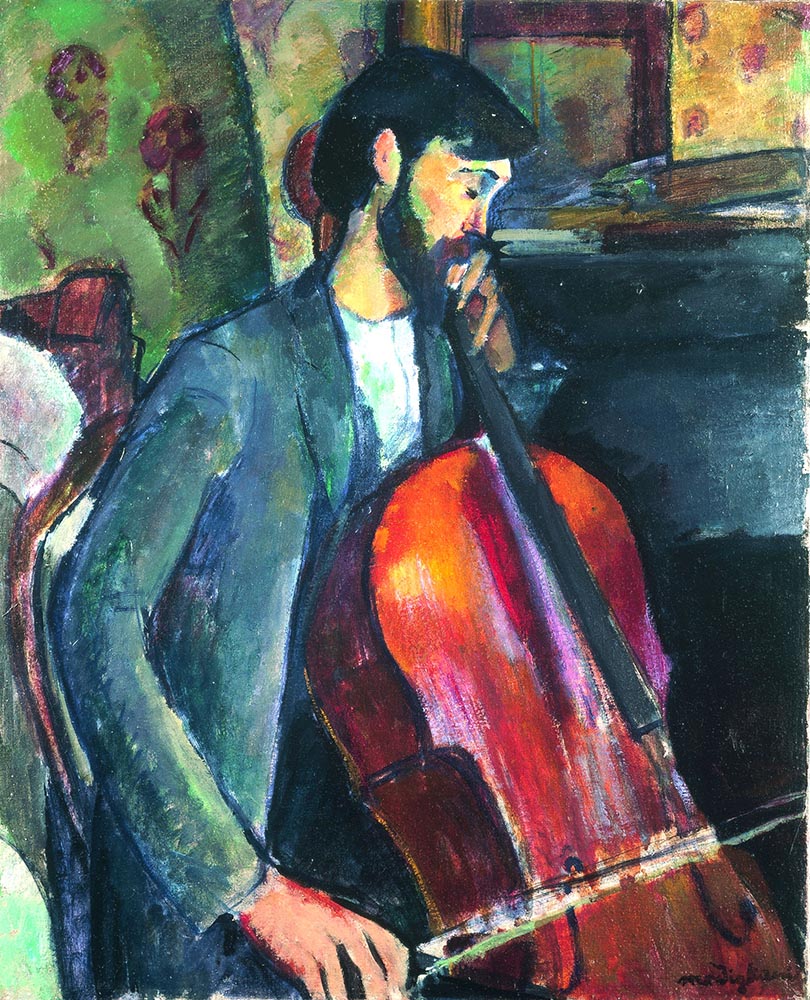
Study for the cello player (Verso Portrait of C. Brancusi)
Oil on canvas — 1909
Identification
- Title
- English: Study for the cello player (verso study for a portrait of Constantin Brancusi).
French: Étude pour le violoncelliste.
Notes: Studio per il Suonatore di violoncello (Ceroni 1970); Étude pour 'Le Violoncelliste' (Christie's 2015); The Cellist (Tate 2017–18; Meadows Museum 2015; Garcia, Juanes and Romero 2023) - Date
- 1909
- Medium
- Oil on canvas
Notes: painted on both sides (reverse: Study for a Portrait of Constantin Brancusi, Ceroni no. 22b) - Dimensions
- 73 × 60 cm (Parisot: 74× 60 cm)
- Signature
- Signed "modigliani" lower right
- Present location
- Abello collection, Madrid
Catalogue numbers
| Compiler | Number |
|---|---|
| Arthur Pfannstiel | no. 16 |
| Joseph Lanthemann | no. 35 |
| Ambrogio Ceroni | no. 22(a) |
| Jeanne Modigliani | YES |
| Christian Parisot | 8/1909 |
| Osvaldo Patani | no. 29 A |
| Modigliani Project | YES |
| MR | YES |
| Modigliani Initiative/ AMDC | ? |
Legal note on MR: This investigation has not had access to MR’s catalogue raisonné; all research here is based on open sources, publications and exhibitions. By no means has that catalogue been copied at any point. Modigliani Project and Modigliani Research Project are marked YES when the work is published or otherwise recorded by those projects, even if no catalogue number is assigned; otherwise the field is marked ?.
Provenance
- Paul Alexandre Collection, Paris
- Private collection, France
- Abello collection, Madrid
The sequence follows the published museum, sale, and catalogue record in this investigation. Gaps and uncertain transfers are marked as such.
Selected bibliography
Book-length publications are marked with a footnote giving a full citation. Exhibition catalogues appear in both this list and the exhibition list when this investigation recorded them in both places.
- Pfannstiel, "catalogue présumé" Modigliani. L'Art et la Vie. Preface de Louis Latourrettes, Seheur, Paris, 1929, p. 41
- Taguchi, Modigliani, Alier-Sha Tokyo, 1936
- Franchi, Modigliani, Arnaud, Firenze, 1946, pl. 5
- Museum of Modern Art, New York, 1951, p. 18
- M. Reynal, Genéve, 1951, p. 1
- Lipchitz, Amedeo Modigliani, H.N. Abrams, New York, 1952, p. 7
- Lipchitz, Amedeo Modigliani, H.N. Abrams, New York, 1953, pl. 2
- Lipchitz, Amedeo Modigliani, H.N. Abrams, New York, 1954, pl. 12
- Rivista di Livorno, Omaggio a Amedeo Modigliani, Livorno, 1954, p. 5
- T. Soby, Modigliani, Museum of Modern art, New York, catalogue exp. 1954, p. 14
- Pfannstiel, Modigliani et son oeuvre, étude critique et catalogue raisonne, Bibliothèque des Arts, Paris, 1956 - no. 162
- Ceroni, Amedeo Modigliani: Peintre; Suivi des Souvenirs de Lunia Czechowska, Edizioni del Milione, 1958 - no. 183
- Gindertael, shop livre diffusion, 1967 p. 2
- Werner, Amedeo Modigliani, Garzanti, Milano 1967, p. 68
- Werner, Amedeo Modigliani, 1968, p. 79
- Lanthemann, Modigliani, catalogue raisonné: sa vie, son oeuvre, son art, G. Condal, Barcelona, 1970 - no. 354
- Ceroni & Piccioni, Il dipinti di Modigliani, Rizzoli, Milano, 1970 - no. 22A5
- Arno, New York 1972, p. 18
- Hubbard, Modigliani and the painters of Montparnasse, Lamplight Publ. New York, 1975, p. 12 , pl. 2 (size 73 × 60 cm. Alexandre Coll.)
- Mann, Modigliani, Thames and Hudson, London, 1980, pp.54/596
- Carluccio, Leymarie, Negri, Russoli, Brunhammer, École de Paris, Rive Gauche, Paris, 1981, p. 200
- C. Roy Modigliani, Paris, 1985, p. 26
- Werner, Modigliani, Harry N. Abrams, NY, 1985, p. 54-55
- Castieau-Barrielle, La vie et l'oeuvre de Amedeo Modigliani, Editions ACR Paris, 1987, page 487
- Braun, Italian Art, 1988, p.60
- Parisot, Modigliani, Editions Graphis Arte Paris, 1988, p. 34
- Parisot, Catalogue Raisonné Modigliani, Graphis Arte, 1991 no. 8/19098
- Patani, Catalogo Generale, Leonardo ed. Milano 1991-94, no. 29 A (verso Brancusi 29 B9
- Parisot, Modigliani, Pierre Terrail, Paris, 1992, p. 2010
- Alexandre, The Unknown Modigliani: Drawings from the Collection of Paul Alexandre, 1993, p. 48
- D. Krystof, Amedeo Modigliani: The Poetry of Seeing, Taschen Cologne, 2000, p. 18
- Soto Caba, Modigliani, the timeless face, Libsa, 200711
- Madrid, Museo Thyssen-Bornemisza, Modigliani y su tiempo, 2008
- R, Le silence éternel, Pinacotheque de Paris, 2008, p. 26 (with the mistake of taking the study for the final painting, giving the measures and data of the final but presenting the photo of the study)
- Dallas, Meadows museum, The Abelló Collection: A Modern Taste for European Masters, 2015
- Ireson, Fraquelli, Modigliani, London, Tate Modern, Skira Rizzoli, London, 2017, pp. 34-3512
Exhibitions
- Paris, 26e Exposition, Société des Artistes Indépendants, Cours-la-Reine, 1910 - no. 3688
- Brussels, Modigliani: Retrospective Exhibition. Palais des beaux-arts, 1933 - no. 12
- Basel, Amedeo Modigliani, Kunsthalle, 1934
- Cleveland, Modigliani: Paintings, Drawings, Sculpture, Cleveland Museum of Art,1951
- New York, Modigliani: Paintings, Drawings, Sculpture, The Museum of Modern Art, 1951
- New York, Museum of Modern Art, Cat. Arno, 1972.
- London - Munich, Italian Art, 1988
- Madrid, Museo Thyssen-Bornemisza, Modigliani y su tiempo, 2008
- Dallas, Meadows museum, The Abelló Collection: A Modern Taste for European Masters, 2015
- London, Modigliani, Tate Modern, 2017-2018
Notes
As no. 5 in D' Atri files as The cello player, studio with a provenance in Alexandre with mention to painting of Brancusi in verso.
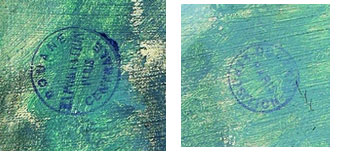
This portrait present the stamp placed by the French export authorities used during the 30's, probably for the exportation done to Japan for an exhibition in 1933.
First Stamp: Configuration used during the 30's / Second Stamp: Configuration used during the 40's -50's.
Where sources disagree, both readings are given. This is a working research page, not a catalogue raisonné.

Introduction
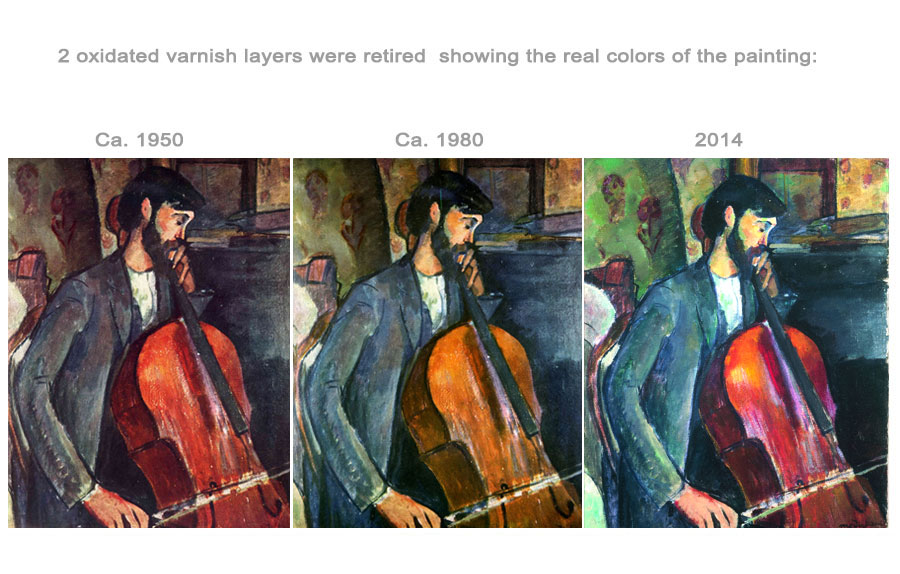
A bearded young man sits in profile to the right, his eyes closed and his head bowed over the neck of a cello. His left hand rises to the fingerboard just below his beard, and his right hand, at the lower edge of the canvas, draws the bow across the strings. He wears a loose blue-grey jacket over a white shirt. The cello, a great swelling body of orange and red, fills the lower right of the picture. Behind him is a green wall patterned with red flowers, a framed picture, a strip of yellow, a horizontal dark ledge and, at the left edge, the back of a red chair and a pale area of white.
This is the oil study for Le Violoncelliste, Ceroni no. 23, the largest and most ambitious painting of Modigliani's first Paris years. It is unusual in three ways. It is a full-scale oil study for a picture that survives, which is rare for Modigliani. It is painted on both sides of one canvas: the reverse carries an unfinished head of the sculptor Constantin Brancusi. And it is one of very few early Modigliani paintings to have had a published technical study devoted entirely to it. In 2016 the owner, Juan Abelló, allowed the whole canvas to be examined under infrared, ultraviolet and X-ray, with X-ray fluorescence analysis of the pigments. The results were published in 2023 by Greta Garcia, David Juanes and Rafael Romero in the International Journal of Conservation Science. That article changes what can honestly be said about this picture, and it is used extensively below.
Ceroni gave the two sides of the canvas a single number, 22, divided into 22a and 22b. This essay treats the cello study (22a); the Brancusi head is the subject of a separate essay. The shared number is flagged here as a duplicate, as the method of this series requires.
Composition and format
At 73 × 60 cm the canvas is a standard no. 20 figure size (my identification of the format, not a statement made by any source consulted). The finished Violoncelliste is much taller and narrower, at 131 × 81 cm (Christie's 1999) or 130 × 81 cm (Ceroni, Parisot and Patani, as reported by Secret Modigliani). The study therefore does not simply reduce the final composition. It works out the figure in a squarer field, and much of what makes the final picture distinctive, its elongation, is not yet present.
The composition is built on a strong diagonal. The cellist's head, near the top centre, is the apex. His back and the right side of the jacket fall in a long curve down to the lower left. The neck of the cello runs from his chin to the lower right, and the bow cuts back across the bottom of the canvas from right to left. The cello's body, cut by the right edge, is the largest single shape in the picture and the heaviest in colour. The figure is cut by the lower edge at the hand and by the left edge at the elbow. Nothing of the legs is visible, so that the man and the instrument read as one compact mass pressed into the picture plane.
The background is divided into rectangles: the patterned green wall at the upper left, a vertical band behind the head, a framed picture at the top centre-right, the yellow patch at the top right, and the long horizontal ledge and dark area that occupy the right half below them. This grid structure, combined with the diagonal of the figure, gives the picture its architectural quality.
Line and drawing
The drawing is firm and continuous. A dark contour defines the face, the neck, the shoulders and the long line of the jacket. The brows are two heavy arches; the eyes are outlined and filled with a dark, liquid tone; the nose is a long straight form with a dark line on its shaded side; the mouth is a small red shape with a dark upper line. The hand is drawn with a few decisive strokes, and the fingers of the glove are indicated by dark lines. The contour of the jacket is continuous and elegant, and it is the main structural line of the picture.
As in other works of 1909, the contours appear to have been reinforced at a late stage. The dark lines of the face and the jacket sit on top of the colour, and they give the figure its clarity and its mask-like quality.
Colour
The colour is built on three notes: the yellow of the jacket, the black of the hat, tie and glove, and the deep brown of the ground. The face is a warm ochre, with red on the lips and a touch of green in the shadows. The white of the collar is the brightest note, and it sets off the black of the tie and the hat. The yellow of the jacket is the dominant colour, and it is the element that the sitter rejected.
The ground is not a flat field. It is worked with streaks of blue and black, and it has a slight luminosity that keeps the figure from floating. The contrast between the warm yellow and the cool dark ground is the main colour relationship of the picture.
Facture
The paint is applied with a loaded brush. In the jacket the strokes follow the form of the body, and the yellow is built up in layers. In the face the paint is more blended, and the features are defined by the dark lines. The ground is painted more freely, with broad strokes that leave the weave visible in places. The handling has the assurance of a finished work, and it is more controlled than the sketch-like handling of some of the earlier portraits of 1909.
Figure, space and expression
The figure is withdrawn into the music. The closed eyes and bowed head turn him away from the viewer and from the room. The left hand at the fingerboard comes close to the beard, so that the instrument seems to rise into the face. It is a familiar image of absorption, and Modigliani makes it physical: the man curves around the instrument, and the instrument presses against him.
The space is shallow. The cellist and his cello are in the foreground; the wall, the picture and the ledge are only a short distance behind. There is little modelling of depth, and the patterned wall reads as a flat surface rather than a receding plane. Yet there is more sense of a real room here than in most of Modigliani's portraits of 1909, which often place the sitter against a coloured field. The chair, the white form, the frame and the ledge are fragments of a specific interior, cut off by the edges of the canvas.
The sitter
The cellist has not been identified by name in any source I consulted. Ceroni's note, as transcribed, says only: "Il violoncellista abitava probabilmente alla Cité Falguière, non lontano dallo studio di Modigliani" ("The cellist probably lived at the Cité Falguière, not far from Modigliani's studio"). The account quoted in the 2023 article goes further: "The musician who played the cello lived in Cité Falguière in a studio on the second floor since 1909, where Modigliani also worked. His modelling sessions allowed the poor devil to practice in the warmth of his neighbours' wood stove."
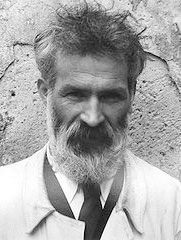
Christie's, in its 1999 essay on the finished painting, reported a suggestion that the cellist might be Brancusi himself, who "though not known to have played the cello was a keen violinist". It rejected the idea: "The grounds for this identification is, however, insubstantial. Despite the facial resemblance, the slender body and elongated forms of the figure in the painting are inconsistent with Brancusi's more robust figure." The juxtaposition of the two heads on the same canvas invites the comparison. Both men are dark and bearded, and both heads are bowed. But the Brancusi head is broader and the features heavier, and I see no reason to go beyond Christie's caution.
Comparisons
The most important comparison is with the finished Violoncelliste (Ceroni no. 23). The two pictures share the main elements: the profile to the right, the closed eyes, the left hand at the neck of the instrument, the right hand with the bow at the bottom, the chair, the white form, the patterned wall and the framed rectangle at the top right. The differences are telling. In the final version the figure is lengthened in every part: the neck is longer, the face narrower, the arm a long, almost boneless curve, as Christie's put it. The colour is lower in key, with a darker, browner red for the cello and a greener, more subdued ground. The study is broader, warmer and rougher. It shows the composition before Modigliani had decided to stretch it.
The second comparison is with Cézanne. Christie's 1999 called the finished picture "the culmination of a period in Modigliani's art that was characterised by the influence of Cézanne", and reported that Paul Alexandre called it "better than Cézanne". The Tate's 2017 guide noted the impact of a Cézanne exhibition of 1907 on The Beggar of Livorno, painted the same summer. In the study, the Cézannian element is visible in the constructive brushstrokes of the jacket and cello, in the use of blue contour, and in the subject itself. A seated musician absorbed in his instrument recalls Cézanne's seated figures, although I have not found a source that names a specific Cézanne model for this picture, and I make no such claim.
The third comparison is with the other Alexandre-circle paintings of 1909. Jean Alexandre (Christie's 2015) was also painted on a reused canvas, on the back of a nude. Christie's wrote that "Modigliani again resorted to this practice when he painted the Étude pour 'Le Violoncelliste', 1909 (Ceroni, no. 22a)". The two-sided canvas belongs to a pattern of economy that the Tate's guide also noted: "Modigliani painted this canvas on both sides, which suggests he had limited funds for art supplies."
Provenance, exhibitions and discrepancies
Provenance as Paul Alexandre, Paris; a private collection, France; and the Abelló collection, Madrid. The 2023 article dates the picture's entry into the Abelló collection to "around 1981", although its wording ("was restored before it entered the Abelló collection around 1981") could also be read as dating the restoration. Christie's 2015 caption for the Brancusi side gives it as "Formerly in the collection of Dr. Paul Alexandre, Paris; Private collection".
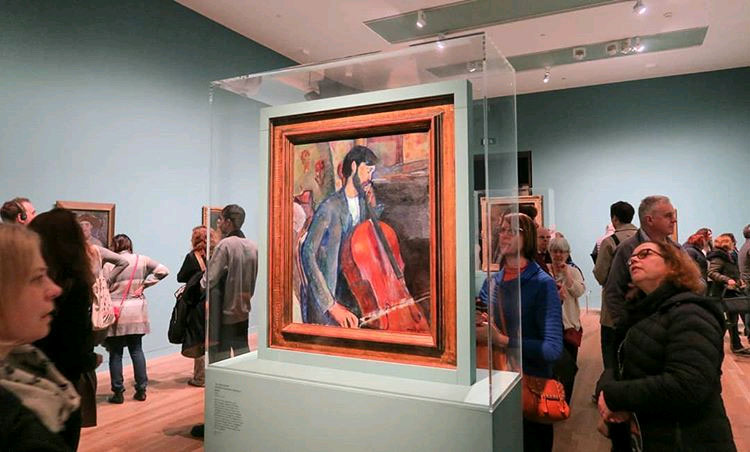
The page lists a long run of exhibitions: the Salon des Indépendants, 1910, no. 3688; Brussels, Palais des Beaux-Arts, 1933, no. 12; Basel, Kunsthalle, 1934; Cleveland and New York, 1951; New York, MoMA, 1972; London and Munich, Italian Art, 1988; Madrid, Thyssen-Bornemisza, Modigliani y su tiempo, 2008; Dallas, Meadows Museum, The Abelló Collection, 2015; London, Tate Modern, 2017–18. The Meadows and Tate showings are confirmed by the SMU press release of April 2015 and the Tate's large-print guide.
Several discrepancies must be flagged:
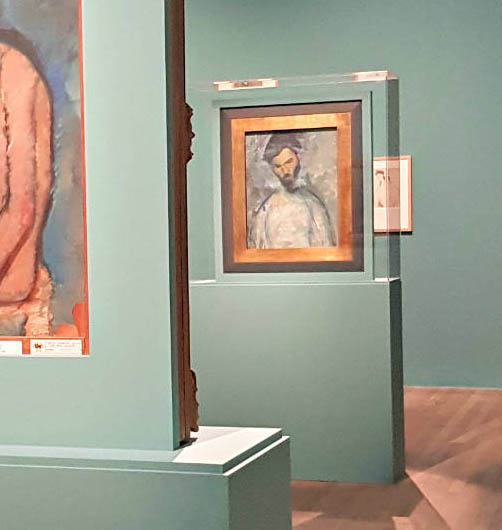
- The Tate, the Meadows Museum and the 2023 study all treat The Cellist as the front. The X-ray evidence (below) suggests that the Brancusi head was painted first, which may explain Ceroni's usage, but the captions as transcribed are inconsistent with the present display.
- The 1910 Salon. The page lists the study as no. 3688 in the 1910 Indépendants, where the catalogue gave only the title "Etude". But the site's own page on the 1910 Salon introduces nos. 3688 and 3689, both "Etude", with the words "Experts locate the next work???". The identification is therefore uncertain. Ceroni's note on no. 23 ("L'opera, così come la precedente opera, venne esposta al Salon des Indépendants di Parigi nel 1910") appears to support it, but it is not proof.
- Export stamps. The page reproduces two French export stamps on the back of the canvas, which it attributes to the 1930s and to the 1940s–50s, "probably for the exportation done to Japan for an exhibition in 1933". I have not been able to verify this account of the stamps. On the Secret Modigliani image of the Brancusi side, round stamps are visible in the upper corners.
Technical analysis
Unlike most of the works in this series, this canvas has been studied in a laboratory. The findings below come from Garcia, Juanes and Romero (2023), who report work carried out in 2016 using raking-light and macro photography, ultraviolet fluorescence, infrared reflectography at about 900 nm, X-radiography and portable energy-dispersive X-ray fluorescence (EDXRF). No samples were taken. The authors say plainly that "no permission was obtained for micro-sampling extraction".
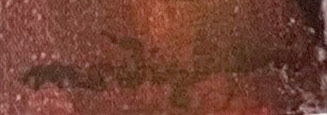
Support and sequence. The radiograph shows "a white high-lead preparation ... applied on both sides". Under the Brancusi side, the authors found "a portrait of a woman with long hair ... occupying the whole pictorial surface", probably from 1906–07. They propose the following sequence: a woman's portrait (1906–07), covered with a white primer; the Brancusi head (1909), after which the canvas was taken off its stretcher, turned and remounted; and finally The Cellist (1909), on the opposite face, "to remain thereafter on the front side". The support "was used three times". This is the authors' interpretation of the radiograph, and they present the reconstruction of the female portrait as "hypothetical".
Underdrawing. Infrared revealed a graphite underdrawing for the cello study, with "subtle, fine, and confident strokes" that do not coincide with the final contours. The authors describe this as "a hitherto unknown underlying drawing in pencil" and say that before their study, published underdrawings concerned only paintings from 1915 onwards.
Pigments. The EDXRF results for the cello side, in eleven areas, are summarised above under "Colour". The authors point out that the lead-white grounds on each face acted as a barrier, so that readings on one side came mainly from that side's paint. Their most significant claim is the identification of Paris (emerald) green, from copper and arsenic in a greenish-yellow area. They state that "Copper-based green had not previously been identified in Modigliani's palette", contradicting a 1981 study that suggested he used only chrome green. They add that emerald green was later found in works at the Art Institute of Chicago and the Barnes Foundation. EDXRF identifies elements, not compounds, and the authors' language ("suggests", "likely", question marks in their table) should be respected. The black of the hair, for instance, could not be identified.
Surface and condition. UV fluorescence distinguished original from later varnish and showed small retouchings. The cleaning sequence reproduced by Secret Modigliani (states of about 1950, about 1980 and 2014) is visual evidence of the same history, though it is not a published technical study.
Comparative context. The reuse of supports fits what the Tate's technical programme found elsewhere. Tate Papers no. 35 (Genty-Vincent et al.) discusses Modigliani works with paintings beneath the visible surface, and King, Ireson, Fraquelli and Townsend (Burlington Magazine, 2018) note that the canvases they studied "seem to have been commercially prepared with an oil-based priming". Neither publication discusses this canvas. Their findings are comparative only. Here, by contrast, the authors describe the white lead layers as preparations applied to cover earlier work, a point to bear in mind before generalising from the Tate's results to this canvas.
Conclusion
The Study for the Cello Player is a working picture, and its value lies partly in what it shows of the work. It sets out, at a smaller and squarer scale, the composition of Modigliani's most ambitious early painting: the bowed profile, the hand at the neck of the instrument, the cramped room with its patterned wall. Its colour, in its present cleaned state, is warmer and brighter than that of the final version, and its handling rougher. Comparing the two shows how Modigliani lengthened and refined the figure between study and finished picture.
The canvas is also an unusually well-examined object. The 2016 campaign published in 2023 found a graphite underdrawing that does not match the final forms, an earlier portrait of a woman beneath the Brancusi side, and emerald green in Modigliani's early palette. These findings rest on non-invasive methods and on the authors' interpretation, and they should be cited as such. The documentary problems are real, however. They include Ceroni's shared number, his contradictory recto and verso captions, the uncertain identification with the 1910 "Etude", the history of confusion with the final painting and the unverified story of the export stamps. None of them affects the attribution, which rests on continuous Alexandre provenance and an early literature beginning with Pfannstiel in 1929. But they should be stated plainly whenever the picture is discussed.
Technical literature
- Greta Garcia, David Juanes and Rafael Romero, "Image Study and Material Characterization of the Two-Sided Painting The Cellist and Portrait of Brancusi by Amedeo Modigliani", International Journal of Conservation Science, vol. 14, no. 3 (2023), pp. 1233–48, DOI 10.36868/IJCS.2023.03.30, https://doi.org/10.36868/ijcs.2023.03.30
- Anaïs Genty-Vincent et al., "Works by Modigliani that have Paintings beneath the Visible Surface", Tate Papers, no. 35 (comparative), https://www.tate.org.uk/research/tate-papers/35/works-by-modigliani-that-have-paintings-beneath-the-visible-surface
- Annette King, Nancy Ireson, Simonetta Fraquelli and Joyce H. Townsend, "The Modigliani Technical Research Study: An introduction to Modigliani's materials and techniques", The Burlington Magazine, vol. 160, no. 1380 (March 2018), pp. 182–88 (comparative), https://www.burlington.org.uk/archive/article/the-modigliani-technical-research-study-an-introduction-to-modiglianis-materials-and-techniques
Sale literature
- Christie's, London, 20th Century Art (sale 6146), 30 June 1999, lot 506, Modigliani, Le violoncelliste: details, provenance, literature, exhibitions and lot essay, https://www.christies.com/en/lot/lot-1478448
- Christie's, New York, 14 May 2015, sale 3736, lot 3, Modigliani, Jean Alexandre (recto) / Nu assis (verso): lot essay and comparative captions, https://www.christies.com/en/lot/lot-5893247
Museum documentation
- Tate Modern, Modigliani (23 November 2017–2 April 2018), large-print guide, rooms 1–11, label for The Cellist (front) / Portrait of Constantin Brancusi (back) (copy at docslib), https://docslib.org/doc/1601730/modigliani-large-print-guide-room-1-11
- Southern Methodist University, "Meadows Museum to present first exhibition in U.S. of paintings from Juan Abelló Collection", press release, 14 April 2015, https://www.smu.edu/news/archives/2015/meadows-museum-abello-exhibit-14april2015
Cited but not independently consulted
Pfannstiel, Modigliani. L'Art et la Vie (1929), p. 4; Taguchi 1936; Franchi 1946, pl. 5; Lipchitz 1952–54; Soby, MoMA, 1951 and 1954; Ceroni 1958, no. 18; Lanthemann 1970, no. 35; Ceroni and Piccioni 1970, no. 22a; Hubbard 1975; Mann 1980, pp. 54, 59; Castieau-Barrielle 1987, p. 48; Parisot, no. 8/1909; Patani, no. 29A; Noël Alexandre, Modigliani inconnu, 1993, p. 48; Krystof 2000, p. 18; Modigliani y su tiempo, Museo Thyssen-Bornemisza, 2008; Le silence éternel, Pinacothèque de Paris, 2008, p. 26; the Meadows Museum catalogue, 2015; Ireson and Fraquelli (eds.), Modigliani, Tate, 2017, pp. 34–35; Buckley, Fraquelli, Ireson and King, Modigliani Up Close, Barnes Foundation, 2022 (quoted in the 2023 article); García Hernández, doctoral thesis, Universitat Politècnica de València, 2016; the catalogues of the 1910 Indépendants, Brussels 1933 and Basel 1934; the D'Atri files (no. 5). All are cited from the Secret Modigliani page on the work, Christie's or Garcia, Juanes and Romero 2023.
Footnotes
- Arthur Pfannstiel, Modigliani. L’Art et la Vie, preface by Louis Latourette, Paris, Seheur, 1929 (presumed catalogue).
- Arthur Pfannstiel, Modigliani et son œuvre, étude critique et catalogue raisonné, Paris, Bibliothèque des Arts, 1956.
- Ambrogio Ceroni, Amedeo Modigliani: Peintre; suivi des souvenirs de Lunia Czechowska, Milan, Edizioni del Milione, 1958.
- Joseph Lanthemann, Modigliani, catalogue raisonné: sa vie, son œuvre, son art, Barcelona, G. Condal, 1970.
- Ambrogio Ceroni and Leone Piccioni, I dipinti di Modigliani, Milan, Rizzoli, 1970.
- Carol Mann, Modigliani, London, Thames and Hudson, 1980.
- Thérèse Castieau-Barrielle, La vie et l’œuvre de Amedeo Modigliani, Paris, ACR, 1987.
- Christian Parisot, Catalogue raisonné Modigliani, Livorno, Graphis Arte, 1991.
- Osvaldo Patani, Amedeo Modigliani: catalogo generale, Milan, Leonardo, 1991–94.
- Christian Parisot, Modigliani, Paris, Pierre Terrail, 1992.
- Victoria Soto Caba, Modigliani: The Timeless Face, Madrid, Libsa, 2007.
- Nancy Ireson and Simonetta Fraquelli, Modigliani, London, Tate Modern / Skira Rizzoli, 2017.