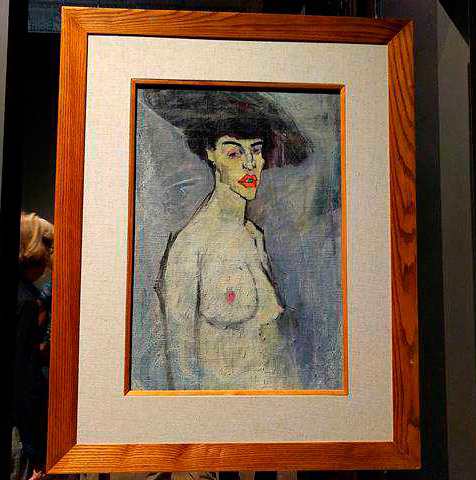
Nude with hat - Woman nude bust (Maud Abrantes on verso)
Oil on canvas — 1908 ?

Identification
- Title
- English: Nude with hat - Woman nude bust (Maud Abrantes on verso).
Also mentioned as: Recto:Bust of Nude Woman with Hat (Tate Papers).
Verso: Portrait of Maud Abrantès (Jewish Museum); Maud Abrantes (Tate Papers) - Date
- 1908-1909 ?
Notes: 1908 (Jewish Museum; Tate Papers). Secret Modigliani gives "1908?" for the recto and "1907–1908–1909?" for the verso - Medium
- Oil on Canvas, painted on both sides.
- Dimensions
- 81.3 x 53.3 cm?
Notes: 81 × 54 cm (Jewish Museum checklist; Ceroni, Patani and Klein); 81 × 55 cm (Pfannstiel). Tate Papers captions give 720 × 490 mm (recto) and 590 × 460 mm (verso). - Signature
- Unsigned
Notes: Recto unsigned. On the verso the text "A JAN ABRAN MO / MODIGLIANI"; a Paris customs export stamp appears on the unpainted lower strip - Present location
- Hecht Museum, University of Haifa, Haifa, Israel. (Cat. no. p-226a-b)
Catalogue numbers
| Compiler | Number |
|---|---|
| Arthur Pfannstiel | NO - only Verso no. 6 (Recto no. 11 in 1929 - not in 1956) |
| Joseph Lanthemann | no. 21 (22 V) |
| Ambrogio Ceroni | no. 7A ( 7B V) |
| Jeanne Modigliani | YES |
| Christian Parisot | 7/1908 (5/1908 V) |
| Osvaldo Patani | no. 12 A (12 B V) |
| Modigliani Project | YES |
| MR | YES |
| Modigliani Initiative/ AMDC | ? |
Legal note on MR: This investigation has not had access to MR’s catalogue raisonné; all research here is based on open sources, publications and exhibitions. By no means has that catalogue been copied at any point. Modigliani Project and Modigliani Research Project are marked YES when the work is published or otherwise recorded by those projects, even if no catalogue number is assigned; otherwise the field is marked ?.
Provenance
- Paul Alexandre collection, Paris.
- Reuben and Edith Hecht.
- Acquired in London, September 1983.
- Hecht Museum University of Haifa, Haifa, Israel (Cat. no. p-226a-b).
The sequence follows the published museum, sale, and catalogue record in this investigation. Gaps and uncertain transfers are marked as such.
Selected bibliography
Book-length publications are marked with a footnote giving a full citation. Exhibition catalogues appear in both this list and the exhibition list when this investigation recorded them in both places.
- Pfannstiel, "catalogue présumé" Modigliani. L'Art et la Vie. Preface de Louis Latourrettes, Seheur, Paris, 1929, p. 2 - no. 111 Included both sides.
- Pfannstiel, Modigliani et son oeuvre, étude critique et catalogue raisonne, Bibliothèque des Arts, Paris, 1956 - no. 6 (No mention to this painting, only the Maud Abrantes on back)2.
- Ceroni, Amedeo Modigliani: Peintre; Suivi des Souvenirs de Lunia Czechowska, Edizioni del Milione, 1958 - no. 4/53.
- Lanthemann, Modigliani, catalogue raisonné: sa vie, son oeuvre, son art, G. Condal, Barcelona, 1970 - no. 214.
- Ceroni & Piccioni, Il dipinti di Modigliani, Rizzoli, Milano, 1970 - no. 7A /7B5.
- Mann, Modigliani, Thames & Hudson, 1980, pp. 40-416.
- Castieau-Barrielle, Modigliani, Ed. AL Paris 19877.
- Parisot, Modigliani, Graphis Arte Livourne 1988, page 33.
- Patani, Catalogo Generale, Leonardo ed. Milano 1991-94 no. 12-A8.
- Parisot, Catalogue Raisonné Modigliani Tome II, Graphis Arte, 1991 no. 7/1908.9
- Alexandre, The Unknown Modigliani: Drawings from the Collection of Paul Alexandre, 1993, p. 54-56.
- D. Krystof, Amedeo Modigliani: The Poetry of Seeing, Taschen Cologne, 2000, p. 13.
- MR, L'Ange au visage grave, Musée du Luxembourg, Paris, 2002, p.106-107, no. 3.10
- Klein, Modigliani: beyond the myth, Ed. Jewish Museum, 2004 p. 90, pl. 3.11
- Soto Caba, Modigliani, the timeless face, Libsa, 2007.12
- Klein, Modigliani Unmasked, The jewish Museum, New York, 2017.11
Exhibitions
- Cleveland Museum of Art and New York, Museum of Modern Art, 1951;
- Paris, Musée du Luxembourg, L'ange au visage grave, 2002;
- New York, Toronto and Washington, Modigliani: Beyond the Myth, 2004–05;
- Seoul, 2015.
- New York, Jewish Museum, Modigliani Unmasked, 2017-201811
- Philadelphia, Barnes Foundation, Modigliani Up Close, 2022–23
- New York, Modigliani Unmasked, The jewish Museum,
Notes
Hecht Museum, University of Haifa, confirms the work (Cat. no. p-226a-b). Oil on canvas, double-sided with “Maud Abrantes” on the reverse. Recent X-ray studies (2022) revealed additional hidden sketches beneath the surface. Dimensions reported vary slightly across sources (~80–81 × 50–54 cm). Where sources disagree, both readings are given. This is a working research page, not a catalogue raisonné.

Introduction
Ceroni's number 7 is a single canvas with two faces. On one side a half-length nude woman in a wide black hat looks out with half-closed, painted eyes and a scarlet mouth. On the other, turned upside down with respect to the first, is the head and shoulders of a dark-haired woman whom Paul Alexandre identified as Maud Abrantès. Ceroni gave the two sides a single number, divided into 7A and 7B. The Secret Modigliani site documents them on two separate pages; this essay treats them together, because the material history of one side cannot be understood without the other. The canvas belongs to the Hecht Museum in Haifa, which hangs it so that both sides can be seen. According to the Associated Press, visitors are "met by an upside down nude portrait" on entering the gallery.
The canvas is also one of the few early works by Modigliani to have been X-rayed with published, if only journalistic, results. In 2022 Hecht Museum staff reported three hidden figures in addition to the two visible paintings, so that the canvas is now said to hold five figures. The essay therefore ends with a technical section that, unusually for this group, rests on direct evidence about the object, though not on a published scientific report.
Composition and format
The recto is an upright composition in which the figure fills the central axis from the top edge to below the breasts. The hat is the dominant shape. Its broad, dark, slightly tilted ellipse runs almost from edge to edge across the upper third, a flat silhouette against which the small, sallow face is set like a mask. Below, the torso is cut off just above the waist. The shoulders are narrow and sloping, and the left arm is reduced to a dark contour descending at the left. The figure is not quite centred. The head sits slightly right of the axis while the body leans to the left, which gives the bust a faintly unstable, swaying posture.
The space around her is unarticulated. A lilac-grey ground, laid in vertical and diagonal drags, fills the field. A paler band sweeps diagonally from the hat's left brim towards the shoulder, and Ceroni's note, as transcribed online, wondered whether it might be a veil ("una veletta posata sui capelli") or simply "una libertà di fondo", a freedom taken with the background. The ambiguity is useful. The band links hat and body and stops the head from floating free of the torso.
The verso is squarer in effect, because, according to Secret Modigliani, the painting covers only about four-fifths of the canvas and leaves a strip unpainted at the lower edge. Maud's head is centred and frontal, set slightly above the middle. Her shoulders, in a dark coat or collar, spread to the edges and close the composition at the bottom like a pedestal. Around the head, ochre and olive arcs, a blue upper field and loose dark strokes form a restless ground that, as the technical section shows, is partly an earlier picture showing through.
Line and drawing
Both sides show Modigliani drawing with the brush in dark, broken contours, but the purpose of the line differs. On the recto the line is graphic and caricatural. The eyebrows are two thick strokes; the nose is outlined in blue-grey, its tip reinforced with a white highlight; the lips are drawn as a hard scarlet shape with the teeth visible between them; and a single black line runs from the chin down the side of the neck. The contours of the body are discontinuous: a strong dark line on the left shoulder and arm, a fainter one under the breasts, and on the right side almost nothing, so that the torso dissolves into the background. The drawing here has the speed and the slightly cruel emphasis of the poster and the illustrated press.
On the verso the line describes rather than caricatures. The heavy eyebrows meet in a continuous arch over the nose, a device that recurs throughout Modigliani's later portraits. The eyes are drawn as almond shapes with heavy lids, the lower lids underlined in dark grey-violet, and the mouth is a small, full shape outlined in red-brown. A single dark line defines the jaw and joins the neck to the V of the collar. The hair is painted rather than drawn, in brown strands with a lock falling across the forehead from the left. Compared with the recto, the drawing of the face is slower and more symmetrical, closer to the portrait than to the type.
Colour
The colour of the recto is built on the contrast of a cool ground with a hot, artificial face. The lilac-grey and blue of the field are repeated in the shadows of the body and in the blue strokes around the eyes and nose. Against them the face is a flat yellow, close to the yellow of a lemon, and the mouth is an intense red-orange. The body is a creamy white with a single pink accent at the nipple. The result is the "masklike" effect of cosmetics noted by the Jewish Museum, which grouped this work with Portrait of a Woman with a Beauty Spot (Ceroni no. 2) and the Maud portrait as examples of "Modigliani's interest in the masklike properties of cosmetics". The yellow face and the white body do not belong to one flesh; they are two different surfaces, one made up, one bare.
The verso has a wider and darker palette. The face is a cool white modelled with pink at the cheeks, mauve-grey in the eye sockets and a warm orange on the nose. The hair is warm brown. Around the head, ultramarine and grey-blue in the upper half meet olive-ochre and yellow-brown arcs in the right half and lower part, and there are touches of red near the right shoulder. Some of these colours belong to the underlying picture rather than to the Maud portrait. They give the work a dense, almost muddy richness that differs from the cleaner contrasts of the recto.
Facture and surface
The recto is thinly painted. In reproduction the canvas weave shows through the ground almost everywhere, and the lilac field is dragged with a dry brush, leaving the grain visible. The face is more opaque, laid in flat patches, and the white of the torso is applied in thicker, scumbled strokes. The handling is quick and unrevised, and parts of the background look unfinished.
The verso is worked more heavily in the face and more thinly at the edges. The white of the face is opaque and smooth, the hair and coat are scrubbed in with darker paint, and the weave shows through the upper blue field and the lower ochre zone. One feature looks accidental. Below Maud's right eye (on the viewer's left) a dark run or blot breaks the edge of the lower lid and drops onto the cheek like a tear. Whether it is a drip, a later loss or an intended shadow cannot be decided from photographs.
Figure and space
Neither picture builds a coherent space. On the recto the hat and the face are pressed flat against the ground, and the torso is modelled only by a little shading under the breasts. The figure exists as an image on a surface, not as a body in a room. On the verso the face is more sculptural: the nose and cheekbones are modelled in light and shadow, and the frontal pose and the symmetry of the brows give it a stable, almost hieratic presence. The surrounding forms, however, deny depth, because some of them are traces of another painting rather than parts of Maud's world.
Iconography: the hat, the nude and the name
The recto belongs to a type that runs through Parisian imagery around 1900: the half-dressed woman whose hat marks her as fashionable or as available, depending on the reader. Ceroni's first catalogue, according to the online transcription of his notes, called the work Nudo di donna con cappello, but Ceroni himself doubted that the dark shape was a hat. The Jewish Museum, Tate Papers and the Hecht Museum, as reported in the press, all keep the hat. The painting's combination of a fashionable accessory with nudity, and of a made-up face with an unidealised body, places it among the femme fatale images the Jewish Museum described as characteristic of Modigliani's first Parisian years.
The identity of the sitter of the recto is not documented. The Jewish Museum calls Maud Abrantès "the presumed model". The verso is better documented. According to the Ceroni note as transcribed online, the sitter was an acquaintance of Modigliani and Paul Alexandre, and Alexandre supplied her name at the time of the first cataloguing. The Jewish Museum's label for the drawings of Maud describes her as "Jewish, American, and married", says she accompanied Modigliani on his first visit to the Rue du Delta, and says she stayed in the artists' colony "for roughly a year before returning to New York". Christie's 2013 essay on La Juive names Maud as the subject of Ceroni nos. 4, 5, 6, 7a/b and 9 and quotes Alexandre's memory of her arriving at the Delta with Modigliani.
Comparisons
The closest comparisons are within Ceroni's first numbers. The made-up face and red mouth of the recto recall the Portrait of a Woman with a Beauty Spot (no. 2) and the Woman with a Blue Scarf (no. 5), while the frontal face, heavy-lidded eyes and joined eyebrows of the verso anticipate La Juive (no. 9). The LaM Buste de jeune femme (no. 6), with its broad brown hat or hairstyle, is another variation on the woman in a hat. The Tate Modern guide of 2017–18 related that picture to Kees van Dongen, and the comparison applies with greater force to the recto here, whose yellow face and acid mouth are close to Van Dongen's Montmartre women.
The rough, unfinished nude also connects with Ceroni no. 8, the Nudo dolente, of the same year and the same dimensions, and with the two nudes of "la petite Jeanne" (nos. 10 and 11). Together they show Modigliani testing the female nude in very different registers within a few months.
Provenance and exhibitions
The documented provenance is short. Secret Modigliani gives: Paul Alexandre, Paris; Reuben and Edith Hecht, acquired in London, September 1983; Hecht Museum, University of Haifa. The Associated Press report says the painting "was bought by the museum's founder in 1983", which agrees in substance.
Several discrepancies should be noted.
Technical analysis
Unlike most early works, this canvas has been examined, but the results known to me are press reports and short museum texts, not a scientific publication. They should be read with that limitation in mind.
Visible evidence. The Jewish Museum's large-print guide states that Modigliani painted the Maud portrait "on the back of the canvas on which he had painted Nude with a Hat earlier that year", and that he "also turned it upside down in order to paint out a previously begun portrait of a woman, whose hat and eyes can still be seen". Tate Papers no. 35 lists the work (C7a/C7b) among those where Modigliani painted on the reverse and turned the canvas, noting that he seemed "unconcerned with covering the original image, as the underlying figures remain clearly visible to the naked eye, down to the colour of their hair and lips". In reproductions of the verso, an inverted eye is visible near the right shoulder, and the ochre and olive arcs around Maud's head and below her collar are consistent with the brim of an inverted hat.
X-radiography (2010 and 2022). According to the Associated Press, the Hecht Museum's curator noticed "the eyes of a third figure peeking from beneath Abrantès' collar" in 2010. In 2022, during a forensic study made for the Barnes Foundation exhibition, the canvas was X-rayed. The Art Newspaper (14 July 2022) credits the imagery to Ron Pincu and reports that, in trying to bring the hidden figure into focus, curators "noticed two more silhouettes: one of a man and the other of a woman with her hair pulled up in a bun". The AP account adds that the hidden woman wears a hat and that the two further figures, on the opposite side, are "completely invisible to the naked eye". Inna Berkowits of the Hecht Museum called the canvas "a sketchbook on a canvas", and both reports state that it holds five figures. The University of Haifa's own news summary garbles the result, saying that the X-ray "discovered a portrait of Maud Abrantes", which is the visible painting. It should not be relied on.
What is not known. I found no published pigment analysis, cross-section or full report of the 2022 imaging. Whether the hidden figures are by Modigliani is a matter of statements by the museum, not of a published argument. The Barnes Foundation catalogue of Modigliani Up Close may contain fuller findings, but I could not consult it. The general findings of the Tate-led study published in The Burlington Magazine in 2018 (lead white grounds, commercially primed canvases, re-use of supports) are comparative evidence only for this work. The 81 × 54 cm format matches the standard French "25 marine" size, which Burlington notes Modigliani used upright from as early as 1908. That is my observation, not one made about this canvas by the study.
Conclusion
Ceroni no. 7 is less a pair of paintings than the trace of a working process. On one face, a quick, poster-like nude explores the made-up face as a mask; on the other, a more patient portrait of Maud Abrantès already contains the frontal head, joined brows and heavy-lidded gaze of the mature work, painted over a woman whose hat and eyes still show through. The X-rays add two figures more. The documentation, however, is uneven. The two Secret Modigliani pages contradict each other on exhibitions, the dimensions vary by source, and the technical results are known through the press. A full technical publication on the Hecht canvas is the most needed addition to the literature on this phase of Modigliani's work.
Museum documentation
- The Jewish Museum, New York, Modigliani Unmasked (2017–18), checklist, https://thejewishmuseum.org/wp-content/uploads/2025/07/Modigliani_Unmasked_checklist.pdf
- The Jewish Museum, New York, Modigliani Unmasked, wall texts and object labels, https://thejewishmuseum.org/wp-content/uploads/2025/07/Modigliani_Unmasked_wall_texts_and_object_labels.pdf
- The Jewish Museum, New York, Modigliani Unmasked, large-print guide, https://thejewishmuseum.org/wp-content/uploads/2025/06/Modigliani_Large_Print_FINAL.pdf
- Tate Modern, Modigliani (23 November 2017–2 April 2018), large-print guide, rooms 1–11 (copy at docslib), https://docslib.org/doc/1601730/modigliani-large-print-guide-room-1-11
Technical and scholarly literature
- Anaïs Genty-Vincent et al., "Works by Modigliani that have Paintings beneath the Visible Surface", Tate Papers, no. 35, https://www.tate.org.uk/research/tate-papers/35/works-by-modigliani-that-have-paintings-beneath-the-visible-surface
- Annette King, Nancy Ireson, Simonetta Fraquelli and Joyce H. Townsend, "The Modigliani Technical Research Study: An introduction to Modigliani's materials and techniques", The Burlington Magazine, vol. 160, no. 1380 (March 2018), pp. 182–88, https://www.burlington.org.uk/archive/article/the-modigliani-technical-research-study-an-introduction-to-modiglianis-materials-and-techniques
Press reports and sale literature
- Chinma Johnson-Nwosu, "Three new Modigliani sketches discovered beneath one of the artist's early nudes", The Art Newspaper, 14 July 2022, https://www.theartnewspaper.com/2022/07/14/modigliani-sketches-discovered-x-rays-hecht-museum-barnes-foundation
- Associated Press, "Unknown Modigliani sketches found hidden beneath Nude with Hat", The Guardian, 13 July 2022, https://www.theguardian.com/artanddesign/2022/jul/13/unknown-modigliani-sketches-found-hidden-beneath-nude-with-hat
- University of Haifa, Division of External Relations, "Hecht Museum scientists find sketches hidden in Modigliano painting", July 2022, https://pr.haifa.ac.il/2022/07/hecht-museum-scientists-find-sketches-hidden-in-modigliano-painting/
- Christie's, New York, Impressionist & Modern Evening Sale, 8 May 2013, lot essay for Modigliani, La Juive, https://www.christies.com/en/lot/lot-5677506
Cited but not independently consulted
Ceroni and Piccioni, I dipinti di Modigliani, Rizzoli, 1970, nos. 7A/7B; Ceroni 1958, no. 4/5; Pfannstiel 1929 and 1956 (no. 6); Lanthemann 1970, nos. 21–22; Parisot 1991; Patani 1991, nos. 12A/12B; Carol Mann, Modigliani, 1980, pp. 40–41; Noël Alexandre, The Unknown Modigliani, 1993, pp. 54–56; Doris Krystof, Modigliani, Taschen, 2000, p. 13; Modigliani: l'ange au visage grave, Musée du Luxembourg, 2002, pp. 106–109, no. 3; Mason Klein (ed.), Modigliani: Beyond the Myth, 2004, p. 90, pls. 3–4; Barnes Foundation, Modigliani Up Close, 2022 (exhibition catalogue). All are cited from the Secret Modigliani pages on the work, the Art Newspaper or Christie's.
Footnotes
- Arthur Pfannstiel, Modigliani. L’Art et la Vie, preface by Louis Latourette, Paris, Seheur, 1929 (presumed catalogue).
- Arthur Pfannstiel, Modigliani et son œuvre, étude critique et catalogue raisonné, Paris, Bibliothèque des Arts, 1956.
- Ambrogio Ceroni, Amedeo Modigliani: Peintre; suivi des souvenirs de Lunia Czechowska, Milan, Edizioni del Milione, 1958.
- Joseph Lanthemann, Modigliani, catalogue raisonné: sa vie, son œuvre, son art, Barcelona, G. Condal, 1970.
- Ambrogio Ceroni and Leone Piccioni, I dipinti di Modigliani, Milan, Rizzoli, 1970.
- Carol Mann, Modigliani, London, Thames and Hudson, 1980.
- Thérèse Castieau-Barrielle, La vie et l’œuvre de Amedeo Modigliani, Paris, ACR, 1987.
- Osvaldo Patani, Amedeo Modigliani: catalogo generale, Milan, Leonardo, 1991–94.
- Christian Parisot, Catalogue raisonné Modigliani, Livorno, Graphis Arte, 1991.
- MR (cited here as MR), Modigliani: l’ange au visage grave, Paris, Musée du Luxembourg, 2002. Cited from the published exhibition catalogue only.
- Mason Klein, Modigliani: Beyond the Myth, New York, The Jewish Museum / Yale University Press, 2004.
- Victoria Soto Caba, Modigliani: The Timeless Face, Madrid, Libsa, 2007.