The Jewess
Oil on canvas — 1908 (1907-1908?)

Identification
- Title
- English: The Jewish - The Jew woman - The Jewess - Woman with hat.
French: La Juive; Portrait.
Italian: L'ebrea; Donna ebrea
Notes: La Juive (Christie's 2013); The Jewess (Jewish Museum 2017–18); L'ebrea (Ceroni & Piccioni 1970, per Christie's); Donna ebrea (Franchi 1946, per Christie's); exhibited in 1908 as Portrait (Salon des Indépendants, no. 4325) - Date
- 1908 (1907-1908?)
Note: c. 1907–08 (Christie's); 1908 (Jewish Museum) - Medium
- Oil on Canvas
- Dimensions
- 54.9 x 46 cm -Christie's; Jewish Museum checklist ; R 55 x 46, Klein 55 x 46.
- Signature
- Signed "Modigliani" upper left
- Present location
- Private Collection ?
Catalogue numbers
| Compiler | Number |
|---|---|
| Arthur Pfannstiel | no. 2 |
| Joseph Lanthemann | no. 20 |
| Ambrogio Ceroni | no. 9 |
| Jeanne Modigliani | YES |
| Christian Parisot | 1/1908 |
| Osvaldo Patani | no. 11 |
| Modigliani Project | YES |
| MR | YES |
| Modigliani Initiative/ AMDC | ? |
Legal note on MR: This investigation has not had access to MR’s catalogue raisonné; all research here is based on open sources, publications and exhibitions. By no means has that catalogue been copied at any point. Modigliani Project and Modigliani Research Project are marked YES when the work is published or otherwise recorded by those projects, even if no catalogue number is assigned; otherwise the field is marked ?.
Provenance
- Paul Alexandre (February, 1913 to 1951?)
- Private Collection ? (1951 to 1977)
- Galerie Schmit, Paris (1977)
- Private Collection (1977 to 1989)
- Maruko Partners in Art, Japan (1989 to 2013)
- Christie's New York - Impressionist & Modern Evening Sale - Sale 2782 - 8 May 2013 - Sold: 6.843.750 USD.
- Laure Denier Collection?
The sequence follows the published museum, sale, and catalogue record in this investigation. Gaps and uncertain transfers are marked as such.
Selected bibliography
Book-length publications are marked with a footnote giving a full citation. Exhibition catalogues appear in both this list and the exhibition list when this investigation recorded them in both places.
- Pfannstiel, "catalogue présumé" Modigliani. L'Art et la Vie. Preface de Louis Latourrettes, Seheur, Paris, 1929, p. 11
- Franchi, Modigliani, Arnaud, Firenze, 1944, pl. 1
- Franchi, Modigliani, Arnaud, Firenze, 1946, pl. 1
- Cat. The Museum of Modern Art. New York 1951, p. 17
- T. Soby, Modigliani, , New York, 1949, p. 13
- Roy , Modigliani, Skira, Lausanne, 1958, p. 22
- Galerie Charpentier, Cent Tableaux de Modigliani, Paris, 1958, p. 26
- J. Modigliani, Modigliani: Man and Myth, Orion Press, New York, 1958, pl. 19 (dated 1907-1908 and located in 1958 at the Alexandre Coll, Paris )2
- Pfannstiel, Modigliani et son oeuvre, étude critique et catalogue raisonne, Bibliothèque des Arts, Paris, 1956 - no. 23
- Ceroni, Amedeo Modigliani: Peintre; Suivi des Souvenirs de Lunia Czechowska, Edizioni del Milione, 1958 - no. 74
- Jeanne Modigliani, Modigliani sans légende 1961, no. 195
- Werner, Amedeo Modigliani, New York, 1966, p. 68
- Sichel, Modigliani: A Biography of Amedeo Modigliani, London, 1967, p. 146-147
- Diehl, E. Flammarion, Paris 1969, p. 9
- Lanthemann, Modigliani, catalogue raisonné: sa vie, son oeuvre, son art, G. Condal, Barcelona, 1970 - no. 206
- Ceroni & Piccioni, Il dipinti di Modigliani, Rizzoli, Milano, 1970 - no. 97
- Diehl, Modigliani, Naefels, 1977, p. 16 and 19
- Mann, Modigliani, Thames and Hudson, London, 1980, p. 478
- Jeanne Modigliani Racconta Modigliani, Editions Graphis Arte 1984 p. 61- 62
- Roy, Ed. Nathan, Modigliani, New York, 1985, p. 154
- Werner, Modigliani, Harry N. Abrams, NY, 1985, p. 50-51
- Castieau-Barrielle, Modigliani, Ed. AL Paris 1987 (dated in 1907)9
- Parisot, Modigliani, Graphis Arte Livorno 1988, page 33
- Parisot, Catalogue Raisonné Modigliani Tome II, Graphis Arte, 1991- no. 1/190810
- Patani, Catalogo Generale, Leonardo ed. Milano 1991-94 - no. 1111
- Schmalenbach, Amedeo Modigliani, Prestel Verlag, 1990-91, p. 61 - no. 1312
- Parisot, Modigliani, Pierre Terrail, Paris, 1992, p.1513
- Alexandre, The Unknown Modigliani: Drawings from the Collection of Paul Alexandre, 1993, p. 44 - 45 - 54- 65 Dated in 1907
- Monti a cura de R. Chiappini, Catalogue Amedero Modigliani, Lugano, Skira, 1999
- Krystof, Amedeo Modigliani: The Poetry of Seeing, Taschen Cologne, 2000, p. 10
- Klein, Modigliani: Beyond the Myth, The Jewish Museum, 2004-2005, p. 89, pl. 214
- Meyers, Modigliani: A Life, Orlando, 2006, pp. 47-48.
- Chiappini, Modigliani, exh. cat., Complesso del Vittoriano, Rome, 2006, p. 26-27
- Soto Caba, Modigliani, the timeless face, Libsa, 200715
- R, Le silence éternel, Pinacotheque de Paris, 2008, p. 25
- M. Secrest, Modigliani: A Life, New York, 2011, p. 123-124.
- R, La Collection Jonas Netter, Pinacotheque de Paris, 2012, p.101
- Klein, Modigliani Unmasked, The jewish Museum, New York, 201714
Exhibitions
- Paris, Salon des Artistes Indépendants, 1908 - no. 4325 (titled Portrait).
- Paris, Grand Palais des Champs-Elysées, Trente ans d'Art Indépendant, 1884-1914, 1926, p. 197 - no. 3096.
- Cleveland Museum of Art, Modigliani: Paintings, Drawings, Sculpture, 1951, p. 51.
- New York, The Museum of Modern Art, Modigliani: Paintings, Drawings, Sculpture, 1951, p. 51.
- Paris, Galerie Charpentier, Cent tableaux de Modigliani, 1958 -no. 3.
- New York, 1972.
- Czechoslovakia, I969 - no. 3.
- Düsseldorf, Kunstsammlung Nordrhein-Westfalen, Amedeo Modigliani: Malerei, Skulpturen, Zeichnungen, 1991.
- Zürich, Kunsthaus, Amedeo Modigliani: Malerei, Skulpturen, Zeichnungen, 1991.
- Tokyo, Tobu Museum of Art, Exposition Amedeo Modigliani au Japon, 1992-93, p. 56 - no. 2.
- Kyoto, Daimaru Museum, Exposition Amedeo Modigliani au Japon, 1992-93, p. 56 - no. 2.
- Osaka, Daimaru Museum of Umeda, Exposition Amedeo Modigliani au Japon, 1992-93, p. 56 - no. 2.
- Ibaraki, Museum of Modern Art, Exposition Amedeo Modigliani au Japon, 1992-93, p. 56 - no. 2.
- Lugano, Amedeo Modigliani, Museo d'Arte Moderna, 1999 - no. 2.
- New York, The Jewish Museum, Modigliani: Beyond the Myth, 2004.
- New York, Jewish Museum, Modigliani unmasked, 2017-18.
Notes
No further documentary note is recorded in this investigation beyond the fields above. Where sources disagree, both readings are given.
Introduction
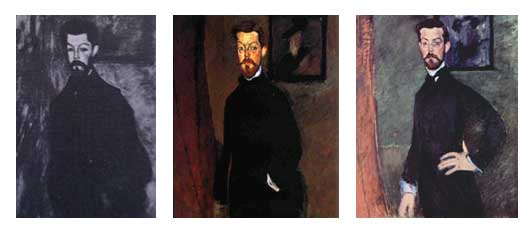
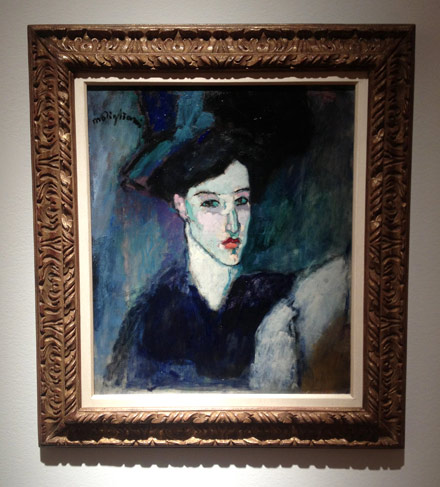
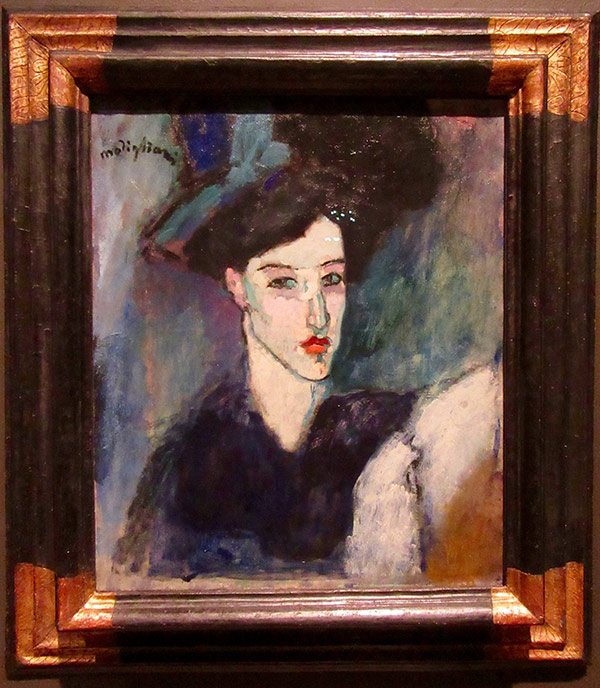
La Juive is the painting with which Modigliani made his public debut as a painter in Paris. Christie's, which sold it in 2013, identified it with no. 4325, Portrait, in his first submission to the Salon des Indépendants in 1908. It was then owned for decades by Dr Paul Alexandre, his first patron, and it appears in the background of the portraits Modigliani painted of Alexandre (Ceroni nos. 13, 14 and 15). The sitter, a pale woman with a large black feathered hat, green-shadowed eyes and a scarlet mouth, is identified in recent literature as Maud Abrantès. The title under which the work became famous is not the one under which it was exhibited, and the tension between the two, Portrait and The Jewess, is at the centre of its interpretation.
This essay examines the painting's composition, line, colour and surface, discusses its iconography and the question of its title, compares it with related works, reviews its provenance and exhibitions with the discrepancies among the sources, and states plainly that no technical study of the work has been published.
Composition and format
The format is close to square (54.9 × 46 cm), and the figure is cut at the chest. The head is placed slightly right of centre and turned a little towards the viewer's right, while the eyes look out at the viewer. The great black hat occupies the whole upper part of the canvas, its brim tilted down to the left, its crown rising into the upper right corner. A cascade of blue and teal feathers rises from the left side of the brim into the upper left corner, beside the signature.
Below the head, the long pale neck descends into a dark blue dress with a V-shaped neckline. At the lower right a mass of white, perhaps a fur boa or a stole, rises from the edge of the canvas to the shoulder, and a patch of ochre fills the extreme corner. The composition is built on a series of diagonals: the brim of the hat, the slant of the shoulders, the line of the white stole. These are balanced by the vertical axis of the neck and nose. The result is an unstable, slightly tilted structure that gives the sitter a languid, leaning presence.
Line and drawing
The drawing is economical and assured. A dark line defines the jaw and the left side of the face, and continues down the neck as a thin contour. The eyebrows are two fine dark arcs, and the eyes are almond shapes with dark, nearly black pupils and heavy upper lids. The nose is long, straight and narrow, drawn with a single dark line along its right side. The lips are small and full, outlined in a deep red.
In contrast with the face, the hat, dress and feathers are not drawn but painted in broad masses. The drawing is concentrated where it carries character: the eyes, the nose and the mouth. This concentration on the features is what the Jewish Museum's wall text emphasises when it describes "the patrician, aquiline nose" and "a curious pale mark" that "obscures the area between her eyes, further isolating and drawing attention to the nose".
Colour
Colour is the painting's most daring element. The face is a cool, chalky white tinged with pink on the cheeks, but its shadows are a strong green, laid along the bridge of the nose, under the eyes, at the corners of the mouth and on the chin. The Jewish Museum calls them "startling dabs of green". The mouth is a hot orange-red, the only warm accent in the picture apart from the ochre corner. The hat is a deep black-blue; the dress is ultramarine and navy; the feathers are teal and bright blue; and the background is a mixture of teal, slate blue, lilac and grey.
The colour structure is therefore a dialogue between a dominant cold harmony (blues, greens, violets) and two small warm notes (the lips and the ochre corner). Christie's essay connects the green modelling with Matisse and with the example of Cézanne, whose 1907 retrospective in Paris had made a deep impression. One may add that the green shadows, by denying the flesh any warmth, make the face as artificial as the made-up faces of Ceroni nos. 2 and 7A, but in a more refined and painterly key.
Facture and surface
The paint is applied in medium-thick, visible strokes that change direction with each area. The background is worked in vertical and diagonal brushstrokes, with the colours left partly unmixed so that teal, blue and lilac lie side by side. The hat is painted in dense black, the feathers in quick, curving strokes. The white stole is built up with thick, broken touches of white and grey over a darker underlayer.
The face is the most finished area: the whites are smoother and more opaque, and the green and pink are laid in small, distinct patches rather than blended. The "curious pale mark" between the eyes, noted by the Jewish Museum, is a lighter area of paint whose origin, whether a deliberate highlight, a later retouching or a change of mind, cannot be determined without technical examination.
Figure and space
The figure is set close to the picture plane, filling the canvas. The background gives no indication of a room; it is a field of colour that rises behind the sitter like a curtain. The head is modelled in some depth through the green shadows, but the hat and the dress are flat silhouettes. This combination of a modelled face with a flat, decorative surround links La Juive with the Symbolist portrait and with the Montmartre women of Kees van Dongen, while the solidity of the face looks forward to Modigliani's sculpture.
Iconography and the question of the title
The painting was exhibited in 1908 as Portrait. The online transcription of Ceroni's note states that the sitter, a friend of Modigliani and Paul Alexandre, was designated by them simply as "l'ebrea" ("the Jewess"). Christie's records the title Donna ebrea in Franchi's book of 1946 and L'ebrea in Ceroni and Piccioni's catalogue of 1970. The Jewish Museum, in 2017–18, gave the title a strong meaning: "In titling this painting, one of the first that Modigliani exhibited, the artist declared that the sitter's cultural identity was more important than her name." It added that the emphasis on the nose was "a self-referential facet of his own Jewishness".
The evidence does not quite support the first claim. The title under which Modigliani showed the work in 1908 was the neutral Portrait, according to Christie's and to the catalogue page reproduced by Secret Modigliani. The title The Jewess is attested, on the evidence available to me, only in Alexandre's later testimony and in the literature from Franchi onwards. It may well reflect what Modigliani and Alexandre called the picture privately, but the claim that "the artist declared" it publicly should be treated with caution.
The sitter's identity has also shifted. Christie's essay names Maud Abrantès as the model of Ceroni nos. 4, 5, 6, 7a/b and 9, and quotes Alexandre's memory of Modigliani arriving at the Delta in late 1907 "accompanied by a supremely elegant woman, Maud Abrantès, and followed by a car which contained, among other things, The Jewess". The Jewish Museum says the model "was most likely" Maud. Christie's also cites Tamar Garb's reading of the picture: "The Jewess is all artifice", a "painted woman" whose cosmetics and fashion are part of the image. The painting can thus be read on two levels: as a portrait of a particular, elegant woman, and as an image of a type, the modern, made-up, possibly Jewish woman of Paris, at a time when, as the Jewish Museum notes, France was still marked by the Dreyfus affair.
Comparisons
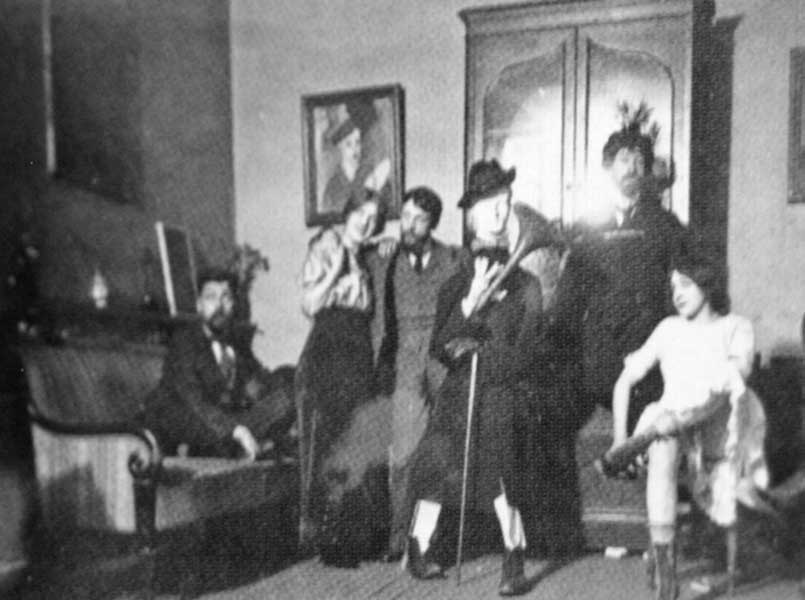
The closest comparison is with the Portrait of Maud Abrantès on the verso of Ceroni no. 7, which shows the same dark hair, heavy-lidded eyes and long nose in a frontal pose. The Nude with a Hat on the recto of the same canvas shares the large black hat. Christie's names Van Dongen, Matisse, Cézanne and Picasso's Blue Period as sources. The Tate Modern guide of 2017–18 used Van Dongen to explain the "strong definition of the sitter's features and the bold use of colour" in the LaM Buste de jeune femme (no. 6), and the comparison applies equally here. La Juive, however, is more resolved than any of the earlier heads. Its importance in Modigliani's own eyes is suggested by its position on the wall behind Paul Alexandre in his portraits of 1909–13. Christie's also mentions a photograph of February 1913 in which the painting hangs at the Delta. There are photographs of the interior of the Delta around 1913 and details of the Alexandre portraits showing the painting.
Provenance and exhibitions
Christie's gives the provenance as: Paul Alexandre, Paris (acquired from the artist by February 1913, and until at least 1951); Galerie Schmit, Paris (by 1977); acquired by the present owners, about 1989. The painting was then sold at Christie's, New York, on 8 May 2013 for $6,843,750 against an estimate of $2–3 million. The Jewish Museum's checklist of 2017–18 gives the owner as the "Laure Denier Collection, Paul Alexandre Family, courtesy of Richard Nathanson, London".
Technical analysis
*No technical study of La Juive is publice. It is not among the works discussed in Tate Papers no. 35 or in the 2018 Burlington Magazine* article on the Modigliani Technical Research Study, and Christie's catalogue essay does not mention any examination. The following observations are therefore either visual or comparative.
- Visual. The "curious pale mark" between the eyes, noted by the Jewish Museum, is the kind of feature that X-radiography or ultraviolet fluorescence could explain (a change, a retouching, a loss). The paint appears to be applied directly, without extensive reworking, and the canvas weave is visible in the thinner areas of the background.
- Comparative. The Burlington study found that Modigliani's early canvases were usually commercially primed with lead white grounds, and that he often reused supports. Tate Papers shows that several works of 1908 (Ceroni nos. 7, 8 and 10) were painted over earlier images. Whether La Juive conceals an earlier painting is unknown; nothing visible in reproduction suggests that it does.
- Format. 55 × 46 cm is the French standard "10 figure" size, the most usual portrait format, so the canvas was probably bought new and prepared. This is my observation from the dimensions, not a published finding.
Conclusion
La Juive is the first work in Ceroni's catalogue in which Modigliani's mature portrait formula is clearly visible: the long neck, the almond eyes, the narrow nose, the flat decorative ground and the strong colour. Its green-shadowed face, black hat and scarlet mouth make it the most memorable of the 1908 pictures, and its place on Paul Alexandre's wall shows that patron and painter valued it. Its documentation is rich compared with that of its neighbours, thanks above all to Christie's 2013 catalogue, but there are still gaps and conflicts: the gap between the 1908 title and the later one, the owner between 1989 and 2013, the exhibition numbers, and the absence of any technical examination. The title The Jewess in particular needs a more careful history than the literature has so far given it.
Sale literature
- Christie's, New York, Impressionist & Modern Evening Sale (sale 2782), 8 May 2013, Modigliani, La Juive: lot details, provenance, literature, exhibitions and essay, https://www.christies.com/en/lot/lot-5677506
Museum documentation
- The Jewish Museum, New York, Modigliani Unmasked (2017–18), checklist, https://thejewishmuseum.org/wp-content/uploads/2025/07/Modigliani_Unmasked_checklist.pdf
- The Jewish Museum, New York, Modigliani Unmasked, wall texts and object labels, https://thejewishmuseum.org/wp-content/uploads/2025/07/Modigliani_Unmasked_wall_texts_and_object_labels.pdf
- Tate Modern, Modigliani (2017–18), large-print guide, rooms 1–11 (copy at docslib), https://docslib.org/doc/1601730/modigliani-large-print-guide-room-1-11
Technical literature (comparative)
- Anaïs Genty-Vincent et al., "Works by Modigliani that have Paintings beneath the Visible Surface", Tate Papers, no. 35, https://www.tate.org.uk/research/tate-papers/35/works-by-modigliani-that-have-paintings-beneath-the-visible-surface
- Annette King, Nancy Ireson, Simonetta Fraquelli and Joyce H. Townsend, "The Modigliani Technical Research Study: An introduction to Modigliani's materials and techniques", The Burlington Magazine, vol. 160, no. 1380 (March 2018), pp. 182–88, https://www.burlington.org.uk/archive/article/the-modigliani-technical-research-study-an-introduction-to-modiglianis-materials-and-techniques
Cited but not independently consulted
Salon des Artistes Indépendants, catalogue, Paris, 1908, p. 290, no. 4325; Trente ans d'art indépendant, Paris, 1926, no. 3096; Arthur Pfannstiel 1929, p. 1, and 1956, no. 2; Giovanni Franchi (ed.), Modigliani, Florence, 1946, pl. 1; Ceroni 1958, p. 41, no. 7; Ceroni and Piccioni, I dipinti di Modigliani, 1970, p. 88, no. 9; Lanthemann 1970, no. 20; Parisot 1991, 1/1908; Patani 1991, no. 11; Werner Schmalenbach, Amedeo Modigliani, 1990, p. 61, no. 13; Noël Alexandre, The Unknown Modigliani, 1993, pp. 44, 54, 65; Tamar Garb, in Mason Klein (ed.), Modigliani: Beyond the Myth, 2004, pp. 47–48; Jeffrey Meyers, Modigliani: A Life, 2006, pp. 47–48; the exhibition catalogues listed in the title block. All are cited from Christie's or from the Secret Modigliani page on the work.
Footnotes
- Arthur Pfannstiel, Modigliani. L’Art et la Vie, preface by Louis Latourette, Paris, Seheur, 1929 (presumed catalogue).
- Jeanne Modigliani, Modigliani: Man and Myth, New York, Orion Press, 1958.
- Arthur Pfannstiel, Modigliani et son œuvre, étude critique et catalogue raisonné, Paris, Bibliothèque des Arts, 1956.
- Ambrogio Ceroni, Amedeo Modigliani: Peintre; suivi des souvenirs de Lunia Czechowska, Milan, Edizioni del Milione, 1958.
- Jeanne Modigliani, Modigliani sans légende, Paris, Gründ, 1961.
- Joseph Lanthemann, Modigliani, catalogue raisonné: sa vie, son œuvre, son art, Barcelona, G. Condal, 1970.
- Ambrogio Ceroni and Leone Piccioni, I dipinti di Modigliani, Milan, Rizzoli, 1970.
- Carol Mann, Modigliani, London, Thames and Hudson, 1980.
- Thérèse Castieau-Barrielle, La vie et l’œuvre de Amedeo Modigliani, Paris, ACR, 1987.
- Christian Parisot, Catalogue raisonné Modigliani, Livorno, Graphis Arte, 1991.
- Osvaldo Patani, Amedeo Modigliani: catalogo generale, Milan, Leonardo, 1991–94.
- Werner Schmalenbach, Amedeo Modigliani, Munich, Prestel, 1990.
- Christian Parisot, Modigliani, Paris, Pierre Terrail, 1992.
- Mason Klein, Modigliani: Beyond the Myth, New York, The Jewish Museum / Yale University Press, 2004.
- Victoria Soto Caba, Modigliani: The Timeless Face, Madrid, Libsa, 2007.