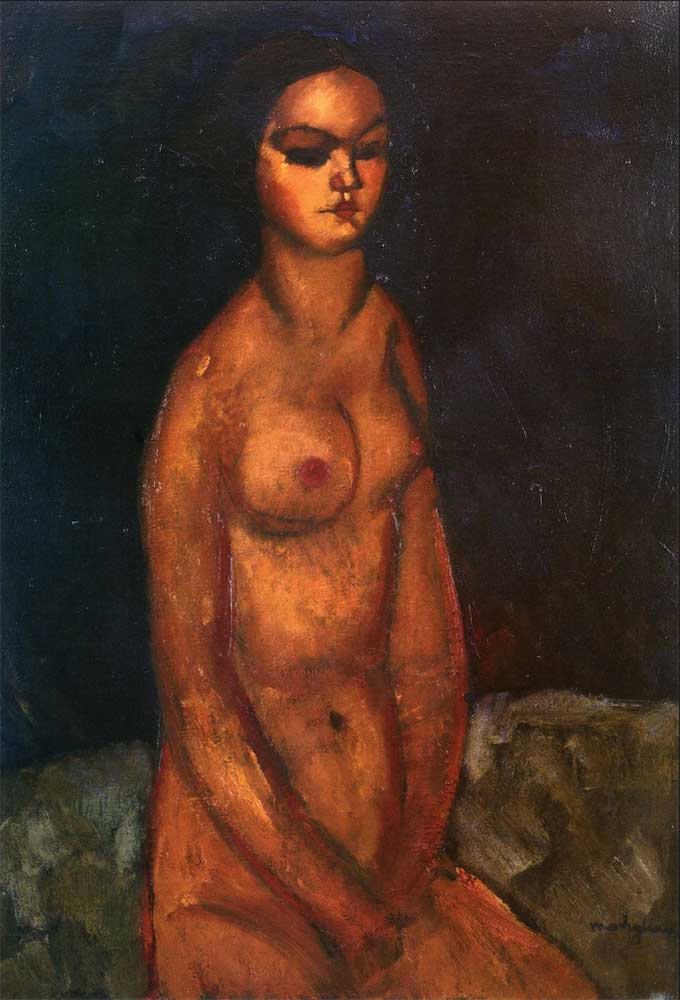
Seated nude - Little Jeanne
Oil on canvas — c. 1908
Identification
- Title
- English: Seated nude - Little Jeanne.
French: La Petite Jeanne.
Also names as: Nu assis (Christie's 2025); Nu debout (La petite Jeanne) (Pfannstiel 1956, per Christie's); Nu, Jeanne assise) (1926 exhibition, per Christie's); Nu, dit "Jeanne" (Lanthemann 1970, per Christie's) - Date
- c. 1908
Notes: c. 1908 (Christie's); 1909 (Lanthemann, per Christie's); 1910 (1926 exhibition, per Christie's) - Medium
- Oil on Canvas
- Dimensions
- 73 x 50 cm?
Notes: 74 × 50.5 cm (Christie's) - Signature
- Signed "modigliani" lower right
- Present location
- Private Collection ?
Catalogue numbers
| Compiler | Number |
|---|---|
| Arthur Pfannstiel | no. 11 |
| Joseph Lanthemann | no. 34 |
| Ambrogio Ceroni | no. 11 |
| Jeanne Modigliani | YES |
| Christian Parisot | 4/1908 |
| Osvaldo Patani | no. 14 |
| Modigliani Project | ? |
| MR | YES |
| Modigliani Initiative/ AMDC | ? |
Legal note on MR: This investigation has not had access to MR’s catalogue raisonné; all research here is based on open sources, publications and exhibitions. By no means has that catalogue been copied at any point. Modigliani Project and Modigliani Research Project are marked YES when the work is published or otherwise recorded by those projects, even if no catalogue number is assigned; otherwise the field is marked ?.
Provenance
- Paul Alexandre.
- Private Collection ?
- Sotheby's, New York, 13 May 1998, lot 31.
- Christie's, New York, 17 November 2025 - Estimate $4,000,000–6,000,000; sold for $4,711,000.
- David Nahmad Coll. New York or London.
The sequence follows the published museum, sale, and catalogue record in this investigation. Gaps and uncertain transfers are marked as such.
Selected bibliography
Book-length publications are marked with a footnote giving a full citation. Exhibition catalogues appear in both this list and the exhibition list when this investigation recorded them in both places.
- Pfannstiel, "catalogue présumé" Modigliani. L'Art et la Vie. Preface de Louis Latourrettes, Seheur, Paris, 1929, p. 41
- Jeanne Modigliani, Modigliani: Man and Myth, Orion Press, New York, 1958, pl. 22 (dated 1908 at the Alexandre coll. Paris)2
- Pfannstiel, Modigliani et son oeuvre, étude critique et catalogue raisonne, Bibliothèque des Arts, Paris, 1956 - no. 113
- Ceroni, Amedeo Modigliani: Peintre; Suivi des Souvenirs de Lunia Czechowska, Edizioni del Milione, 1958 - no. 94
- Jeanne Modigliani, Modigliani sans légende 1961, p. 225
- Diehl, E. Flammarion, paris 1969, p. 12
- Lanthemann, Modigliani, catalogue raisonné: sa vie, son oeuvre, son art, G. Condal, Barcelona, 1970 - no. 346
- Ceroni & Piccioni, Il dipinti di Modigliani, Rizzoli, Milano, 1970 - no. 117
- Mann, Modigliani, Thames and Hudson, London, 1980 - no. 148
- Diehl, Modigliani, Crown Publishers, New York, 1989, p. 12 (located in Nahmad Coll NY)
- Parisot, Catalogue Raisonné Modigliani, Graphis Arte, 1991 - no. 4/19089
- Patani, Catalogo Generale, Leonardo, Milano, 1991-94 - no. 1410
- Soto Caba, Modigliani, the timeless face, Libsa, 200711
Exhibitions
- Paris, Salon des Artistes Indépendants, 1908 - no. 4328, p. 290.
- Paris, 30 years of Salon des Artistes Indépendants, 1926 - no. 3099, p. 197.
- Brussels, Palais des Beaux-Arts, November 1933, p. 19, no. 4 .
Notes
No further documentary note is recorded in this investigation beyond the fields above. Where sources disagree, both readings are given.
Introduction
A young woman sits upright, facing us, her hands crossed in her lap, her eyes lowered or closed. Her body, painted in warm orange and ochre with red-brown contours, rises like a column from a greenish drapery against a nearly black ground. This is the Nu assis, Ceroni no. 11, which Ceroni's note, as transcribed online, describes as showing the same model as the preceding work, the "petite Jeanne" of the Bust of a Young Girl (no. 10). Christie's identifies it with no. 4328 (Femme nu) in Modigliani's first group of paintings at the Salon des Indépendants of 1908. Owned by Paul Alexandre until at least 1933, it passed through the Nahmad collection, was sold at Sotheby's in 1998 and was sold again at Christie's in New York in November 2025.
This is the first work in Ceroni's catalogue in which Modigliani's nude acquires the calm, sculptural monumentality that would characterise the later nudes. The essay examines the painting's formal qualities, its iconography, its relation to the works around it, and a documentation that, thanks to Christie's 2025 catalogue, is fuller than for most early works. The Secret Modigliani page on the work has not been updated to include that sale. No technical study of the painting has been published.
Composition and format
The canvas is upright, about 74 × 50 cm, and the figure occupies its central axis, cut off at mid-thigh by the lower edge. The head is placed high, slightly to the left of centre, and is tilted gently to the viewer's right. The shoulders are narrow and sloping, the arms hang straight down beside the body, and the hands meet in the lap. The torso is frontal, with the breasts and navel clearly placed on the axis.
The composition is divided horizontally at about two-thirds of its height by the line of the drapery or seat on which the figure sits. Above this line the ground is a dark blue-black, uniform except for a dark red-brown zone at the right; below it, greenish-grey and olive drapery spreads to left and right. The figure links the two zones as a vertical column. The arms, held close to the body, form a long oval with the shoulders and the hands, and enclose the torso in a closed shape. This closed contour is the key to the composition: the figure is self-contained and still.
Line and drawing
The contour of the figure is drawn in red-brown and dark red, not in the blue-black of the Nudo dolente or the Bust of a Young Girl. The lines are continuous and smooth along the outer edges of the arms, firm at the shoulders and breasts, and broken where the body meets the drapery. The forearms and hands are summarily indicated by a few curved lines.
The face is drawn with great economy. The eyebrows form a single arch that continues into the line of the nose, a device found in the Portrait of Maud Abrantès (no. 7B) and in many later portraits. The eyes are reduced to dark, lowered lids, the nose is long and straight, and the mouth is small, with a red upper lip. The jaw and chin are rounded, and the neck is short and thick, without the elongation of the later work. The hair is drawn back from the face, dark and close to the head.
Colour
The colour is dominated by the warm orange of the flesh against the cold dark of the ground. The body is painted in orange, ochre and pinkish tones, with red-brown shading along the sides of the torso, under the breasts and on the arms. The nipples and navel are touched with pink and dark red, and the face is lighter, with a golden-yellow forehead and cheeks. The ground is deep blue-black, and the drapery is a mixture of olive green, grey and dull yellow.
This harmony of warm figure and dark ground is close to Cézanne's late figure paintings, in which modelling is achieved by colour rather than by light and shade. Christie's catalogue essay points to Cézanne's influence in the structured application of paint. The warm orange of the body also contrasts with the white of the Nudo dolente and with the cool ochre of the Bust of a Young Girl. Within a few months, Modigliani moved from a pale, spectral nude to a warm and solid one.
Facture and surface
The paint is applied more evenly than in the other early nudes. The body is built up with short, parallel strokes of orange and ochre that follow the form, in a manner reminiscent of Cézanne's "constructive" brushwork. The face is smoother and more blended. The dark ground is painted thinly and evenly, and the drapery is handled more loosely, with broken strokes of green, grey and yellow.
The surface appears more finished and more consistent than that of nos. 8 and 10. There are no visible traces of an underlying image in reproduction, and the signature, in dark paint on the green drapery at the lower right, is integrated into the composition.
Figure and space
The figure is set close to the picture plane, but she sits on something, and the drapery gives a minimal sense of a ledge or bed. The body is modelled in depth by the warm and cool tones and by the red-brown shading, so that the torso reads as a rounded volume, almost a carved form. The dark ground provides no spatial depth, and the effect is of a figure in a niche, lit from the front.
Iconography: the seated model and the question of "debout"
The pose, frontal, seated, with hands crossed and eyes lowered, recalls the modest, self-contained figures of religious and archaic art more than the provocative nude of the Parisian salon. Christie's catalogue essay relates the painting to Picasso's Demoiselles d'Avignon (1907), with its masklike faces and its frontal, monumental figures. The comparison is apt for the simplification of the face, though Modigliani's figure lacks the aggression of Picasso's. The essay also cites June Rose's biography, according to which the model, Jeanne, was a young woman who worked in a brothel. The online Ceroni note describes "la petite Jeanne" of no. 10 as a patient of Paul Alexandre. Both identifications rest on testimony I have not been able to check.
The early titles of the work show some confusion. Pfannstiel in 1956 listed it as Nu debout (La petite Jeanne), that is, as a standing nude, although the figure is clearly seated; the 1926 exhibition catalogue, according to Christie's, called it Nu (Jeanne assise) and dated it 1910. Lanthemann dated it 1909. The Secret Modigliani page gives 1908, consistent with its identification with no. 4328 of the 1908 Salon. The variation suggests that early cataloguers relied on lists rather than on direct examination, a point that also emerges from Christie's remark that Noël Alexandre's 1993 book reproduces the work "with incorrect dimensions".
Comparisons
The most direct comparison is with the Bust of a Young Girl (no. 10), which shows the same model, according to Ceroni's note. There she looks out directly, painted in a rough, feverish manner over a reused canvas; here she lowers her eyes and the handling is calmer and more constructive. The two works show Modigliani shifting from the expressive to the sculptural within a single year.
The Nudo dolente (no. 8) provides a contrast of mood: the head thrown back and the open mouth against the lowered eyes and closed contour of no. 11. The Nude with a Hat (no. 7A) is a contrast of type: a made-up, fashionable woman against a simple, unadorned model.
Outside Ceroni's numbers, the Jewish Museum's 2017–18 exhibition included two ink drawings from the Alexandre family collection titled La Petite Jeanne, dated about 1909, one showing her "Seated Nude on a Bed" and one "Seated Nude Leaning on Her Right Elbow". They confirm that the model posed for Modigliani on several occasions and that the name was preserved in the Alexandre collection.
Provenance and exhibitions
Christie's 2025 catalogue gives the provenance as: Paul Alexandre, Paris (acquired from the artist, and until at least 1933); Nahmad collection, London; private collection, London (by 1991); Sotheby's, New York, 13 May 1998, lot 31; acquired at that sale by the seller. The painting was sold at Christie's, New York, on 17 November 2025 for $4,711,000 against an estimate of $4–6 million.
Technical analysis
No technical study of this painting is known to me. It is not discussed in Tate Papers no. 35 or in the 2018 Burlington Magazine article on the Modigliani Technical Research Study, and the Christie's 2025 catalogue, as far as I could read it, cites no examination. The following points are visual or comparative.
- Visual. In reproduction there is no sign of an earlier painting beneath the surface, unlike the Nudo dolente and the Bust of a Young Girl, in which an inverted head is visible at the lower right. The handling is more even and finished than in those works.
- Comparative. The Burlington study found that Modigliani's canvases of this period were mostly commercially primed with lead white grounds, and that he frequently reused supports, including canvases by other artists. Tate Papers documents several works of 1908 painted over earlier images (Ceroni nos. 7, 8 and 10). Whether the Nu assis conceals an earlier composition could only be established by X-radiography.
- Format. About 73 × 50 cm corresponds to the French standard "20 marine" canvas (73 × 50 cm) used upright. The Burlington article notes that Modigliani used marine and landscape strainers turned upright from as early as 1908. This connection is mine, not the study's.
Conclusion
The Nu assis marks a turning point in Modigliani's early work. The same model who appears flushed and direct in the Bust of a Young Girl is here transformed into a calm, self-contained figure, built up in warm, constructive strokes and enclosed in a continuous contour. It announces both the sculptures Modigliani was soon to carve and the great nudes of 1916–17. Its documentation is now relatively full, thanks to Christie's 2025 catalogue, but the Secret Modigliani page on the work has not caught up with the 1998 and 2025 sales, and there are inconsistencies over the Brussels 1933 loan, the dimensions and the early titles. As with La Juive, there is no published technical examination, and X-radiography would be needed to say whether this canvas, like several of its neighbours, conceals an earlier picture.
Sale literature
- Christie's, New York, 17 November 2025, Modigliani, Nu assis: lot details, provenance, literature, exhibitions and essay, https://www.christies.com/en/lot/lot-6559938
Museum documentation
- The Jewish Museum, New York, Modigliani Unmasked (2017–18), large-print guide, https://thejewishmuseum.org/wp-content/uploads/2025/06/Modigliani_Large_Print_FINAL.pdf
Technical literature (comparative)
- Anaïs Genty-Vincent et al., "Works by Modigliani that have Paintings beneath the Visible Surface", Tate Papers, no. 35, https://www.tate.org.uk/research/tate-papers/35/works-by-modigliani-that-have-paintings-beneath-the-visible-surface
- Annette King, Nancy Ireson, Simonetta Fraquelli and Joyce H. Townsend, "The Modigliani Technical Research Study: An introduction to Modigliani's materials and techniques", The Burlington Magazine, vol. 160, no. 1380 (March 2018), pp. 182–88, https://www.burlington.org.uk/archive/article/the-modigliani-technical-research-study-an-introduction-to-modiglianis-materials-and-techniques
Cited but not independently consulted
Salon des Artistes Indépendants, catalogue, Paris, 1908, p. 290, no. 4328; Trente ans d'art indépendant, Paris, 1926, p. 197, no. 3099; Palais des Beaux-Arts, Brussels, 1933, p. 19, no. 4; Sotheby's, New York, 13 May 1998, lot 31 (sale catalogue); Pfannstiel 1929, p. 4, and 1956, p. 59, no. 11; Ceroni 1958, p. 42, no. 9; Jeanne Modigliani, Modigliani sans légende, 1958/1961, and Modigliani: Man and Myth, 1958, pl. 22; Lanthemann 1970, p. 109, no. 34; Ceroni and Piccioni, I dipinti di Modigliani, 1970, p. 88, no. 11; Carol Mann, Modigliani, 1980, no. 14; Gaston Diehl, Modigliani, 1989, p. 12; Parisot 1991, 4/1908; Patani 1991, no. 14; Noël Alexandre, The Unknown Modigliani, 1993, p. 84; June Rose's biography of Modigliani. All are cited from Christie's or from the Secret Modigliani page on the work.
Footnotes
- Arthur Pfannstiel, Modigliani. L’Art et la Vie, preface by Louis Latourette, Paris, Seheur, 1929 (presumed catalogue).
- Jeanne Modigliani, Modigliani: Man and Myth, New York, Orion Press, 1958.
- Arthur Pfannstiel, Modigliani et son œuvre, étude critique et catalogue raisonné, Paris, Bibliothèque des Arts, 1956.
- Ambrogio Ceroni, Amedeo Modigliani: Peintre; suivi des souvenirs de Lunia Czechowska, Milan, Edizioni del Milione, 1958.
- Jeanne Modigliani, Modigliani sans légende, Paris, Gründ, 1961.
- Joseph Lanthemann, Modigliani, catalogue raisonné: sa vie, son œuvre, son art, Barcelona, G. Condal, 1970.
- Ambrogio Ceroni and Leone Piccioni, I dipinti di Modigliani, Milan, Rizzoli, 1970.
- Carol Mann, Modigliani, London, Thames and Hudson, 1980.
- Christian Parisot, Catalogue raisonné Modigliani, Livorno, Graphis Arte, 1991.
- Osvaldo Patani, Amedeo Modigliani: catalogo generale, Milan, Leonardo, 1991–94.
- Victoria Soto Caba, Modigliani: The Timeless Face, Madrid, Libsa, 2007.