Nude Woman bust
Oil on canvas — 1908 ?
Identification
- Title
- French: Nude Woman bust - Young nude.
French: La petite Jeanne.
Also as: Bust of Young Girl (Tate Modern, 2017–18); Bust of a young girl / Bust of a girl (Burlington 2018); Bust of a Young Girl (Tate Papers). - Date
- c. 1908 ?
- Medium
- Oil on Canvas
- Dimensions
- 61 x 38 cm
- Signature
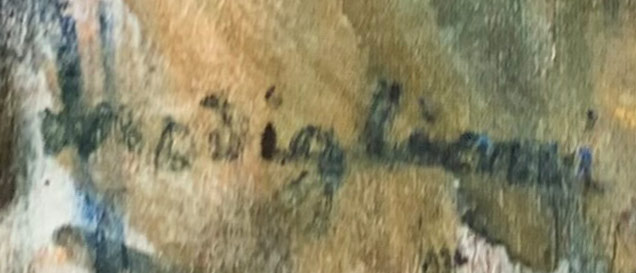
- Signed "modigliani" lower left
Notes: partial canvas stamp in the shape of an artist's palette on the reverse (Burlington 2018) - Present location
- Private Collection ?
Catalogue numbers
| Compiler | Number |
|---|---|
| Arthur Pfannstiel | no. 10 |
| Joseph Lanthemann | no. 33 |
| Ambrogio Ceroni | no. 10 |
| Jeanne Modigliani | YES |
| Christian Parisot | 3/1908 |
| Osvaldo Patani | no. 15 |
| Modigliani Project | YES |
| MR | YES |
| Modigliani Initiative/ AMDC | ? |
Legal note on MR: This investigation has not had access to MR’s catalogue raisonné; all research here is based on open sources, publications and exhibitions. By no means has that catalogue been copied at any point. Modigliani Project and Modigliani Research Project are marked YES when the work is published or otherwise recorded by those projects, even if no catalogue number is assigned; otherwise the field is marked ?.
Provenance
- Paul Alexandre, Paris
- Perls Galleries, New York
- Private Collection ?
The sequence follows the published museum, sale, and catalogue record in this investigation. Gaps and uncertain transfers are marked as such.
Selected bibliography
Book-length publications are marked with a footnote giving a full citation. Exhibition catalogues appear in both this list and the exhibition list when this investigation recorded them in both places.
- Pfannstiel, "catalogue présumé" Modigliani. L'Art et la Vie. Preface de Louis Latourrettes, Seheur, Paris, 1929, p. 41
- Pfannstiel, Modigliani et son oeuvre, étude critique et catalogue raisonne, Bibliothèque des Arts, Paris, 1956 - no. 102
- Ceroni, Amedeo Modigliani: Peintre; Suivi des Souvenirs de Lunia Czechowska, Edizioni del Milione, 1958 - no. 83
- Roy , Modigliani, Skira, Lausanne, 1958, p. 25
- Lanthemann, Modigliani, catalogue raisonné: sa vie, son oeuvre, son art, G. Condal, Barcelona, 1970 - no. 334
- Ceroni & Piccioni, Il dipinti di Modigliani, Rizzoli, Milano, 1970 - no. 105
- Mann, 1980, page 146
- Carluccio, Leymarie, Negri, Russoli, Brunhammer, École de Paris, Rive Gauche, Paris, 1981, p. 198
- Modigliani - Gli anni della scultura, Ed. Mondadori, Milan 1984, page 67
- Catalogue National Museum Tokyo 1985, no. 3
- C. Roy, 1985, Ed. Nathan, page 15
- Castieau-Barrielle, Modigliani, Editions ACR Paris, 1987, page 327
- Mondadori, Modigliani a Montparnasse, 1988, page 33
- Catalogue Galleria d'Arte Moderna, Verona 1988, page 33
- Angela Ceroni, Les nus, Paris 1989, page 43
- Catalogue Fondation Pierre Gianadda, Martigny 1990, no. 3
- Schmalenbach, Amedeo Modigliani, Prestel Verlag, 1990-91, p. 60 - no. 128
- Parisot, Catalogue Raisonné Modigliani, Graphis Arte, 1991- n º 3/19089
- Patani, Catalogo Generale, Leonardo, Milano, 1991-94 - no. 1510
- Soto Caba, Modigliani, the timeless face, Libsa, 200711
- Ireson/ Lewis, Modigliani, London, Tate Mdern, 201712
- Ireson, Fraquelli, Modigliani, London, Tate Modern, Skira Rizzoli, London, 2017, p. 2812
Exhibitions
- Paris, Salon des Artistes Indépendants, 1908 - no. 4326.
Note: Christie's identifies no. 4328 (Femme nu) with the Seated Nude (no. 11). The online Ceroni note says that no. 10 was shown in 1908 without giving a number. The identification of no. 10 with no. 4326 is plausible but is not supported by a definitive source. - Bruxelles, Palais des Beaux-Arts, 1933 - no. 4 (with doubts).
Note: Christie's, in its 2025 catalogue of the Seated Nude, gives exactly the same exhibition and number ("Brussels, Palais des Beaux-Arts, November 1933, p. 19, no. 4") for another painting. Both cannot be right. The Christie's citation or this must be in doubt. - Livourne, Gli anni della scultura, Villa Maria 1984 - no. 1.
- Tokyo, Modigliani exhibition, National Museum, 1985 - no. 3.
- Nagoya, Modigliani exhibition, Aichi Prefectural Art Gallery, 1985.
- Verona, Galleria d'Arte Moderna, 1988, p. 33.
- Martigny, Modigliani, Fondation Pierre Gianadda, 1990.
- Düsseldorf, Kunstsammlung Nordrhein Westfalen, Amedeo Modigliani. Malerei, Skulpturen, 1991 - no. 5.
- Zürich, Kunsthaus, Amedeo Modigliani. Malerei, Skulpturen, 1991 - no. 5.
- London, Modigliani, Tate Modern, 2017-2018.
Notes
As no. 4 and no. 232 in D' Atri files located in Alexandre Collection, Paris.
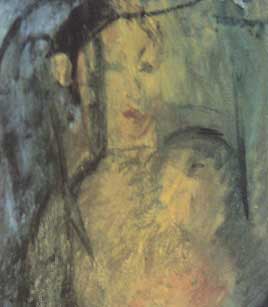
D'Atri mentions that in the back there are many figures, probably he is talking of the frontal image more than from (verso) back of the painting, this investigation has not seen the image from the verso.
As can be seen at near inspection, the canvas is reused.
Where sources disagree, both readings are given. This is a working research page, not a catalogue raisonné.
Introduction
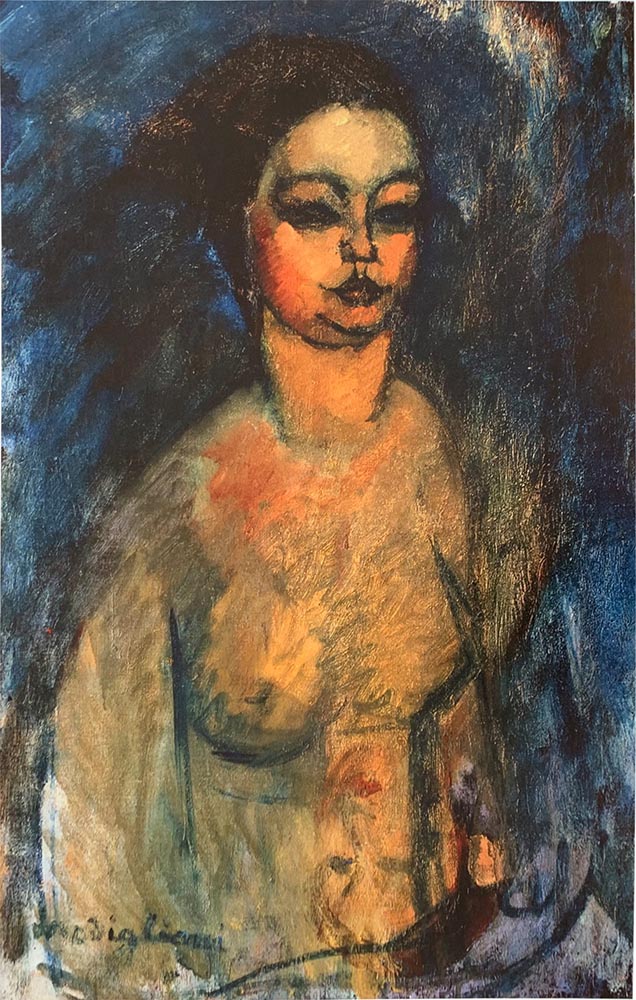
This small, narrow canvas shows a young woman, nude to below the breasts, facing the viewer against a dark blue ground. Her round face, flushed cheeks, dark eyes and full, dark mouth are framed by a wide mass of black hair. Ceroni's note, as transcribed online, identifies her as "la petit Jeanne", a patient of Dr Paul Alexandre, and records that the painting was shown at the Salon des Indépendants in 1908. Tate Modern exhibited it in 2017–18 as Bust of Young Girl beside the Nudo dolente (Ceroni no. 8), and Tate Papers and The Burlington Magazine discuss it as one of the earliest examples of Modigliani reusing another painter's canvas. It is, together with no. 8, one of the few early works for which there is some published technical observation.
The essay considers the painting's composition, drawing, colour and handling; the iconography of the young model; its relation to the Seated Nude (no. 11), which shows the same sitter; its provenance and exhibitions; and the technical evidence.
Composition and format
The canvas is unusually narrow, 61 × 38 cm, a ratio of about 1.6 to 1. The figure is placed on the central axis and fills most of the width, the shoulders almost touching the edges. The head is in the upper third, slightly tilted to the viewer's left; the eyes look out frontally. The bust is cut off below the breasts by a horizontal fold or edge, and below it the lower part of the canvas is occupied by a loosely painted zone with a dark curving line that sweeps from the lower left to the lower right.
The verticality of the format is emphasised by the long dark contours that run down the sides of the body, like the edges of a column. The wide hair, by contrast, spreads horizontally and creates a dark, cloudy crown around the head. The composition is therefore a simple, almost iconic structure: a frontal head on a columnar body, centred in a narrow field.
Line and drawing
The face is drawn with dark, firm contours. The eyebrows are two dark arcs, the eyes are almond shapes with dark irises and lids, the nose is a short, broad form with dark nostrils, and the mouth is a dark, full shape with a defined upper lip. The jaw is outlined by a strong line that continues under the chin. The features are slightly asymmetrical, the left eye (on the viewer's right) larger than the other.
The body is drawn with long, broken lines in dark blue-black. On the left side of the composition, a vertical stroke indicates the arm, and on the right a similar line runs from the shoulder towards the hip. A dark curved line marks the underside of the breast. At the bottom, the sweeping curve already noted cuts across the composition with no obvious descriptive role. It may belong to the underlying painting, or it may indicate drapery or the edge of a chair.
Colour
The palette is dominated by the dark blue of the ground, laid in vigorous strokes of ultramarine and blue-black with lighter blue streaks, especially at the top and the right edge. Against it the flesh is painted in warm ochre and yellow, with a large orange-red patch on the upper chest and the left shoulder (on the viewer's left) and orange-red on the cheeks. The hair is black-brown, the lips dark red-brown. In the lower right, whitish and pale grey touches appear in the area where, according to the technical literature, the head of an underlying figure is visible.
The colour is warmer and more earthy than in La Juive (no. 9), but cooler than in the Seated Nude (no. 11). The red patches on the chest and cheeks give a feverish, flushed quality that is consistent with, though not proof of, the tradition that the sitter was a patient of Alexandre's.
Facture and surface
The paint is applied with energy and little refinement. The blue ground is scrubbed and hatched in directional strokes, and in places the canvas texture and a lighter underlayer show through. The flesh is built up in thick, irregular touches of ochre and orange, with visible brushmarks that follow the curves of the body. The face is more carefully painted, with smoother transitions on the cheeks and forehead.
The lower part of the canvas is the least resolved. Strokes of ochre, grey and white overlap without clear forms, and the dark sweeping line lies on top. This is exactly the zone where, according to Tate and Burlington, the underlying image shows through, and it is difficult to separate the two paintings with the eye.
Figure and space
There is almost no indication of space. The figure is pressed against the picture plane, and the dark ground surrounds her like a niche. The body is modelled only by the contrast of warm flesh and dark contours, and by a little shading under the breast. The head, with its frontal gaze and solid features, has a sculptural quality, while the body is flatter and more sketchy.
Iconography: "la petite Jeanne"
The name "la petite Jeanne" comes, on the evidence available to me, from Paul Alexandre's circle. The online transcription of Ceroni's notes describes her as a patient of the doctor and identifies her with the model of the Seated Nude (no. 11). Christie's 2025 catalogue of the Seated Nude cites June Rose's biography, according to which Jeanne was a young woman who worked in a brothel. Neither identification is documented in sources I have seen, and the two are not incompatible. The Jewish Museum exhibited two drawings from the Alexandre family collection in 2017–18 titled La Petite Jeanne, dated about 1909, one showing her seated on a bed, which confirms that the name was used in the Alexandre collection.
The image is neither a portrait in the social sense of La Juive nor an expressive figure like the Nudo dolente. It is a direct, unidealised study of a young woman's head and body, frontal and still, whose round face and dark eyes have something of the folk or "primitive" simplicity that would become central to Modigliani's sculpture.
Comparisons
The most important comparison is with the Seated Nude (no. 11), which shows the same model at three-quarter length, with eyes downcast and hands crossed in her lap. In no. 10 she looks out directly and her face is more individual; in no. 11 the face is more generalised and the body more sculptural. The two works seem to represent successive stages in Modigliani's approach to the figure in 1908.
The second comparison is with the Nudo dolente (no. 8). Tate hung the two side by side, noting that for both "he re-used an old canvas upside down" and that "in both works a face is visible on the lower right-hand side". Both have a dark blue ground and a rough, unfinished handling, but the mood of no. 10 is calm rather than anguished.
Tate also hung in the same room the LaM Buste de jeune femme (no. 6), whose round, flushed face and dark hair are closely related. Tate related that work to Kees van Dongen, and the bright red cheeks of no. 10 suggest the same source.
Provenance and exhibitions
Paul Alexandre, Paris; Perls Galleries, New York; private collection (queried). No auction record of the work and no independent source for the Perls stage. The Tate guide and the Burlington article give only "private collection".
Technical analysis
There is no monographic technical study of this painting, but the Tate-led Modigliani Technical Research Study refers to it in two publications, and these are direct evidence.
Reused canvas by another hand. Tate Papers no. 35 states that in two works of 1908 now in private collections, "Bust of a Young Girl (C10) and Nude Study (C8), Modigliani seems to have used works by other artists, turned 180 degrees, as supports". The Burlington article (2018) states that "the head of an underlying figure is clearly visible in Bust of a girl (1908; private collection; C10)", and suggests that either the covering paint has become more transparent with age or Modigliani did not bother to conceal the earlier composition. The Tate guide places the face "on the lower right-hand side". Secret Modigliani reproduces the signature area turned through 180 degrees, in which, according to the page, "another portrait of a woman is visible".
Canvas stamp. The Burlington article reports "a partial canvas stamp on the reverse of Bust of a young girl (1908; private collection; C10) in the shape of a large artist's palette", which "is obscured by the strainer and remains unidentified". A colourman's stamp could identify the supplier and so help date the underlying painting, but it has not been read.
Format. The dimensions, 61 × 38 cm, correspond to the French standard "12 marine" canvas used upright. Burlington notes that Modigliani used landscape and marine strainers turned upright, with "examples from as early as 1908". It does not name this work, and the connection is my observation. If the canvas came from another artist, as Tate Papers suggests, the format may of course reflect that artist's choice rather than Modigliani's.
What is not known. No X-radiograph, infrared image or pigment analysis of the work has been published, as far as I could establish, and the authorship of the underlying painting is unknown. The general findings of the Burlington study on grounds and pigments are comparative evidence only.
Conclusion
The Bust of a Young Girl is a modest, intense painting: a frontal head with flushed cheeks and dark eyes on a column of warm flesh, framed by a scrubbed blue ground. Its importance lies partly in what it shares with the Seated Nude, the same young model seen in two different ways in the same year, and partly in its material history as a reused canvas, probably by another artist, with an unidentified colourman's stamp on the back. The documentation is incomplete and in places contradictory: the 1908 catalogue number is not securely established, and the Brussels 1933 loan is also attributed to no. 11. A technical examination of the reverse and of the underlying portrait would be the most useful next step.
Museum documentation
- Tate Modern, Modigliani (23 November 2017–2 April 2018), large-print guide, rooms 1–11 (copy at docslib), https://docslib.org/doc/1601730/modigliani-large-print-guide-room-1-11
- The Jewish Museum, New York, Modigliani Unmasked (2017–18), large-print guide, https://thejewishmuseum.org/wp-content/uploads/2025/06/Modigliani_Large_Print_FINAL.pdf
Technical and scholarly literature
- Anaïs Genty-Vincent et al., "Works by Modigliani that have Paintings beneath the Visible Surface", Tate Papers, no. 35, https://www.tate.org.uk/research/tate-papers/35/works-by-modigliani-that-have-paintings-beneath-the-visible-surface
- Annette King, Nancy Ireson, Simonetta Fraquelli and Joyce H. Townsend, "The Modigliani Technical Research Study: An introduction to Modigliani's materials and techniques", The Burlington Magazine, vol. 160, no. 1380 (March 2018), pp. 182–88, https://www.burlington.org.uk/archive/article/the-modigliani-technical-research-study-an-introduction-to-modiglianis-materials-and-techniques
Sale literature
- Christie's, New York, 17 November 2025, Modigliani, Nu assis: lot details, exhibitions and essay, https://www.christies.com/en/lot/lot-6559938
Cited but not independently consulted
Salon des Artistes Indépendants, catalogue, Paris, 1908; Palais des Beaux-Arts, Brussels, 1933, exhibition catalogue; Ceroni and Piccioni, I dipinti di Modigliani, Rizzoli, 1970, no. 10; Ceroni 1958, no. 8; Pfannstiel 1929, p. 4, and 1956, no. 10; Claude Roy, Modigliani, Skira, 1958, p. 25; Lanthemann 1970, no. 33; Carol Mann, Modigliani, 1980, p. 14; Werner Schmalenbach, Amedeo Modigliani, 1990, p. 60, no. 12; Parisot 1991, 3/1908; Patani 1991, no. 15; Fondation Pierre Gianadda, Modigliani, Martigny, 1990; Nancy Ireson and Simonetta Fraquelli (eds), Modigliani, London, Tate, 2017, p. 28; June Rose's biography of Modigliani (as cited by Christie's); the D'Atri files (nos. 4 and 232). All are cited from the Secret Modigliani page on the work or from Christie's.
Footnotes
- Arthur Pfannstiel, Modigliani. L’Art et la Vie, preface by Louis Latourette, Paris, Seheur, 1929 (presumed catalogue).
- Arthur Pfannstiel, Modigliani et son œuvre, étude critique et catalogue raisonné, Paris, Bibliothèque des Arts, 1956.
- Ambrogio Ceroni, Amedeo Modigliani: Peintre; suivi des souvenirs de Lunia Czechowska, Milan, Edizioni del Milione, 1958.
- Joseph Lanthemann, Modigliani, catalogue raisonné: sa vie, son œuvre, son art, Barcelona, G. Condal, 1970.
- Ambrogio Ceroni and Leone Piccioni, I dipinti di Modigliani, Milan, Rizzoli, 1970.
- Carol Mann, Modigliani, London, Thames and Hudson, 1980.
- Thérèse Castieau-Barrielle, La vie et l’œuvre de Amedeo Modigliani, Paris, ACR, 1987.
- Werner Schmalenbach, Amedeo Modigliani, Munich, Prestel, 1990.
- Christian Parisot, Catalogue raisonné Modigliani, Livorno, Graphis Arte, 1991.
- Osvaldo Patani, Amedeo Modigliani: catalogo generale, Milan, Leonardo, 1991–94.
- Victoria Soto Caba, Modigliani: The Timeless Face, Madrid, Libsa, 2007.
- Nancy Ireson and Simonetta Fraquelli, Modigliani, London, Tate Modern / Skira Rizzoli, 2017.