Lady with a blue scarf
Oil on canvas? — 1907 ?

Identification
- Title
- English: Lady with a blue scarf / woman with a blue shawl.
French: Femme à l'écharpe bleue.
Notes: Woman with blue scarf (Cincinnati, 1959); Femme à l'écharpe bleue (auction 1966); Maud Abrantes (Christie's 1983); Woman with blue shawl (García, Juanes and Romero 2023) - Date
- c. 1907 ?
- Medium
- oil on canvas ? (probably cardboard based on visual frontal inspection)
Notes: Oil on canvas according to the 1959 Cincinnati checklist and Ceroni. - Dimensions
- 30.5 x 22.9 cm
Notes: 33 × 24 cm in Ceroni and Patani, also García et al. 2023) - Signature
- Unsigned?
- Present location
- Unknown
Notes: Formerly Helena Rubinstein, New York; sold Christie's, New York, 16 November 1983, lot 334 (per Christie's 2013)
Catalogue numbers
| Compiler | Number |
|---|---|
| Arthur Pfannstiel | ? |
| Joseph Lanthemann | no. 13 |
| Ambrogio Ceroni | no. 5 |
| Jeanne Modigliani | YES |
| Christian Parisot | YES |
| Osvaldo Patani | no. 7 |
| Modigliani Project | ? |
| MR | YES |
| Modigliani Initiative/ AMDC | ? |
Legal note on MR: This investigation has not had access to MR’s catalogue raisonné; all research here is based on open sources, publications and exhibitions. By no means has that catalogue been copied at any point. Modigliani Project and Modigliani Research Project are marked YES when the work is published or otherwise recorded by those projects, even if no catalogue number is assigned; otherwise the field is marked ?.
Provenance
- Daniel-Henry Kahnweiler, Paris (probably acquired to Guillaume?/ based on HR Memoirs talking about her Modigliani's)
- Helena Rubinstein Collection (acquired from above)
- Sold at Helena Rubinstein collection, Parke Bernet Galleries NY auction April 1966?
- Sold Christie's, New York, 16 November 1983, lot 334 ? as Maud Abrantes?
- Unknown location
The sequence follows the published museum, sale, and catalogue record in this investigation. Gaps and uncertain transfers are marked as such.
Selected bibliography
Book-length publications are marked with a footnote giving a full citation. Exhibition catalogues appear in both this list and the exhibition list when this investigation recorded them in both places.
- Ceroni & Piccioni, Il dipinti di Modigliani, Rizzoli, Milano, 1970 - no. 51
- Lanthemann, Modigliani, catalogue raisonné: sa vie, son oeuvre, son art, G. Condal, Barcelona, 1970 - no. 132
- Patani, Catalogo Generale, Leonardo, Milano, 1991-94 - no. 73
- Soto Caba, Modigliani, The timeless face, Libsa, Madrid, 20074
Exhibitions
- Cincinnati, Amedeo Modigliani: Paintings, Sculpture and Drawings, The Contemporary Arts Center, 1959 - no. 1
Notes
Not in D'Atri papers.
No further documentary note is recorded in this investigation beyond the fields above. Where sources disagree, both readings are given.

Introduction
The fifth painting in Ambrogio Ceroni's 1970 catalogue is the least documented of the early group and in some respects the most striking. A young woman with dark, blue-black hair and a pale, almost bloodless face looks straight at the viewer. Her mouth is a vivid orange-red, a pale blue scarf shows at her throat, and a black coat closes around her shoulders. The picture is unsigned and its whereabouts are unknown. Its history runs through two of the most famous names in twentieth-century collecting: Daniel-Henry Kahnweiler, the dealer of Picasso and Braque, and Helena Rubinstein, the cosmetics entrepreneur, in whose New York apartment it hung for years. It was the first painting in the Modigliani exhibition held in Cincinnati in 1959, and it has recently served, alongside Ceroni nos. 1 and 2, as a reference image for the type of portrait Modigliani painted in his first Paris years.
This essay describes and analyses the picture as far as reproductions allow, discusses the uncertainty over its support and dimensions, considers its place among the frontal heads of 1906–07, and sets out what is known and not known about its history.
Composition and format
The format is upright and small, and the composition is frontal and nearly symmetrical. The head is centred and occupies the upper half of the field. The crown of the hair comes close to the top edge, and the bust, cut by the lower edge and both sides, fills the lower half. The black coat forms a broad inverted V, its lapels opening to reveal the scarf, which descends as a narrow, pale vertical from chin to lower edge. The scarf thus extends the central axis established by the nose, and the whole image is organised on that vertical: hair, eyes, nose, mouth, scarf.
Against this axis the hair provides a horizontal counter-weight. It is cut in a heavy fringe and swells out at the sides into two broad, rounded masses that make the head almost as wide as the shoulders. That silhouette, wider at the top than the narrow chin, gives the face a triangular, slightly mask-like shape that anticipates the more radical simplifications of Modigliani's mature heads.
Line and drawing
The drawing is economical and more linear than in the tonal heads of nos. 1 and 2. The eyes are drawn with dark, slightly drooping upper lids over light grey-blue irises; the right eye (viewer's left) is set a fraction higher than the left, and both gaze directly out. Short dark strokes mark the brows. A firm line runs down the right side of the nose and turns into the nostril. The mouth is the most emphatic passage: a full, slightly pouting shape in orange-red, its central line drawn in dark paint. The jaw is defined by a faint shadow on the left side and by the edge of the coat collar on the right.
Around the hair a lighter band of ground is visible, as though the head had been reserved against the background and the surrounding paint stopped short of its contour. This feature is consistent with the practice described in the 2018 Burlington introduction to the Modigliani Technical Research Study, in which Modigliani painted around his initial lines and left "a thin border of unpainted ground around the figure". Whether that is what we see here cannot be confirmed from a photograph.
Colour
The colour is cooler and more saturated than in the other early heads. The hair is a dense violet-blue, almost ultramarine in places, with darker strokes inside. The face is a pale, whitish flesh tinged with lilac in the shadows under the eyes and along the nose, and only lightly warmed on the cheeks. The scarf is a cool, pale cornflower blue. The coat is black, with traces of blue in its folds. The ground is a dull olive-brown, laid in with vertical strokes, lighter around the head and darker toward the edges.
Two warm accents interrupt this cool scheme: the orange-red of the lips, the most saturated colour in the painting, and the faint pink of the cheeks. The result is a sharply made-up face, with the pallor, the coloured mouth and the dark-rimmed eyes of the cosmetic fashion of the period. The blue hair is not naturalistic. It echoes the scarf and the shadows of the face and binds the head into a cool harmony against the olive ground. This is the closest the early group comes to the expressive colour of the Fauves, though the palette remains restrained.
Facture and support
The paint is thin, applied in short strokes that leave the texture of the support visible across the ground and coat. The ground in particular shows parallel vertical striations, which could be the marks of a stiff brush or the grain of a board. The face is more fully worked but still thinly painted.
The nature of the support is uncertain. The Cincinnati checklist of 1959 (as transcribed by Secret Modigliani) and Ceroni describe the work as oil on canvas, while the Secret Modigliani page on the work suggests that it is "probably cardboard". The Tate Papers study of works with hidden paintings confirms that in his earliest years Modigliani used supports "from cardboard to canvas". A painted cardboard would not be anomalous, but no examination has been published.
The dimensions are also uncertain. The Secret Modigliani page on the work gives 30.5 × 22.9 cm, which is exactly 12 × 9 inches and so probably derives from an American measurement, perhaps made while the picture was in New York. Ceroni and Patani give 33 × 24 cm, the same as Ceroni no. 2 and close to the dimensions of no. 1. The difference of about 2.5 cm in height and 1 cm in width is too large to be a rounding error and could reflect measurement of the sight size inside a frame, a later trimming, or simply a transcription error. García, Juanes and Romero (2023) use 33 × 24 cm, following Ceroni.
Figure and space
As in the other frontal heads, there is no defined space. The figure sits against a flat field, and its closeness to the picture plane is emphasised by the cropping. What is new is the degree of flattening: the black coat is a nearly uninflected shape, the hair a silhouette, the scarf a strip. Volume is concentrated in the face, which is modelled with light and shadow, while everything around it tends toward flat pattern. That split, a modelled face set in a flat surround, would become a structural principle of Modigliani's mature portraits.
Iconography
The sitter is not identified. Her cropped, voluminous hairstyle, her painted mouth and her dark, tailored coat suggest a fashionable young Parisian, perhaps from the world of the theatre or the cafés that Modigliani frequented. Like the beauty spot in Ceroni no. 2, the made-up mouth links the picture to the theme that the Jewish Museum's Modigliani Unmasked exhibition (2017–18) identified as Modigliani's "interest in the masklike properties of cosmetics". The face here is less a likeness than a construction of pallor, colour and line, and the gaze is direct but unrevealing.
There is a pleasing irony in the painting's later history. It came to belong to Helena Rubinstein, whose fortune was built on cosmetics, and who, according to the 2022 press kit of the Musée d'art et d'histoire du Judaïsme, was introduced to Modigliani in Paris by Misia Sert and displayed works of art, including works by Modigliani, in her beauty salons.
Comparisons
The painting belongs with Ceroni nos. 1 and 2, with which it shares size, format, frontality and the pale face framed by dark hair. García, Juanes and Romero reproduced all three in 2023 (their Fig. 7) as "three portraits of women from the same period recognized in Ceroni's Catalogue Raisonné". Their aim was to characterise the type of a long-haired female portrait of 1906–07 that their imaging had revealed beneath Modigliani's Portrait of Brancusi. Compared with its two companions, no. 5 is cooler and more linear: it replaces their tonal envelopment with contrasts of blue, black, olive and red, and its features are more sharply drawn.
It also points forward to the Woman Bust of 1907 (Ceroni no. 4), in the contrast of a pale face against a coloured costume, and to the 1908 Buste de jeune femme (Ceroni no. 6), in the triangle of face and the emphatic mouth. In that sense it marks the transition within the earliest group from the vignette heads of nos. 1 and 2 to the more constructed portraits of 1907–08.
Provenance and exhibitions
Provenance, with queries: Daniel-Henry Kahnweiler, Paris; Helena Rubinstein (acquired from Kahnweiler); sold in the Helena Rubinstein sale at Parke-Bernet Galleries, New York, in April 1966; present location unknown.
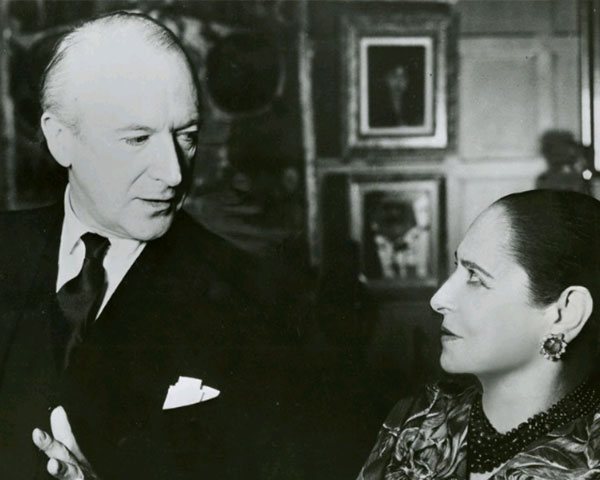
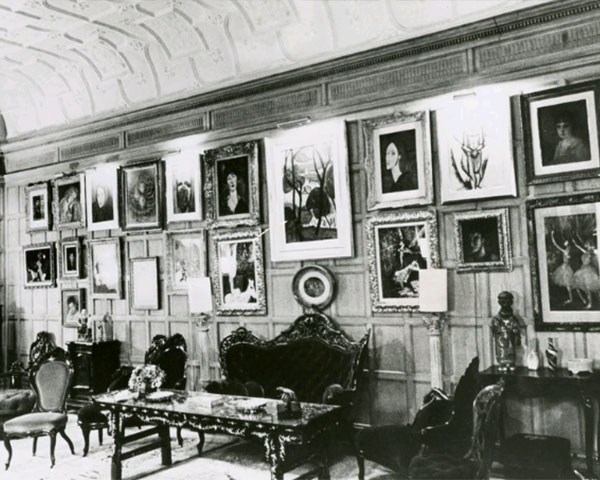
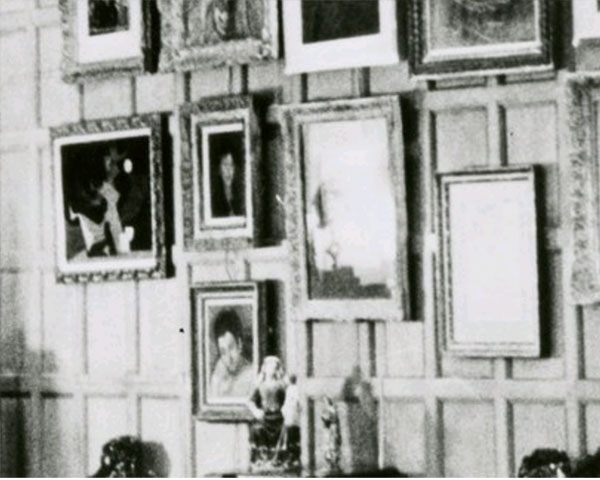
The Rubinstein ownership is documented by the Cincinnati exhibition of 1959. The Secret Modigliani transcription of the checklist lists, as painting no. 1, "Woman with blue scarf, Oil on canvas, Helena Rubinstein, NY". The exhibition was organised by The Contemporary Arts Center at the Cincinnati Art Museum in April–May 1959 under Allon T. Schoener and had previously travelled, with fewer works, to Chicago and Milwaukee. The Secret Modigliani page on the work also reproduces photographs that it identifies as showing the picture in Rubinstein's Park Avenue apartment and in a photograph inscribed "with Cecil Beaton, 1957". These photographs could not be independently verified.
Rubinstein died in 1965, and her collections were sold at Parke-Bernet in New York in a series of sales in April and October 1966. According to a listing of the sale catalogues (source 4), these included Modern Paintings and Sculptures, Part One (20 April 1966, sale 2428), Part Two (27 April 1966, sale 2431) and Modern Drawings and Prints (28 April 1966, sale 2432), the last of which lists Modigliani among its artists. I could not consult those catalogues, and so cannot confirm whether this painting was included or what it fetched. A later sale is documented, however: in its 2013 essay on La Juive (Ceroni no. 9), Christie's illustrates Femme à l'écharpe bleue, 1907, as "formerly in the Collection of Helena Rubinstein, New York" and "sold, Christie's, New York, 16 November 1983, lot 334". The same essay identifies the sitter as Maud Abrantès. I have not seen the 1983 sale catalogue, and the work's location after 1983 is unknown.
Discrepancies. The dimensions (30.5 × 22.9 cm against 33 × 24 cm) and the support (canvas against probable cardboard) are unresolved. The Secret Modigliani page on the work queries the 1907 date.
Technical analysis
No technical study of this painting is known, and its present location is unknown, which makes examination impossible for now. The following observations are comparative.
Comparative evidence. The Tate Papers study of hidden paintings shows that Modigliani's earliest supports ranged from cardboard to canvas and that he reused supports. Its analysis of Jean-Baptiste Alexandre with a Crucifix (1909) identified a thick lead white ground, vermilion-based flesh, lead white for the shape of the face and zinc white for its features, and cobalt blue and Prussian blue among the blues. The Burlington introduction notes that lead white grounds are typical and that a dark halo often appears in X-radiographs around his figures. The 1981 study by Delbourgo and Faillant-Dumas, as summarised in the Burlington, lists Prussian blue among Modigliani's pigments. Which blue was used for the hair and scarf of this picture is unknown.
What examination could establish. If the picture resurfaces, three questions are pressing: whether the support is canvas or cardboard (and whether, if canvas, it has been laid down); its exact dimensions, to settle the discrepancy; and whether the light band around the hair is reserved ground, as in the practice described by the Technical Research Study. Its cool blues and bright red lips would also make it a useful comparison with the 1909 palette documented in Rouen.
Conclusion
The Woman with a Blue Scarf is the coolest and most graphic of the earliest heads in Ceroni's catalogue. Its blue-black hair, pallid face and orange-red mouth turn the tonal vignette of 1906 into something closer to a mask of cosmetics, and its flattened coat and scarf foreshadow the planar surrounds of Modigliani's mature portraits. Its history, from a possible Kahnweiler provenance through the Rubinstein collection and the Cincinnati exhibition of 1959 to an unknown location after 1966, is as incomplete as its physical description. Locating the painting is the necessary first step to resolving the questions of support, size and technique that the documentation leaves open.
Collection and sale documentation
- Musée d'art et d'histoire du Judaïsme, Paris, Helena Rubinstein: l'aventure de la beauté, press kit (2022), https://www.mahj.org/sites/default/files/2022-01/dossier-de-presse-exposition-helena-rubinstein.pdf
- "The Helena Rubinstein Collection sale at Parke-Bernet in New York City" (bookseller's description of the 1965–66 sale catalogues), https://doczz.net/doc/5097742/helena-rubinstein-collection (accessed 25 October 2026).
- The Jewish Museum, New York, Modigliani Unmasked, wall texts and object labels (2017), https://thejewishmuseum.org/wp-content/uploads/2025/07/Modigliani_Unmasked_wall_texts_and_object_labels.pdf
Library catalogue records (Bibliothèque nationale de France)
- Françoise Cachin and Ambrogio Ceroni, Tout l'œuvre peint de Modigliani, Paris, Flammarion, 1972 (French edition of Ceroni's 1970 catalogue). https://catalogue.bnf.fr/ark:/12148/cb35281604b
- Arthur Pfannstiel, Modigliani et son œuvre, Paris, La Bibliothèque des Arts, 1956. https://catalogue.bnf.fr/ark:/12148/cb32524906f
Technical and scholarly literature
- Greta García, David Juanes and Rafael Romero, "Image Study and Material Characterization of the Two-Sided Painting The Cellist and Portrait of Brancusi by Amedeo Modigliani", International Journal of Conservation Science, vol. 14, no. 3 (2023), pp. 1233–48, DOI: 10.36868/IJCS.2023.03.30, https://ijcs.ro/public/IJCS-23-81_Garcia.pdf
- Annette King, Nancy Ireson, Simonetta Fraquelli and Joyce H. Townsend, "The Modigliani Technical Research Study: An introduction to Modigliani's materials and techniques", The Burlington Magazine, vol. 160, no. 1380 (March 2018), pp. 182–88. https://www.burlington.org.uk/archive/article/the-modigliani-technical-research-study-an-introduction-to-modiglianis-materials-and-techniques
- Anaïs Genty-Vincent et al., "Works by Modigliani that have Paintings beneath the Visible Surface", Tate Papers, no. 35, https://www.tate.org.uk/research/tate-papers/35/works-by-modigliani-that-have-paintings-beneath-the-visible-surface
- Christie's, New York, Impressionist & Modern Evening Sale, 8 May 2013, lot essay for Modigliani, La Juive (fig. 1: Femme à l'écharpe bleue), https://www.christies.com/en/lot/lot-5677506
Footnotes
- Ambrogio Ceroni and Leone Piccioni, I dipinti di Modigliani, Milan, Rizzoli, 1970.
- Joseph Lanthemann, Modigliani, catalogue raisonné: sa vie, son œuvre, son art, Barcelona, G. Condal, 1970.
- Osvaldo Patani, Amedeo Modigliani: catalogo generale, Milan, Leonardo, 1991–94.
- Victoria Soto Caba, Modigliani: The Timeless Face, Madrid, Libsa, 2007.