Woman bust
Oil on canvas— 1907
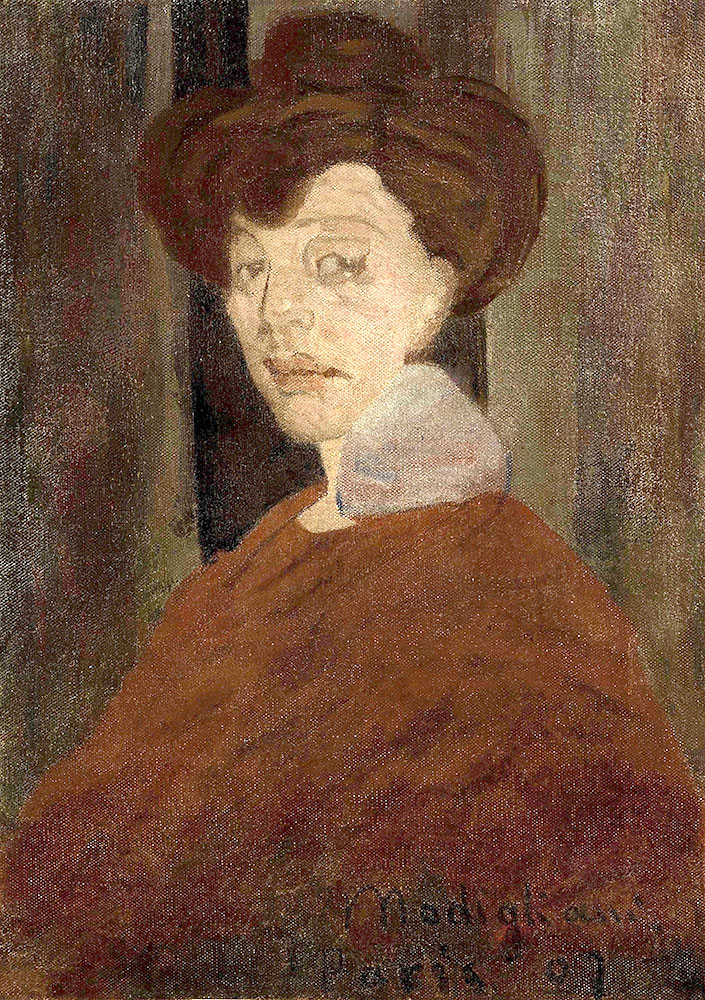
Identification
- Title
- English: Woman bust.
French: Portrait de femme (Christie's 2010);Buste de femme (Les Amis de Modigliani)
- Date
- 1907 (Dated on the canvas)
- Medium
- Oil on Canvas
- Dimensions
- 46.1 x 33.2 cm
Notes: 45.5 × 32.5 cm (Ceroni and Patani, according to the work's documentation) - Signature
- Signed "Modigliani" with the text "Paris' 07" lower right
- Present location
- Private Collection?
Sold Christie's London, 24 June 2010, sale 7859, lot 336
Catalogue numbers
| Compiler | Number |
|---|---|
| Arthur Pfannstiel | NO |
| Joseph Lanthemann | no. 11 |
| Ambrogio Ceroni | no. 4 |
| Jeanne Modigliani | YES |
| Christian Parisot | ? |
| Osvaldo Patani | no. 8 |
| Modigliani Project | ? |
| MR | ? |
| Modigliani Initiative/ AMDC | ? |
Legal note on MR: This investigation has not had access to MR’s catalogue raisonné; all research here is based on open sources, publications and exhibitions. By no means has that catalogue been copied at any point. Modigliani Project and Modigliani Research Project are marked YES when the work is published or otherwise recorded by those projects, even if no catalogue number is assigned; otherwise the field is marked ?.
Provenance
- T. P. Grange, London, 1963
- Miss D. V. Watson, London
- Sotheby's, London, 29 Nov 1989, lot 119
- Christie's, London, King Street, sale 6470 - Impressionist & modern art, 26 June 2001, lot 231, sold for £120,000 ($169,932 - €197.045,00)
- Christie's, London, King Street, sale 7859 - Impressionist/Modern day sale, 24 June 2010, lot 336, sold for £409,250 ($612,238)
The sequence follows the published museum, sale, and catalogue record in this investigation. Gaps and uncertain transfers are marked as such.
Selected bibliography
Book-length publications are marked with a footnote giving a full citation. Exhibition catalogues appear in both this list and the exhibition list when this investigation recorded them in both places.
- Lanthemann, Catalogue Raisonne, G. Condal, Barcelona, 1970 - no. 111
- Ceroni & Piccioni, Il dipinti di Modigliani, Milan. 1970 - no. 42
- Patani, Catalogo Generale, Leonardo ed. Milano 1991-94 - no. 83
- Soto Caba, Modigliani, the timeless face, Libsa, 20074
Exhibitions
- Frankfurt, Kunstverein, Steinernes Haus, Amedeo Modigliani, 1963 - no. 2
Notes
Not included in D'Altri papers.
No further documentary note is recorded in this investigation beyond the fields above.
Where sources disagree, both readings are given.
Introduction
Few of Modigliani's earliest paintings carry a date. This one does: "Modigliani / Paris 07" is written in dark paint across the lower right of the canvas. When Christie's sold the picture in London in 2010, its catalogue noted that according to Ambrogio Ceroni this was the first painting Modigliani signed and dated in Paris, and therefore an anchor for the chronology of his first years there. Ceroni placed it fourth in his 1970 catalogue. The picture is larger and more ambitious than the small frontal heads that precede it: a half-length woman in a rust-brown cape turns her head back over her shoulder to look at the viewer, against a ground of vertical stripes. It is a picture about a glance, and about the elegant, slightly guarded self-presentation of a modern Parisian woman.
This essay analyses the picture's design, drawing, colour and surface, considers its relationship to Whistler and to the portrait conventions of the Belle Époque, sets out its well-documented market history, and reviews the comparative technical evidence.
Composition and format
The canvas is a tall rectangle in a proportion of about seven to five. If its dimensions are original, 46 × 33 cm corresponds to the standard French no. 8 paysage (landscape) size used upright. The 2018 Burlington introduction to the Modigliani Technical Research Study found that Modigliani often turned paysage and marine strainers on their short edges to use them for portraits, and gives examples "from as early as 1908". If the identification is right, this would be a slightly earlier instance of the same habit; the strainer itself has not, to my knowledge, been examined.
The figure is built as a broad pyramid. The cape spreads across the whole lower half of the canvas, its edges cut by the frame on both sides and at the bottom. Above it the head is set left of centre and turned three-quarters toward the viewer, while the shoulders and the body beneath the cape appear to face toward the right. A stiff, pale collar rises behind the jaw on the right side, and the hair is piled high in a rounded mass with a knot on top that almost touches the upper edge. The axis of the composition runs diagonally from the lower left, through the face, to the collar and the dark vertical band behind it at the upper right.
That diagonal twist is the key to the picture. The body withdraws, the head returns. Christie's described the pose as giving "a sense of immediacy ... as though it were a snap-shot", and the effect is indeed of a figure caught in movement. Yet the broad, nearly motionless cape and the vertical stripes of the ground give the image a countervailing stability.
Line and drawing
The face is drawn more precisely than any other part of the picture. The brows are fine arcs; the eyes are long, with heavy upper lids, the irises pushed to the corners so that the sitter looks sideways at the viewer. The nose is long and thin, its shadowed side marked by a firm line; the mouth is small, full and closed, painted in a muted coral. The left side of the face, toward the viewer, is outlined against the ground with a thin dark line from temple to chin.
Elsewhere drawing is minimal. The contour of the cape is defined by the change from rust to the striped ground, and its interior is unmodelled except for a few darker strokes suggesting folds. The collar is a soft, irregular shape of white and lilac with no clear edge. The hair is built of curving strokes of reddish brown that describe its volume without detailing it. The contrast between the carefully drawn face and the broadly laid-in costume is a constant of Modigliani's portraiture from this point on.
Colour
The colour is subdued and harmonious, organised around a single warm note. The cape is a rust or burnt-orange brown, the largest area of colour in the picture, and slightly darker at the lower left where the signature sits. The hair repeats the same family in a deeper, redder key. The face is a pale ivory, almost chalky, with cool grey-green shadows at the eye sockets and along the nose and a faint pink on the cheek and lips. The collar introduces the only cool light: an off-white tinged with lilac and blue.
The ground is the most complex area. It consists of vertical bands of grey-green, olive, dull violet and brown, of varying widths and with soft, scumbled edges, suggesting a striped wallpaper, a curtain or simply a decorative screen. Behind the head on the right, a deep, nearly black band drops vertically from the knot of hair to the collar, isolating the face against the darkest value in the picture and doubling as a cast shadow or a door frame.
Christie's linked this colour to Ludwig Meidner's memory of Modigliani's early work: "here and there reminiscent of Toulouse-Lautrec or, in their greyish green tonality, of Whistler's work", "moderate and cultured in colour as well as in design" (Meidner, Burlington Magazine, 1943, as quoted by Christie's). The description fits this picture better than any other in the early group. The grey-green ground and the rust figure are tuned to each other like the "harmonies" and "arrangements" of Whistler's full-length portraits.
Facture and surface
The paint is thin and dry, applied in short, broken strokes. In the ground the vertical bands are built from many small touches, and the texture of the canvas shows through everywhere, producing a granular, slightly shimmering surface. The cape is painted in the same way, with the rust colour scrubbed over a darker underlayer so that the weave remains visible. The face is more densely painted but still matte, with little impasto. Overall the handling recalls pastel or distemper more than conventional oil painting, and it gives the picture the muted, velvety surface that the reproductions show.
Meidner also recalled that Modigliani applied layers of coloured varnish to give his early pictures "a pellucid, iridescent tone". The dry, matte appearance of this picture in reproduction does not obviously support that, but the state of the surface, and any varnish, has not been published.
Figure and space
The figure occupies a shallow space between the picture plane and the striped ground. There is no floor or furniture. Depth is suggested only by the overlapping of the cape over the stripes and of the head over the dark band. The cape's breadth makes the woman seem substantial, even monumental, while the small head and the glance over the shoulder keep her alert and aloof. Christie's remarked that the figure has "a sense of volume and stillness that may already reveal his interest in sculpture and even, perhaps, in the work of Paul Cézanne", whose retrospective at the Salon d'Automne of 1907 Modigliani could have seen. The LaM's 2016 chronology also records the 1907 Cézanne retrospective. But the means here remain tonal and decorative rather than Cézannian: there is no constructive brushstroke and no faceting of planes.
Iconography
The sitter is not identified. Her clothing is that of a fashionable woman of the period: a voluminous cape or mantle, a high standing collar and hair dressed in a tall chignon. The glance over the shoulder belongs to the repertoire of society portraiture and of fashion illustration, from Boldini to the posters of the Belle Époque, and also to the more ironic images of Parisian women by Toulouse-Lautrec. Modigliani avoids both flattery and caricature. The face is long and slightly haggard, with shadowed eyes and a pinched mouth, and the expression is reserved and wary rather than charming.
That reserve became one of the defining qualities of Modigliani's portraits. Here, in 1907, it already separates the picture from the society portrait it formally resembles. The woman looks out, but she does not invite.
Comparisons
Within the earliest group the picture is closest in palette to the Woman with a Blue Scarf (Ceroni no. 5) and in the treatment of the face to Tête de femme (Ceroni no. 2), but it is larger, more fully composed and more worldly than either. The head turned over the shoulder has no parallel among the frontal heads of nos. 1, 2 and 5 or the strict profile of no. 3. The broad treatment of costume as a single coloured mass anticipates the Buste de jeune femme of 1908 (Ceroni no. 6), where the blouse is likewise a broad, lightly modelled field, though there the contours are firmer and the colour bolder.
Beyond Modigliani, the obvious reference is Whistler, whom Meidner said Modigliani admired: the subdued harmonies, the vertical format, the figure detached against a decorative but unspecific ground. Christie's also proposed Meidner's own later self-portraits, with their pale faces against dark grounds, as a parallel. That is a comparison of temperament rather than of influence, since Meidner's self-portraits date from after his Paris years.
Provenance, exhibitions and sales
The documented history begins only in 1963, when, according to Christie's, the picture belonged to T. P. Grange in London and was exhibited at the Kunstverein in Frankfurt (Steinernes Haus), June–July 1963. It later belonged to Miss D. V. Watson, whose property was sold at Sotheby's in London on 29 November 1989, lot 119. It reappeared in an anonymous sale at Christie's London on 26 June 2001, lot 231 (sale 6470). The Secret Modigliani page on the work records a price of £120,000 for that sale. It was sold again at Christie's London on 24 June 2010 (sale 7859, lot 336) for £409,250 including premium, against an estimate of £150,000–200,000. Les Amis de Modigliani record the same 2010 sale.
The present owner is not published. Nothing is known of the picture's first half-century: there is no record of an early owner, no entry in Pfannstiel's catalogues of 1929 and 1956, and no early exhibition. How the picture reached London by 1963 is undocumented.
Technical analysis
No technical examination of this painting has been published, so far as I could establish. It is in a private collection and does not appear among the works whose findings are reported in the Burlington introduction to the Modigliani Technical Research Study (2018), in the Tate Papers no. 35 articles consulted, or in the LaM/C2RMF research programme on French public collections. The following is comparative.
Comparative evidence. The Burlington introduction reports lead white in most grounds, sometimes with an additional zinc white priming; painted borders; and a "dark halo" around figures in X-radiographs where the artist painted around his initial drawing. The Tate Papers study of works with hidden paintings shows that Modigliani reused canvases as early as 1908 and that his early supports ranged "from cardboard to canvas". Its analysis of Jean-Baptiste Alexandre with a Crucifix (1909) identified a thick lead white ground, a supplier's stamp (Hardy-Alan, rue du Cherche-Midi) that the authors connect to a purchase before July 1907, vermilion-based flesh and a dark jacket mixed from several pigments, including bone black, Prussian blue and cobalt blue.
What this painting could show. Because the work is dated 1907 on its face, it is potentially one of the most valuable early pictures for technical study: its materials could provide a securely dated reference point for Modigliani's palette and supports before the better-studied works of 1908–09. Examination of the reverse could identify a supplier's stamp or a standard-size strainer mark; X-radiography could test whether the "dark halo" is already present around the head; and elemental mapping could establish whether the grey-greens of the ground contain chrome green or are mixtures of black, yellow and white, as Meidner's "greyish green tonality" might suggest.
Conclusion
The Portrait de femme of 1907 is the most fully realised of Modigliani's earliest surviving paintings and the only one that dates itself. Its subdued harmonies of rust, grey-green and ivory, its tall format and its decorative ground place it in the orbit of Whistler and Lautrec. The twist of the body and head and the guarded, sidelong glance give it a psychological edge that is Modigliani's own. Its sales history is clear from 1963 onward, but its first owners are unknown. Its secure date makes it a natural candidate for the technical study that it has not yet received.
Sale records and documentation
- Christie's, London, Impressionist/Modern Day Sale, 24 June 2010, sale 7859, lot 336, "Amedeo Modigliani (1884–1920), Portrait de femme", with lot essay, https://www.christies.com/en/lot/lot-5334022 (accessed 25 October 2026).
- Les Amis de Modigliani, "Les premiers temps à Montmartre", http://www.amis-de-modigliani.net/vie/les-premiers-temps-a-montmartre/ (accessed 25 October 2026).
- LaM, Villeneuve-d'Ascq, Amedeo Modigliani: l'œil intérieur, dossier pédagogique (2016), https://www.musee-lam.fr/sites/default/files/2019-01/Dossier-pedago-Modigliani-l-oeil-interieur.pdf
Library catalogue records (Bibliothèque nationale de France)
- Françoise Cachin and Ambrogio Ceroni, Tout l'œuvre peint de Modigliani, Paris, Flammarion, 1972 (French edition of Ceroni's 1970 catalogue). https://catalogue.bnf.fr/ark:/12148/cb35281604b
- Ambrogio Ceroni, Amedeo Modigliani, peintre, Milan, Edizioni del Milione, 1958. https://catalogue.bnf.fr/ark:/12148/cb31986813q
- Arthur Pfannstiel, Modigliani et son œuvre, Paris, La Bibliothèque des Arts, 1956. https://catalogue.bnf.fr/ark:/12148/cb32524906f
Technical and scholarly literature
- Annette King, Nancy Ireson, Simonetta Fraquelli and Joyce H. Townsend, "The Modigliani Technical Research Study: An introduction to Modigliani's materials and techniques", The Burlington Magazine, vol. 160, no. 1380 (March 2018), pp. 182–88. https://www.burlington.org.uk/archive/article/the-modigliani-technical-research-study-an-introduction-to-modiglianis-materials-and-techniques
- Anaïs Genty-Vincent et al., "Works by Modigliani that have Paintings beneath the Visible Surface", Tate Papers, no. 35, https://www.tate.org.uk/research/tate-papers/35/works-by-modigliani-that-have-paintings-beneath-the-visible-surface
- Modigliani Initiative, "Literature: Ceroni 1958", https://catalogue.modigliani-initiative.org/literature/entry.php?id=618
Cited but not independently consulted
Ceroni and Piccioni, I dipinti di Modigliani, Rizzoli, 1970, no. 4; Lanthemann 1970, no. 11; Patani 1991, no. 8 (all as cited by Christie's); Soto Caba 2007 (as cited on the Secret Modigliani page on the work); Sotheby's London, 29 November 1989, lot 119, and Christie's London, 26 June 2001, lot 231 (known from the Christie's 2010 provenance; the sale catalogues were not consulted); Frankfurt Kunstverein 1963 catalogue. Ludwig Meidner, "The Young Modigliani: Some Memories", The Burlington Magazine, vol. 82 (April 1943), pp. 87–91, is quoted from the Christie's lot essay.
Footnotes
- Joseph Lanthemann, Modigliani, catalogue raisonné: sa vie, son œuvre, son art, Barcelona, G. Condal, 1970.
- Ambrogio Ceroni and Leone Piccioni, I dipinti di Modigliani, Milan, Rizzoli, 1970.
- Osvaldo Patani, Amedeo Modigliani: catalogo generale, Milan, Leonardo, 1991–94.
- Victoria Soto Caba, Modigliani: The Timeless Face, Madrid, Libsa, 2007.