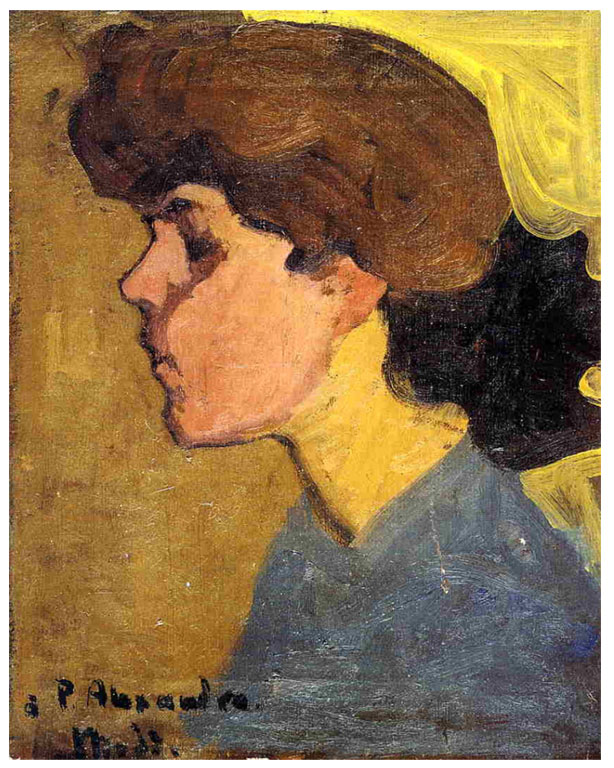
Woman head in profile
Oil on canvas?— 1906-7 ?
Identification
- Title
- English: Woman head in profile.
French: Tête de femme de profil.
Also mentioned as Head of a Woman in Profile (Jewish Museum, New York, 2017–18). - Date
- c. 1906-7 ?
- Medium
- Oil on Canvas
- Dimensions
- 33.5 x 29.5 cm
- Signature
- Signed "Modi."Dedicated and signed "à P. Alexandre / Modi." lower left
- Present location
- Paul Alexandre Family Collection, Paris?
Richard Nathanson, London (Jewish Museum, 2017)
Catalogue numbers
| Compiler | Number |
|---|---|
| Arthur Pfannstiel | no. 4 |
| Joseph Lanthemann | no. 16 |
| Ambrogio Ceroni | no. 3 |
| Jeanne Modigliani | YES |
| Christian Parisot | YES |
| Osvaldo Patani | no. 9 |
| Modigliani Project | YES |
| MR | YES |
| Modigliani Initiative/ AMDC | ? |
Legal note on MR: This investigation has not had access to MR’s catalogue raisonné; all research here is based on open sources, publications and exhibitions. By no means has that catalogue been copied at any point. Modigliani Project and Modigliani Research Project are marked YES when the work is published or otherwise recorded by those projects, even if no catalogue number is assigned; otherwise the field is marked ?.
Provenance
- Paul Alexandre Collection (Acquired from the artist)
The sequence follows the published museum, sale, and catalogue record in this investigation. Gaps and uncertain transfers are marked as such.
Selected bibliography
Book-length publications are marked with a footnote giving a full citation. Exhibition catalogues appear in both this list and the exhibition list when this investigation recorded them in both places.
- Pfannstiel, catalogue présumé, Paris, 1929, p. 21
- Pfannstiel, Modigliani et son oeuvre, étude critique et catalogue raisonne, Bibliothèque des Arts, Paris, 1956 - no. 42
- Ceroni, Amedeo Modigliani: Peintre; Suivi des Souvenirs de Lunia Czechowska, Edizioni del Milione, 1958 - no. 23
- Lanthemann, Catalogue Raisonne, G. Condal, Barcelona, 1970 - no. 164
- Ceroni & Piccioni, Il dipinti di Modigliani, Milan. 1970 - no. 35
- Patani, Catalogo Generale, Leonardo ed. Milano 1991-94 - no. 96
- MR, L'Ange au visage grave, Musée du Luxembourg, Paris, 2002, p.104-105 - no. 27
- Klein, Modigliani: Beyond the Myth, The Jewish Museum, 2004-2005, p. 91, pl. 68
- Soto Caba, Modigliani, the timeless face, Libsa, 20079
- Klein, Modigliani Unmasked, The jewish Museum, New York, 20178
Exhibitions
- Paris, Modigliani: l'Ange au visage grave, Musée du Luxembourg, 2002 - no. 2
- Milano, Modigliani: l'ange au visage grave, Palazzo Reale, 2003 - no. 2
- Toronto, Modigliani: Beyond the Myth, The Art Gallery of Ontario, 2004 - 2005
- New York, Modigliani unmasked, Jewish Museum, 2018
Notes
Not in D'Atri papers.
Where sources disagree, both readings are given. This is a working research page, not a catalogue raisonné.

.jpg)
Introduction
Of the paintings Ambrogio Ceroni placed at the beginning of Modigliani's catalogue, this is the most surprising. The neighbouring heads of 1906–07 are frontal, dark and tonal. This one shows a woman in strict left-facing profile, painted in flat, warm, unexpectedly bright colour: salmon flesh, a chestnut mass of hair, a slate-blue blouse, an ochre ground, and at the upper right a ribbon of yellow arabesques against black. It is dedicated "à P. Alexandre", to Dr Paul Alexandre, Modigliani's first patron, and it has stayed in the Alexandre family. The Jewish Museum in New York exhibited it in 2017–18, in Modigliani Unmasked, as one of the earliest works in a show built on the Alexandre collection.
This essay considers how the picture is made, what the profile meant for an artist who otherwise painted his sitters face on, how its colour relates to the Paris avant-garde of 1905–07, and what is known of its history and physical make-up.
Composition and format
The canvas is nearly square, much broader in proportion than the small upright supports of Ceroni nos. 1, 2 and 5. The head and shoulders fill it. The profile faces left, and the tip of the nose comes within a few centimetres of the left edge, so the figure looks out of the picture into a narrow band of ochre space. Behind her, to the right, the picture is more crowded: the full, rounded mass of the hair extends almost to the upper edge, a black zone fills the area behind the nape, and a decorative yellow form climbs the upper right corner. The bust is cut by the lower edge on a diagonal running from lower left to the right shoulder.
This asymmetry matters. The face is placed at the left, in the light, against an empty ground; the right half of the picture holds the darker, busier masses. The eye moves from the mouth and nose, the most sharply drawn passage, back through the dark eye socket and cheek into the hair and the black behind. The design is held together by large shapes rather than by detail: the dome of the hair, the angular block of the face, the yellow column of the neck and the broad wedge of the blouse.
Line and drawing
The profile is constructed with a few decisive strokes. A single dark line separates forehead, nose, lips and chin from the ground; the nose is long and nearly straight, the lips are slightly parted and pushed forward, and the chin recedes into a firm jaw. Drawing in dark paint defines the eye, set deep in a brown socket under a heavy brow, and a short stroke marks the ear-lobe area at the edge of the hair. The neck is drawn in two long curves, the back one swelling slightly, and the neckline of the blouse is a simple V.
There is a striking contrast between the hard, almost carved profile and the loose, broad handling of the hair, which is laid in with curving, overlapping strokes of chestnut and darker brown. Modigliani's later portraits often combine an incisive contour with a softly painted interior. Here, already, the profile line does most of the work of characterisation.
The profile itself is exceptional in his painted work. An article in NY Arts Magazine by Ante Glibota called it "a single expressionistic portrait in profile" and "the only exception" to Modigliani's rule of frontal portraits. That is overstated: the LaM in Villeneuve-d'Ascq, for example, owns a painted Profil d'homme of 1915, and the profile was a standard format in his drawings and his carved heads of 1911–13. But among the paintings of 1906–08, a strict profile is indeed rare, and the choice deserves comment.
Colour
Colour is the picture's most radical feature. The flesh is a salmon pink, modelled with red-brown in the cheek and around the eye; there is little attempt at the cool, greyish half-tones of the frontal heads. The neck, by contrast, is a strong yellow, as though the light falling on it had been translated directly into pigment. The blouse is a slate or grey-blue, with lighter and darker strokes indicating folds. The ground at the left is a dull ochre, laid in with loose vertical strokes through which a darker underlayer shows. Behind the head is a deep, glossy black, and at the upper right a pale lemon-yellow arabesque, painted in thick curling strokes over a lighter yellow, suggests a curtain, a lace-edged fabric, or the ornamental back of a chair.
These complementary oppositions (yellow against blue, salmon against grey-blue, yellow against black) place the picture firmly in the years when the Fauves had made arbitrary, high-key colour the defining issue of Paris painting. The LaM's educational dossier for its 2016 exhibition describes the young Modigliani as on the whole "peu réceptif aux épanchements colorés des fauves" (little receptive to the colourful outpourings of the Fauves). This profile is one of the few early works in which that receptiveness can be seen. The colour is warm and decorative rather than violent: it suggests the Nabis and Gauguin, and the posters and lithographs of Toulouse-Lautrec, as much as Matisse or Derain. (These comparisons are stylistic; no source documents which works Modigliani had seen.)
Facture and surface
The paint is applied more thickly and more variably than in the frontal heads. In the hair and the yellow arabesque the brushwork is broad and curving, and the strokes remain visible as ridges. In the face the paint is more smoothly blended, but the transition from salmon to red-brown is made with distinct touches rather than continuous modelling. The ochre ground is thinner and allows the darker layer beneath to show, and in places the canvas appears to be exposed near the lower edge. The black behind the head is dense and saturated.
The surface therefore reads as a set of separately worked zones, each with its own texture: smooth flesh, ridged hair, thin ground, dense black, thick yellow. That approach, in which the material character of each area is kept distinct, is a step away from the unifying tonal veil of Ceroni nos. 1 and 2 and toward the patchwork construction of the 1908 Woman with Hat (Ceroni no. 6).
Figure and space
Space is shallow and is defined by overlapping rather than by perspective. The head stands in front of the black zone, which stands in front of (or beside) the yellow arabesque; the ochre ground at the left has no depth at all. The figure is close to the picture plane and is cut by the frame on two sides. Because the profile looks out of the picture, the viewer is excluded from the sitter's gaze, a notable inversion of the direct confrontation of the frontal heads. The woman is seen, as it were, in passing, absorbed in something outside the frame.
Iconography and the dedication
The sitter is not identified. Her hair, piled high and full around the head, follows the fashion of the period, and the simple blouse gives no indication of class or profession. The dedication "à P. Alexandre", lettered above the abbreviated signature "Modi.", is more informative than the image. It records a gift, and it places the painting within the friendship that began, according to the Jewish Museum's wall text, in the winter of 1907 at the artists' colony Alexandre ran at 7 rue du Delta. It also suggests that the date "c. 1906–07" should be read with the later end of that range in mind, since the dedication can hardly precede the two men's acquaintance, unless it was added later. The abbreviated "Modi.", the artist's nickname, adds to the sense of intimacy.
The Secret Modigliani page on the work states that the painting is visible in a photograph of 1913, taken as Alexandre was leaving the Delta studios. The Jewish Museum's wall text describes a photograph dated 5 July 1913 in which Alexandre stands with others and "on the ground are two paintings by Modigliani: Head of a Woman and Melancholy Nude". The photograph is an important early document of the painting's presence in the Alexandre collection.
Comparisons
Within the Ceroni sequence the closest comparison in colour and handling is not with nos. 1, 2 or 5, which are tonal, but with no. 6, the LaM Buste de jeune femme of 1908, which shares the hard contour, the warm flesh and the broad, brushed ground, though it returns to the frontal pose. The Jewish Museum grouped the profile in the same section as The Beggar Woman (1909) and the Hecht Museum's Portrait of Maud Abrantès and Nude with a Hat (both 1908), which show a later stage of the same process: increasingly simplified features and stronger contours.
Outside Modigliani's work, the format of the profile bust against a decorative backdrop recalls the Italian Renaissance profile portrait and its later translation into modern poster-like flatness by Lautrec and the Nabis. The comparison helps to explain why a strict profile, archaic in one sense, could look modern in 1907.
Provenance and exhibitions
The painting has remained with Paul Alexandre and his heirs. The Jewish Museum's 2017 checklist credits it to the "Paul Alexandre Family, courtesy of Richard Nathanson, London". It was exhibited in Paris and Milan in 2002–03 as no. 2 of Modigliani: l'ange au visage grave, at the Art Gallery of Ontario in Toronto in 2004–05 during the tour of Modigliani: Beyond the Myth (catalogue ed. Mason Klein, p. 91, pl. 6, as cited on the Secret Modigliani page on the work), and in New York in Modigliani Unmasked (2017–18). The Secret Modigliani page on the work notes that the painting is not in the D'Atri papers.
Technical analysis
No technical study of this painting has been published, so far as I could establish. It is in a private collection and does not figure in the findings reported in the 2018 Burlington introduction to the Modigliani Technical Research Study, in the Tate Papers no. 35 articles I consulted, or in the LaM/C2RMF Les secrets de Modigliani project, which studied works in French public collections. The following points are comparative.
Comparative evidence. The Burlington introduction reports lead white in most grounds examined, an occasional additional zinc white priming, and a "dark halo" in X-radiographs where Modigliani painted around his initial drawing. A strongly drawn profile such as this one would be a good test of whether that habit was already present in 1906–07. The Tate Papers analysis of Jean-Baptiste Alexandre with a Crucifix (1909), also from the Alexandre collection, found vermilion-based flesh, lead white for the shape of the face and zinc white for the features, red lake on a tin-based substrate, chrome green, cobalt blue, Prussian blue and bone black. The 1981 study by Delbourgo and Faillant-Dumas, as summarised in the Burlington, lists chrome or cadmium yellow among Modigliani's pigments; whether either is responsible for the bright yellows of the neck and arabesque here is unknown.
Questions for future study. The visible ridges of paint in the hair and arabesque, and the darker layer showing through the ochre ground, invite X-radiography and cross-sections: they could show whether the ground was originally a different colour or whether, like the 1909 Portrait of Brancusi, the canvas carries an earlier image. The relationship between the dedication and the paint film (whether it was painted at the same time or later) could be clarified by examination under magnification and ultraviolet light.
Conclusion
Head of a Woman in Profile stands apart in the earliest group of Modigliani's paintings. Where its companions are frontal, dark and tonal, it is turned away, flat and bright. Its colour shows a brief engagement with Fauve and Nabi practice that Modigliani would soon abandon; its incisive profile, by contrast, anticipates the linear concentration of his mature style. Its dedication and continuous Alexandre provenance make it a key document of the first patronage that sustained him. A technical study, and a precise reconciliation of its recorded measurements, remain to be done.
Museum and exhibition documents
- The Jewish Museum, New York, Modigliani Unmasked, 15 September 2017–4 February 2018, exhibition checklist, https://thejewishmuseum.org/wp-content/uploads/2025/07/Modigliani_Unmasked_checklist.pdf
- The Jewish Museum, New York, Modigliani Unmasked, wall texts and object labels, https://thejewishmuseum.org/wp-content/uploads/2025/07/Modigliani_Unmasked_wall_texts_and_object_labels.pdf
- LaM, Villeneuve-d'Ascq, Amedeo Modigliani: l'œil intérieur, dossier pédagogique (2016), https://www.musee-lam.fr/sites/default/files/2019-01/Dossier-pedago-Modigliani-l-oeil-interieur.pdf
- LaM, Villeneuve-d'Ascq, collection page "Buste de jeune femme – Amedeo Modigliani" (list of the museum's other Modigliani works, including Profil d'homme, 1915), https://www.musee-lam.fr/fr/buste-de-jeune-femme
- LaM, Les Secrets de Modigliani, dossier pédagogique (2021), https://www.musee-lam.fr/sites/default/files/2021-06/LaM_dossier-pedagogique_Secrets-de-Modigliani.pdf
Press and secondary literature
- Ante Glibota, "Amadeo Modigliani: The Prince of Montparnasse", NY Arts Magazine, https://nyartsmagazine.net/amadeo-modigliani-the-prince-of-montparnasse-by-ante-glibota/ (accessed 25 October 2026).
Library catalogue records (Bibliothèque nationale de France)
- Mason Klein (ed.), Modigliani: Beyond the Myth, New York, The Jewish Museum, 2004. https://catalogue.bnf.fr/ark:/12148/cb39175814b
- Mason Klein, Modigliani Unmasked, with an essay by Richard Nathanson, New York, The Jewish Museum, 2017. https://catalogue.bnf.fr/ark:/12148/cb452916159
- Marc Restellini (ed.), Modigliani: l'ange au visage grave, Paris, Musée du Luxembourg / Milan, Skira, 2002. https://catalogue.bnf.fr/ark:/12148/cb38996050w
- Ambrogio Ceroni, Amedeo Modigliani, peintre, Milan, Edizioni del Milione, 1958. https://catalogue.bnf.fr/ark:/12148/cb31986813q
- Françoise Cachin and Ambrogio Ceroni, Tout l'œuvre peint de Modigliani, Paris, Flammarion, 1972. https://catalogue.bnf.fr/ark:/12148/cb35281604b
- Arthur Pfannstiel, Modigliani, Paris, M. Seheur, 1929. https://catalogue.bnf.fr/ark:/12148/cb325249053
- Arthur Pfannstiel, Modigliani et son œuvre, Paris, La Bibliothèque des Arts, 1956. https://catalogue.bnf.fr/ark:/12148/cb32524906f
- Noël Alexandre, Modigliani inconnu, Paris, Albin Michel, 1993. https://catalogue.bnf.fr/ark:/12148/cb35593312b
Technical and scholarly literature
- Annette King, Nancy Ireson, Simonetta Fraquelli and Joyce H. Townsend, "The Modigliani Technical Research Study: An introduction to Modigliani's materials and techniques", The Burlington Magazine, vol. 160, no. 1380 (March 2018), pp. 182–88. https://www.burlington.org.uk/archive/article/the-modigliani-technical-research-study-an-introduction-to-modiglianis-materials-and-techniques
- Anaïs Genty-Vincent et al., "Works by Modigliani that have Paintings beneath the Visible Surface", Tate Papers, no. 35, https://www.tate.org.uk/research/tate-papers/35/works-by-modigliani-that-have-paintings-beneath-the-visible-surface
- Greta García, David Juanes and Rafael Romero, "Image Study and Material Characterization of the Two-Sided Painting The Cellist and Portrait of Brancusi by Amedeo Modigliani", International Journal of Conservation Science, vol. 14, no. 3 (2023), pp. 1233–48, DOI: 10.36868/IJCS.2023.03.30, https://ijcs.ro/public/IJCS-23-81_Garcia.pdf
Footnotes
- Arthur Pfannstiel, Modigliani. L’Art et la Vie, preface by Louis Latourette, Paris, Seheur, 1929 (presumed catalogue).
- Arthur Pfannstiel, Modigliani et son œuvre, étude critique et catalogue raisonné, Paris, Bibliothèque des Arts, 1956.
- Ambrogio Ceroni, Amedeo Modigliani: Peintre; suivi des souvenirs de Lunia Czechowska, Milan, Edizioni del Milione, 1958.
- Joseph Lanthemann, Modigliani, catalogue raisonné: sa vie, son œuvre, son art, Barcelona, G. Condal, 1970.
- Ambrogio Ceroni and Leone Piccioni, I dipinti di Modigliani, Milan, Rizzoli, 1970.
- Osvaldo Patani, Amedeo Modigliani: catalogo generale, Milan, Leonardo, 1991–94.
- MR (cited here as MR), Modigliani: l’ange au visage grave, Paris, Musée du Luxembourg, 2002. Cited from the published exhibition catalogue only.
- Mason Klein, Modigliani: Beyond the Myth, New York, The Jewish Museum / Yale University Press, 2004.
- Victoria Soto Caba, Modigliani: The Timeless Face, Madrid, Libsa, 2007.