Woman head
Oil on canvas? — 1906-7 ?
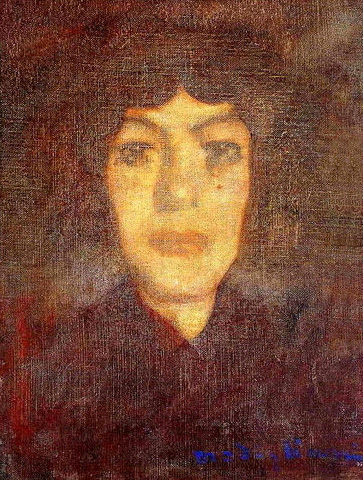
Identification
- Title
- English: Woman head / the beauty spot.
Also as Tête de femme (Sotheby's 2023);Tête de femme au grain de beauté (Noël Alexandre 1993, as cited by Sotheby's) - Date
- c. 1906-7 ?
- Medium
- Oil on Canvas
- Dimensions
- 32.5 x 24.5 cm (Ceroni - Patani - MR states 33 x 24)
Notes:
33 × 24 cm in Sotheby's 2023; also Ceroni, Patani and Restellini, according to the work's documentation. - Signature
- Signed "modigliani" lower right in blue
- Present location
- Private Collection, Paris?
Notes:
Dr Paul Alexandre, Paris (acquired from the artist), thence by descent; offered at Sotheby's Paris, 20 October 2023, lot 60.
Present owner not published
Catalogue numbers
| Compiler | Number |
|---|---|
| Arthur Pfannstiel | no. 1 |
| Joseph Lanthemann | no. 10 |
| Ambrogio Ceroni | no. 2 |
| Jeanne Modigliani | YES |
| Christian Parisot | no. 2 |
| Osvaldo Patani | no. 6 |
| Modigliani Project | ? |
| MR | YES |
| Modigliani Initiative/ AMDC | ? |
Legal note on MR: This investigation has not had access to MR’s catalogue raisonné; all research here is based on open sources, publications and exhibitions. By no means has that catalogue been copied at any point. Modigliani Project and Modigliani Research Project are marked YES when the work is published or otherwise recorded by those projects, even if no catalogue number is assigned; otherwise the field is marked ?.
Provenance
- Paul Alexandre Collection ?
- Sale Sotheby's Paris, 20 October 2023, lot 60.
- Private Collection.
The sequence follows the published museum, sale, and catalogue record in this investigation. Gaps and uncertain transfers are marked as such.
Selected bibliography
Book-length publications are marked with a footnote giving a full citation. Exhibition catalogues appear in both this list and the exhibition list when this investigation recorded them in both places.
- Pfannstiel, "catalogue présumé" Modigliani. L'Art et la Vie. Preface de Louis Latourrettes, Seheur, Paris, 19291
- Pfannstiel, Modigliani et son oeuvre, étude critique et catalogue raisonne, Bibliothèque des Arts, Paris, 19562
- Lanthemann, Catalogue Raisonne, G. Condal, Barcelona, 1970 - , no. 103
- Ceroni & Piccioni, Il dipinti di Modigliani, Milan. 1970 - no. 24
- Patani, Catalogo Generale, Leonardo ed. Milano 1991-94 - no. 65
- Alexandre 1993, p. 62
- Monti a cura de R. Chiappini, Catalogue Amedeo Modigliani, Lugano, Skira, 1999
- MR, L'Ange au visage grave, Musée du Luxembourg, Paris, 2002, p.102-103, no. 16
- Parisot, Modigliani la vita. Le opere, Carte Secrete Editore, 2006, illustrated, no. 27
- Soto Caba, Modigliani, the timeless face, Libsa, 20078
Exhibitions
- Lugano, Amedeo Modigliani, Museo d'Arte Moderna, 1999 - no. 1
- Paris, Modigliani: l'ange au visage grave, Musée du Luxembourg, 2002 - no. 1
- Milano, Modigliani: l'ange au visage grave, Palazzo Reale, 2003 - no. 1
- Tokyo and Osaka, Modigliani et le Primitivisme, 2008, no. 3
Notes
Not in D'Atri papers.
Where sources disagree, both readings are given. This is a working research page, not a catalogue raisonné.

Introduction
Second in Ambrogio Ceroni's 1970 catalogue of Modigliani's paintings, this small head of a woman belongs to the handful of pictures that survive from the artist's first months in Paris, where he settled at the beginning of 1906. It is almost exactly the size of La Duse (Ceroni no. 1) and of the Woman with a Blue Scarf (Ceroni no. 5), and a recent technical paper reproduces the three side by side as representative female portraits of 1906–07. Unlike La Duse, which passed through the Paris salerooms, this picture stayed with the family of its first owner, Dr Paul Alexandre, until Sotheby's offered it in Paris in October 2023. Its history is therefore short and unusually secure. The image is one of the most direct records of Modigliani's painting before the encounters with Cézanne, Brancusi and non-Western sculpture that transformed it after 1907.
This essay examines the composition, drawing, colour and handling of the painting, considers the beauty spot that gave it its secondary title, compares it with its closest companions, sets out its provenance and exhibitions, and reviews what technical research can and cannot say about it.
Composition and format
The canvas is an upright rectangle in a proportion of roughly four to three, close to a small commercial figure format. The head sits almost exactly on the vertical axis and fills the upper two thirds of the field. The top edge crops the crown of the hair. The lower edge cuts the shoulders, which are wrapped in a dark garment that rises into a pointed V under the chin. There are no hands, no setting and no accessories. The composition is strictly frontal and symmetrical: the eyes lie on one horizontal, the long straight nose marks the central vertical, and the mouth repeats the horizontal lower down. This is the format of the iconic head, and its strictness stands out all the more because the paint is handled so softly.
Two concentric frames enclose the face. The first is the hair, a dark, unevenly brushed mass that falls in loose waves on either side and comes down over the forehead in a short fringe. The second is the garment, whose collar converges below the chin. Between these dark zones the face appears as a pale, slightly elongated oval, the only area of light in the picture. The structure recalls the vignette of La Duse, but the face is larger in relation to the field and the surrounding darkness is less absolute. The viewer meets the sitter at close range and at eye level.
Line and drawing
Modigliani's later work is defined by contour, but here tone absorbs almost all of the drawing. No line encloses the oval of the face. It is formed where the light flesh meets the darker hair and ground, and along the jaw and the left cheek the edge is deliberately blurred. Drawing appears only in the features. The eyebrows are two short, slightly arched strokes. The eyes are dark, almond-shaped lids with small irises, the left set a little lower and more heavily shadowed than the right, which gives the gaze a faint asymmetry. A dark stroke runs down the side of the nose to a shadowed nostril. The mouth is a broad, full shape in dull red, its upper lip defined by a dark line.
These small asymmetries keep the frontal scheme from hardening into a mask. They give the face the quality of a particular person seen at a particular moment. In later years Modigliani would treat the two eyes differently on purpose, as a sign of inwardness. Here the variation is still naturalistic, the result of observation rather than of a system.
Colour
The palette is narrow and dark. The ground and hair are built from deep browns, purplish reds and warm blacks that shade into one another. A stronger brick-red appears at the lower left, and the ground as a whole has a violet-brown cast. The garment is a dark purple-black. Against these the flesh is a warm, slightly yellowed ivory, cooler in the shadows around the eyes and under the nose, pinker on the cheeks and lips. The only colour outside this tonal family is the blue of the signature at the lower right, a fairly saturated hue. No pigment has been identified; the description is purely visual.
The picture works through contrasts of value rather than of hue. In this it matches Ludwig Meidner's later memory of Modigliani's earliest Paris work. As quoted by Christie's in 2010, Meidner described pictures "reminiscent of Toulouse-Lautrec or, in their greyish green tonality, of Whistler's work", quite unlike the paintings of the Fauves at the Indépendants, and "moderate and cultured in colour as well as in design" (Burlington Magazine, 1943). This picture is warmer than the "greyish green" Meidner describes, but it shows the same restraint.
Facture and surface
The paint is thin. Across much of the background and garment the weave of the canvas shows through, giving a granular, almost textile surface that is visible even in reproduction. The ground and hair seem to have been scrubbed on in fairly dry strokes dragged across the grain, so that the paint catches on the raised threads. The face is more fully painted, but even there the paint is not built up into impasto; the modelling comes from thin, overlapping layers of warm and cool tones. Because the same textured surface runs from the background through the hair into the shadows of the face, the figure is tied into the ground and seems to emerge from a dark, vibrating atmosphere.
Meidner also recalled that Modigliani covered his early pictures with "as many as ten layers" of coloured varnish to give them a "pellucid, iridescent tone ... reminiscent of old masters". A photograph cannot show whether this painting carries such a varnish, and, so far as I could establish, no one has examined it. The recollection is reported here only as context.
Figure and space
There is no space in the perspectival sense. The ground is a field of brushed darkness, slightly lighter at the upper right and lower left, not a wall or a room. The head presses close to the picture plane, and the cropping at top and bottom makes it feel nearer still. Volume is suggested only by the light on the face. Because the neck is hidden, the head seems to float above the dark V of the collar. This shallow space, filled by the figure, is a constant from Modigliani's first paintings to his last. What changes is the means: here tonal envelopment holds the figure in place; later, contour and flat planes of colour do the same work.
Iconography: the beauty spot
The picture takes its secondary title from a small dark mark on the sitter's left cheek, just below and outside the eye. Noël Alexandre's 1993 publication of his grandfather's collection called it Tête de femme au grain de beauté, according to Sotheby's. A grain de beauté can be a natural mole. In the cosmetic culture of the Belle Époque, however, it could also be applied: a patch or painted spot associated with the theatre, the café-concert and the demi-monde. The Jewish Museum's Modigliani Unmasked (2017–18) drew attention to this theme. Its labels note Modigliani's "interest in the masklike properties of cosmetics" in a 1908 drawing titled Portrait of a Woman with a Beauty Spot and in his portraits of his lover Maud Abrantès. That drawing is a different work from this painting (black crayon and watercolour on paper), but the shared motif suggests a continuing preoccupation.
In the painting the spot is understated. Nothing else in the image (no rouge, jewellery or costume) marks the sitter as a performer, and the model's identity is not recorded. Read cautiously, the spot is a single individualising detail that stands out because the rest of the face is generalised. It anticipates Modigliani's later use of a few emphatic marks, such as an earring, a necklace or a hairline, to give a stylised head a specific identity.
Comparisons
The closest comparisons are the other paintings at the start of Ceroni's catalogue. With La Duse (no. 1) the picture shares its size, its frontal head enclosed in dark masses, its tonal palette and its lowercase signature. It is more open, however: the face is larger and more clearly lit, the features more firmly drawn, the surrounding darkness warmer. The Woman with a Blue Scarf (no. 5) shares the size and the dark hair framing a pale frontal face, but adds a cool accent of pale blue at the throat and stronger red lips. The Woman Bust signed and dated "Paris 07" (no. 4) turns the head over the shoulder against a striped ground, a more complex and more Whistlerian design.
Greta García, David Juanes and Rafael Romero, in their 2023 study of the two-sided The Cellist / Portrait of Brancusi, reproduced Ceroni nos. 1, 5 and 2 together (Fig. 7) as "three portraits of women from the same period recognized in Ceroni's Catalogue Raisonné". Imaging had revealed beneath Portrait of Brancusi a portrait of a long-haired woman that they assign to 1906–07, and these three pictures served as the comparison. Current technical scholarship thus treats the present work as typical of the earliest phase. That phase, as the LaM's 2016 exhibition literature also stresses, is marked by Toulouse-Lautrec rather than by Fauvism or Cubism.
Provenance and exhibitions
According to Sotheby's, Dr Paul Alexandre acquired the painting directly from the artist, and it passed by descent to the consignor of 2023. Alexandre met Modigliani in the winter of 1907 at the artists' colony he ran at 7 rue du Delta and became his first steady patron. If the painting dates from 1906 or early 1907, Alexandre probably acquired it some time after it was painted, but no document records when. The Secret Modigliani page on the work gives the Alexandre provenance with a question mark, while Sotheby's states it without qualification. The page also notes that the work is not in the D'Atri papers.
The picture was exhibited at Lugano in 1999, as no. 1 of Modigliani: l'ange au visage grave at the Musée du Luxembourg in 2002–03, at the Palazzo Reale in Milan in 2003 and, according to Sotheby's, in Tokyo and Osaka in 2008.
Sotheby's offered it as lot 60 on 20 October 2023 (estimate €200,000–300,000). The lot page shows "Auction Closed" but no result, so I cannot confirm whether it sold.
Technical analysis
So far as I could establish, no technical study of this painting (X-radiography, infrared reflectography, X-ray fluorescence or pigment analysis) has been published. Its findings do not appear in the 2018 Burlington introduction to the Modigliani Technical Research Study, in the two Tate Papers no. 35 articles consulted, or in the LaM's Les secrets de Modigliani, which covered works in French public collections. What follows is comparative.
Comparative evidence. The Burlington introduction reports that most grounds in the paintings studied contain lead white, sometimes with an extra zinc white priming. It also finds that Modigliani often painted around his drawn lines, leaving a "dark halo" in X-radiographs. The Tate Papers study of works with paintings beneath the visible surface notes that in his early years he painted on supports "from cardboard to canvas" and was reusing canvases by 1908. Its analysis of Jean-Baptiste Alexandre with a Crucifix (1909, Rouen), the closest securely analysed work from the Alexandre circle, found:
- a thick lead white ground;
- flesh based mainly on vermilion, with lead white for the shape of the face and zinc white for the features;
- a dark jacket built from bone black, Prussian blue, cobalt blue, chrome green, red lake and vermilion.
Questions for future study. The legible canvas weave suggests a thin ground or very thin paint, but the colour of the ground cannot be seen. The dark, layered background could hide an earlier composition; García and colleagues have shown that Modigliani did paint over heads of exactly this type. The blue signature would also repay elemental analysis, to establish whether its pigment occurs elsewhere in the picture.
Conclusion
Tête de femme is a quiet picture but an unusually useful one. Its provenance is direct, its date falls firmly in the first Paris phase, and its tonal, enveloping style, close to Whistler and Lautrec, shows how far Modigliani still was in 1906–07 from the linear, sculptural art for which he is known. Even so, it contains signs of what was to come: the frontal, symmetrical head, the removal of setting, and a single emphatic detail, the beauty spot, that gives an individual face to a generalised type. A technical examination would make it more useful still.
Sale records
- Sotheby's, Paris, Art Impressionniste et Moderne Evening Auction, 20 October 2023, lot 60, "Amedeo Modigliani, Tête de femme" (Property from the Dr Paul Alexandre Collection), https://www.sothebys.com/buy/d8fe0f5e-eee4-4517-9c9d-1593e96abbb6/lots/2d0e6485-6ed1-4c3d-bc6c-60ada2460321 (accessed 25 October 2026).
- Christie's, London, 24 June 2010, sale 7859, lot 336, "Amedeo Modigliani, Portrait de femme" (Ceroni no. 4; cited here for its lot essay quoting Ludwig Meidner), https://www.christies.com/en/lot/lot-5334022 (accessed 25 October 2026).
Museum and exhibition documents
- The Jewish Museum, New York, Modigliani Unmasked, 15 September 2017–4 February 2018, exhibition checklist, https://thejewishmuseum.org/wp-content/uploads/2025/07/Modigliani_Unmasked_checklist.pdf
- The Jewish Museum, New York, Modigliani Unmasked, wall texts and object labels, https://thejewishmuseum.org/wp-content/uploads/2025/07/Modigliani_Unmasked_wall_texts_and_object_labels.pdf
- LaM, Villeneuve-d'Ascq, Amedeo Modigliani: l'œil intérieur, dossier pédagogique (2016), https://www.musee-lam.fr/sites/default/files/2019-01/Dossier-pedago-Modigliani-l-oeil-interieur.pdf
- LaM, Villeneuve-d'Ascq, Les Secrets de Modigliani, 19 February 2021–20 February 2022, dossier pédagogique (Stéphanie Jolivet and Anne Gaëlle Le Flohic), https://www.musee-lam.fr/sites/default/files/2021-06/LaM_dossier-pedagogique_Secrets-de-Modigliani.pdf
Library catalogue records (Bibliothèque nationale de France)
- Ambrogio Ceroni, Amedeo Modigliani, peintre, Milan, Edizioni del Milione, 1958. https://catalogue.bnf.fr/ark:/12148/cb31986813q
- Françoise Cachin and Ambrogio Ceroni, Tout l'œuvre peint de Modigliani, Paris, Flammarion, 1972. https://catalogue.bnf.fr/ark:/12148/cb35281604b
- Arthur Pfannstiel, Modigliani, Paris, M. Seheur, 1929. https://catalogue.bnf.fr/ark:/12148/cb325249053
- Arthur Pfannstiel, Modigliani et son œuvre, Paris, La Bibliothèque des Arts, 1956. https://catalogue.bnf.fr/ark:/12148/cb32524906f
- Noël Alexandre, Modigliani inconnu, Paris, Albin Michel, 1993. https://catalogue.bnf.fr/ark:/12148/cb35593312b
- Rudy Chiappini (ed.), Amedeo Modigliani, Lugano, Museo d'Arte Moderna / Milan, Skira, 1999. https://catalogue.bnf.fr/ark:/12148/cb37555814b
- Marc Restellini (ed.), Modigliani: l'ange au visage grave, Paris, Musée du Luxembourg / Milan, Skira, 2002. https://catalogue.bnf.fr/ark:/12148/cb38996050w
Technical and scholarly literature
- Annette King, Nancy Ireson, Simonetta Fraquelli and Joyce H. Townsend, "The Modigliani Technical Research Study: An introduction to Modigliani's materials and techniques", The Burlington Magazine, vol. 160, no. 1380 (March 2018), pp. 182–88. https://www.burlington.org.uk/archive/article/the-modigliani-technical-research-study-an-introduction-to-modiglianis-materials-and-techniques
- Anaïs Genty-Vincent et al., "Works by Modigliani that have Paintings beneath the Visible Surface", Tate Papers, no. 35, https://www.tate.org.uk/research/tate-papers/35/works-by-modigliani-that-have-paintings-beneath-the-visible-surface
- Greta García, David Juanes and Rafael Romero, "Image Study and Material Characterization of the Two-Sided Painting The Cellist and Portrait of Brancusi by Amedeo Modigliani", International Journal of Conservation Science, vol. 14, no. 3 (2023), pp. 1233–48, DOI: 10.36868/IJCS.2023.03.30, https://ijcs.ro/public/IJCS-23-81_Garcia.pdf
- Modigliani Initiative, "Literature: Ceroni 1958", https://catalogue.modigliani-initiative.org/literature/entry.php?id=618
Footnotes
- Arthur Pfannstiel, Modigliani. L’Art et la Vie, preface by Louis Latourette, Paris, Seheur, 1929 (presumed catalogue).
- Arthur Pfannstiel, Modigliani et son œuvre, étude critique et catalogue raisonné, Paris, Bibliothèque des Arts, 1956.
- Joseph Lanthemann, Modigliani, catalogue raisonné: sa vie, son œuvre, son art, Barcelona, G. Condal, 1970.
- Ambrogio Ceroni and Leone Piccioni, I dipinti di Modigliani, Milan, Rizzoli, 1970.
- Osvaldo Patani, Amedeo Modigliani: catalogo generale, Milan, Leonardo, 1991–94.
- MR (cited here as MR), Modigliani: l’ange au visage grave, Paris, Musée du Luxembourg, 2002. Cited from the published exhibition catalogue only.
- Christian Parisot, Modigliani: la vita, le opere, Rome, Carte Segrete, 2006.
- Victoria Soto Caba, Modigliani: The Timeless Face, Madrid, Libsa, 2007.