La Duse
Oil on cardboard? — 1906-7 ?
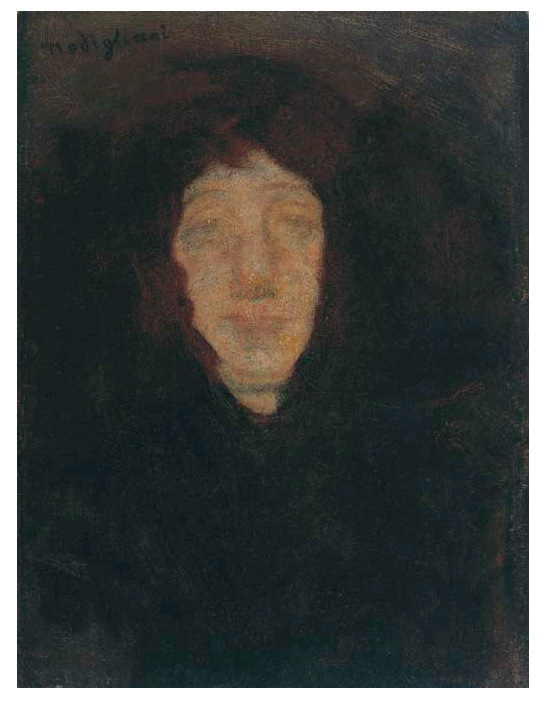
Identification
- Title
- English: Bust of woman - Eleanora Duse.
French: La Duse.
Also recorded as Buste de femme, Bust of a Woman and Portrait de la Duse - Date
- c. 1906-7 ?
- Medium
- Oil on cardboard.
Notes:
Oil on canvas laid down on board (Christie's 2004: "oil on canvas laid down on board"; 1945 Drouot sale: "toile marouflée"; Pfannstiel: oil on cardboard; Ceroni and Patani: oil on canvas) - Dimensions
- 32.7 x 24.8 cm
Notes:
32.7 × 24.8 cm (Christie's 2004).
Variant measurements recorded in the literature: Ceroni 33 × 27 cm; Patani 32.5 × 24.5 cm; 1921 sale 40 × 30 cm; 1945 sale 33 × 25 cm - Signature
- Signed upper left (Pfannstiel say the back with ink the text "Amedeo Modigliani, Paris, Etude and ink sketch of hands?)
- Present location
- Private Collection ?
Notes:
Private collection (sold Christie's London, 23 June 2004, sale 6921, lot 259)
Catalogue numbers
| Compiler | Number |
|---|---|
| Arthur Pfannstiel | no. 1 |
| Joseph Lanthemann | no. 9 |
| Ambrogio Ceroni | no. 1 |
| Jeanne Modigliani | YES |
| Christian Parisot | YES |
| Osvaldo Patani | no. 5 |
| Modigliani Project | ? |
| MR | YES |
| Modigliani Initiative/ AMDC | ? |
Legal note on MR: This investigation has not had access to MR’s catalogue raisonné; all research here is based on open sources, publications and exhibitions. By no means has that catalogue been copied at any point. Modigliani Project and Modigliani Research Project are marked YES when the work is published or otherwise recorded by those projects, even if no catalogue number is assigned; otherwise the field is marked ?.
Provenance
- Paul Alexandre, Paris
- Sale Hotel Drouot - Tableaux Modernes, 18 7 February / 1921 - Lot 63 as Portrait de la Duse. Toile - 40 x 30
- Jonas Netter, Paris?
- Sale Hotel Drouot - Tableaux Modernes, 15 / June / 1945 - Lot 110 as La Duse. Toile marouflée.- 33 x 25 Sold price: 180.000 FF
- Galerie Beres, Paris
- Swiss collection, Ca. 1980
- Galerie Pierre-Yves Gabus, Beveix
- Sale Christie´s London, 23 / June / 2004, Sale no. 6921- Lot 259 Est. 91.250 - 127.750 USD - sold 130.853 USD
- Private collection
The sequence follows the published museum, sale, and catalogue record in this investigation. Gaps and uncertain transfers are marked as such.
Selected bibliography
Book-length publications are marked with a footnote giving a full citation. Exhibition catalogues appear in both this list and the exhibition list when this investigation recorded them in both places.
- Pfannstiel, "catalogue présumé" Modigliani. L'Art et la Vie. Preface de Louis Latourrettes, Seheur, Paris, 1929, p. 11
- Pfannstiel, Modigliani et son oeuvre, étude critique et catalogue raisonne, Bibliothèque des Arts, Paris, 1956 - no. 12
- Ceroni, Amedeo Modigliani: Peintre; Suivi des Souvenirs de Lunia Czechowska, Edizioni del Milione, 1958 - no. 13
- Lanthemann, Modigliani, catalogue raisonné: sa vie, son oeuvre, son art, G. Condal, Barcelona, 1970 - no. 94
- Ceroni & Piccioni, Il dipinti di Modigliani, Rizzoli, Milano, 1970 - no. 1 (as oil on canvas wrong size)5
- Martigny, F. P. Gianadda, Modigliani, 1990, no. 4- Ill. p. 78 - 207
- Parisot, Modigliani la vita. Le opere, Carte Secrete Editore, 2006, illustrated.6
- Soto Caba, Modigliani, the timeless face, Libsa, 20077
Exhibitions
- Martigny, Modigliani, Fondation Pierre Gianadda, 1990 - no. 4
Notes
Pfannstiel mentions that in the back there is a sketch of the hands of the artist made with ink (unseen by the compiler)
Where sources disagree, both readings are given. This is a working research page, not a catalogue raisonné.
Introduction
The small, dark La Duse stands at the head of Ambrogio Ceroni's catalogue of Modigliani's paintings. Christie's listed it as no. 1 of Ceroni and Piccioni's I dipinti di Modigliani (Milan, 1970) when it sold the picture in London in 2004, and the work's published documentation gives the same number. Ceroni's catalogues of 1958 and 1970 became the standard reference for the authenticity of Modigliani's paintings, and the Tate-led Modigliani Technical Research Study (2017–18) adopted his 1970 sequence as its chronological frame. To be Ceroni no. 1 is to be offered as the beginning of the authenticated painted work.
The object itself is modest: oil on canvas laid down on board, about 33 by 25 centimetres. A woman's face, seen frontally, comes out of a near-black mass of hair, veil or shawl. Hardly any colour separates the figure from the ground. This essay looks closely at that image, places it within the small group of heads Modigliani painted in his first Paris years, sets out what the documents say about its history, and reviews what technical research on his early paintings can and cannot tell us about it.
Composition and format
The upright format matches a small commercial support. The face sits slightly left of the vertical axis, and its upper edge falls about a quarter of the way down, so the head fills the upper middle of the field. Below it, the dark mantle spreads to the lower edge in a rough triangle. That shape gives the image a pyramidal stability, but it reads as a soft-edged pool of darkness rather than a drawn contour. There is no shoulder line, neckline or costume detail. The body is suggested only by the darkness growing heavier toward the bottom.
The face is framed twice. A band of warm red-brown, which may be hair or the lining of a hood, runs down both cheeks and closes under the chin in a narrow V. A larger zone of cool, nearly black paint encloses that band and dissolves at its edges into a dull umber background, slightly lighter at the top, with no wall or defined space. The effect is concentric: the eye passes from the dark periphery through the brown frame to the pale oval and finally to the features. It is a vignette, far from the planar, colour-blocked grounds of the portraits of 1915–19.
Line and drawing
Modigliani is usually seen as a painter governed by line. The Burlington introduction to the Technical Research Study describes how, in later works, he painted around his initial drawing, leaving a reserve of ground that shows up as a dark halo in X-radiographs. In La Duse almost none of that graphic structure is visible. The features are made with tone. The brows are low, soft shadows, and the eyes are heavy-lidded hollows marked by grey and blue-grey half-tones. The nose is a vertical ridge warmed with orange at the tip, and the mouth is a short, compressed horizontal. The contour between face and hair is blurred along most of its length, and only the chin is closed by a firmer stroke.
The one assertive line is the signature, "modigliani", written in lowercase cursive at the upper left, where Christie's also records it. Its fluent, slightly rising script contrasts with the soft modelling below. Pfannstiel noted an ink inscription and an ink sketch of hands on the reverse. This could not be verified, because the reverse is now covered by the board.
Colour, light and facture
The palette is very restricted. As far as a reproduction allows one to judge, it consists of blacks and very dark blue-greens in the mantle; warm umber and red-brown in the hood and upper background; and flesh built from pale pinkish-cream and ochre, warmed with orange-red at the nose, lips and cheeks and cooled with grey-violet in the eye sockets. There is no saturated colour. The face is lit from the front without a cast shadow, so the light seems to come from within the oval, and the figure reads more as an apparition than as a model in a studio. Visually, the closest analogies are the late-Symbolist tonal portraits current in Paris around 1900: Eugène Carrière's misty maternities, Whistler's dark "arrangements" and the melancholic heads of Picasso's Blue Period. These are offered here as interpretation. None of the sources consulted documents a specific model.
The paint is thin over most of the surface. The mantle is brushed in broad, loose, sometimes dry strokes through which a canvas texture shows. The face is more built up, but it is scumbled rather than impasted: pale flesh is dragged over darker underlayers, which gives a grainy, powdery complexion, and small accents are set into it wet-in-wet. The work has the quality of an étude, which fits the inscription Pfannstiel reported.
The literature on the painting gives conflicting media: cardboard (Pfannstiel), canvas (Ceroni, Patani) and "toile marouflée" (1945 sale). Christie's description, "oil on canvas laid down on board", reconciles them. The painting was made on canvas and later laid onto a rigid support, which explains why it could have been taken for cardboard. The 40 × 30 cm recorded in the 1921 sale, against 32.7 × 24.8 cm since 1945, may reflect frame measurements or trimming at the time of lining. Only physical examination could settle the question.
Figure, expression and title
The expression is indrawn and grave. The eyes seem almost closed, the mouth is set, and the head is held exactly frontal. The face neither meets nor avoids the viewer's gaze. It is present in the manner of a mask or an icon. This refusal to describe a gaze anticipates, in a different language, the blank almond eyes of the mature portraits. The picture also has almost no depth. The face is softly but genuinely modelled, while everything around it flattens into darkness. That tension between relief and surface runs through all of Modigliani's later painting.
The title links the image to Eleonora Duse (1858–1924), the most celebrated Italian actress of her generation. The painting was sold as "Portrait de la Duse" in 1921 and 1945, and Christie's sold it as La Duse. No source consulted shows that Duse sat for Modigliani, and no document dated to the work's making records the title. The neutral Buste de femme, used by the Amis de Modigliani website and by García et al. (2023), is the safer description. "La Duse" is best treated as a traditional identification, probably prompted by the face's resemblance to the actress's tragic stage persona, and not as a documented portrait.
Comparison with related works
The Amis de Modigliani site notes that Ceroni records only five oils (C.001–C.005) for 1906–07. García, Juanes and Romero (2023) reproduce three of them together as portraits "from the same period recognized in Ceroni's catalogue raisonné": the present Bust of a Woman (Ceroni no. 1), Woman with Blue Shawl (1907, 33 × 24 cm, no. 5) and Woman's Head (1906–07, 33 × 24 cm, no. 2). All three share a format of about 33 × 24 cm, which suggests a standard commercial size, a bust-length female head framed by heavy dark hair or a shawl, a tonal ground and soft handling. Woman's Head (Tête de femme), offered at Sotheby's Paris in 2023 with a direct provenance from Dr Paul Alexandre, Modigliani's first patron, is signed lower right and is published by Noël Alexandre (1993) as Tête de femme au grain de beauté. Beside it, La Duse is darker, more frontal and more closed.
The group has taken on new importance in technical research. García et al. found, beneath the double-sided The Cellist / Portrait of Brancusi (1909), a hidden female portrait with long hair, which they date to 1906–07 precisely by analogy with Ceroni nos. 1, 2 and 5. Images of the La Duse type thus now serve as stylistic benchmarks for the artist's first year in Paris.
Provenance and exhibition history
The provenance documented for the work runs: Paul Alexandre, Paris; Hôtel Drouot, February 1921, lot 63 ("Portrait de la Duse", canvas, 40 × 30 cm); Jonas Netter, Paris (query-marked); Hôtel Drouot, 15 June 1945, lot 110 ("toile marouflée", 33 × 25 cm, 180,000 francs); Galerie Berès, Paris; Swiss collection, about 1980; Galerie Pierre-Yves Gabus, Bevaix; Christie's London, 23 June 2004, lot 259; private collection. Christie's own provenance is shorter: Jonas Netter; Galerie Berès; acquired by the father of the consignor about 1980. The lot was offered as "Property from a Private Swiss Collection", estimated at £50,000–70,000, and sold for £71,700. The Alexandre link is therefore unconfirmed, while the Netter link, given with a query in the work's documentation, is stated without qualification by Christie's. The only recorded exhibition is the 1990 Fondation Pierre Gianadda retrospective in Martigny (no. 4, ill. pp. 78, 207). The Amis de Modigliani website's suggestion that the picture was shown at Laura Wylda's gallery is explicitly "sans certitude" (without certainty).
Note on numbering. Christie's gives Ceroni–Piccioni 1970, no. 1 (ill. p. 87). The work's documentation adds Pfannstiel 1956, no. 1 and Ceroni 1958, no. 1. However, Sotheby's 2023 cites Pfannstiel 1929 and 1956, no. 1 and Ceroni 1958, no. 1 for the Alexandre Tête de femme. Either the 1958 and 1970 sequences differ or one secondary source is wrong. The volumes themselves should be checked before citing "Ceroni 1958, no. 1".
Technical analysis
Specific findings. No published technical study of La Duse was found: no pigment analysis, X-radiography, infrared reflectography or UV examination. The work is not among the paintings examined in the Tate-led study (The Burlington Magazine, 2018; Tate Papers no. 35). Nor is it in the published material on Les secrets de Modigliani (LaM, 2021–22) or Modigliani Up Close (Barnes Foundation, 2022–23), or in the 1981 Laboratoire de recherche des musées de France campaign cited by García et al. García et al. reproduce it only as a stylistic comparison and did not analyse it. The physical observations in this essay are therefore inferences from reproductions.
Comparative findings (other works). King et al. (2018) found lead white in most of the grounds examined, sometimes with an extra zinc-white priming, on commercially primed oil grounds. The Tate Papers authors note that early on Modigliani painted on "various kinds of support, from cardboard to canvas", and that he reused supports from 1908 (Hecht Museum, C7a/b; C8; C10). For 1909, EDXRF on The Cellist and Portrait of Brancusi identified cobalt blue, lead and zinc whites, emerald green, chromium greens, iron earths, vermilion, a probable red lake and an unresolved bone or organic black. MA-XRF on Jean-Baptiste Alexandre with a Crucifix (Rouen) showed vermilion flesh tones, lead and zinc whites deployed for different handling qualities, and apparently black passages built from mixtures.
These results define what an examination of La Duse could test. X-radiography could show whether the canvas carries an earlier image and could map lead white in the face. Infrared imaging could look for underdrawing. XRF could show whether the dark mantle is a mixed "black" or a simple carbon black. Study of the lining could clarify the dimensional discrepancies.
Conclusion
La Duse is a small, nearly monochrome head in which a pale, grave face emerges from enveloping darkness. Its language is late Symbolist, yet its frontality, withheld gaze and concentration on a single head already point toward the portrait type Modigliani would make his own. Its documentary standing rests on Ceroni's 1970 no. 1, a provenance traceable to Jonas Netter and Galerie Berès, and one exhibition. That standing is sound but thin. The 1958 numbering conflict, the unconfirmed Alexandre provenance and the absence of any technical examination make it a work whose position at the head of the authenticated corpus calls for direct scientific study. The research of the last decade now provides the comparative data such a study would need.
Sale and catalogue records
- Christie's, London, Impressionist and Modern Art, 23 June 2004, sale 6921, lot 259, "Amedeo Modigliani (1884–1920), La Duse", https://www.christies.com/en/lot/lot-4311335 (accessed 25 October 2026).
- Sotheby's, Paris, Art Impressionniste et Moderne Evening Auction, 20 October 2023, lot 60, "Amedeo Modigliani, Tête de femme" (Property from the Dr Paul Alexandre Collection), https://www.sothebys.com/buy/d8fe0f5e-eee4-4517-9c9d-1593e96abbb6/lots/2d0e6485-6ed1-4c3d-bc6c-60ada2460321 (accessed 25 October 2026).
- Les Amis de Modigliani, "Les premiers temps à Montmartre", http://www.amis-de-modigliani.net/vie/les-premiers-temps-a-montmartre/ (accessed 25 October 2026).
- Modigliani Initiative, "Literature: Ceroni 1958", Amedeo Modigliani Digital Catalogue, https://catalogue.modigliani-initiative.org/literature/entry.php?id=618 (accessed 25 October 2026).
Library catalogue records (Bibliothèque nationale de France, catalogue général)
- Ambrogio Ceroni, Amedeo Modigliani, peintre. Suivi des Souvenirs de Lunia Czechowska, Milan, Edizioni del Milione, 1958. BnF: https://catalogue.bnf.fr/ark:/12148/cb31986813q
- Françoise Cachin and Ambrogio Ceroni, Tout l'œuvre peint de Modigliani, Paris, Flammarion, 1972 (French edition of Ceroni's 1970 Rizzoli catalogue). BnF: https://catalogue.bnf.fr/ark:/12148/cb35281604b
- Arthur Pfannstiel, Modigliani, preface by Louis Latourrettes, Paris, M. Seheur, 1929. BnF: https://catalogue.bnf.fr/ark:/12148/cb325249053
- Arthur Pfannstiel, Modigliani et son œuvre: étude critique et catalogue raisonné, Paris, La Bibliothèque des Arts, 1956. BnF: https://catalogue.bnf.fr/ark:/12148/cb32524906f
- Noël Alexandre, Modigliani inconnu: témoignages, documents et dessins inédits de l'ancienne collection de Paul Alexandre, Paris, Albin Michel, 1993. BnF: https://catalogue.bnf.fr/ark:/12148/cb35593312b
- Modigliani [exhibition catalogue], Martigny, Fondation Pierre Gianadda, 19 June–28 October 1990. BnF: https://catalogue.bnf.fr/ark:/12148/cb35545263d
- Les secrets de Modigliani: techniques et pratiques artistiques d'Amedeo Modigliani [exhibition catalogue], Villeneuve-d'Ascq, LaM, 2021–22 (published 2022). BnF: https://catalogue.bnf.fr/ark:/12148/cb47099736d
- Barbara Buckley, Simonetta Fraquelli, Nancy Ireson and Annette King (eds), Modigliani Up Close, Philadelphia, Barnes Foundation, 2022. BnF: https://catalogue.bnf.fr/ark:/12148/cb47142942b
Technical and scholarly literature
- Annette King, Nancy Ireson, Simonetta Fraquelli and Joyce H. Townsend, "The Modigliani Technical Research Study: An introduction to Modigliani's materials and techniques", The Burlington Magazine, vol. 160, no. 1380 (March 2018), pp. 182–88. https://www.burlington.org.uk/archive/article/the-modigliani-technical-research-study-an-introduction-to-modiglianis-materials-and-techniques ; JSTOR: https://www.jstor.org/stable/44870483
- Anna Ceroni and Simonetta Fraquelli, "The catalogues raisonnés of Amedeo Modigliani", The Burlington Magazine, vol. 160, no. 1380 (March 2018), pp. 189–95 (cited via the Modigliani Initiative and the Burlington introduction; full text not consulted).
- Anaïs Genty-Vincent, Simonetta Fraquelli, Annette King, Allison Langley, Jennifer Mass, Kim Muir, Mina Porell, Marie-Amélie Senot and Anya Shutova, "Works by Modigliani that have Paintings beneath the Visible Surface", Tate Papers, no. 35, https://www.tate.org.uk/research/tate-papers/35/works-by-modigliani-that-have-paintings-beneath-the-visible-surface (accessed 25 October 2026).
- "Modigliani's Painted Nudes: A Technical Study", Tate Papers, no. 35, https://www.tate.org.uk/research/tate-papers/35/modiglianis-painted-nudes-technical-study (accessed 25 October 2026).
- Greta García, David Juanes and Rafael Romero, "Image Study and Material Characterization of the Two-Sided Painting The Cellist and Portrait of Brancusi by Amedeo Modigliani", International Journal of Conservation Science, vol. 14, no. 3 (2023), pp. 1233–48, DOI: 10.36868/IJCS.2023.03.30, https://ijcs.ro/public/IJCS-23-81_Garcia.pdf
- Barnes Foundation, press release, "The Barnes Foundation Presents Modigliani Up Close", 22 August 2022, https://www.barnesfoundation.org/press/press-releases/modigliani-up-close
Footnotes
- Arthur Pfannstiel, Modigliani. L’Art et la Vie, preface by Louis Latourette, Paris, Seheur, 1929 (presumed catalogue).
- Arthur Pfannstiel, Modigliani et son œuvre, étude critique et catalogue raisonné, Paris, Bibliothèque des Arts, 1956.
- Ambrogio Ceroni, Amedeo Modigliani: Peintre; suivi des souvenirs de Lunia Czechowska, Milan, Edizioni del Milione, 1958.
- Joseph Lanthemann, Modigliani, catalogue raisonné: sa vie, son œuvre, son art, Barcelona, G. Condal, 1970.
- Ambrogio Ceroni and Leone Piccioni, I dipinti di Modigliani, Milan, Rizzoli, 1970.
- Christian Parisot, Modigliani: la vita, le opere, Rome, Carte Segrete, 2006.
- Victoria Soto Caba, Modigliani: The Timeless Face, Madrid, Libsa, 2007.