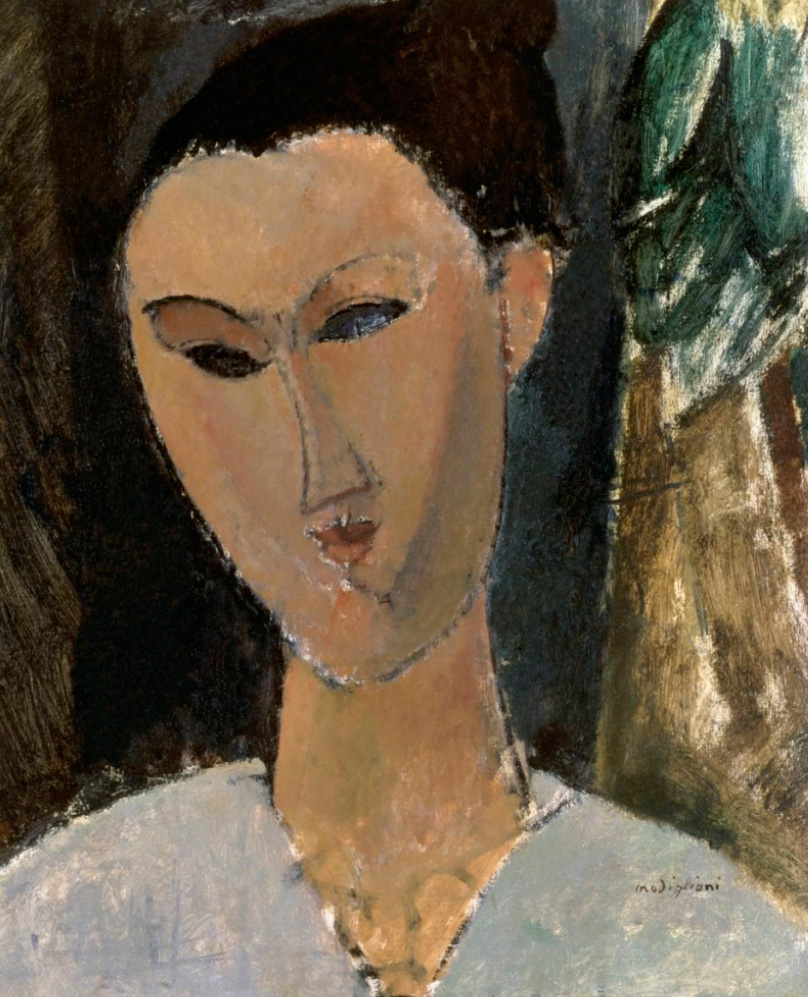
Woman Bust - Woman head with curtains
Oil on canvas — 1915?
Identification
- Title
- English: Woman Bust - Woman head with curtains.
Notes:Testa di donna, con tendaggio (Ceroni); Woman bust (list of Ceroni numbers) - Date
- 1915?
- Medium
- Oil on canvas ?
- Dimensions
- 45.5 x 32.5 cm ?
Notes: 45.5 × 32.5 cm (list of Ceroni numbers); 542 x 42 (Parisot). - Signature
- "modigliani" low right?
- Present location
- Unknown Location
Notes: Ceroni (Private Coll. London?)
Catalogue numbers
| Compiler | Number |
|---|---|
| Arthur Pfannstiel | NO (no. 91?) |
| Joseph Lanthemann | no. 87 |
| Ambrogio Ceroni | no. 51 |
| Jeanne Modigliani | ? |
| Christian Parisot | ? |
| Osvaldo Patani | NO |
| Modigliani Project | ? |
| MR | ? |
| Modigliani Initiative/ AMDC | ? |
Legal note on MR: This investigation has not had access to MR’s catalogue raisonné; all research here is based on open sources, publications and exhibitions. By no means has that catalogue been copied at any point. Modigliani Project and Modigliani Initiative are marked YES when the work is published or otherwise recorded by those projects, even if no catalogue number is assigned; otherwise the field is marked ?.
Provenance
- (Ceroni or Lanthemann no provenance)
- ( if no. 91 in Pfannstiel, dated in 1916 it will have a provenance in Guillaume coll.?)
- Sale Sotheby's 28 June / 1994 - Lot 30
- Private Collection?
The sequence follows the published museum, sale, and catalogue record in this investigation. Gaps and uncertain transfers are marked as such.
Selected bibliography
Book-length publications are marked with a footnote giving a full citation. Exhibition catalogues appear in both this list and the exhibition list when this investigation recorded them in both places.
- Lanthemann, Modigliani, catalogue raisonné: sa vie, son œuvre, son art, Barcelona, 1970, no. 871
- Ceroni & Piccioni, I dipinti di Modigliani, Milan. 1970, no. 512
Exhibitions
Not recorded in this investigation.
Notes
This painting has not been seen since the auction and there is no accesible record at Sotheby's.
(this investigation received the image from an undisclosed source)
Where sources disagree, both readings are given. This is a working research page, not a catalogue raisonné.
Introduction
Ceroni no. 51 is one of the least documented paintings in the 1915 section of his catalogue. Ceroni's caption reads only "Testa di donna, con tendaggio" (Head of a woman, with a curtain). It gives no owner, no location and no note, whereas the neighbouring captions for nos. 52–55 all name a city. The Secret Modigliani page on the work adds little. It lists no exhibitions, one sale, at Sotheby's on 28 June 1994, lot 30, and the statement that "this investigation received the image from an undisclosed source".
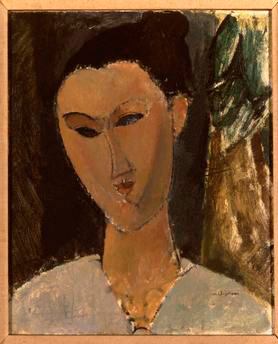
What survives, therefore, is essentially an image: a colour reproduction of good quality and a small photograph of the picture in a frame, both published on the Secret Modigliani page on the work. This essay reads that image closely. It describes how the head is constructed, how the curtain on the right organises the space, and how the colour relates to other works of 1915. It then sets out the inconsistencies in the documentation, of which the most important concerns the dimensions.
Composition and format
The picture is an upright bust portrait. The woman's head is placed in the upper centre, slightly to the left of the vertical axis, and, with the hair, it fills about two-thirds of the picture's height. Her long neck descends to a pale blouse with a V-shaped opening, which occupies the whole lower edge. To the left the background is dark, a brown-black that is lighter at the far edge. To the right a curtain, painted in greens and ochres, hangs from the top edge and falls behind the woman's shoulder to the bottom of the picture. The curtain is the motif that gives the picture its title in Ceroni.
The composition is built on a simple division into a dark left and a lighter right. The head stands on the border between them: its left side is silhouetted against the dark ground, its right side against the shadow at the edge of the curtain. This is a device Modigliani used repeatedly in 1915, when he often placed a sitter in front of a vertical boundary, such as a door frame, a wall edge or a hanging cloth, so that the head would be framed asymmetrically.
The proportions of the two reproductions are of some importance for the documentation. The large reproduction has a width-to-height ratio of 0.81. The framed photograph shows an image area of about the same proportion. A support of 45.5 × 32.5 cm, the size given on the Secret Modigliani page on the work, would have a ratio of 0.71. A support of 54 × 42 cm would have a ratio of 0.78, and the standard French 8 Figure canvas of 46 × 38 cm a ratio of 0.83. The reproductions are therefore closer to the wider formats than to 45.5 × 32.5. A third image, the black-and-white plate that modigliani1909.com reproduces with its transcription of Ceroni's caption, shows the same composition, with the same signature at lower right, and has a ratio of 0.77. The three images therefore agree with one another and disagree with 45.5 × 32.5 cm. This does not prove that the given size is wrong, since all three may be cropped, but it is a reason to treat the given size with caution.
Line
The drawing of the face is economical and firm. The outline runs in a single dark line from the left temple to the chin, curves under the jaw and rises on the right to the ear. Under the chin and along the jaw it is reinforced with a pale stroke, almost white, that separates the face from the neck and gives it the look of a mask set on a column. The neck is outlined by two nearly parallel lines that converge slightly towards the blouse.
The features follow the scheme of the masklike heads of 1915. A long, straight nose is drawn as a single line from the root of the brow down to a triangular tip. The brows are thin arcs, and both run into the line of the nose. The mouth is small and full, painted in a darker pink, with a dark central line. Each eye is a long almond outlined in dark paint. A thin pale line surrounds the face's main contour on the upper left, from the hair to the cheek.
The hair is the least linear element. It is painted as a dark mass, gathered on top of the head, and its lower edge cuts across the forehead in a gentle curve. The few dark strokes that indicate the shoulders and the V of the blouse are rapid and broken. The signature, "modigliani", written small in dark paint on the blouse at lower right, is drawn with the same thin brush.
Colour
The colour is subdued and warm in the face, cool and varied in the setting. The face and neck are painted in a light ochre-pink, slightly warmer on the cheeks and darker in the shadows under the nose and chin. The lips are a deeper pink. The two eyes are treated differently. The viewer's left eye is filled with a dark brown, almost black. The viewer's right eye is a lighter blue-grey, with a darker centre. This asymmetry is one of Modigliani's most persistent devices in 1915, and it gives the face a divided expression: one eye seems to look, the other to be absent or turned inward.
The blouse is a pale grey-blue, almost white, with light blue shadows along the neckline. It is the lightest area in the picture and it supports the head like a pedestal. The background on the left is a deep, brushy brown-black, with lighter, reddish-brown strokes at the left edge. The curtain on the right combines dark green, blue-green and a lighter green in its upper part, with ochre, tan and grey in the vertical folds below. A strip of shadow between the curtain and the woman's face, in dark blue-black, separates the warm flesh from the cool green.
The colour scheme thus relies on two contrasts: of warm flesh against cool surroundings, and of a dark left half against a lighter, more varied right half. Both are typical of the bust portraits of 1915, though in this picture the effect is gentler than in the more aggressive red and blue-green of Tête rouge (Ceroni no. 50), discussed in the previous essay of this series.
Facture
The paint is applied with a mixture of flat, smoothed passages and loose, open brushwork. The face is laid in with relatively even, opaque strokes, which are blended so that the brushmarks remain only faintly visible. The background and the curtain are painted much more freely. On the left, long dark strokes run diagonally and vertically, leaving the lighter paint beneath showing through at the edges. On the right, the curtain is built up of short, broken strokes of green and long, dragged vertical strokes of ochre and grey that describe the folds.
The blouse is painted thinly and quickly, with visible strokes in several directions, and the thin dark lines of its outline are drawn over the paint, not under it. Along the jaw and under the chin a stroke of light paint has been added late, over the flesh, to sharpen the contour. The same procedure, a late pale or dark line used to redefine an edge, is visible in several of the 1915 portraits.
Nothing can be said from the reproductions about the texture of the support. The large reproduction does not show any canvas weave, but its resolution is limited and it seems to have been made from a print or transparency, not from the picture itself. The framed photograph is too small to show surface detail.
Figure and space
The woman is seen almost frontally. The axis of the nose leans a little, so that the head seems faintly inclined. The long neck and this slight inclination give the figure a gentle, almost melancholy pose. There is no indication of the arms, and the body is reduced to the pale shape of the blouse.
The space is shallow. The dark ground on the left has no defined depth, and the curtain on the right seems to hang only a short distance behind the figure. The curtain is the only element that suggests a setting: it implies an interior, perhaps a window or a doorway, but nothing more is shown. The overlapping of the head over the edge of the curtain, and of the shoulder over its lower part, is the only means by which the picture creates depth. This is the shallow, stage-like space of many of Modigliani's 1915 portraits, where a background element is reduced to a flat band of colour that frames the sitter.
Iconography and sitter
The sitter is not identified in any source I consulted. Ceroni's caption and the Secret Modigliani page both describe her only as a woman, and neither proposes a name. The hair gathered on top of the head, the long neck and the pale V-necked blouse are common to several female portraits of 1915, and they are not enough to suggest an identity.
The curtain, by contrast, has a clear role. In the portraits of 1915, a hanging cloth or a curtain is one of the few elements of setting Modigliani retained. It serves to divide the picture into fields of colour, to give a vertical accent against which the slight tilt of the head can be read, and to suggest an interior without describing it. In the present picture the curtain also serves a colouristic purpose. Its greens are the coolest notes in the picture and they set off the warm pink of the face.
Comparisons
The closest comparisons are within Ceroni's own sequence for 1915. Tête rouge (Ceroni no. 50), a painting on cardboard in the Centre Pompidou, shows a similarly frontal female head with a long neck, divided eyes and a schematic nose, placed in front of a dark ground divided by lines. In Tête rouge, however, the colour is a flaming red and the setting is reduced to a cross, while in the present picture the colour is restrained and the setting is a recognisable curtain. The contrast suggests that Modigliani was trying out different solutions for the same type of head.
A second comparison is with Lola de Valence (Ceroni no. 49), in the Metropolitan Museum of Art, discussed earlier in this series. There the head is an enormous profile on paper laid on panel, cut by the upper edge, and the features are reduced to wedges and bars. The present picture uses the same vocabulary of long nose and schematic mouth in a much calmer, frontal arrangement, which shows how widely the type could be varied within a single year.
A third comparison, which I mention only as comparative evidence, is with the portraits of Henri Laurens (Ceroni nos. 53 and 54), discussed later in this series. In the bust portrait of Laurens (Ceroni no. 53), the head is placed in front of a tall, dark red shape on the right and a pale blue ground on the left, a division very similar to the one used here.
Provenance and exhibitions
The provenance is almost entirely unknown. The Secret Modigliani page on the work notes "(Ceroni or Lanthemann no provenance)" and suggests that "if it could be no. 91 in Pfannstiel, dated in 1916 it will have a provenance in Guillaume coll.??". The only documented event is the sale at "Sotheby's 28 June / 1994 - Lot 30", followed by "Private Collection?". The Secret Modigliani list of Ceroni numbers gives "P.C. London" as the location. No exhibitions are listed, and the page notes that the painting "has not been seen since the 50´s". The bibliography lists only Lanthemann, 1970, no. 87, and Ceroni and Piccioni, I dipinti di Modigliani, no. 51.
Discrepancies
- Proportions. As noted above, the two reproductions on the Secret Modigliani page have a width-to-height ratio of about 0.81, and the plate on modigliani1909.com 0.77, which is closer to 54 × 42 or to the standard 8 Figure format (46 × 38 cm) than to 45.5 × 32.5 cm (0.71). Without a measured image the point cannot be settled, but the given size should be treated as provisional.
- Pfannstiel. The catalogue table gives Pfannstiel as "NO (? no. 91)", and the provenance note speculates on a Guillaume provenance if the identification with Pfannstiel no. 91 is correct. The identification remains a hypothesis.
Technical analysis
No technical study of this work exists, as far as I can find. Its location is unknown, the medium is given with a question mark, and the only images are reproductions from an undisclosed source. Nothing can be said about its support, ground or pigments beyond what is visible in those images.
The comparative literature defines what an examination would need to establish. King, Ireson, Fraquelli and Townsend, in their introduction to the Modigliani Technical Research Study, report that the canvases they examined "seem to have been commercially prepared with an oil-based priming". They also note that "Some of the paintings in our study have pinholes in all four corners", which suggests that Modigliani sometimes painted canvases pinned to the wall before stretching them, and that "a large number of canvases had painted borders and, in one case, pencil lines beneath the paint that define the limits of the image". That one case is the bust portrait of Henri Laurens (Ceroni no. 53), painted in the same year as the present work. The framed photograph does not allow one to see whether the present picture has a painted border, pinholes or pencil lines at its edges.
Tate Papers, no. 35, in Anaïs Genty-Vincent et al.'s study of works with paintings beneath the visible surface, notes that "During the early years of his career, Modigliani painted on various kinds of support, from cardboard to canvas". The question mark on "Oil on canvas ?" therefore matters. If the support were cardboard, the proportions and the size would need to be reconsidered, and the loose, translucent handling of the background would have a different explanation. These are comparative observations only. They do not establish anything about the present picture.
Conclusion
Head of a Woman with a Curtain is a small, well-composed bust portrait of 1915, in which Modigliani sets a masklike head with divided eyes against a dark ground and a green and ochre curtain. Its warm, restrained flesh tones, its pale blouse and its cool setting place it among the gentler female heads of that year, in contrast with the violent colour of the Tête rouge. The curtain is more than a prop: it divides the picture, frames the head and supplies the cool colour against which the face is read.
The documentation is thin and partly inconsistent. Ceroni's caption gives neither owner nor place, the Secret Modigliani page lists one sale and no exhibitions, and the dimensions on the page appear to have been contaminated by those of the preceding number. The proportions of the reproductions suggest a wider format than the 45.5 × 32.5 cm given. Until the painting is located and examined, its size, support and history remain open questions.
Museum, auction and exhibition sources
No museum, auction or exhibition source for this work could be found. The Sotheby's sale of 28 June 1994 is known only from the Secret Modigliani page on the work.
Technical literature (comparative)
- Annette King, Nancy Ireson, Simonetta Fraquelli and Joyce H. Townsend, "The Modigliani Technical Research Study: An introduction to Modigliani's materials and techniques", The Burlington Magazine, vol. 160, no. 1380 (March 2018), https://www.burlington.org.uk/archive/article/the-modigliani-technical-research-study-an-introduction-to-modiglianis-materials-and-techniques (comparative)
- Anaïs Genty-Vincent et al., "Works by Modigliani that have Paintings beneath the Visible Surface", Tate Papers, no. 35, https://www.tate.org.uk/research/tate-papers/35/works-by-modigliani-that-have-paintings-beneath-the-visible-surface (comparative)
Sources that could not be opened
The Sotheby's catalogue of 28 June 1994 was not found online. Pfannstiel's catalogue of 1956, which might confirm or exclude the identification with Pfannstiel no. 91, was not usefull. No photograph of the work taken from the original was available.
Cited but not independently consulted
Lanthemann, Modigliani, catalogue raisonné: sa vie, son œuvre, son art, 1970, no. 87; Ceroni and Piccioni, I dipinti di Modigliani, 1970 (given as 1972), no. 51. Page and catalogue numbers are given without the footnote digits the page attaches to them, which on this page are separated by a space (for example "no. 87 1" is read as no. 87). All are cited from the Secret Modigliani page on the work.
Footnotes
- Joseph Lanthemann, Modigliani, catalogue raisonné: sa vie, son œuvre, son art, Barcelona, G. Condal, 1970.
- Ambrogio Ceroni and Leone Piccioni, I dipinti di Modigliani, Milan, Rizzoli, 1970.