The red head
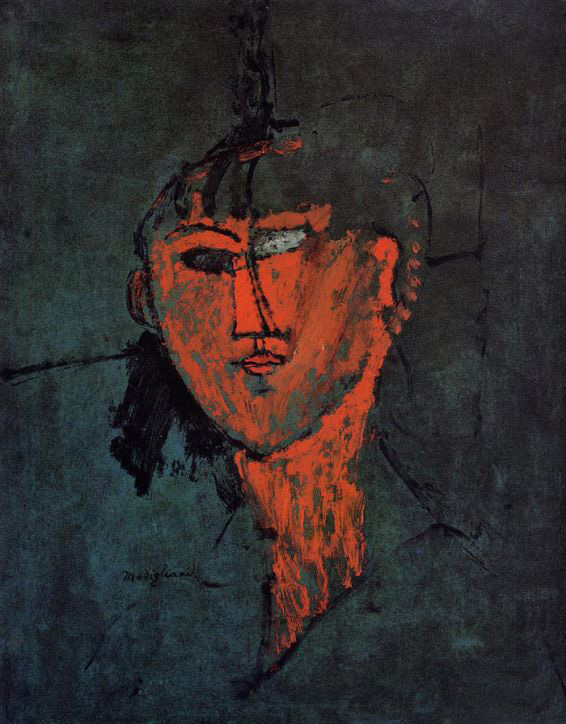
Oil on cardboard— 1915
Identification
- Title
- English: The red head
Notes: Tête rouge (Centre Pompidou); Testa di giovane rossa (Ceroni); Tête de jeune femme rousse (Ceroni's French edition, according to Pompidou) - Date
- 1915
- Medium
- Oil on cardboard
Notes: "Huile sur carton" (oil on cardboard) (Centre Pompidou); oil on paper (Ceroni; Parisot) - Dimensions
- 54 x 42.5 cm
Notes: 54 x 42 (Ceroni, Parisot) - Signature
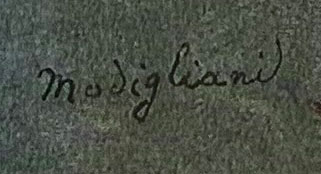
- Signed "modigliani" lower left - on Verso "S.B.G."
- Present location
- Centre Pompidou, Musée national d'art moderne, Paris, AM 4286 P, purchased 1964.
Catalogue numbers
| Compiler | Number |
|---|---|
| Arthur Pfannstiel | NO |
| Joseph Lanthemann | no. 53 |
| Ambrogio Ceroni | no. 50 |
| Jeanne Modigliani | YES |
| Christian Parisot | 1/1915 |
| Osvaldo Patani | no. 55 |
| Modigliani Project | ? |
| MR | YES |
| Modigliani Initiative/ AMDC | ? |
Legal note on MR: This investigation has not had access to MR’s catalogue raisonné; all research here is based on open sources, publications and exhibitions. By no means has that catalogue been copied at any point. Modigliani Project and Modigliani Initiative are marked YES when the work is published or otherwise recorded by those projects, even if no catalogue number is assigned; otherwise the field is marked ?.
Provenance
- ?
- Centre Pompidou, Paris (acquired 1964)
- no. Inv. AM 4286 P
The sequence follows the published museum, sale, and catalogue record in this investigation. Gaps and uncertain transfers are marked as such.
Selected bibliography
Book-length publications are marked with a footnote giving a full citation. Exhibition catalogues appear in both this list and the exhibition list when this investigation recorded them in both places.
- Ponente,Modigliani, Ed. Toray, Barcelona, 1969 - no. 18
- Lanthemann, Modigliani, catalogue raisonné: sa vie, son œuvre, son art, Barcelona, 1970, no. 531
- Ceroni & Piccioni, I dipinti di Modigliani, Milan. 1970 (1972 in Spanish), no. 502
- Zurcher, Modigliani, Ed. F. Hazan, Paris, 1980, no. 83
- Roy Modigliani, Paris, 1985, p. 28.
- Castieau-Barrielle, La vie et l'œuvre de Amedeo Modigliani, Editions ACR Paris, 1987, p. 1344
- Schmalenbach, Amedeo Modigliani, Prestel Verlag, 1990 p. 77 - no. 295
- Patani, Catalogo Generale, Leonardo ed. Milano 1991-96
- Parisot. Modigliani: Catalogue raisonné. Ed. Giorgio and Guido Guastalla. Vol. 2,Peintures, dessins, aquarelles. Livorno, 1991,no. 1/19157
- Parisot, Modigliani, Pierre Terrail, Paris, 1992, p. 2018
- MR, L'Ange au visage grave, Musée du Luxembourg, Paris, 2002, p.569
- Klein, Modigliani: Beyond the Myth, The Jewish Museum, 2004-2005, p. 50, f. 710
- Soto Caba, Modigliani, the timeless face, Libsa, 200711
- Martigny, Fondation Pierre Gianadda, Modigliani et l'Ecole de Paris, June-November 2013, pp. 38-39
Exhibitions
- Düsseldorf, Kunstsammlung Nordrhein-Westfalen, Amedeo Modigliani: Malerei, Skulpturen, Zeichnungen, 1991 - no. 15
- Zurich, Kunsthaus, Amedeo Modigliani: Malerei, Skulpturen, Zeichnungen, 1991 - no. 15
- Toronto, Modigliani: Beyond the Myth, The Art Gallery of Ontario, 2004 - 2005
- Madrid, Modigliani y su tiempo, Museo Nacional Thyssen Bornemisza, 2008
- Martigny, Fondation Pierre Gianadda, Modigliani et l'Ecole de Paris, 2013 - no. 7
- Pisa, Palazzo d’arte e cultura, Amedeo Modigliani et ses amis, 2014 - 2015
- Torino, Galleria d’Arte Moderna, Modigliani e la Bohème di Parigi, 2015
- Villeneuve d'Ascq, L'oeil intérieur, LaM. Lille Métropole musée d'art moderne, 2016
- Budapest, Modigliani, Hungarian National Gallery, 2016
- Helsinki, Modigliani, Ateneum Art Museum, 2016-2017
Notes
Not in D'Atri papers
The Centre Pompidou, Musée national d’art moderne, confirms Tête rouge (inv. AM 4286 P), oil on cardboard, 54 × 42.5 cm, [1915], acquired by purchase in 1964.
Where sources disagree, both readings are given. This is a working research page, not a catalogue raisonné.
The red head
Introduction
The Tête rouge in the Centre Pompidou is one of Modigliani's most intense images of 1915. It shows a frontal head painted in a burning red-orange on a dark blue-green ground. The face has the features of a mask: one eye dark, the other blank, a long straight nose, a tiny mouth. Behind the head, thin dark lines form a cross. Ceroni's caption is "Testa di giovane rossa, Parigi, proprietà privata" (Head of a red-haired young woman, Paris, private property), and he adds no note. The picture entered the Musée national d'art moderne in 1964, after the sale of the collection of André Lefèvre. It has since been widely exhibited, from Düsseldorf and Zurich in 1991 to Helsinki in 2016–17.
Unlike most of the works in this series, the Tête rouge has a substantial published interpretation. The Centre Pompidou's online page reproduces two texts by Brigitte Leal from the museum's collection catalogues, and the LaM's 2016 exhibition dossier cites it twice. This essay draws on both, together with the Secret Modigliani page on the work. It describes the picture's composition, line and colour, and its use of the African mask. It also addresses a few minor discrepancies in the documentation.
Composition and format
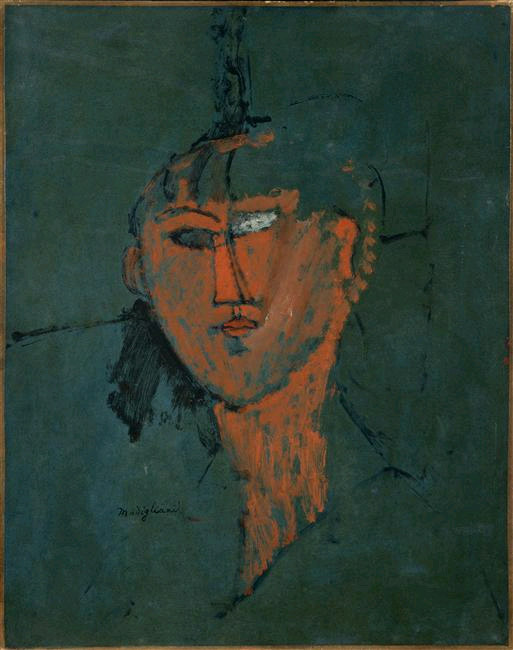
The support is a sheet of cardboard of 54 × 42.5 cm, an upright of about 1 : 1.27. The two reproductions on the Secret Modigliani page have width-to-height ratios of 0.782 and 0.789, close to the 0.787 given by the museum's dimensions. One of them shows the edges of the support, with a thin, lighter band all round.
The head is placed high and slightly to the left of the vertical axis, and it occupies the upper two-thirds of the picture. It is frontal, but tilted a little to the viewer's right, so the vertical axis of the nose leans slightly. The neck descends from it as a long, tapering column, reduced to streaks of red. It fades out into the dark ground well before the bottom edge. The lower third of the picture is almost empty: dark blue-green, with a few faint lines for the shoulders and the signature, "modigliani", written small in black in the lower left, at the level of the neck.
Behind the head two thin dark lines cross. A vertical rises from the top of the head to the upper edge, broken and doubled like a cord or a carved post. A horizontal runs from the left edge to the ear, at the height of the mouth, and continues on the right as a short dark stroke beyond the cheek. The LaM's dossier on L'œil intérieur notes that in Modigliani's portraits "le fond est suggéré plus que représenté" (the background is suggested more than represented). It lists among its examples "une simple croix (Tête rouge, 1915)" (a simple cross). The cross is the only structure in the background. It locates the head in space and gives the composition a fixed axis against which the slight tilt of the head can be felt.
Line
The head is drawn in black over the red with a thin, firm brush. The nose is a long straight line from the brow to the tip, closed at the bottom by a short horizontal and two small strokes for the nostrils. The eyebrows are two flat arcs that join the nose at the top. The mouth is a small shape of two lobes, with a dark line between the lips. The outline of the face is drawn only on the viewer's left, as a curve from the temple to the chin. On the right the red simply ends against the dark ground. A dark fringe of hair cuts across the forehead in a straight line, and above it the hair is suggested by a few curved strokes and a mass of red brushwork.
The eyes are the most striking feature. The viewer's left eye is a dark almond, outlined in black and filled with dark blue-green. The right eye is a horizontal patch of white and pale blue-grey, with no pupil. This asymmetry, a seeing eye and a blind one, recurs in Modigliani's portraits. Here it is particularly sharp, because the white patch is the lightest area in the picture and immediately draws the eye. Leal includes "dissymétrie" and "yeux bouchés" (blocked eyes) among the traits of the Fang masks that she sees behind the picture.
Colour
The colour is what gives the picture its title and its force. The face and neck are painted in a bright red-orange, close to vermilion, laid over the dark ground in thick, broken strokes that let the blue-green show through. The result is a vibrating, unevenly lit surface, in which the red seems to glow from within. At the neck the strokes are long and vertical, and the ground shows between them like the dark of a wound. The ground itself is a deep, cold blue-green, almost black in the upper corners, and slightly lighter around the head. A dark, almost black patch of hair on the left, below the ear, is the darkest note in the picture.
Leal's text in the 2007 collection catalogue, reproduced on the Pompidou page, places the colour precisely. She speaks of "la violence de sa couleur sanguine, dans la lignée du chromatisme fauve de Matisse et de Derain ou de la coloration océanienne des Demoiselles d'Avignon (1907) de Picasso" (the violence of its blood-red colour, in the line of the Fauve chromatism of Matisse and Derain, or of the Oceanic colouring of Picasso's Demoiselles d'Avignon). The LaM dossier makes the same point more briefly. Writing of Modigliani's search for a personal style, it speaks of "coloris cubistes (Femme au ruban de velours, 1915) ou fauves (Tête rouge)" (Cubist colouring, as in the Woman with a Velvet Ribbon, or Fauve colouring, as in the Tête rouge). The complementary pairing of red and blue-green is the essential device. Each colour intensifies the other, and the red head seems to project from the cold ground.
Facture
The Pompidou texts insist on the rapidity of the execution. The first text, from the 2008 graphic arts catalogue, speaks of "le fa presto de la touche, l'incandescence de la couleur" (the rapidity of the touch, the incandescence of the colour). The 2007 text speaks of the picture's "technique cézannienne d'esquisse" (Cézannian sketch technique). The surface confirms this. The red is applied in quick, separate strokes that do not cover the ground completely. The black drawing is laid over it without correction. The background is brushed in broad, thin strokes, with variations in tone that follow the movement of the brush. The whole picture could have been painted in a single session.
The cardboard support explains some of these effects. The ground does not absorb the paint as a canvas would, and the strokes stay on the surface with clear edges. In places the thin layers of the background may let the brown of the cardboard show through, which would explain the slightly muddy, warm undertone of the blue-green. In one of the reproductions on the Secret Modigliani page, a lighter band runs around the edges of the picture. It may be unpainted card at the edge of the sheet or the effect of an earlier frame.
Figure and space
The head appears rather than sits in space. It has no shoulders, and the neck dissolves into the ground. The dark field surrounds it on all sides. The cross behind it is the only element that measures depth, and it is a flat sign rather than an object. Leal's final sentence describes the effect: "Ainsi projetée hors de l'obscurité par son pigment sanguinolent de tête coupée, Tête rouge resplendit comme une apparition, celle d'une des ultimes icônes du cubisme" (Projected out of the darkness by its blood-red pigment like a severed head, Tête rouge shines like an apparition, that of one of the last icons of Cubism). The image of the severed head is strong, but it fits the picture. The neck ends in streaks of red against the dark, with no body below.
Iconography and sitter
Ceroni calls the sitter a "giovane rossa", a red-haired young woman, and the French edition, according to the Pompidou, a "jeune femme rousse". Yet the red of the picture is not the hair, which is dark. It is the face itself. The title Tête rouge is more exact. No source I have consulted identifies the sitter, and the picture is better understood as a variation on a type than as a portrait.
The type is the African mask. Leal writes that the head has "sa morphologie typiquement primitiviste, plus ou moins inspirée des masques Fang du Gabon (ovale fin du visage, dissymétrie, nez en quart de brie, yeux bouchés, bouche minuscule)" (its typically primitivist morphology, more or less inspired by the Fang masks of Gabon: the fine oval of the face, asymmetry, nose like a wedge of brie, blocked eyes, tiny mouth). She says these features "déréalisent la tête" (derealise the head). "Elles la métamorphosent même en masque, doté de la présence énigmatique et magique conférée aux masques tribaux" (They even transform it into a mask, endowed with the enigmatic and magical presence conferred on tribal masks). The Modigliani Initiative traces this source to "the simplified forms of African art that he had access to in the gallery of Paul Guillaume (1891–1934) and the residence of Frank Burty Haviland (1886–1971)".
The earlier text by Leal adds a reservation. It says that the touch and colour "la sauvent de la dépersonnalisation, liée à une stylisation mécanique du primitivisme et du cubisme qui pèse sur les portraits de Modigliani" (save it from the depersonalisation, linked to a mechanical stylisation of primitivism and Cubism, that weighs on Modigliani's portraits). This is a fair critical point. The Tête rouge is a mask, but a painted and burning one, not a schema.
Comparisons
Leal compares the picture with two portraits of 1915: "célèbre Portrait de Pablo Picasso (1915, cat. rais. 1, n° 85)" and "Portrait d'Henri Laurens (1915, Lucerne, coll. Rosengart)". She links them by their "technique cézannienne d'esquisse". In her first text she describes these pictures as "une série d'huiles sur carton contemporaines" (a series of contemporary oils on cardboard).
Within this batch, the Tête rouge is the frontal pole of a set of mask-heads. Head of a woman in profile (Ceroni no. 48), shown in 1958 as a "Portrait de style nègre", has the same orange flesh against a dark and green ground, but in three-quarter view. Lola de Valence (Ceroni no. 49) is the profile pole, a flat plane of orange in front of stage flats. Beatrice Hastings with a hat (Ceroni no. 46) is painted in a similar hot flesh colour. The contrast with it is the clearest measure of change. There the colour is broken into patches that build a face, while here it is laid in streaks inside a black drawing that builds a mask.
Provenance and exhibitions
The Pompidou gives "Achat en 1964" (purchase, 1964). Leal's texts say that the picture was "acquise lors de la vente de la collection André Lefèvre en 1964". The Pompidou's bibliography lists two 1964 publications. One is the exhibition Collection André Lefèvre, Paris, Musée national d'art moderne, March–April 1964, "cat. n° 210 cit. p. 31 (non daté)". The other is the Vente de la Collection André Lefèvre, Paris, Palais Galliera, 1 December 1964, "cat. n° 72 cit. et reprod. coul.". The Secret Modigliani page gives only "Centre Pompidou, Paris (acquired 1964)".
The exhibitions given on the Secret Modigliani page are:
- Düsseldorf and Zurich, 1991, no. 15.
- Toronto, Art Gallery of Ontario, Modigliani: Beyond the Myth, 2004–05.
- Madrid, Museo Thyssen-Bornemisza, 2008.
- Martigny, Fondation Pierre Gianadda, 2013, no. 7.
- Pisa, 2014–15.
- Turin, 2015.
- Villeneuve d'Ascq, LaM, L'œil intérieur, 2016.
- Budapest, Hungarian National Gallery, 2016.
- Helsinki, Ateneum, 2016–17.
The Pompidou's bibliography adds several others:
- Munich and Paris, L'expressionnisme européen, 1970, no. 40.
- New York, Guggenheim, Rendezvous, 1998–99, no. 76.
- Tokyo, 2007, no. 21.
- Saint-Tropez, L'Annonciade, 2010.
It also gives the catalogue number in Madrid 2008 (no. 54) and in Pisa (no. 53), and notes that in the Jewish Museum exhibition of 2004–05 the picture was shown "seulement à Toronto" (only in Toronto).
Discrepancies
- The Lefèvre catalogue number. Leal's 2007 text gives "cat. vente n° 210". In the Pompidou's own bibliography, no. 210 is the number in the March–April 1964 exhibition of the Lefèvre collection at the Musée national d'art moderne. The sale catalogue of 1 December 1964 gives no. 72.
Technical analysis
No published technical study of the Tête rouge was found. The Pompidou page gives no conservation information beyond the medium and dimensions.
The comparative literature is limited for works on cardboard. King, Ireson, Fraquelli and Townsend explicitly excluded works "on board" from their analysis of standard sizes, and their technical findings concern mainly canvases. The same article does give a useful point of reference for the pigments. In listing the colours found in earlier studies of works in French collections, it includes vermilion. The red-orange of this picture looks like vermilion or a red lead mixture, but no analysis has been made. The IJCS study of The Cellist found vermilion among the pigments of that canvas. That is comparative evidence.
What an examination should address is clear. X-ray fluorescence would identify the red and the blue-green. Infrared reflectography would show whether there is an underdrawing beneath the black lines, and whether the cross was painted before or after the head. A look at the verso would confirm the "S". Under magnification, the edges of the strokes would show the order of the layers, which the surface already suggests: dark ground first, then red, then black.
Conclusion
The Tête rouge combines the African mask, the Fauve colour that Leal and the LaM name, and a rapid, sketch-like execution on cardboard. The result is an image at once very simple and very intense. The head is reduced to a few lines, the colour to two complementaries, and the background to a cross. Leal's description of it as "une apparition" is accurate: the head has no body, no setting and no individual identity, but it has a striking presence.
In Ceroni's sequence it closes a group of five works that runs from the dense, patchy Beatrice Hastings with a hat to this mask of red on cardboard. Those five works show how quickly Modigliani's painting changed between 1914 and 1915. The documentation of the Tête rouge is sound, thanks to the Pompidou. The small discrepancies concern the Lefèvre sale numbers in the museum's own texts, Ceroni's paper support, and a figure number given as a catalogue number. None affects the identification.
Museum, auction and exhibition sources
- Centre Pompidou, Musée national d'art moderne, Tête rouge, AM 4286 P, https://www.centrepompidou.fr/fr/ressources/oeuvre/cgzzRxy (data, bibliography, and texts by Brigitte Leal from Collection art graphique, 2008, and Collection art moderne, 2007)
- LaM, Villeneuve-d'Ascq, Amedeo Modigliani: l'œil intérieur, dossier pédagogique (2016), https://www.musee-lam.fr/sites/default/files/2019-01/Dossier-pedago-Modigliani-l-oeil-interieur.pdf
- The Modigliani Initiative, Amedeo Modigliani Digital Catalogue, "Lola de Valence (AMDC 30)", https://catalogue.modigliani-initiative.org/catalogue/entry.php?id=30 (for Modigliani's sources in African art; the Modigliani Initiative does not publish this work)
Technical literature (comparative)
- Annette King, Nancy Ireson, Simonetta Fraquelli and Joyce H. Townsend, "The Modigliani Technical Research Study: An introduction to Modigliani's materials and techniques", The Burlington Magazine, vol. 160, no. 1380 (March 2018), https://www.burlington.org.uk/archive/article/the-modigliani-technical-research-study-an-introduction-to-modiglianis-materials-and-techniques (comparative)
- Greta García, David Juanes and Rafael Romero, "Image Study and Material Characterization of the Two-Sided Painting The Cellist and Portrait of Brancusi by Amedeo Modigliani", International Journal of Conservation Science, vol. 14, no. 3 (2023), pp. 1233–48, DOI: 10.36868/IJCS.2023.03.30, https://ijcs.ro/public/IJCS-23-81_Garcia.pdf (comparative)
Sources that could not be opened
No technical report on the work was found, and the verso was not seen. The Pompidou's collection catalogues of 2007 and 2008 were consulted only through the extracts reproduced on the museum's page. The Lefèvre exhibition and sale catalogues of 1964 and Ceroni's plate (said to be reproduced "in negative") were not available. A Centre Pompidou PDF that, according to a search result, describes the work as oil on canvas was not opened, so it is not used here.
Cited but not independently consulted
Ponente, Modigliani, 1969, no. 18; Lanthemann, 1970, no. 53; Ceroni and Piccioni, I dipinti di Modigliani, 1970 (given as 1972), no. 50; Zurcher, Modigliani, 1980, no. 8; Roy, Modigliani, 1985, p. 28; Castieau-Barrielle, 1987, p. 134; Schmalenbach, Amedeo Modigliani, 1990, p. 77, no. 29 (fig. 29 according to the Pompidou); Patani, 1991–94; Parisot, 1991, no. 1/1915; Parisot, Modigliani, 1992, p. 201; MR, L'Ange au visage grave, 2002, p. 56; Klein, Modigliani: Beyond the Myth, 2004–05, p. 50, fig. 7; Soto Caba, 2007; Martigny, Fondation Pierre Gianadda, 2013, pp. 38–39. Page and catalogue numbers are given without the footnote digits the page attaches to them, which on this page are separated by a space (for example "no. 53 1" is read as no. 53).
Footnotes
- Joseph Lanthemann, Modigliani, catalogue raisonné: sa vie, son œuvre, son art, Barcelona, G. Condal, 1970.
- Ambrogio Ceroni and Leone Piccioni, I dipinti di Modigliani, Milan, Rizzoli, 1970.
- Bernard Zurcher, Modigliani, Paris, F. Hazan, 1980.
- Thérèse Castieau-Barrielle, La vie et l’œuvre de Amedeo Modigliani, Paris, ACR, 1987.
- Werner Schmalenbach, Amedeo Modigliani, Munich, Prestel, 1990.
- Osvaldo Patani, Amedeo Modigliani: catalogo generale, Milan, Leonardo, 1991–94.
- Christian Parisot, Catalogue raisonné Modigliani, Livorno, Graphis Arte, 1991.
- Christian Parisot, Modigliani, Paris, Pierre Terrail, 1992.
- MR (cited here as MR), Modigliani: l’ange au visage grave, Paris, Musée du Luxembourg, 2002. Cited from the published exhibition catalogue only.
- Mason Klein, Modigliani: Beyond the Myth, New York, The Jewish Museum / Yale University Press, 2004.
- Victoria Soto Caba, Modigliani: The Timeless Face, Madrid, Libsa, 2007.