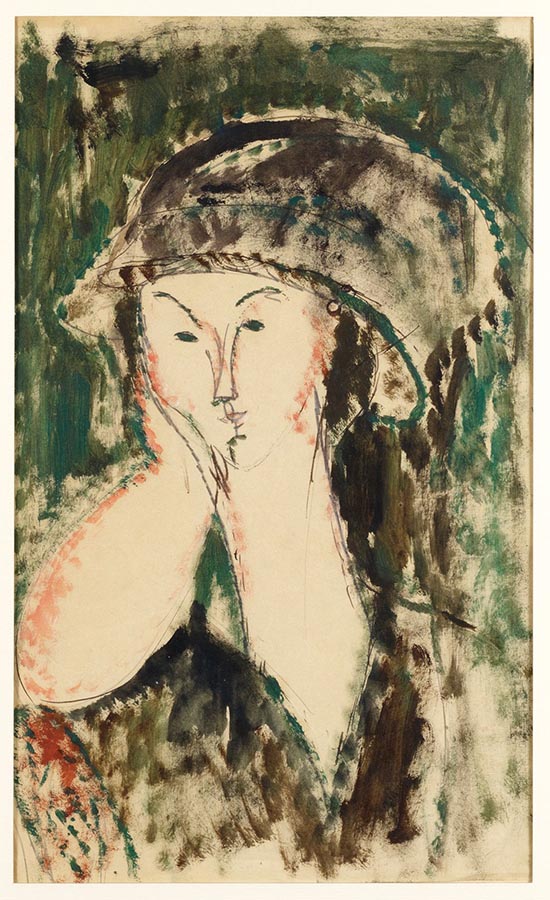
Beatrice Hastings, hand on right cheek
Oil on paper or cardboard? — 1915? (R dates in 1914)
Identification
- Title
- English: Beatrice Hastings, hand on right cheek.
Notes: Beatrice Hastings appoggiata al braccio sinistro (Ceroni); Béatrice Hastings (Paris 1981 and Martigny 1990 exhibition lists) - Date
- 1915? (MR dates in 1914)
Notes: 1915 (Paris 1981 and Martigny 1990 exhibition lists); 1914 (MR in Tokyo and Osaka 2008) - Medium
- Oil on cardboard?
Notes: Oil on paper (Ceroni; MR in Paris 2002 and Milan 2003); tint, gouache and crayon on paper (Paris 1981); ink and gouache over pencil (Martigny 1990 exhibition list); oil on canvas (Paris 2012 exhibition list). - Dimensions
- 42.5 x 26.3 cm ?
Notes: 42.5 × 26.3 cm? ( Paris 1981); 45 × 35 cm (Ceroni and Patani, and MR in Paris 2012); 42 × 25 cm (MR in Tokyo and Osaka 2008). - Signature
- Unsigned?
- Present location
- Netter Coll. Paris?
Catalogue numbers
| Compiler | Number |
|---|---|
| Arthur Pfannstiel | NO |
| Joseph Lanthemann | NO |
| Ambrogio Ceroni | no. 82 |
| Jeanne Modigliani | NO |
| Christian Parisot | ? |
| Osvaldo Patani | no. 82 |
| Modigliani Project | ? |
| MR | YES |
| Modigliani Initiative/ AMDC | ? |
Legal note on MR: This investigation has not had access to MR’s catalogue raisonné; all research here is based on open sources, publications and exhibitions. By no means has that catalogue been copied at any point. Modigliani Project and Modigliani Initiative are marked YES when the work is published or otherwise recorded by those projects, even if no catalogue number is assigned; otherwise the field is marked ?.
Provenance
- Netter Coll. Paris
The sequence follows the published museum, sale, and catalogue record in this investigation. Gaps and uncertain transfers are marked as such.
Selected bibliography
Book-length publications are marked with a footnote giving a full citation. Exhibition catalogues appear in both this list and the exhibition list when this investigation recorded them in both places.
- Ceroni & Piccioni, I dipinti di Modigliani, Rizzoli, Milano, 1970 - no. 82 ( as oil on paper size 45 x 35 )1
- Musée de Art Moderne de la Ville de Paris, Modigliani exib. cat., 1981 p. 187 - no. 161
- Castieau-Barrielle, La vie et l'œuvre de Amedeo Modigliani, Editions ACR, Paris, 1987, p. 123 (tint, gouache and crayon on paper)2
- Patani, Catalogo Generale, Leonardo, Milano, 1991-94 - no. 823
- MR, L'Ange au visage grave, Musée du Luxembourg, Paris, 2002, pp. 194-1954
- R, Modigliani et le primitivisme, curated by MR, Exhib. Cat. Tokyo, Osaka, 2008 - no. 22 - dated in 1914 with wrong size and medium
- R, La Collection Jonas Netter, Pinacotheque de Paris, 2012 - no. 32 pp. 112-113 - dated as from 1915 with wrong size and medium
Exhibitions
- Paris, Modigliani, Musée de Art Moderne de la Ville de Paris, 1981 - no. 161 (size 42.5 x 26.3 as Tint, gouache and crayon on paper)
- Martigny, Modigliani, Fondation Pierre Gianadda, 1990 - no. 46 p. 119 ( size 42.5 x 26.3 and tint, gouache and crayon on paper)
- Paris, Modigliani: l'ange au visage grave, Musée du Luxembourg, 2002 - no. 27 - as oil on paper
- Milano, Modigliani: l'ange au visage grave, Palazzo Reale, 2003 - no. 22 - as oil on paper
- Tokyo, Modigliani et le primitivisme, curated by MR, The National Arts Center, 2008 - no. 22 - dated in 1914 with wrong size and medium
- Osaka, Modigliani et le primitivisme, curated by MR, The National Museum of Art, 2008 - no. 22 - dated in 1914 with wrong size and medium
- Paris, La Collection Jonas Netter, Pinacotheque de Paris, 2012 - no. 32 (dated in 1915 with size 45 x 35 wrong medium as oil on canvas)
- Milano, La Collection Jonas Netter, Palazzo Reale, 2013 - no. 32 (dated in 1915 with size 45 x 35 wrongt medium as oil on canvas)
Notes
Not in D'Atri papers.
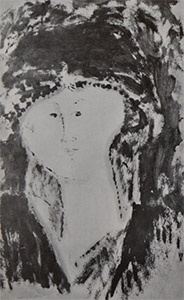
There is another very similar composition:
Where sources disagree, both readings are given. This is a working research page, not a catalogue raisonné.
Introduction
This portrait of Beatrice Hastings belongs to a small group of works on paper or board in which Modigliani combined pencil drawing with loosely brushed colour. Hastings is shown at half length, wearing a large hat with a broad brim, her head resting on her hand. Her face, neck and arm are left largely in the colour of the support and defined by pencil lines, while the hat, the hair, the dress and the background are brushed in green, brown and black. A few touches of red and orange enliven the cheeks, the arm and the lower left corner.
The work has been shown repeatedly since 1981, most recently in the exhibitions of the Jonas Netter collection in Paris in 2012 and in Milan in 2013. Its medium, size and date, however, are given in at least five different ways in the sources assembled by the Secret Modigliani page, and Ceroni's title describes the pose differently from the title used on that page.
Composition and format
The work is upright and narrow. In my measurement, the reproduction on the Secret Modigliani page has a proportion of height to width of 1.636, including a narrow pale margin at the edges, and the Ceroni plate, as reproduced on modigliani1909.com, 1.679. A size of 42.5 × 26.3 cm gives 1.616, and 42 × 25 cm gives 1.68; both are consistent with the photographs. The size of 45 × 35 cm, which the Secret Modigliani page attributes to Ceroni, Patani and the Netter exhibition of 2012, gives 1.29. In my measurement, it is incompatible with both photographs and describes a much squarer sheet. The Secret Modigliani page's list of Ceroni's paintings, which also gives 45 × 35 cm, adds the comment that the correct size is 42 × 25 cm, with a query.
The head is placed high and slightly to the left of the vertical axis, framed by the hat, whose brim forms an arc from the left edge almost to the right edge. Below the face, the arm rises from the lower left in a broad diagonal to the hand, which supports the chin and the cheek at the left side of the face. The neck descends from the chin to a V neckline, whose sides run down to the lower edge. At the right, the hair falls in a dark mass from beneath the hat to the shoulder.
In my reading, the composition is built on two diagonals and an arc. The arm forms one diagonal from the lower left to the face, the right side of the V neckline another, and the brim of the hat the arc that closes the top. The pale shapes of the face, neck and arm form a single connected area at the centre, surrounded by the darker colour of the hat, dress and background.
Line
The face is drawn in fine dark pencil or ink. The eyebrows are long, thin arches, joined to the line of the nose. The eyes are small almond shapes, each with a dark pupil. The nose is long and straight, the mouth small, and the chin pointed. A few lines at the side of the face mark the cheek where it rests on the hand. The contour of the face is open at several points and merges with the pale ground of the support.
The arm and hand are drawn with long curving lines, partly doubled, which follow the outer contour of the arm from the lower left up to the face. The fingers are indicated by a few short strokes below the chin. The neck is bounded by two lines that continue into the V of the neckline. In my reading, the drawing is rapid and confident, and some lines are left unfinished or are restated beside earlier ones.
The brim of the hat is marked by a row of small green dots, which run along its lower edge from the left side of the face to the right shoulder. Tate Papers, no. 35, by Anaïs Genty-Vincent et al., observes that two works on paper of 1915, Ceroni nos. 84 and 85, "show the use of dots to establish the outlines of forms". The article does not discuss the present work. In my reading, the dotted brim here is a related device, though it decorates the hat rather than outlining the figure. This comparison is comparative evidence.
Colour
The colour is concentrated in the surroundings. The background is brushed in dark green, with lighter greens and patches of the pale support showing through. The hat is a dark purplish brown, darker at the crown and lighter towards the brim. The hair at the right is a warm dark brown. The dress is green-black at the centre and brown at the sides.
Against these colours, the face, neck and arm are the pale tone of the support. The cheeks and the outer contour of the arm are touched with small strokes of orange-pink, which are laid in short parallel hatchings. At the lower left corner, below the arm, there is a patch of red and orange, with green strokes, which in my reading indicates a cushion, a garment or a part of the setting; the reproduction does not allow a firm identification.
In my reading, the contrast between the pale figure and the dark green surroundings is the principal effect of colour in the work. The orange-pink hatching provides a transition between them and gives the flesh a slight warmth.
Facture
The surface is dominated by rapid, broad brushwork. The background is scrubbed in vertical and diagonal strokes, thin enough in places for the support to show through. The hat is painted with broader strokes, with some heavier areas of dark colour at the crown. The hair is laid in with a few loaded strokes. The paint at the lower edge is thinner and more broken.
The figure, by contrast, is barely painted. The face, neck and arm are left in reserve, and the only colour on them is the orange-pink hatching. In my reading, the handling is that of a work in which drawing and painting are combined on equal terms: the pencil lines are not covered, and the painted areas do not attempt to model the flesh.
The medium of the coloured areas is disputed. The Secret Modigliani page gives oil on cardboard and reports oil on paper, tint, gouache and crayon on paper, and oil on canvas in other sources. The exhibition list for Martigny 1990, on the Secret Modigliani site, gives the work as no. 46, "Béatrice Hastings v. 1915 Encre et gouache sur traits de crayon" (Béatrice Hastings, about 1915, ink and gouache over pencil lines). In my reading, the thin, matt and partly transparent brushwork of the background is consistent with a water-based medium or with thinned oil; a reproduction cannot distinguish them.
Figure and space
The figure is close to the picture plane and fills the sheet. There is no indication of a room. The background is a field of green brushwork without architecture, furniture or horizon, and the hat and hair stand against it as flat shapes. Only the patch of red at the lower left suggests something in front of or beside the figure.
The pose is one of rest or reflection. The head inclines slightly towards the supporting hand, and the eyes look out towards the viewer with an expression that, in my reading, is calm and withdrawn. The arm, rising from the lower left, occupies more space than the head and gives the pose its stability.
The title used on the Secret Modigliani page names the hand on the right cheek. In my reading of the reproduction, the arm enters from the viewer's left and the hand supports the side of the face at the viewer's left. That arm is the sitter's right arm, and the cheek it touches is her right cheek. Ceroni's title, as transcribed, describes Hastings as leaning on her left arm. This may reflect a description from the viewer's side, or a different reading of the pose.
Iconography and sitter
The sitter is identified as Beatrice Hastings in Ceroni's caption, on the Secret Modigliani page and in the exhibition lists of 1981 and 1990. The large hat is an attribute that recurs in her portraits. Tate Etc., in an article on Hastings and Modigliani that I opened for earlier essays in this series, notes the variety of the portraits: "She is hatted or unhatted; glimpsed frontal, profile or three quarters". The Christie's essay of 2022 on Beatrice Hastings (devant une porte), Ceroni no. 81, states that the artist painted her "at least fourteen times".
The pose of the head resting on the hand is a traditional one in portraiture and is often associated with thought or melancholy. No source opened for this essay discusses its meaning in the present work. In my reading, the pose here is informal and intimate, consistent with a work made quickly in the sitter's presence, but that is an inference from the handling rather than a documented fact.
The date is uncertain. The Paris 1981 and Martigny 1990 exhibition lists give about 1915; the Secret Modigliani page reports that the exhibitions in Tokyo and Osaka in 2008 dated the work to 1914 and that the Netter exhibition of 2012 dated it to 1915. Modigliani's relationship with Hastings began in 1914, after her arrival in Paris in April of that year, according to the Christie's essay of 2002 on Ceroni no. 81, so either date is possible.
Comparisons
The similar composition formerly with Perls Galleries. The Secret Modigliani page notes that there is a very similar composition and illustrates it with a reproduction captioned as Beatrice Hastings, Perls Galleries. The site's page on that work gives oil and pencil on paper, 41 × 26 cm, signed modigliani at the bottom left, formerly Perls Galleries, New York, with reproductions in Werner 1966 and Lanthemann 1970, no. 668, and states that the work is not in Ceroni. The near identity of size with the present work, 42.5 × 26.3 cm, is notable. Whether the two are versions of the same composition or whether one is a repetition of the other cannot be determined from the sources opened.
Beatrice Hastings in Front of a Door (Ceroni no. 81). The preceding work in Ceroni's sequence shows Hastings in a plumed cap, painted in oil on canvas, in black and brown. The present work shares the hat and the long neck, but its handling is far looser, and the face is drawn rather than painted. The comparison shows the range of Modigliani's technique in the portraits of the same sitter.
Rosa Porprina (Ceroni no. 84) and La Marseillaise (Ceroni no. 85). These works, discussed in the following essays in this series, are also on paper, with pencil or crayon drawing and oil, and leave much of the support visible. They share with the present work the use of dots along contours and the combination of drawing and paint. Tate Papers, no. 35, identifies them as two works of 1915 that use dots to establish the outlines of forms. In my reading, the present portrait belongs to the same group of mixed-media works on paper, but this is comparative evidence, and the medium of the present work remains disputed.
Provenance and exhibitions
The Secret Modigliani page gives the provenance only as the Netter collection, Paris, and the present location as the Netter collection, with a query. Ceroni's caption, as transcribed, gives Paris, private collection. The French Wikipedia article on Jonas Netter states that he discovered Modigliani in 1915 and that he was put in contact with Léopold Zborowski. The Pinacothèque de Paris page on the exhibition La Collection Jonas Netter: Modigliani, Soutine et l'aventure de Montparnasse gives its dates as 4 April to 9 September 2012, and describes Netter as a discreet collector whose works had been kept by a branch of his family. It does not list the present work.
The exhibitions given by the Secret Modigliani page are: Paris, Musée d'Art Moderne de la Ville de Paris, 1981, no. 161; Martigny, Fondation Pierre Gianadda, 1990, no. 46, p. 119; Paris, Musée du Luxembourg, Modigliani: l'ange au visage grave, 2002, no. 27, as oil on paper; Milan, Palazzo Reale, 2003, no. 22, as oil on paper; Tokyo, The National Arts Center (as the page gives it), and Osaka, The National Museum of Art, Modigliani et le primitivisme, 2008, no. 22; Paris, Pinacothèque, 2012, no. 32; and Milan, Palazzo Reale, 2013, no. 32. The site's list for the 1981 exhibition gives no. 161 as Béatrice Hastings, about 1915. The site's list for Martigny gives no. 46 as Béatrice Hastings, about 1915, ink and gouache over pencil, private collection. The site's list for the Netter exhibition of 2012 includes a Beatrice Hastings of 1915 in oil on canvas, which, in my inference, is the present work.
Discrepancies
- Medium. The Secret Modigliani page gives oil on cardboard; Ceroni and the exhibitions of 2002 and 2003 oil on paper; the page reports tint, gouache and crayon on paper for 1981 and 1990; the site's list for Martigny 1990 gives ink and gouache over pencil; the exhibitions of 2012 and 2013, according to the page, gave oil on canvas. In my inference, tint may be a rendering of the French encre (ink).
- Date. About 1915 in 1981 and 1990; 1914 in 2008; 1915 in 2012.
Technical analysis
No technical examination of the work has been opened. The following remarks are based on the reproduction and on comparative literature.
Support. The support is given as paper or cardboard, and once as canvas. In my reading, the pale ground visible in the face, neck and arm, and the absence of any canvas texture in the reproduction, are consistent with paper or board; canvas seems unlikely. Tate Papers, no. 35, by Anaïs Genty-Vincent et al., notes that "During the early years of his career, Modigliani painted on various kinds of support, from cardboard to canvas". This is comparative.
Medium. The thin, partly transparent green and brown washes may be gouache, ink or thinned oil. The Martigny list gives ink and gouache; Ceroni gives oil. The Burlington Magazine article by Annette King, Nancy Ireson, Simonetta Fraquelli and Joyce H. Townsend, "The Modigliani Technical Research Study. An introduction to Modigliani's materials and techniques", vol. 160, no. 1380 (March 2018), reports that drawing in the works studied "varied from clean graphite lines to ones made with thin brushes in paint of varying colours". In the present work, in my reading, both kinds of line appear: graphite or ink lines in the face and arm, and brushed dots and strokes in the hat and background. Analysis would be needed to identify the binders. This is comparative.
Sequence. In my reading, the pencil drawing of the face and arm preceded the colour, since the brushwork of the background stops at, or runs over, the pencil contours. The orange-pink hatching on the cheeks and arm may have been added with a brush or a coloured crayon.
Conclusion
Beatrice Hastings, Hand on Right Cheek is a mixed-media portrait in which the drawing of the face, neck and arm is left in reserve against a dark field of green and brown brushwork. The arm rising from the lower left, the hat with its dotted brim and the V of the neckline form a clear structure. The pale figure, touched with orange-pink, is set against dense surroundings, and the work keeps the immediacy of a drawing.
The documentation is contradictory. The medium is given as oil, gouache, ink or crayon, on paper, cardboard or canvas; the size as 42.5 × 26.3, 42 × 25 or 45 × 35 cm; the date as 1914 or 1915. In my measurement, the photographs rule out 45 × 35 cm. Ceroni's title refers to the left arm, while the reproduction shows the sitter's right. A closely similar composition of almost the same size, formerly with Perls Galleries and not included by Ceroni, needs to be studied alongside this work.
Museum, auction and exhibition sources
- Pinacothèque de Paris, La Collection Jonas Netter: Modigliani, Soutine et l'aventure de Montparnasse, https://www.pinacotheque.com/expo-2/
- Wikipédia, "Jonas Netter", https://fr.wikipedia.org/wiki/Jonas_Netter (biographical source)
- Christie's, New York, 20th Century Evening Sale, 17 November 2022, lot 9, Beatrice Hastings (devant une porte), https://www.christies.com/en/lot/lot-6397618 (for the number of portraits)
- Christie's, New York, 6 November 2002, lot 35, Beatrice Hastings devant une porte, https://www.christies.com/en/lot/lot-3998905 (for the sitter's arrival in Paris)
- Chloe Aridjis, "Modigliani and 'La Poétesse Anglaise'", Tate Etc., issue 41 (Autumn 2017), https://www.tate.org.uk/tate-etc/issue-41-autumn-2017/modigliani-beatrice-hastings-la-poetesse-anglaise
Technical literature (comparative)
- Annette King, Nancy Ireson, Simonetta Fraquelli and Joyce H. Townsend, "The Modigliani Technical Research Study. An introduction to Modigliani's materials and techniques", The Burlington Magazine, vol. 160, no. 1380 (March 2018) (comparative)
- Anaïs Genty-Vincent et al., "Works by Modigliani that have Paintings beneath the Visible Surface", Tate Papers, no. 35, https://www.tate.org.uk/research/tate-papers/35/works-by-modigliani-that-have-paintings-beneath-the-visible-surface (comparative)
Sources that could not be opened
The catalogues of the exhibitions of 1981, 1990, 2002, 2003, 2008, 2012 and 2013 in printed form, which are known here only from the Secret Modigliani pages; the private dossier of MR reported on the Secret Modigliani page; any technical report on the work.
Cited but not independently consulted
Ceroni & Piccioni, I dipinti di Modigliani, Rizzoli, Milano, 1972, no. 82; Musée d'Art Moderne de la Ville de Paris, Modigliani exhib. cat., 1981, p. 187, no. 161; Castieau-Barrielle, La vie et l'œuvre de Amedeo Modigliani, Editions ACR, Paris, 1987, p. 123; Patani, Catalogo Generale, Leonardo, Milano, 1991–1994, no. 82; MR, L'Ange au visage grave, Musée du Luxembourg, Paris, 2002, pp. 194–195; R, Modigliani et le primitivisme, Tokyo, Osaka, 2008, no. 22; R, La Collection Jonas Netter, Pinacothèque de Paris, 2012, no. 32, pp. 112–113. Titles are given as the page gives them, without the footnote digits it attaches to them.
Footnotes
- Ambrogio Ceroni and Leone Piccioni, I dipinti di Modigliani, Milan, Rizzoli, 1970.
- Thérèse Castieau-Barrielle, La vie et l’œuvre de Amedeo Modigliani, Paris, ACR, 1987.
- Osvaldo Patani, Amedeo Modigliani: catalogo generale, Milan, Leonardo, 1991–94.
- MR (cited here as MR), Modigliani: l’ange au visage grave, Paris, Musée du Luxembourg, 2002. Cited from the published exhibition catalogue only.