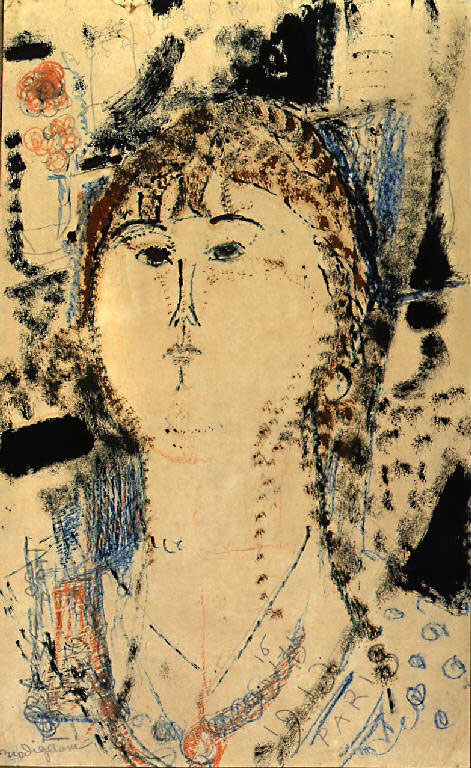
Woman portrait (Rosa Porprina)
Oil on paper? — 1915 ?
Identification
- Title
- English: Woman portrait (Rosa Porprina).
Notes: Rosa porprina (Ceroni); Woman's Head (Rosa Porprina) (Cleveland and New York 1951; Tate Papers, no. 35); Woman head (Rosa porprina) (Milan 1958). - Date
- 1915 ?
Notes: 1915 (dated, according to the 1951 catalogue; Ceroni); inscribed 16 Febbr. - Medium
- Oil and crayon on paper ?
Notes: Coloured pencil and oil on paper (1951 catalogue); oil on paper (Ceroni) - Dimensions
- 44 x 27 cm?
Notes: 44 × 27 cm? (Ceroni); 43 × 26 cm (Drouot sale, 1930) - Signature
- Signed "modigliani" lower left and dated with a game of words (16 Febbr.) and text "Rosa Porprina" on upper center.
Notes: at lower right, besides the date, Paris and other pencil words not reliably legible (Ceroni's note, as transcribed) - Present location
- Museo del Novecento, Milano, Italia (Inv. no. 8745)
Catalogue numbers
| Compiler | Number |
|---|---|
| Arthur Pfannstiel | no. 66 (III) |
| Joseph Lanthemann | no. 676 |
| Ambrogio Ceroni | no. 84 |
| Jeanne Modigliani | YES |
| Christian Parisot | 5/1915 - 197/15 |
| Osvaldo Patani | no. 86 |
| Modigliani Project | ? |
| MR | YES |
| Modigliani Initiative/ AMDC | ? |
Legal note on MR: This investigation has not had access to MR’s catalogue raisonné; all research here is based on open sources, publications and exhibitions. By no means has that catalogue been copied at any point. Modigliani Project and Modigliani Initiative are marked YES when the work is published or otherwise recorded by those projects, even if no catalogue number is assigned; otherwise the field is marked ?.
Provenance
- Unknown
- Sold: Drouot, Salle 6 - 21-May-1930 - Lot no. 48 - Rosa Porprina 43 x 26 cm sold for 4.600 FF? (illustrated in catalogue, p. 9)
- Riccardo Jucker Coll. Milano (Ceroni, 1951)
- Museo del Novecento, Milano, Italia (Inv. no. 8745)
The sequence follows the published museum, sale, and catalogue record in this investigation. Gaps and uncertain transfers are marked as such.
Selected bibliography
Book-length publications are marked with a footnote giving a full citation. Exhibition catalogues appear in both this list and the exhibition list when this investigation recorded them in both places.
- Carrieri, Il disegno Italiano contemporaneo,
- Damiani, Milano 1945, pl. 13
- Exh. Cat. Associazione fra gli amatori e i cultori delle arti figurative contemporanee, Milano, 1946
- Vitali, Preferenze, U. Hoepli Ed. Milano, 1950
- T. Soby, Modigliani, Museum of Modern art, New York, catalogue exp. 1951, p. 27
- Lipchitz, Amedeo Modigliani,H.N. Abrams, New York 1953, pl. 531
- T. Soby, Modigliani, Museum of Modern art, New York, catalogue exp. 1954 p. 29
- Pfannstiel, Modigliani et son œuvre, étude critique et catalogue raisonné, Bibliothèque des Arts, Paris, 1956 - no. 66 (III)2
- Ceroni, Amedeo Modigliani: Peintre; Suivi des Souvenirs de Lunia Czechowska, Edizioni del Milione, 1958 - no. 523
- Lanthemann, Modigliani, catalogue raisonné: sa vie, son œuvre, son art, G. Condal, Barcelona, 1970 - no. 6764
- Ceroni & Piccioni, I dipinti di Modigliani, Rizzoli, Milano, 1970 - no. 845
- Castieau-Barrielle, La vie et l'œuvre de Amedeo Modigliani, Editions ACR, Paris, 1987 , p. 1326
- Schmalenbach, Amedeo Modigliani, Prestel, Munich, 1990 p. 377
- Parisot, Catalogue Raisonné Modigliani, Graphis Arte, 1991 - no. 5/19158
- Patani, Catalogo Generale, Leonardo, Milano, 1991-94 - no. 869
- Parisot - Laure Modigliani, Catalogue Raisonné Modigliani / Dessins/Aquarelles Tome III, Ed. Carte Segrete, Milano, 2006 - no. 197/151011
- MR, L'Ange au visage grave, Musée du Luxembourg, Paris, 2002, pp. 184-18512
- Soto Caba, Modigliani, The timeless face, Libsa, Madrid, 200713
Exhibitions
- Milano, Exh. Cat. Associazione fra gli amatori e i cultori delle arti figurative contemporanee, 1946 - no. 26
- Cleveland Museum of Art, Modigliani: Paintings, Drawings, Sculpture, 1951
- New York, The Museum of Modern Art, Modigliani: Paintings, Drawings, Sculpture, 1951
- Bern, Modigliani, Campigli, Sironi, Kunsthalle, 1955 - no. 51 in drawings
- Milano, Mostra di Amedeo Modigliani, Palazzo Reale, Curated by Franco Russoli, 1958 - no. 58
- Edinburgh, Modigliani, Royal Scottish Academy, 1963 - no. 16
- London, Modigliani, Tate Gallery, 1963 - no. 16
- New York, Modigliani,1972
- Paris, Modigliani: l'ange au visage grave, Musée du Luxembourg, 2002 - no. 22
- Milano, Modigliani: l'ange au visage grave, Palazzo Reale, 2003 - no. 18
Notes
There are 4 very similar or almost identical compositions.
The Museo del Novecento, Milan, holds the work under inv. 8745.
Where sources disagree, both readings are given. This is a working research page, not a catalogue raisonné.
Introduction
Rosa Porprina is a work on paper in which Modigliani combined pencil, coloured crayon and oil. A woman's head and shoulders are drawn frontally on the pale paper, with a fringe and long hair rendered in reddish-brown crayon, a necklace with a red pendant at the throat, and dotted contours along the chin, the neck and the shoulders. Around the figure, blue crayon hatching, black blots of oil paint and a scattering of drawn motifs fill the sheet: red flowers at the upper left, blue circles at the lower right, inscriptions and a signature.
Ceroni included the work in his catalogue of paintings as no. 84, and it is also included in Parisot's catalogue of drawings and watercolours. It was exhibited in New York and Cleveland in 1951 among the drawings and watercolours, and in Milan in 1958 among the works in tempera and pastel. Its hybrid status, between painting and drawing, is one of the questions it raises. Tate Papers, no. 35, by Anaïs Genty-Vincent et al., cites it as one of two works of 1915 that use dots to establish the outlines of forms. For this essay I opened the Secret Modigliani page on the work, the transcription of Ceroni's catalogue on modigliani1909.com, the catalogue of the 1951 exhibition, the Secret Modigliani pages on the exhibitions of 1951 and 1958, Tate Papers, no. 35, and the English and Italian Wikipedia articles on the Museo del Novecento.
Composition and format
In my measurement, the reproduction on the Secret Modigliani page has a proportion of height to width of 1.631, and the Ceroni plate The size of 44 × 27 cm gives 1.63 and the size of the Drouot sale of 1930, 43 × 26 cm, 1.65. Both agree with the photographs. The catalogue of 1951 gives a size in inches that, as reproduced in the copy I opened, is partly illegible, but its first figure corresponds to about 44 cm.
The head is placed high, in the upper half of the sheet, slightly to the left of the vertical axis. The face is a broad oval, framed by the hair, which falls on both sides to the shoulders. The neck is long and descends to the necklace, whose pendant lies at the lower edge, on the vertical axis. The shoulders slope away to the lower corners.
In my reading, the figure is structured by construction lines. A vertical red line runs from the chin down the neck to the pendant, and a horizontal red line crosses it at the base of the neck. These lines, which are not covered by any colour, mark the axis of the figure and give the drawing the appearance of a study in which the construction remains visible. The figure is surrounded by an irregular frame of motifs: the red flowers at the upper left, the black blots at the sides, the blue hatching at the left and right, the blue circles at the lower right, and a structure drawn in red and blue at the lower left.
Line
The face is drawn in fine dark pencil. The eyebrows are thin arches, the eyes almond shapes with dark pupils, and the nose a long narrow form, its outline doubled, ending in two small nostrils. The mouth is small, with the upper lip drawn as a dark bow. The contour of the face is not drawn as a continuous line; the oval is defined by the hair at the sides and by a row of dots at the chin.
Dots are the most distinctive element of the line. A row of small dark dots runs along the jaw and the chin. Other rows run down the sides of the neck and along the shoulders, and the necklace is a row of dots ending in the red pendant. The hair at the right side is drawn as a series of dotted and looped strokes. Tate Papers, no. 35, states that this work and the Portrait of Madame Othon Friesz, La Marseillaise "show the use of dots to establish the outlines of forms", and relates the practice to Modigliani's sculpture: on the less finished side of a carved head of 1911–1913 in the Centre Pompidou, "outlines of the head are marked with holes made with a point chisel". In my reading, the dots here do not so much establish the outlines as replace them: the chin and the neck have no continuous contour, only the dotted one.
The hair is drawn in reddish-brown crayon, in short parallel strokes arranged in rows, which in my reading suggest plaits or braids. The fringe falls straight across the forehead. The blue crayon hatching at the sides of the head and on the shoulders is laid in diagonal and vertical strokes, sometimes dense and sometimes loose.
Colour
The colour is that of a drawing rather than a painting. The paper provides the pale ground and the flesh of the face, neck and shoulders. The hair is reddish brown. Blue crayon is used for the hatching around the head and on the left shoulder, for the circles at the lower right and for some of the construction at the lower left. Red is used for the flowers at the upper left, the construction lines on the neck, the pendant and parts of the necklace, and the structure at the lower left. Black oil paint forms irregular blots and dabs around the head, especially at the upper centre, the left and the right edges.
In my reading, the black blots are the boldest element of the work. They are not descriptive: they do not form a background, a hat or a shadow, but are set down in the space around the figure as patches of dense colour. Together with the blue hatching they create a dark, broken frame for the pale head.
The title Rosa Porprina may relate to the red flowers at the upper left. Ceroni's note states: "Il titolo si riferisca alla scritta a lapis" (the title refers to the pencil inscription). In my reading, porprina is a form related to the Italian words for purple, and the phrase may be read as purple rose, which would suit the flowers. This is my interpretation; no source opened for this essay explains the phrase.
Facture
The work is built up in layers of different media. In my reading of the reproduction, the pencil drawing of the face and the construction lines come first, followed by the crayon, in reddish brown for the hair and blue for the hatching, and finally the black oil blots, which in places lie over the crayon. The oil is applied with a loaded brush in short dabs and broader patches, and its edges are sharp. In some areas, especially at the upper centre, the black is dragged so that the paper shows through.
The crayon is applied with variable pressure. In the hair, the strokes are firm and dense; in the hatching around the head, they are lighter and more open. The dots along the contours are made with the point of the pencil or crayon, in my reading, and differ in size and density.
The 1951 catalogue gives the medium as coloured pencil and oil on paper, and the Secret Modigliani page as oil and crayon on paper. The two descriptions agree. The inclusion of the work in the Milan exhibition of 1958 among the works in tempera and pastel, according to the Secret Modigliani list, and in the Bern exhibition of 1955 among the drawings, according to the page on the work, shows that the work has been treated both as a painting and as a drawing.
Figure and space
The figure is frontal and close to the picture plane. There is no indication of a room or a setting, and the motifs around the head, the flowers, the circles and the structure at the lower left, are not placed in any spatial relation to the figure. In my reading, they belong to the surface of the sheet, like the inscriptions, rather than to a represented space.
The face is calm and direct. The eyes, with their dark pupils, look out at the viewer. The head is upright, without the tilt that appears in many of Modigliani's portraits. The long neck and the necklace give the figure a vertical emphasis, which the red construction line reinforces.
The figure, in my reading, has the quality of an image built up on the sheet rather than a portrait from life. The construction lines, the dotted contours and the decorative motifs around it suggest a work in which the artist was exploring the means of drawing as much as describing a sitter.
Iconography and sitter
The sitter is not identified. The title derives, according to Ceroni, from the pencil inscription, and the Secret Modigliani page reads Rosa Porprina at the top.
The inscriptions at the lower right are discussed in Ceroni's note, which states that "In basso a destra, oltre alla data, l'indicazione Paris, assieme ad altre, pure a matita, non sicuramente interpretabili" (at the lower right, besides the date, the word Paris, with others, also in pencil, that cannot be reliably interpreted). In my reading, the figure 16 and the letters PARI are visible at the lower right, and the signature modigliani at the lower left. The Secret Modigliani page reads the date as 16 Febbr., which it calls a game of words. In my inference, if the date is read as 16 February and the year as 1915, as the 1951 catalogue and Ceroni give it, the work would be among the earliest of the year.
The flowers, the circles and the necklace give the image a decorative character. In my reading, they relate to the ornamental elements, earrings, pendants and patterned grounds, that appear in other heads of 1915, but here they are drawn freely on the sheet rather than integrated into the figure.
Comparisons
Portrait of Madame Othon Friesz, La Marseillaise (Ceroni no. 85). The next work in Ceroni's sequence is also on paper, with drawing and oil, inscriptions, and dotted contours. Tate Papers, no. 35, groups the two works as examples of the use of dots. In my reading, the two sheets also share the use of words as part of the image: Rosa Porprina and Paris here, La Marseillaise, Hommage and respectueux in the work in Denver.
Head of Beatrice Hastings, Jucker collection (Ceroni no. 78). The head of Beatrice Hastings formerly in the Jucker collection, which I discussed in an earlier essay in this series, is also in the Museo del Novecento, under inv. no. 8744, according to the Secret Modigliani page on that work. The present work has inv. no. 8745. The consecutive numbers suggest that the two works entered the museum together with the Jucker collection.
Beatrice Hastings in Front of a Door (Ceroni no. 81). In the 1951 catalogue, the present work is illustrated on p. 27 and the Brillouin portrait of Beatrice Hastings, Ceroni no. 81, on p. 28. The comparison between the two shows the difference between Modigliani's finished oils on canvas and his mixed-media works on paper of the same year.
Provenance and exhibitions
Provenance as unknown before a sale at Drouot, Paris, Salle 6, on 21 May 1930, lot 48, as Rosa Porprina, 43 × 26 cm, sold for 4,600 FF, with a query, and illustrated in the catalogue, p. 9; then the Jucker collection, Milan; and the Museo del Novecento, Milan, inv. no. 8745. Ceroni's caption, as transcribed, gives Milan, property of Riccardo Jucker. The 1951 catalogue gives the lender as Dr. Riccardo Jucker, Milan. The Secret Modigliani list of the paintings published by Ceroni gives the Jucker collection and the Civica Galleria d'Arte Moderna, Milan. Tate Papers, no. 35, locates the work in the Galleria d'Arte Moderna, Milan.
Italian Wikipedia states that the works on the first floor of the Museo del Novecento come principally from the Jucker collection, "acquistata nel 1992 dal comune di Milano" (acquired in 1992 by the city of Milan), and that the room devoted to the avant-garde contains paintings by Modigliani. English Wikipedia states that the museum opened on 6 December 2010 in the Palazzo dell'Arengario. The present work is not named in either article.
The exhibitions given by the Secret Modigliani page are: Milan, Associazione fra gli amatori e i cultori delle arti figurative contemporanee, 1946, no. 26; Cleveland and New York, 1951; Bern, Kunsthalle, Modigliani, Campigli, Sironi, 1955, no. 51, in the drawings; Milan, Palazzo Reale, 1958, no. 58; Edinburgh, Royal Scottish Academy, and London, Tate Gallery, 1963, no. 16; New York, 1972; Paris, Musée du Luxembourg, 2002, no. 22; and Milan, Palazzo Reale, 2003, no. 18. The Secret Modigliani list of the 1958 exhibition gives no. 58 as Woman head (Rosa porprina) in the section Tempera and Pastel. The site's list of the 1951 exhibition gives the work among the drawings and watercolours, as dated 1915, coloured pencil and oil on paper, lent by Dr. Riccardo Jucker.
Discrepancies
- Medium. Ceroni gives oil on paper, the 1951 catalogue coloured pencil and oil on paper; the Secret Modigliani page oil and crayon on paper. The work is catalogued by Parisot both among the paintings and among the drawings and watercolours.
- Size. 44 × 27 cm (Ceroni) and 43 × 26 cm (Drouot, 1930). The difference is small and may reflect the mount.
- Date and inscription. The 1951 catalogue gives 1915, dated; the Secret Modigliani page gives 1915 with a query and reads the inscription as 16 Febbr. Ceroni's note mentions the date at the lower right without giving it.
Technical analysis
No technical examination of the work has been opened. The following remarks are based on the reproduction and on comparative literature.
Media. The combination of pencil, coloured crayon and oil on paper is given by the 1951 catalogue and the Secret Modigliani page. In my reading, the black blots are oil, applied thickly enough to have sharp edges and a slight sheen in the reproduction, and the coloured lines are crayon. The Burlington Magazine article by Annette King, Nancy Ireson, Simonetta Fraquelli and Joyce H. Townsend, "The Modigliani Technical Research Study. An introduction to Modigliani's materials and techniques", vol. 160, no. 1380 (March 2018), reports that drawing in the works studied "varied from clean graphite lines to ones made with thin brushes in paint of varying colours". This is comparative.
Dots. Tate Papers, no. 35, by Anaïs Genty-Vincent et al., is the only technical study opened that names the present work. It cites it, with Ceroni no. 85, for the use of dots to establish outlines, in a passage about the possible relation between Modigliani's painting and his sculpture. The article's evidence for the relation comes from the carved head in the Centre Pompidou and from the painting of Paul Alexandre, not from an examination of the present work. Its remark about the present work is therefore based on visual observation.
Oil on paper. Oil applied directly to paper can leave a halo of binder in the surrounding fibres. In my reading of the reproduction, some of the black blots have a slightly darker edge, which could be such a halo, but this cannot be confirmed without examination. Paper with oil may also become brittle or discoloured. The reproduction shows a warm, slightly yellowed tone, which may reflect the age of the paper or the photograph.
Construction lines. The red vertical and horizontal lines on the neck are, in my reading, construction lines left visible. Their presence suggests that Modigliani laid out the axis of the figure before drawing it. This is an inference from the reproduction.
Conclusion
Rosa Porprina is one of the most experimental works in Ceroni's catalogue for 1915. A frontal head, drawn in pencil and crayon on the bare paper, is surrounded by black oil blots, blue hatching, red flowers, circles and inscriptions. The contours of the chin, neck and shoulders are dotted rather than drawn, a practice that Tate Papers, no. 35, relates to the marks of the point chisel in Modigliani's sculpture. The construction lines on the neck remain visible, and the work keeps the character of a drawing even in its painted passages.
The work's status between painting and drawing is reflected in its catalogues and exhibitions: it is in Ceroni's catalogue of paintings and in Parisot's catalogue of drawings, and it was exhibited among drawings in 1951 and 1955 and among works in tempera and pastel in 1958. Its location is given under different names, its date relies on a partly legible inscription, and the four similar compositions mentioned by the Secret Modigliani page remain unidentified.
Museum, auction and exhibition sources
- Cleveland Museum of Art and Museum of Modern Art, Modigliani: Paintings, Drawings, Sculpture (1951), catalogue, https://assets.moma.org/documents/moma_catalogue_2916_300191634.pdf
- Wikipedia, "Museo del Novecento", https://it.wikipedia.org/wiki/Museo_del_Novecento
- Wikipedia, "Museo del Novecento", https://en.wikipedia.org/wiki/Museo_del_Novecento
Technical literature (comparative)
- Anaïs Genty-Vincent et al., "Works by Modigliani that have Paintings beneath the Visible Surface", Tate Papers, no. 35, https://www.tate.org.uk/research/tate-papers/35/works-by-modigliani-that-have-paintings-beneath-the-visible-surface (names the present work; comparative for its technical context)
- Annette King, Nancy Ireson, Simonetta Fraquelli and Joyce H. Townsend, "The Modigliani Technical Research Study. An introduction to Modigliani's materials and techniques", The Burlington Magazine, vol. 160, no. 1380 (March 2018) (comparative)
Sources that could not be opened
The Museo del Novecento's own page on the work; the Lombardia Beni Culturali page on the work, whose fetch returned no content; the Drouot sale catalogue of 21 May 1930; the catalogues of the exhibitions of 1946, 1955, 1963, 1972, 2002 and 2003 in printed form; a student paper on the Jucker collection seen only in search results; the four similar compositions mentioned by the Secret Modigliani page.
Cited but not independently consulted
Carrieri, Il disegno Italiano contemporaneo, Damiani, Milano, 1945, pl. 13; Exh. Cat. Associazione fra gli amatori e i cultori delle arti figurative contemporanee, Milano, 1946; Vitali, Preferenze, U. Hoepli Ed., Milano, 1950; Lipchitz, Amedeo Modigliani, H.N. Abrams, New York, 1953, pl. 53; T. Soby, Modigliani, Museum of Modern Art, New York, 1954, p. 29; Pfannstiel, Modigliani et son œuvre, Bibliothèque des Arts, Paris, 1956, no. 66 (III); Ceroni, Amedeo Modigliani: Peintre, Edizioni del Milione, 1958, no. 52; Lanthemann, Modigliani, catalogue raisonné, G. Condal, Barcelona, 1970, no. 676; Ceroni & Piccioni, I dipinti di Modigliani, Rizzoli, Milano, 1972, no. 84; Castieau-Barrielle, La vie et l'œuvre de Amedeo Modigliani, Editions ACR, Paris, 1987, p. 132; Schmalenbach, Amedeo Modigliani, Prestel, Munich, 1990, p. 37; Parisot, Catalogue Raisonné Modigliani, Graphis Arte, 1991, no. 5/1915; Patani, Catalogo Generale, Leonardo, Milano, 1991–1994, no. 86; Parisot and Laure Modigliani, Catalogue Raisonné Modigliani, Dessins/Aquarelles, Tome III, Carte Segrete, Milano, 2006, no. 197/15; MR, L'Ange au visage grave, Musée du Luxembourg, Paris, 2002, pp. 184–185; Soto Caba, Modigliani, The timeless face, Libsa, Madrid, 2007. Titles are given as the page gives them, without the footnote digits it attaches to them.
Footnotes
- Jacques Lipchitz, Amedeo Modigliani, New York, Harry N. Abrams, 1953.
- Arthur Pfannstiel, Modigliani et son œuvre, étude critique et catalogue raisonné, Paris, Bibliothèque des Arts, 1956.
- Ambrogio Ceroni, Amedeo Modigliani: Peintre; suivi des souvenirs de Lunia Czechowska, Milan, Edizioni del Milione, 1958.
- Joseph Lanthemann, Modigliani, catalogue raisonné: sa vie, son œuvre, son art, Barcelona, G. Condal, 1970.
- Ambrogio Ceroni and Leone Piccioni, I dipinti di Modigliani, Milan, Rizzoli, 1970.
- Thérèse Castieau-Barrielle, La vie et l’œuvre de Amedeo Modigliani, Paris, ACR, 1987.
- Werner Schmalenbach, Amedeo Modigliani, Munich, Prestel, 1990.
- Christian Parisot, Catalogue raisonné Modigliani, Livorno, Graphis Arte, 1991.
- Osvaldo Patani, Amedeo Modigliani: catalogo generale, Milan, Leonardo, 1991–94.
- Christian Parisot, Modigliani: la vita, le opere, Rome, Carte Segrete, 2006.
- Christian Parisot and Laure Modigliani, Catalogue raisonné Modigliani, dessins et aquarelles, tome III, Milan, Carte Segrete, 2006.
- MR (cited here as MR), Modigliani: l’ange au visage grave, Paris, Musée du Luxembourg, 2002. Cited from the published exhibition catalogue only.
- Victoria Soto Caba, Modigliani: The Timeless Face, Madrid, Libsa, 2007.