Sketch for the portrait of Diego Rivera
Oil on cardboard — 1914 ?

Identification
- Title
- English: Sketch for Diego Rivera portrait.
Notes: Studio per il ritratto di Diego Rivera (Ceroni); Retrato de Diego Rivera (Museu de Arte de São Paulo, MASP); Sketch for the portrait of Diego Rivera (Othersi); Diego Rivera (Martigny 1990). - Date
- 1914
Notes: 1914 (Ceroni; Martigny 1990); 1916 (MASP; Diego Rivera's letter of 2 September 1953; Brussels 1933); "end of 1914" (Pfannstiel 1956). - Medium
- Oil on cardboard
Notes: Oil on paper (MASP); oil on cardboard (Rojas Garcidueñas 1974; Martigny 1990); oil on canvas (Ceroni). - Dimensions
- 100.2 x 81.3 cm
Notes: 100.5 × 81 × 3 cm (MASP); 100 × 79 cm (Ceroni;Patani; Rojas Garcidueñas 1974). - Signature
- Unsigned
- Present location
- MASP, São Paulo, Brazil ( no. MASP.00147)
Notes: Museu de Arte de São Paulo Assis Chateaubriand, inv. MASP.00147, gift of Mario Dedini, 1952.
Catalogue numbers
| Compiler | Number |
|---|---|
| Arthur Pfannstiel | 1956/ no. 28 |
| Joseph Lanthemann | no. 49 |
| Ambrogio Ceroni | 1970/ no. 41 |
| Jeanne Modigliani | YES |
| Christian Parisot | 3/1914 |
| Osvaldo Patani | no. 46 |
| Modigliani Project | ? |
| MR | YES |
| Modigliani Initiative/ AMDC | ? |
Legal note on MR: This investigation has not had access to MR’s catalogue raisonné; all research here is based on open sources, publications and exhibitions. By no means has that catalogue been copied at any point. Modigliani Project and Modigliani Initiative are marked YES when the work is published or otherwise recorded by those projects, even if no catalogue number is assigned; otherwise the field is marked ?.
Provenance
- Coll. Francis Carco, Paris
- Sale: Drouot, Collection Francis Carco : tableaux, aquarelles, dessins et estampes modernes - 2/03/1925, p. 29
- Netter Collection, Paris ?
- Galerie Percier, Paris (1934)?
- Galerie de France, Paris (1944-45)
- Mario Dedini Coll.
- MASP- Donation, Mario Dedini (1952).
The sequence follows the published museum, sale, and catalogue record in this investigation. Gaps and uncertain transfers are marked as such.
Selected bibliography
Book-length publications are marked with a footnote giving a full citation. Exhibition catalogues appear in both this list and the exhibition list when this investigation recorded them in both places.
- Palais des beaux-arts, Bruxelles, Modigliani: Retrospective Exhibition. 1933, no. 18 (Dated 1916)
- Galerie de France, Paris, Modigliani Peintures, 1944-45, no. 1 (size 100 x 81 cm)
- Musée de l’Orangerie, Paris, 1953, p. 69
- Palais des Beaux-Arts, Bruxelles 1954, p.91
- Central Museum, Utrecht 1954, p.
- Kunstmuseum, Bern 1954, pl. 61
- Milan, Palazzo Reale, 1954, pl. 102
- Descargues, Paris, 1951, pl. 32
- Descargues, Paris, 1954, pl. 32
- Pfannstiel, Modigliani et son œuvre, étude critique et catalogue raisonné, Bibliothèque des Arts, Paris, 1956 - no. 28 (dated at the end of 1914)
- Roy, Modigliani, Skira, Lausanne, 1958, p. 36
- Ceroni, Amedeo Modigliani: Peintre; Suivi des Souvenirs de Lunia Czechowska, Edizioni del Milione, 1958 - no. 322
- Jeanne Modigliani, Modigliani: Man and Myth, Orion Press, New York, 1958, pl. 30 ( dates in 1914-1915)
- Werner, Amedeo Modigliani, Garzanti, Milano 1967, p. 76
- Werner, Amedeo Modigliani, 1968, p. 84
- Diehl, Modigliani, Ed. Flamarion. 1969, p. 30
- Lanthemann, Modigliani, catalogue raisonné: sa vie, son œuvre, son art, Barcelona, 1970 - no. 494
- Ceroni & Piccioni, I dipinti di Modigliani, Rizzoli, Milano, 1970 - no. 41 (dated in 1914)
- Mann, Modigliani, London, 1980, p. 986
- Zurcher, Editeur Hazan Paris, 1980, no. 3
- Carluccio, Leymarie, Negri, Russoli, Brunhammer, École de Paris, Rive Gauche, Paris, 1981, p. 207
- Roy Modigliani, Paris, 1985, p.38
- Castieau-Barrielle, Modigliani, ACR Editions Paris 1987, p 1127
- Parisot, Graphis Arte, 1988. p. 71
- Buisson, la Scuola di parigi e Modigliani, Graphis Arte, 1989, p. 101
- Modigliani, The National Museum of Modern Art, Tokyo 1989, no. 6
- Diehl, Modigliani, Crown Publishers, New York, 1989, p. 30
- Catalogue exposition Fondation Pierre Gianadda, Martigny, 1990, p. 106, no. 34
- Schmalenbach, Amedeo Modigliani, Prestel, Munich, 1990, p. 66 - no. 188
- Parisot, Catalogue Raisonné Modigliani, Graphis Arte, 1991 no. 3/1914
- Patani, Catalogo Generale, Leonardo, Milano, 1991-94 - no. 4610
- Parisot, Modigliani, Pierre Terrail, Paris, 1992, p. 5111
- Krystof, Amedeo Modigliani: The Poetry of Seeing, Taschen Cologne, 2000, p. 42
- MR, L'Ange au visage grave, Musée du Luxembourg, Paris, 2002, p.176-177, no. 1812
- Soto Caba, Modigliani, The timeless face, Libsa, 2007
Exhibitions
- Bruxelles, Modigliani: Retrospective Exhibition. Palais des beaux-arts, 1933 - no. 18 (Dated 1916)
- Basel, Kunsthalle, 1934, no. 10
- Paris, Modigliani Peintures, Galerie de France, 1945-46 - no. 1
- Paris, Musée del’Orangerie, 1953
- Chefs-d'œuvre duMusée d’Art de São Paulo, Palais des Beaux-Arts Bruxelles 1954
- Utrecht, Central Museum 1954
- Berne, Kunstmuseum 1954
- Londres, The Tate Gallery 1954
- Düsseldorf, Kunsthalle 1954
- Milano, Palazzo Reale, Modigliani, 1954
- New York, The Metropolitan Museum of Art 1957
- Liege, Musée Saint-Georges,1980 p. 43, no. 44
- Tokyo, The National Museum of Modern Art, Modigliani, 1989 - no. 6
- Martigny, Fondation Pierre Gianadda, Modigliani, 1990 - no. 34
- Düsseldorf , Amedeo Modigliani, Art Gallery of Nordrhein-Westfalen 1991 - no. 12
- Zurich, Amedeo Modigliani, Kunsthaus , 1991 - no. 12
- Paris, Modigliani: l'ange au visage grave, Musée du Luxembourg, 2002 - no. 18
- Milano, Modigliani: l'ange au visage grave, Palazzo Reale, 2003 - no. 15
Notes
As no. 18 in D’Atri papers dated 1914-16 - titled Diego Rivera, peintre Mexicain, size 100 x 80 - Provenance in Galerie Percier 1933
MR in the published exhibition text at L'Ange au visage grave, Paris, 2002, p.176:
" In 1914, Modigliani used to stay at Rivera's home, in the 16 Rue du Saint-Gothard. he executed this portrait there..."
MASP files have a letter by Diego Rivera itself saying the next lines:
Mexico, 2nd September 1953
Mr. P. M. Bardi / Art Museum / São Paulo, Brazil.
The photo you sent me is the original oil painting by Modigliani, my portrait for which I posed in my studio where he worked frequently at 26 rue du depart, in Montparnasse next to the railway station. It was painted in the year of 1916.
Sincerely
Diego Rivera
in the same file the secretary of Rivera informs that there are 3 other portraits of Diego by Modigliani
1.- J. Netter Coll, Paris (spelling mistake is Netter Coll.)
2.- Galerie Pierre, Paris (probably Percier?)
3.- Van de Klip collection, Brussels
( Parisot in his CR makes a mix with the provenance of both paintings)
Notes:
The Museu de Arte de São Paulo (MASP) confirms Portrait of Diego Rivera (inv. MASP.00147), oil on paper, 100.5 × 81 cm, dated 1916, gift of Mario Dedini, 1952. Diego Rivera’s 1953 letter to P. M. Bardi states the portrait was painted in his Montparnasse studio in 1916.
Where sources disagree, both readings are given. This is a working research page, not a catalogue raisonné.
Introduction
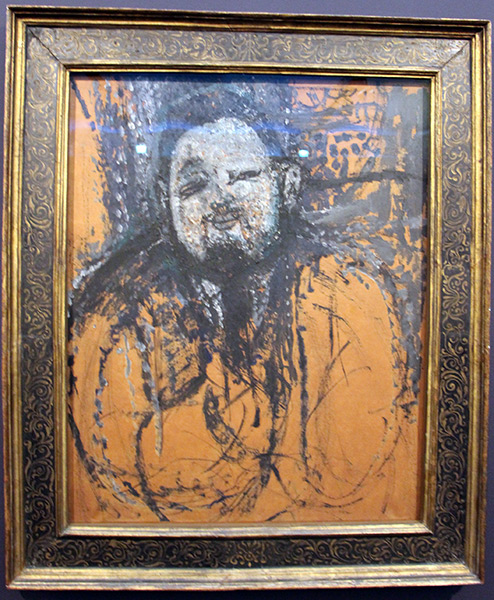
A heavy man fills the whole sheet. His broad, pale face, tilted slightly to his right, sits in a dense black mass of beard, hair and collar. His eyes are reduced to two narrow, half-closed slits, and his mouth is a short smile under a dark moustache. Below the head the body is not painted so much as drawn with the brush: long black and grey-green strokes loop round the shoulders, the belly and the arms, and leave the warm ochre of the support bare between them. Around the head, white, grey and green dabs, set side by side, make a vibrating halo. To the upper right a dark green band crosses the background horizontally, and a scatter of black spots and short strokes suggests some patterned surface or object behind the sitter.
The sitter is the Mexican painter Diego Rivera, who was in Paris for most of the decade before 1921. The Kunstsammlung Nordrhein-Westfalen, which owns the other painted portrait of him by Modigliani (C42), writes that Modigliani and Rivera, "who spent time in the French metropolis between 1911 and 1921, were close friends". Ceroni's note, as transcribed by modigliani1909.com, opens with the same point: "il pittore messicano Diego Rivera fu abbastanza amico di Modigliani: i biografi ricordano le loro discussioni, le bevute, i litigi turbolenti" (the Mexican painter Diego Rivera was quite a friend of Modigliani: biographers recall their discussions, their drinking, their turbulent quarrels). It then gives the reason the work matters: "Opera di notevole interesse per l'esecuzione di gusto divisionista. Si veda anche il n°42" (a work of considerable interest for its divisionist execution; see also no. 42).
Ceroni calls it a studio, a study, but the Museu de Arte de São Paulo, which has owned it since 1952, calls it simply Retrato de Diego Rivera and dates it 1916. This essay looks at the work as it appears in the reproduction on the Secret Modigliani page and in the MASP description, and asks what kind of object it is: a study, an unfinished portrait or a finished work in a deliberately open manner.
Composition and format
The support is large for Modigliani in 1914: about one metre high and 81 cm wide. MASP gives 100.5 × 81 × 3 cm, and Ceroni 100 × 79 cm. The proportions, close to five to four, are much squarer than those of the caryatids and the Paul Alexandre portrait of 1913 (C40). The reproduction on the Secret Modigliani page has a width-to-height ratio of 0.81, which matches the stated dimensions; there is no sign that the image has been cropped.
The head is placed high and a little to the left of centre. Its top almost touches the upper edge, and the chin lies at about two-fifths of the height. The body below spreads to both edges and is cut off by the bottom of the support, so that the sitter seems too big for the frame. Nelson Aguilar, in the 1998 MASP catalogue text reproduced on the museum's website, describes the effect well: the portrait "infringe a regra, explodindo o formato em dois ritmos concêntricos que qualificam a figura exuberante do muralista mexicano" (breaks the rule, exploding the format in two concentric rhythms that define the exuberant figure of the Mexican muralist). He contrasts it with the other Modigliani portraits at MASP, whose figures are "longilíneo" (long-limbed, elongated), and he reads its proportions as "elaborada em número de ouro" (worked out in the golden ratio). I have not measured the composition closely enough to test that claim, and it should be treated as an interpretation.
The two concentric rhythms are visible in the reproduction. An inner oval is formed by the head and the black mass of beard and collar. An outer oval is drawn by the great loops of the shoulders and arms, which swing down from either side of the neck and meet at the bottom edge. The space between them is almost empty ochre. The composition therefore works from the centre outwards, like ripples, rather than being built up from a base.
Line
Line dominates the lower two-thirds of the work. The brush, loaded with thinned black or dark green, moves in long, fast, curving strokes. Some are doubled or tripled, as if the painter searched for the contour several times and left every attempt in place. At the lower left a short spiral, like a coil or a hook, may indicate a hand, a pipe or a fold of cloth; I cannot identify it securely. At the right, long verticals hang from the shoulder. Many strokes end in a drip or a thin trail, which shows that the paint was fluid and the support was probably upright on the easel.
Around the head the line changes character. The outline of the face is closed and firm on the left, where a dark contour separates the pale cheek from the black hair. On the right the face merges with the beard and the ear through broken touches. The eyes are two short, slanted strokes. The mouth is a small curve. The nose is not drawn at all; it is suggested by the change from pale to grey in the middle of the face. This economy of line is typical of the heads Modigliani had been carving in stone in 1911–13, where the features are cut as shallow ridges in a smooth oval. Here, though, the oval is soft and full, not elongated.
Colour
The colour range is narrow: ochre, black, a dull green, grey and white, with a few touches of pinkish flesh in the face. Aguilar's text names three of these elements: "o vazio presente na coloração ocre do papelão é incitado pelas correntes negras e prateadas" (the emptiness present in the ochre colouring of the cardboard is stirred by the black and silvery currents). The ochre is not a painted ground but the support itself, left visible over most of the lower half. The "silvery" currents are the grey-green and white dabs that surround the head and run down the left side.
The face is the lightest area: a mixture of white, grey and pale pink laid in small dabs, so that it seems to glow from within the dark beard. The contrast between the cool, pale face and the warm, bare ochre is the central colour event of the work. There is no red except a faint warmth in the lips and cheeks. Compared with the Düsseldorf portrait (C42), where Ceroni praises the "intensità cromatica", this is almost a monochrome.
Facture
The facture is the reason Ceroni singled the work out. In the area around the head the paint is laid in separate dabs, small and roughly round, of white, grey and green, set close together on the dark ground. MASP's text calls this "a técnica divisionista": the artist "multiplica as pinceladas, criando uma construção em vitral" (multiplies the brushstrokes, creating a construction like stained glass). The word vitral fits the area to the upper left of the head, where the dabs are arranged in vertical rows like leaded glass.
These dabs are not the dots of Seurat or Signac. They are not small, regular or optically mixed; they are thick, irregular and often follow the direction of the form, so that they read as a kind of luminous texture rather than as colour analysis. The face is built the same way: overlapping pale touches over a darker underlayer, which gives it a granular surface. In the lower half the paint is thin and liquid. The contrast between the dense, dabbed head and the thinly drawn body is, I think, deliberate. It concentrates the viewer's attention where the likeness is, and leaves the rest as an energetic notation.
Aguilar compares the work to Cézanne's watercolours: "O quadro é tão inacabado quanto as aquarelas de Cézanne" (the picture is as unfinished as Cézanne's watercolours). The comparison is apt in one respect. In Cézanne's late watercolours the white paper is part of the image, not simply a gap. Here the ochre support plays the same role: it is the colour of the body, the light and the air at once.
Figure and space
There is no clear interior. The dark band at the upper right may be the edge of a shelf, a stretcher or a picture on the wall, and the black spots beside it may be a patterned fabric; none of this is legible. The figure is not placed in a room so much as surrounded by a field of marks. The halo of dabs around the head separates it from the background and pushes it forward. The body has no weight on a chair: the loops of the arms and belly float on the support.
This openness gives the work an impression of speed, as if the sitter had been caught in conversation. It also creates a strange monumentality. The figure fills the sheet and seems larger than life, and the narrow eyes and faint smile make him look inward, amused and self-contained. Aguilar's text goes further and reads the image as "a antecipação destinativa do modelo" (an anticipation of the sitter's destiny), relating the sun-like halo to the "culto solar, pré-colombiano" (pre-Columbian solar cult) that Rivera would honour on his return to Mexico. That reading belongs to Aguilar, and it depends on hindsight; but the halo around the head is a real feature of the painting.
Iconography and the sitter
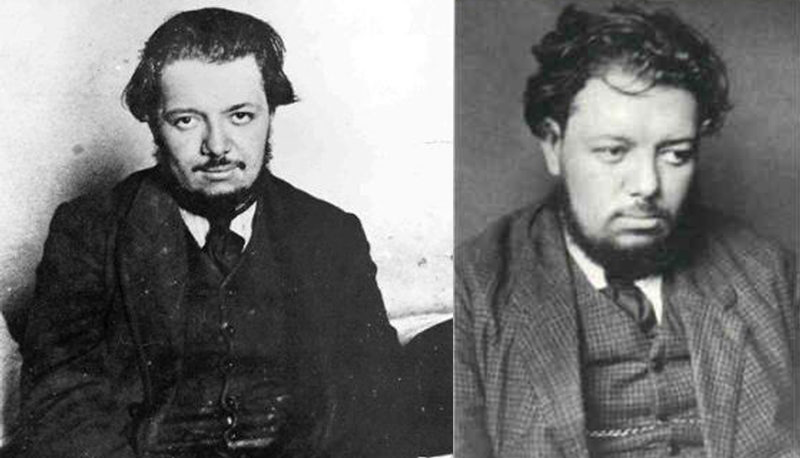
Rivera was a large, heavy man, and photographs of him from 1916 and 1919 are reproduced on the Secret Modigliani page on the work for comparison. Modigliani does not flatter him. He gives him a broad face, a soft double chin hidden in the beard and a massive body, but also a look of calm intelligence. There is no attribute of profession: no brush, palette or canvas. What the portrait conveys is presence and temperament.
The most important document about the work is a letter from Rivera himself. José Rojas Garcidueñas published it in 1974 in the Anales del Instituto de Investigaciones Estéticas of the Universidad Nacional Autónoma de México, after being allowed to copy it at MASP. Rivera, writing from Mexico to Pietro Maria Bardi on 2 September 1953, says that the photograph he was sent "es la de un óleo original de Modigliani, retrato mio para el que posé en mi propio estudio donde trabajaba él frecuentemente en 26 Rue du Depart, en Montparnasse al lado de la estación del ferrocarril. Fue pintado en el año de 1916" (is of an original oil by Modigliani, a portrait of me for which I posed in my own studio, where he often worked, at 26 rue du Départ, in Montparnasse beside the railway station. It was painted in the year 1916).
The letter establishes three things. Rivera recognised the portrait as genuine. He posed for it in his own studio. And he dated it 1916. Rojas Garcidueñas adds, translating from the Portuguese of the MASP documentation, that Modigliani painted "otros tres retratos de Diego Rivera" (three other portraits of Diego Rivera), located in the "Col. J. Nethen, París; Galería Pierre, París; Van de Klip. Bruselas". "Nethen" is evidently Jonas Netter, who owned the Düsseldorf portrait (C42) from at least 1929 to at least 1934, according to the Kunstsammlung Nordrhein-Westfalen. The other two locations cannot be identified from these sources.
Comparisons
The obvious comparison is with C42, the portrait of Rivera in Düsseldorf. The two works are almost the same height (about one metre) and show the sitter in the same pose: head tilted, eyes narrowed, beard merging with a dark collar. In Düsseldorf, however, the whole surface is covered with paint, the palette is dark blue, black and ochre with strong touches of red, and the head is more modelled. Ceroni's two notes point in opposite directions: no. 41 is praised for its "divisionist" execution, no. 42 for its "intensità cromatica" (chromatic intensity). The São Paulo work looks like an earlier, more open stage of the same idea, which is presumably why it is called a study; but nothing in the sources I have seen proves that it was made first or as a preparation for the other.
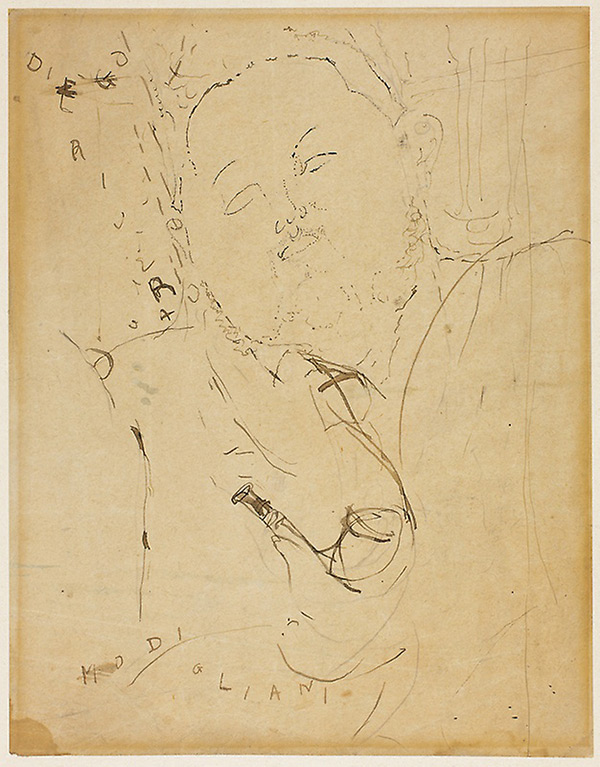
The second comparison is with the drawings. The Martigny exhibition of 1990, as listed on the Secret Modigliani page, showed four drawings of Rivera dated 1914 (nos. 30–33) next to this painting (no. 34). The 1981 exhibition at the Musée d'Art Moderne de la Ville de Paris, according to the Secret Modigliani page on that exhibition, included five drawings of Rivera dated 1914 (nos. 141–145). The existence of so many drawings supports the idea that the sitter posed repeatedly.
The third comparison is with the two portraits of Frank Burty Haviland (C43 and C44), which Ceroni explicitly groups with the Rivera portraits: "Le effigi di Havillard e quelle di Rivera sono uniche per la concezione pittorica nella vicenda di Modigliani" (the portraits of Haviland and those of Rivera are unique in conception in Modigliani's career). In all four works the brush is broken into separate touches. In the LACMA Reverie (C43) the ochre cardboard is also left bare. The difference is that the Haviland portraits are built with brightly coloured dabs, whereas the São Paulo Rivera is almost monochrome.
Finally, Aguilar notes that this portrait differs from the five other Modiglianis at MASP, which belong to the later, elongated manner. Placed beside them, it shows how far the painter was from his mature formula in 1914 (or 1916).
Provenance and exhibitions
MASP gives a single provenance step: "Doação Mario Dedini, 1952" (gift of Mario Dedini, 1952). The Secret Modigliani page gives a fuller sequence: Francis Carco, Paris; the Carco sale at the Hôtel Drouot on 2 March 1925; possibly the Netter collection; possibly Galerie Percier (1934); Galerie de France, Paris (1944–45); Mario Dedini; and MASP from 1952. It also reports that the d'Atri papers give the provenance "Galerie Percier 1933".
Exhibitions on the Secret Modigliani page include Brussels, Palais des Beaux-Arts, 1933 (no. 18, dated 1916); Basel, Kunsthalle, 1934; Paris, Galerie de France, 1945–46; a series of exhibitions in 1953–57 (Paris, Brussels, Utrecht, Bern, London, Düsseldorf, Milan and New York), several of them presenting the masterpieces of MASP; Liège 1980; Tokyo 1989; Martigny 1990 (no. 34); Düsseldorf and Zurich 1991; and Paris and Milan, L'Ange au visage grave, 2002–03. Of these, only Martigny 1990 can be checked against the exhibition list on the Secret Modigliani site, which gives no. 34 as "Diego Rivera, 1914, Huile sur carton, MASP, Sao Paulo".
Discrepancies.
- Date. MASP and Rivera's own letter give 1916; Brussels 1933 also dated it 1916, according to the Secret Modigliani page. Ceroni, Martigny 1990 and the Secret Modigliani page give 1914, and Pfannstiel (1956) is cited for "the end of 1914". Rivera's letter was written 37 years after the event and could be mistaken; but it is the only first-hand statement.
- Medium. MASP's data field says "Óleo sobre papel" (oil on paper), while its own catalogue text, by Aguilar, refers to the "papelão" (cardboard). Rojas Garcidueñas, who saw the work, wrote "óleo, sobre cartón". Martigny 1990 and the Secret Modigliani page say cardboard. Ceroni, says canvas, which is certainly wrong.
- Dimensions. MASP gives 100.5 × 81 cm and Ceroni and Rojas Garcidueñas 100 × 79 cm. The differences of up to 2 cm in width are larger than usual and might reflect measurement inside or outside a frame.
- Place. Rivera says he posed in his own studio at 26 rue du Départ. The Secret Modigliani page quotes the 2002 Luxembourg catalogue (MR) as saying that "Modigliani used to stay at Rivera's home, in the 16 Rue du Saint-Gothard. he executed this portrait there". Both may be true at different times, but they cannot both describe the place where this portrait was painted unless Rivera misremembered.
- Title. MASP calls it a portrait, not a study or sketch.
- The "three other portraits". Rivera's secretary listed three other painted portraits of Rivera by Modigliani. Only one other is known today (C42). The Secret Modigliani page notes that Parisot's catalogue "makes a mix with the provenance of both paintings".
Technical analysis
No technical study of this work has been published that I could find or open. MASP's website lists a conservation department, but its page on the work gives no technical data. The following remarks are therefore based on the reproduction and on comparative evidence from other works.
The support is probably cardboard, as most sources say. The ochre colour of the bare areas is consistent with an unprimed commercial board, and the sharp edges of the dabs on top of it suggest that the board did not absorb the paint quickly. The drips at the lower edge of some strokes show that the paint was thinned and the support was upright. The depth of 3 cm given by MASP must include a backing or mount, since cardboard itself is much thinner; I have no information on how the work is mounted.
As comparative evidence, the Tate Papers, no. 35, study of Modigliani's hidden paintings states that "During the early years of his career, Modigliani painted on various kinds of support, from cardboard to canvas", and that the choice was "largely influenced by his precarious financial situation". The same study adds that "He also painted in other artists' studios, using their supplies in addition to or instead of his own". This fits Rivera's account that Modigliani "worked frequently" in his studio. The Burlington Magazine introduction to the Tate study notes that its analysis of standard canvas sizes covered only "paintings in the exhibition that used strainers (so excluding those on board)", which confirms that the boards of 1914–15 have not been studied in the same systematic way.
What would a technical examination tell us? Infrared reflectography could show whether there is underdrawing in charcoal or graphite beneath the black loops, which would help to decide whether this was conceived as a study. Pigment analysis could identify the white (lead or zinc) and the green, and compare them with the Düsseldorf portrait. Dendrochronology is irrelevant, but fibre analysis of the board could show whether the two Rivera portraits are on the same kind of support. None of this has been published.
Conclusion
The São Paulo portrait of Diego Rivera is less a study than a demonstration of how much Modigliani could leave out. A pale face, built of separate dabs, glows in a halo of grey and white touches; everything else is drawn with a few fast black loops on bare ochre board. The result is both intimate and monumental, and quite unlike the elongated portraits for which Modigliani is known.
Its documentation is unusually rich, thanks to Rivera's letter of 1953, and unusually contradictory. The date (1914 or 1916), the medium (paper, cardboard or canvas), the place (rue du Départ or rue du Saint-Gothard) and even the title (portrait or study) all vary from source to source. What is clear is that Rivera himself accepted the work as a portrait of him, painted from life, and that Ceroni was right to group it with the Haviland portraits as a moment, unique in Modigliani's work, when he tried a divisionist touch.
Museum, auction and exhibition sources
- Museu de Arte de São Paulo Assis Chateaubriand (MASP), Retrato de Diego Rivera, 1916, inv. MASP.00147, with text by Nelson Aguilar from Luiz Marques (ed.), Catálogo do Museu de Arte de São Paulo Assis Chateaubriand (1998; reprinted 2008), https://masp.org.br/acervo/obra/retrato-de-diego-rivera
- Kunstsammlung Nordrhein-Westfalen, Düsseldorf, Portrait de Diego Rivera, 1914, inv. 0231 (for the friendship and the Netter provenance), https://sammlung.kunstsammlung.de/en/works/104 and https://www.kunstsammlung.de/en/collection/work/bildnis-diego-rivera-1914-english-version
Technical literature (comparative)
- Anaïs Genty-Vincent, Simonetta Fraquelli, Annette King, Allison Langley, Jennifer Mass, Kim Muir, Mina Porell, Marie-Amélie Senot and Anya Shutova, "Works by Modigliani that have Paintings beneath the Visible Surface", Tate Papers, no. 35, https://www.tate.org.uk/research/tate-papers/35/works-by-modigliani-that-have-paintings-beneath-the-visible-surface (comparative)
- Annette King, Nancy Ireson, Simonetta Fraquelli and Joyce H. Townsend, "The Modigliani Technical Research Study: An introduction to Modigliani's materials and techniques", The Burlington Magazine, vol. 160, no. 1380 (March 2018), https://www.burlington.org.uk/archive/article/the-modigliani-technical-research-study-an-introduction-to-modiglianis-materials-and-techniques (comparative)
Secondary transcription
- José Rojas Garcidueñas, "Diego Rivera por Modigliani", Anales del Instituto de Investigaciones Estéticas, vol. XII, no. 43 (1974), p. 131, https://doi.org/10.22201/iie.18703062e.1974.43.999 (PDF: https://www.analesiie.unam.mx/index.php/analesiie/article/download/999/986/1004); transcribes Diego Rivera's letter to P. M. Bardi of 2 September 1953
- "Catalogue de l'Oeuvre Peint de Modigliani di Ambrogio Ceroni", modigliani1909.com (web transcription of catalogue caption and notes, nos. 41, 42 and 44), https://www.modigliani1909.com/ceroni.html
Cited but not independently consulted
Brussels, Palais des Beaux-Arts, Modigliani, 1933, no. 18; Galerie de France, Modigliani Peintures, 1944–45, no. 1; Musée de l'Orangerie, 1953, p. 69; Descargues, 1951 and 1954, pl. 32; Pfannstiel, Modigliani et son œuvre, 1956, no. 28; Roy, Modigliani, 1958, p. 36, and 1985, p. 38; Ceroni, Amedeo Modigliani peintre, 1958; Jeanne Modigliani, Modigliani: Man and Myth, 1958, pl. 30; Werner, 1967 and 1968; Diehl, 1969 and 1989, p. 30; Lanthemann, 1970, no. 49; Ceroni and Piccioni, 1970, no. 41; Mann, 1980; Zurcher, 1980, no. 3; Carluccio et al., École de Paris, 1981, p. 207; Castieau-Barrielle, 1987; Parisot, 1988 and 1991, no. 3/1914, and 1992; Buisson, 1989, p. 101; Tokyo, 1989, no. 6; Martigny, Fondation Pierre Gianadda, 1990, no. 34; Schmalenbach, 1990; Patani, 1991–94, no. 46; Krystof, 2000, p. 42; Modigliani: l'ange au visage grave, Musée du Luxembourg, 2002, pp. 176–177; Soto Caba, 2007.
Footnotes
- Arthur Pfannstiel, Modigliani et son œuvre, étude critique et catalogue raisonné, Paris, Bibliothèque des Arts, 1956.
- Ambrogio Ceroni, Amedeo Modigliani: Peintre; suivi des souvenirs de Lunia Czechowska, Milan, Edizioni del Milione, 1958.
- Jeanne Modigliani, Modigliani: Man and Myth, New York, Orion Press, 1958.
- Joseph Lanthemann, Modigliani, catalogue raisonné: sa vie, son œuvre, son art, Barcelona, G. Condal, 1970.
- Ambrogio Ceroni and Leone Piccioni, I dipinti di Modigliani, Milan, Rizzoli, 1970.
- Carol Mann, Modigliani, London, Thames and Hudson, 1980.
- Thérèse Castieau-Barrielle, La vie et l’œuvre de Amedeo Modigliani, Paris, ACR, 1987.
- Werner Schmalenbach, Amedeo Modigliani, Munich, Prestel, 1990.
- Christian Parisot, Catalogue raisonné Modigliani, Livorno, Graphis Arte, 1991.
- Osvaldo Patani, Amedeo Modigliani: catalogo generale, Milan, Leonardo, 1991–94.
- Christian Parisot, Modigliani, Paris, Pierre Terrail, 1992.
- MR (cited here as MR), Modigliani: l’ange au visage grave, Paris, Musée du Luxembourg, 2002. Cited from the published exhibition catalogue only.
- Victoria Soto Caba, Modigliani: The Timeless Face, Madrid, Libsa, 2007.