Woman seated with a glass
Oil on cardboard? — 1914 ?
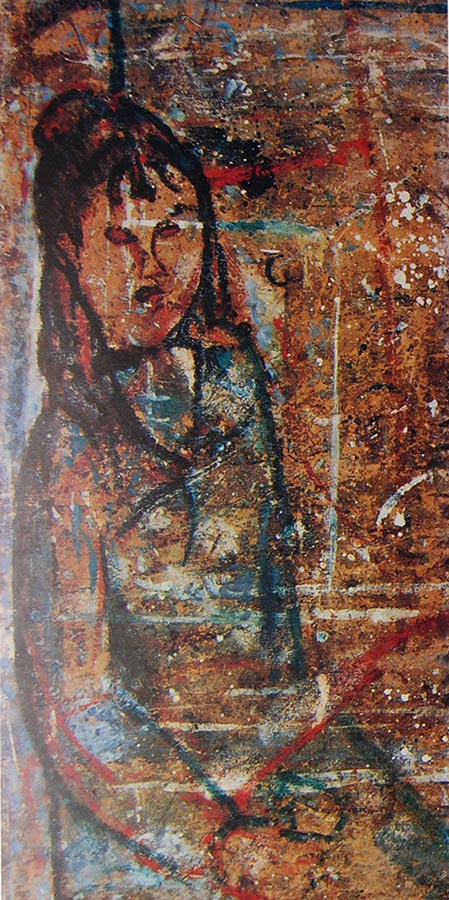
Identification
- Title
- English: Woman seated with glass - Beatrice Hastings with glass - The absinthe drinker.
Notes: Donna seduta, con bicchiere (Ceroni); Femme Assise tenant un verre (Martigny, 1990); Seated woman with a glass (Paris, 1981) - Date
- 1914 ?
Notes: 1914 (Parisot 1991, and Paris Ex.1981); 1915 (Parisot 1992, and Martigny 1990) - Medium
- Oil on cardboard (Martigny 1990)
Notes: "Huile sur carton"- oil on paper (Ceroni); oil on panel (Parisot) - Dimensions
- 103 x 50.5 cm
Notes: 102 × 51 cm (Ceroni; Parisot); 103 × 50 cm (Pfannstiel; Descargues); 103 × 49 cm (d'Atri papers) - Signature
- Signed "modigliani" upper left
- Present location
- Private Collection?
Catalogue numbers
| Compiler | Number |
|---|---|
| Arthur Pfannstiel | 1929 / no. 1- 1956 / no. 31 |
| Joseph Lanthemann | no. 73 |
| Ambrogio Ceroni | no. 47 |
| Jeanne Modigliani | YES |
| Christian Parisot | 2/1914 |
| Osvaldo Patani | no. 52 |
| Modigliani Project | ? |
| MR | YES |
| Modigliani Initiative/ AMDC | ? |
Legal note on MR: This investigation has not had access to MR’s catalogue raisonné; all research here is based on open sources, publications and exhibitions. By no means has that catalogue been copied at any point. Modigliani Project and Modigliani Initiative are marked YES when the work is published or otherwise recorded by those projects, even if no catalogue number is assigned; otherwise the field is marked ?.
Provenance
- Galerie Bing, Paris (1925-29 to 1955?)
- Coll. Tenoudji, Paris (1958)?
- Private Collection, Paris
- Galerie Petrides, Paris (1990)
- Private Collection?
The sequence follows the published museum, sale, and catalogue record in this investigation. Gaps and uncertain transfers are marked as such.
Selected bibliography
Book-length publications are marked with a footnote giving a full citation. Exhibition catalogues appear in both this list and the exhibition list when this investigation recorded them in both places.
- Pfannstiel, "catalogue presume" Modigliani. L'Art et la Vie. Preface by Louis Latourette, Seheur, Paris, 1929, p. 10, no. 11
- Descargues, Paris, 1951, pl. 24 (as the Absinthe drinker 103 x 50 with the text "Cliche Bing")
- Descargues, Paris, 1954, pl. 24
- (as the Absinthe drinker 103 x 50 with the text "Cliche Bing")
- Pfannstiel, Modigliani et son œuvre, étude critique et catalogue raisonné, Bibliothèque des Arts, Paris, 1956 - no. 322
- Ceroni, Amedeo Modigliani: Peintre; Suivi des Souvenirs de Lunia Czechowska, Edizioni del Milione, 1958 - no. 1583
- Lanthemann, Modigliani, catalogue raisonné: sa vie, son œuvre, son art, Barcelona, 1970 - no. 734
- Ceroni & Piccioni, I dipinti di Modigliani, Rizzoli, Milano, 1970 - no. 47 ( incorrectly as oil on paper, size wrong 102 x 51)
- Musée de Art Moderne de la Ville de Paris, Modigliani- 1981, p. 110, no.18
- Buisson, la Scuola di parigi e Modigliani,
- Graphis Arte, 1989, p. 100
- Catalogue, Modigliani, Fondation Pierre
- Gianadda, Martigny, 1990, P. 106, no. 36
- Parisot, Catalogue Raisonné Modigliani, Graphis Arte, 1991 - no. 2/1914 (dated 1914)
- Patani, Catalogo Generale, Leonardo, Milano, 1991-94 - no. 527
- Parisot, Modigliani, Pierre Terrail, Paris, 1992, p. 58 (dated 1915)
- Parisot, A. Modigliani Jeanne Hébuterne e gli artisti di Montmartre e Montparnasse, Maiocchi Edizioni, Milano, 2003, pp. 126-127
- Soto Caba, Modigliani, The timeless face, Libsa, 2007
Exhibitions
- Paris. Galerie Bing. 1925
- Bern, Modigliani Campigli Sironi, Kunsthalle Bern, 1955 - no. 2
- Paris, Musée d’Art Moderne de la ville de
- Paris, Modigliani, 1981 - no. 18
- Paris, Galerie Paul Pétrides, I989
- Martigny, Modigliani, Fondation Pierre Gianadda, 1990 - no. 36
- Bari, Amedeo Modigliani, Jeanne Hébuterne e gli artisti di Montmartre e Montparnasse, Castello Svevo, 2003 (curated by Christian Parisot)
- Caserta, A. Modigliani Jeanne Hébuterne e gli artisti di Montmartre e Montparnasse, Belvedere Reale di San Leucio, 2003
Notes
No further documentary note is recorded in this investigation beyond the fields above. Where sources disagree, both readings are given.
Introduction
A tall, narrow picture of a seated woman with long dark hair. It is painted thinly in a few colours and with much of its structure in line. Ceroni's caption reads "Donna seduta, con bicchiere, Parigi, proprietà privata" (Seated woman, with a glass, Paris, private property). His note is short and exact: "Dipinto scarno di materiale, essenzialmente disegnativo" (a painting sparse in material, essentially drawn). The Secret Modigliani page on the work gives two other titles. The absinthe drinker comes from Descargues's plates of 1951 and 1954. Beatrice Hastings with glass identifies the sitter with the English writer who was Modigliani's partner from 1914 to 1916.
The work is little known. It was last seen in public, according to the same page, in two exhibitions of 2003 curated by Christian Parisot, at Bari and Caserta. The only reproduction available the one on this page. It is photographed from a printed plate, and the halftone screen is visible on enlargement. Its colour cannot be trusted, and fine detail is lost.
The analysis that follows describes what can be seen with reasonable confidence. It says so where the image does not allow a firm reading. It then sets the work beside the other narrow vertical portraits of the same months, above all Beatrice Hastings at the piano (Ceroni no. 45).
Composition and format
The format is extreme. At 103 × 50.5 cm the height is about twice the width, and the page's reproduction has a width-to-height ratio of 0.499, which agrees with the size given (0.490). Such a format is not a standard French canvas size. It is consistent with a sheet of paper or board cut to measure. Modigliani used almost exactly the same proportions for Beatrice Hastings at the piano, given by the Secret Modigliani page as 102 × 48.5 cm on cardboard. The two pictures could have been cut from the same stock, though nothing proves it yet.
The figure is pushed to the left. The head sits in the upper left quarter, its left side close to the edge of the support. A long fall of dark hair frames the face on both sides. Above the head, a dark vertical line rises from the crown of the hair to the top edge. It might be read as a cord, a bar of the background or simply a constructional line. The body descends along the left side of the panel as a series of dark contours. Its outline curves out to the left at the level of the hip and returns at the bottom edge. In the lower half a long red line runs diagonally from the lower left upwards to the right. It crosses other lines and may mark an arm or the edge of a table. Several pale horizontal strokes cross the lower half from side to side. They may be the edges of a table, a bench or a wall, but the reproduction does not allow a sure reading.
The right half of the picture is background, crossed by vertical and horizontal strokes. A short red horizontal mark lies at the height of the eyes, to the right of the head. Just below it is a small curved shape, like an open "C". It could be the rim or handle of a glass or cup, and so the object of the title. I cannot be sure of this: in the reproduction I cannot identify a drinking glass with any certainty. The title has been transmitted since Ceroni, and the glass must be accepted on the authority of those who saw the original.
Line
Ceroni's word "disegnativo" is the best description of the picture. The drawing is done with a brush loaded with dark paint, blue-black or dark brown, and it varies in width from a thin trace to a broad band. The face has the features Modigliani gave Hastings in other portraits. It is a long oval with a pointed chin. The eyes are two small, dark, slightly uneven shapes, the brows are short arcs, and the nose is a long straight line ending in a small hook. The small mouth is dark and slightly open. The line of the jaw is drawn firmly on the viewer's left and lost on the right, where face and hair merge.
The body is all line. A dark contour descends from the shoulder on the viewer's left to the bottom edge, and a second runs parallel to it inside. Between them a long pale band marks the torso or the arm. On the right side of the figure a broad vertical stroke of blue-green and black descends from the chin to the lap and gives the figure its weight. It may be the edge of a dark dress or a long lock of hair. The lower half of the composition is crossed by red lines, which interrupt the dark drawing and create a second, warmer network.
Colour
In the reproduction, the dominant colour is an orange-ochre that covers almost the whole surface. It reads as the colour of the support or of a thin warm priming showing through. Over it Modigliani has laid a dark drawing in blue-black, small areas of blue-green and turquoise, a few strokes of vermilion and many short white or cream strokes. The face is warmer than the background, a darker orange with reddish shadows. It is the only area where the colour is applied in a continuous layer.
The white strokes deserve attention. Some are clearly part of the composition, such as the horizontal lines in the lower half and the vertical line to the right of the figure. Others are small spatters and dots scattered over the upper right of the picture. They look less like brushwork than like drops, or possibly losses where the paint layer has flaked to show a pale ground. A printed reproduction cannot settle this. If they are losses, the support would have a pale preparation under the orange. If they are spatters, they are an unusual, almost accidental element in Modigliani's painting.
Facture
"Scarno di materiale" means that the paint is thin. The support's own colour and texture remain visible over large parts of the surface. Strokes are dragged rather than laid. In several places the brush seems almost dry, leaving broken marks that let the ground show through. The painting has the character of a large oil sketch, made rapidly with relatively few colours. Modigliani's other portraits of these months, such as Beatrice Hastings with a hat (Ceroni no. 46), are painted in a dense impasto. That picture builds the face out of separate, thick touches of colour. Here the face is drawn and then filled in with a thin, warm layer, and the rest of the figure is left as drawing.
The difference between paper, cardboard and panel, the three supports proposed in the literature, cannot be judged from the reproduction. On a smooth paper or board the dragged strokes would leave broken marks of exactly this kind. The slightly grainy texture of the background also fits a board or a heavy paper rather than a canvas. That is an impression and not an examination.
Figure and space
The space is shallow and ambiguous. The figure is placed against a background of crossing lines that might be the panelling of a café or a room, but no element is sufficiently described to build a setting. The pale horizontal lines in the lower half suggest a table at which the woman sits, with the glass, if that is what the curved form is, placed on or above it. Yet the lines continue through the figure. They do not stop at its contour, so the table and the figure occupy the same plane. This flattening, in which background and figure are drawn with the same line and the same colours, connects the picture with the Cubist experiments that the Modigliani Initiative mentions in its account of the Hastings portraits.
The woman is seen frontally but turned slightly to the viewer's right, with her head tilted down. Her gaze is directed out of the picture to the right, towards the curved form and the red mark. The expression is withdrawn, close to melancholy, which fits the title given by Descargues, The absinthe drinker. That title evokes a theme with a long history in Paris painting, from Manet and Degas to Picasso. Its use for this picture by Descargues and the photographs "Cliche Bing" that the Secret Modigliani page reports show how the work was framed for the market in the 1950s.
Iconography and sitter
Ceroni does not name the sitter, and the identification with Beatrice Hastings is not found in his caption. On the page appears only as an alternative title. It is plausible on visual grounds. Tate Papers, no. 35 lists features shared by an X-radiographed figure and the portrait of Hastings at the Art Institute of Chicago (C58): "both sitters wear their dark hair piled on top of their head, with a jagged fringe; both have oval-shaped faces with narrow pointed chins, have long necks". The oval face, the pointed chin and the mass of dark hair are present here. The hair, however, falls loose rather than being piled up. Beatrice Hastings at the piano (Ceroni no. 45), with which the present work shares its format, is the closest comparison. A secure identification would need an independent source, such as an early exhibition title or a statement by someone who knew the sitter. I have not found one.
The glass and the title The absinthe drinker place the picture among the café subjects of Modigliani's Montparnasse years.
Comparisons
The most useful comparisons are with the two other Hastings pictures already treated. Beatrice Hastings at the piano (Ceroni no. 45) is the same kind of narrow, tall picture on cardboard, but painted densely. Beatrice Hastings with a hat (Ceroni no. 46) is on canvas and built up in thick separate strokes. The present work is the opposite pole: thin, linear and fast. If all three portray the same sitter, they illustrate the range of manners Modigliani tried in the first year of his return to painting. That range is what the Modigliani Initiative describes when it speaks of portraits ranging "from Pointillism to Cubism".
The linear construction also connects the picture to the drawings of 1914–15, in which Modigliani sets the figure in a few continuous lines. The Tête rouge (Ceroni no. 50) in this batch shows another path out of the same drawing: there, line encloses a saturated colour field. Here, line stands almost alone on a coloured ground.
Provenance and exhibitions
According to the investigation page on the work, the provenance runs as follows:
- Galerie Bing, Paris ("1925-29 to 1955?").
- Coll. Tenoudji, Paris ("(1958)?").
- Private Collection, Paris.
- Galerie Petrides, Paris (1990).
- Private Collection?
Ceroni's caption gives "Parigi, proprietà privata". The Secret Modigliani list of Ceroni numbers gives "Tenoudji Coll. Paris" as the owner in Ceroni's day.
The exhibitions given are:
- Paris, Galerie Bing, 1925.
- Bern, Kunsthalle, Modigliani Campigli Sironi, 1955, no. 2.
- Paris, Musée d'Art Moderne de la Ville de Paris, Modigliani, 1981, no. 18. The Secret Modigliani exhibition page lists no. 18 as "Seated woman with a glass 1914".
- Paris, Galerie Paul Pétrides, "I989".
- Martigny, Fondation Pierre Gianadda, Modigliani, 1990, no. 36. The Secret Modigliani exhibition page lists no. 36 as "Femme Assise tenant un verre", 1915, "Huile sur carton", lent by the Galerie Petrides, Paris.
- Bari, Castello Svevo, and Caserta, Belvedere Reale di San Leucio, 2003.
Discrepancies
- Support. Cardboard (Martigny 1990), paper (Ceroni, who also wrote "Dipinto scarno di materiale") and panel (Parisot). The page marks Ceroni's paper as incorrect based on visual image, further investigation must be done.
- Dimensions. 103 × 50.5, 103 × 50, 102 × 51 and 103 × 49 cm. The differences are small and probably reflect different measurements of an irregular sheet.
- Date. Parisot dates it 1914 in 1991 and 1915 in 1992, and the two exhibitions differ in the same way (1914 in Paris, 1981; 1915 in Martigny, 1990).
- Pfannstiel 1956. The table gives no. 31. The bibliography reads "no. 322", which, after removing the footnote digit, gives no. 32. That is the number the page on Ceroni no. 46 gives for Beatrice Hastings with a hat. The table's 31 is probably correct.
- Ceroni 1958. The bibliography reads "no. 1583". After removing the footnote digit, this gives no. 158. That is a surprisingly high number for a picture of 1914–15, given that the same edition is cited as no. 36 for no. 45 and no. 46.
Technical analysis
No technical study of this picture has been published, as far as I can find, and its present location is unknown. Everything that can be said about materials is based on visual inspection of a printed reproduction and on comparison with studies of other works.
The two facts most worth establishing are the nature of the support and whether there is a ground. The orange-ochre colour that dominates the reproduction may be the colour of a card, of a thin priming, or of a film of oil paint. The white spatters may be paint or losses. King, Ireson, Fraquelli and Townsend set aside works "on board" from their analysis of standard canvas sizes, because their survey of formats was limited to "paintings in the exhibition that used strainers (so excluding those on board)". Tate Papers, no. 35 notes, in a footnote, that "The use of embossed wallpaper as a support is evident in" a portrait of Beatrice Hastings of 1915 (private collection, C76). Modigliani's choice of unusual paper or board supports for portraits of Hastings is therefore attested in at least one other case. These are comparative facts only.
If the picture were examined, raking light would show whether the white marks sit on top of the paint or are losses. Ultraviolet would show later retouching. An examination of the edges would settle whether the support is a single card, paper laid on board or a panel. Until then, Ceroni's observation remains the most precise statement about the picture's technique.
Conclusion
Woman seated with a glass is an essentially graphic picture in which Modigliani uses the brush to draw. He leaves the warm support or ground to stand for flesh and atmosphere, and sets a few lines of red and white against a dark network of contours. Its extreme vertical format and the oval face with its pointed chin relate it to Beatrice Hastings at the piano, and its thin, rapid handling sets it apart from the dense portraits of Hastings. The identification with Hastings remains plausible but unproven.
The documentation is unstable. The support, the date, the Pfannstiel number of 1956 and the Ceroni number of 1958 all vary between sources, and the work's present owner is unknown. The glass of the title cannot be located with certainty in the available reproduction. Only an examination of the original, or a good colour photograph, could settle the questions this essay leaves open.
Museum, auction and exhibition sources
- The Modigliani Initiative, Amedeo Modigliani Digital Catalogue, "Portrait of Beatrice Hastings, 1914 (AMDC 25)", https://catalogue.modigliani-initiative.org/catalogue/entry.php?id=25 (for the range of the Hastings portraits; the Modigliani Initiative does not publish this work)
Technical literature (comparative)
- Annette King, Nancy Ireson, Simonetta Fraquelli and Joyce H. Townsend, "The Modigliani Technical Research Study: An introduction to Modigliani's materials and techniques", The Burlington Magazine, vol. 160, no. 1380 (March 2018), https://www.burlington.org.uk/archive/article/the-modigliani-technical-research-study-an-introduction-to-modiglianis-materials-and-techniques (comparative)
- Anaïs Genty-Vincent et al., "Works by Modigliani that have Paintings beneath the Visible Surface", Tate Papers, no. 35, https://www.tate.org.uk/research/tate-papers/35/works-by-modigliani-that-have-paintings-beneath-the-visible-surface (comparative)
- Barbara Buckley et al., "Modigliani's Painted Nudes: A Technical Study", Tate Papers, no. 35, https://www.tate.org.uk/research/tate-papers/35/modiglianis-painted-nudes-technical-study (comparative; footnote on the wallpaper support of C76)
Sources that could not be opened
The work's present location is unknown, and no colour photograph made from the original was found. The catalogues of Bern 1955, Bari and Caserta 2003, and the Galerie Pétrides exhibition were not available. Descargues's plates with the "Cliche Bing" credit are known only from the Secret Modigliani page's description.
Cited but not independently consulted
Pfannstiel, Modigliani. L'Art et la Vie, 1929, p. 10, no. 1; Descargues, Paris, 1951 and 1954, pl. 24 (as the Absinthe drinker, 103 × 50, "Cliche Bing"); Pfannstiel, Modigliani et son œuvre, 1956, no. 32 (table: no. 31); Ceroni, Amedeo Modigliani: Peintre, 1958, no. 158; Lanthemann, 1970, no. 73; Ceroni and Piccioni, I dipinti di Modigliani, 1970, no. 47; Musée d'Art Moderne de la Ville de Paris, Modigliani, 1981, p. 110, no. 18; Buisson, La Scuola di Parigi e Modigliani, 1989, p. 100; Modigliani, Fondation Pierre Gianadda, Martigny, 1990, p. 106, no. 36; Parisot, 1991, no. 2/1914; Patani, 1991–94, no. 52; Parisot, Modigliani, Pierre Terrail, 1992, p. 58; Parisot, A. Modigliani, Jeanne Hébuterne e gli artisti di Montmartre e Montparnasse, Maiocchi, 2003, pp. 126–127; Soto Caba, 2007. Page and catalogue numbers are given without the footnote digits the page attaches to them (for example "no. 734" is read as no. 73, footnote 4). All are cited from the Secret Modigliani page on the work.
Footnotes
- Arthur Pfannstiel, Modigliani. L’Art et la Vie, preface by Louis Latourette, Paris, Seheur, 1929 (presumed catalogue).
- Arthur Pfannstiel, Modigliani et son œuvre, étude critique et catalogue raisonné, Paris, Bibliothèque des Arts, 1956.
- Ambrogio Ceroni, Amedeo Modigliani: Peintre; suivi des souvenirs de Lunia Czechowska, Milan, Edizioni del Milione, 1958.
- Joseph Lanthemann, Modigliani, catalogue raisonné: sa vie, son œuvre, son art, Barcelona, G. Condal, 1970.
- Ambrogio Ceroni and Leone Piccioni, I dipinti di Modigliani, Milan, Rizzoli, 1970.
- Christian Parisot, Catalogue raisonné Modigliani, Livorno, Graphis Arte, 1991.
- Osvaldo Patani, Amedeo Modigliani: catalogo generale, Milan, Leonardo, 1991–94.
- Christian Parisot, Modigliani, Paris, Pierre Terrail, 1992.
- Victoria Soto Caba, Modigliani: The Timeless Face, Madrid, Libsa, 2007.