Beatrice Hastings at the piano
Oil on cardboard — 1914
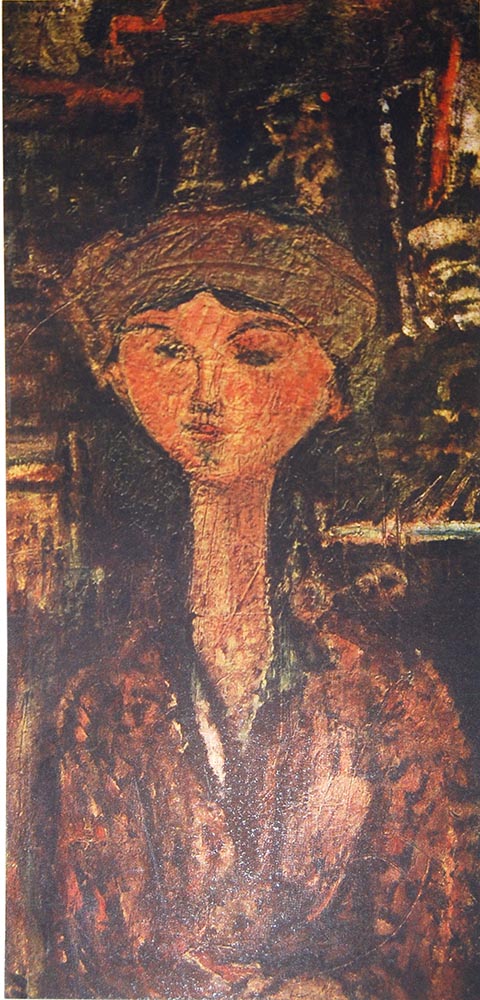
Identification
- Title
- English: Beatrice Hastings at the piano
French: Beatrice Hastings devant le piano; Beatrice Hastings au piano.
Notes: Portrait au piano (Madame Hasting) (Hôtel Drouot sale catalogue, 12 May 1939, lot 76); Beatrice Hastings (Ceroni); La signora Hastings davanti al pianoforte ( according to Ceroni's 1958 note) - Date
- 1914
Notes: 1914 in the work; towards the end of 1914 (Ceroni's note); 1915 (d'Atri papers); "commencement de 1915"(Hôtel Drouot sale catalogue, 12 May 1939, lot 76). - Medium
- Oil on cardboard
Notes: Oil on cardboard (Pfannstiel, D’Atri); oil and graphite on cardboard (Ceroni 1958); oil on canvas (Ceroni 1970; Patani; Carrieri 1947); "Carton sur toile" (1939 sale catalogue). - Dimensions
- 102 x 48,5 cm ?
Notes: 102 × 48.5 cm (1939 sale catalogue: "Haut., 1 m. 02; larg., 48 cent. 1/2"); 102 × 46.5 cm (Pfannstiel; d'Atri papers); 102 × 48 cm (Ceroni; Parisot)
- Signature
- Signed "Modigliani " upper left and dated 14
Notes: signed top right and dated 1915 (D'Atri papers- probably a mistake) - Present location
- Unknown Private Collection or lost ?
Catalogue numbers
| Compiler | Number |
|---|---|
| Arthur Pfannstiel | no. 30 |
| Joseph Lanthemann | no. 51 |
| Ambrogio Ceroni | 1958 / no. 36 - 1970 / no. 45 |
| Jeanne Modigliani | YES |
| Christian Parisot | 1/1914 |
| Osvaldo Patani | no. 50 |
| Modigliani Project | ? |
| MR | YES |
| Modigliani Initiative/ AMDC | ? |
Legal note on MR: This investigation has not had access to MR’s catalogue raisonné; all research here is based on open sources, publications and exhibitions. By no means has that catalogue been copied at any point. Modigliani Project and Modigliani Initiative are marked YES when the work is published or otherwise recorded by those projects, even if no catalogue number is assigned; otherwise the field is marked ?.
Provenance
- Leopold Zborowsk, Paris
- Galerie Bing, Paris (1929)
- Private Collection, France?
- Sold: Paris, Drouot 12 May 1939 lot 76
- Private Collection, Milano (Ca. 1946)
- Unknown location or lost?
The sequence follows the published museum, sale, and catalogue record in this investigation. Gaps and uncertain transfers are marked as such.
Selected bibliography
Book-length publications are marked with a footnote giving a full citation. Exhibition catalogues appear in both this list and the exhibition list when this investigation recorded them in both places.
- Pfannstiel, "catalogue presume" Modigliani. L'Art et la Vie. Preface by Louis Latourette, Seheur, Paris, 1929, p. 61
- S. Taguchi, Tokyo 1936
- Hotel Drouot, Paris 12 May 1939, lot 76, p. 25 ( in the auction they say 102 x 48, 5 - canvas over cardboard, it is probably the type of texturated cardboard in many other works)
- Cat. exposition, Modigliani, Associazione fra gli amatori e i cultori delle arti figurative contemporanee, Milano, 1946, pl. 2
- Carrieri, Modigliani, 12 opere de Modigliani, E. il Milione,
- Milan 1947, pl. 2 (incorrectly named as oil on canvas and located in Private Collection, Milano)
- Milan 1950, pl. 2
- Pfannstiel, Modigliani et son œuvre, étude critique et catalogue raisonné, Bibliothèque des Arts, Paris, 1956 - no. 302
- Jeanne Modigliani, Modigliani: Man and Myth, Orion Press, New York, 1958, mentioned in text p. 753
- Ceroni, Amedeo Modigliani: Peintre; Suivi des Souvenirs de Lunia Czechowska, Edizioni del Milione, 1958 - no. 36 (incorrectly named as oil on canvas, 102 x 48 cm and as lost)
- Lanthemann, Modigliani, catalogue raisonné: sa vie, son œuvre, son art, G. Condal, Barcelona, 1970 - no. 515
- Ceroni & Piccioni, I dipinti di Modigliani, Rizzoli, Milano, 1970 - no. 456
- Parisot, Catalogue Raisonné Modigliani, Graphis Arte, 1991 no. 1/1914
- Patani, Catalogo Generale, Leonardo ed. Milano 1991-94 - no. 508
- Soto Caba, Modigliani, The timeless face, Libsa, 2007
Exhibitions
- Milano, Modigliani, Associazione fra gli amatori e i cultori delle arti figurative contemporanee, 1946
Notes
As no. 264 in D’Atri papers as oil on cardboard or cardboard laid on canvas - size 102 x 46.5 signed top right and dated 1915 (clearly a mistake is signed top left and dated 1914) - provenance in Zborowski > Bing 1929
Where sources disagree, both readings are given. This is a working research page, not a catalogue raisonné.
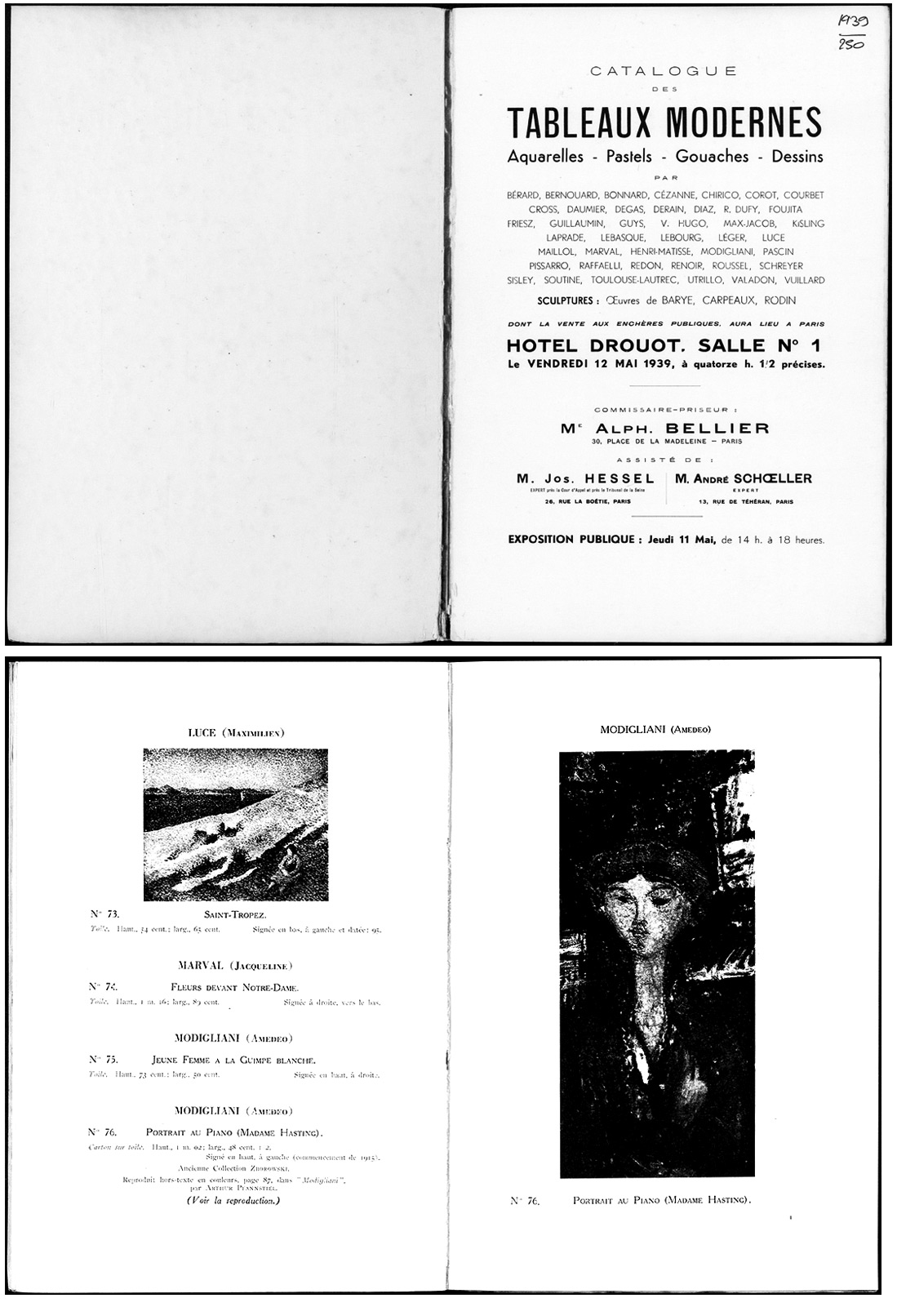
Catalogue of the Auction in 1939: For this auction the work must probably have an Andre Schoeller expertise certificate very common in similar works from the period.
Introduction
This is, according to Ceroni, the first of Modigliani's many portraits of Beatrice Hastings, and the work has not been seen in public since 1946. His note reads: "L'effigiata è l'inglese Beatrice Hastings, poetessa e scrittrice, con la quale Modigliani convisse, più o meno burrascosamente, per quasi due anni. Alla prima catalogazione il dipinto fu citato come La signora Hastings davanti al pianoforte. E' pensabile che, per la concezione e la materia così densa, sia il primo ritratto della poetessa eseguito da Modigliani verso la fine del 1914" (The sitter is the Englishwoman Beatrice Hastings, poet and writer, with whom Modigliani lived, more or less stormily, for almost two years. In the first cataloguing the painting was cited as Mrs Hastings in front of the piano. It is likely, because of its conception and its very dense paint, that this is the first portrait of the poet painted by Modigliani, towards the end of 1914).
The Tate Papers, no. 35, describes Hastings as "the British writer, poet and journalist Beatrice Hastings, who was Modigliani's partner from mid-1914 to mid-1916", and adds that she "was born in England, raised in South Africa and, having returned to England, relocated to Paris in 1914 to become a correspondent for The New Age: A Weekly Review of Politics, Literature and Art". It also says that "she was well read, well travelled, fiercely intellectual, artistic and a fellow foreigner in the bohemian avant-garde of Paris during the war."
The work is known today only through reproductions. The Secret Modigliani page gives as its present location "Unknown Private Collection or lost ?". The image on the page is a colour reproduction, apparently photographed from a book, with visible creases and uneven light. The page also reproduces the catalogue of the sale at the Hôtel Drouot on 12 May 1939, in which the work was lot 76, with a black-and-white reproduction. This essay is therefore an analysis of a lost or hidden work through two printed images, and its conclusions must be read with that limitation in mind.
Composition and format
The format is extremely narrow. The support measures about 102 × 48.5 cm, a ratio of less than one to two. The reproduction on the Secret Modigliani page has a ratio of 0.48, in agreement with the stated dimensions. It is by far the narrowest format among the works in this group; the Rivera and Haviland portraits (C41–C44) are all close to five to four.
The figure is placed in the centre and seen from the front. The head is high, about one third of the way down. It is crowned with a wide, flat hat or turban. Under the head, a very long neck, as long as the head itself, runs down to the neckline of a dress or coat, which opens in a V. The body fills the lower half of the support and is cut by the lower edge, at about the waist. The figure is symmetrical, and the long vertical of the neck sets the axis of the whole composition.
The background is dark and filled with irregular forms. Above the hat, there are blocks of red, brown and dark green, and at the upper left a red rectangle with a black frame. At the right, behind the shoulder, there is a pattern of pale horizontal stripes and a long pale horizontal line, which may be the edge of a piano or a piece of furniture. The piano of the title is not clearly visible in the reproduction. The pale line at the right, and the dark mass at the lower right, may be part of it.
Line
The face is drawn with a few clear lines. The eyebrows are long, thin arcs, which continue into the line of the nose. The eyes are almond-shaped and partly closed; the left eye, on the viewer's right, seems darker or narrower. The nose is long and straight, the mouth small and red, the chin pointed. The outline of the face is a regular oval, set off against the dark hair and the hat.
The neck is drawn as a long cylinder, outlined on both sides by dark lines. Its length is exaggerated, as in many later portraits by Modigliani. Here, in what Ceroni considers the first portrait of Hastings, the device is already fully present. In this respect the work is very different from the Haviland and Rivera portraits, where the head is observed from life and the neck is hidden. Here the face has the regularity of a mask, and the neck the elongation of a column.
Colour
The reproductions do not allow a precise analysis of the colour. In the colour image, the face is a warm orange-pink, the hat a dull grey-brown, the neck a pale ochre. The dress is a dark reddish brown, mottled with lighter touches. The background is dominated by dark brown and black, with accents of bright red, especially at the upper left and right, and with pale blue-grey stripes at the right.
The overall effect is dark and warm, with the face as the brightest area. This is very different from the high-keyed, divisionist colour of the Haviland and Rivera portraits, and closer to the dark, earthy palette of many portraits of 1915. The colour image may be darker than the original, since it is a reproduction of a reproduction, but the black-and-white reproduction in the 1939 sale catalogue confirms the strong contrast between the pale face and neck and the dark background.
Facture
Ceroni's note speaks of "la materia così densa" (the very dense paint). In the colour reproduction, the paint looks thick and worked, with a granular, crusty texture in the background and the dress. The background forms are built of broad, overlapping strokes, and the dress is mottled with small touches of red, brown and pink. The face is smoother, but it too has a slightly textured surface.
Some of the texture visible in the reproduction is due to the reproduction itself, which is creased and unevenly lit. The real surface of the painting cannot be judged from it. The Secret Modigliani page suggests that the support, described in the 1939 catalogue as cardboard laid on canvas, is "probably the type of texturated cardboard in many other works". That is plausible, but it cannot be verified without the work.
Figure and space
The figure is frontal and close to the picture plane, but the background gives a sense of an interior. The dark blocks and the red rectangle above the head may be furniture, pictures on the wall or a curtain, and the pale stripes at the right may be the keys or edge of a piano. The space is shallow, and the figure seems to stand or sit in front of a dense, crowded wall.
The figure is self-contained. The face is turned to the viewer, but the eyes, half closed, do not quite meet the viewer's gaze. The symmetry, the long neck and the hat give the figure a hieratic quality, more like an icon than a portrait from life.
Iconography and the sitter
Hastings was an established writer when she arrived in Paris in 1914. The Tate Papers, no. 35, as quoted above, describes her as a correspondent for The New Age and as "fiercely intellectual". Ceroni calls her "poetessa e scrittrice". The piano of the title, the hat and the crowded interior suggest a domestic setting. They may refer to Hastings's own surroundings, but I have no source that identifies the room or the piano.
The hat is notable. The Secret Modigliani page captions the image "Beatrice Hastings with hat". The flat, wide shape of the hat echoes the oval of the face, and it gives the figure an elegant, slightly theatrical air. Later portraits of Hastings show her with her hair piled up, as in Woman Seated in Front of a Fireplace (Beatrice Hastings) of 1915, described in the Tate Papers, no. 35, as having "dark hair piled on top of their head, with a jagged fringe". In this early portrait, the hat hides the hair.
Comparisons
The most useful comparison is with Woman Seated in Front of a Fireplace (Beatrice Hastings), 1915 (C58), which the Tate Papers, no. 35, compares with an underlying image found by X-radiography beneath Portrait of a Girl. According to the Tate Papers, both show an oval face "with narrow pointed chins", "long necks" and "a dark long-sleeved dress with a high v-shaped neckline". The same features appear in Beatrice Hastings at the Piano: the oval face, the pointed chin, the long neck and the dark dress with a V-shaped neckline. The comparison supports the identification of the sitter, and suggests that Modigliani established a type for Hastings at the start and returned to it.
The contrast with the other works of 1914 is striking. The Rivera and Haviland portraits (C41–C44) are close views of seated figures, painted with small, divided touches on bare cardboard. Beatrice Hastings at the Piano is a tall, frontal image, with dense paint and a mask-like face. If Ceroni is right that it belongs to the end of 1914, it marks the point at which Modigliani moved from the experimental, divisionist portraits of his friends to the stylised portraits that made his reputation. Basler's account, quoted by Sotheby's in 2008, describes this move towards "un type de formes aux lignes allongées, aux proportions exagérées avec goût" (a type of form with elongated lines, with proportions exaggerated with taste). The long neck of this portrait is a clear early example.
Provenance and exhibitions
The Secret Modigliani page gives the following provenance: Léopold Zborowski, Paris; Galerie Bing, Paris (1929); a private collection, France (with a question mark); the sale at the Hôtel Drouot on 12 May 1939, lot 76; a private collection, Milan (c. 1946); and "Unknown location or lost?". The d'Atri papers, as reported on the page, give "Zborowski > Bing 1929".
The sale catalogue, reproduced on the Secret Modigliani page, is the Catalogue des tableaux modernes, aquarelles, pastels, gouaches, dessins, for a sale at the "Hotel Drouot. Salle no 1", on "Vendredi 12 Mai 1939". The auctioneer was Me Alph. Bellier, assisted by M. Jos. Hessel and M. André Schoeller. As far as I can read the low-resolution scan, the lot reads: "No 76. Portrait au piano (Madame Hasting). Carton sur toile. Haut., 1 m. 02; larg., 48 cent. 1/2. Signé en haut, à gauche (commencement de 1915). Ancienne Collection Zborowski. Reproduit hors-texte en couleurs, page 87, dans 'Modigliani', par Arthur Pfannstiel. (Voir la reproduction.)" The preceding lot, no. 75, is another Modigliani, Jeune femme à la guimpe blanche. The Secret Modigliani page suggests that the work "must probably" have had an expertise certificate from André Schoeller for this sale, but gives no evidence for one.
The only exhibition listed on the Secret Modigliani page is Milan, Associazione fra gli amatori e i cultori delle arti figurative contemporanee, 1946, where the work was reproduced as pl. 2.
Discrepancies.
- Date. The Secret Modigliani page gives 1914 and says the work is dated 14; Ceroni proposes the end of 1914; the d'Atri papers give 1915; the 1939 catalogue, as I read it, gives "commencement de 1915" (early 1915). The 1939 catalogue mentions a signature but not a date.
- Position of the signature. The Secret Modigliani page and the 1939 catalogue give top left; the d'Atri papers give top right. The Secret Modigliani page calls the d'Atri reading "clearly a mistake".
- Medium. Pfannstiel and the d'Atri papers give cardboard; Ceroni, Patani and Carrieri give canvas; the 1939 catalogue gives "Carton sur toile" (cardboard on canvas). The Secret Modigliani page describes the sale catalogue as saying "canvas over cardboard", which reverses the order of the catalogue's words. Cardboard laid on canvas would explain how both readings arose.
- Dimensions. 102 × 48.5 cm (1939 catalogue), 102 × 48 cm (Ceroni; Parisot), 102 × 46.5 cm (Pfannstiel; d'Atri papers).
- Title. The 1939 catalogue gives "Madame Hasting", without the final "s".
- Image file name. The scan of the sale catalogue on the Secret Modigliani page has a file name containing "1932", but its title page shows 12 May 1939.
- Location. Ceroni 1958 listed the work as lost, according to the Secret Modigliani page, and the Ceroni list on the same site also gives "As lost". The page now gives the location as unknown or lost.
Technical analysis
No technical study of this work is known, and none can be made until it is found: its location is unknown. All that can be said about its materials comes from the sale catalogue of 1939 ("Carton sur toile"), the conflicting descriptions of later authors and the printed reproductions. The Secret Modigliani list of Ceroni numbers gives the medium as oil and graphite on cardboard, but I have found no source for the graphite.
Comparative evidence helps to frame the questions. The Tate Papers, no. 35, states that "During the early years of his career, Modigliani painted on various kinds of support, from cardboard to canvas", and that his choices were "largely influenced by his precarious financial situation". Laying cardboard on canvas was a common way of strengthening a fragile support; whether this was done by Modigliani or later is unknown. The same Tate Papers study used X-radiography to find, beneath Portrait of a Girl, a figure resembling Hastings, which shows how much technical study can add to the history of her portraits. If Beatrice Hastings at the Piano resurfaces, examination of the support, the signature and any underlying image would be the priorities. The Burlington Magazine introduction to the Tate technical study of 2018 excluded works "on board" from its analysis of canvas sizes, so there is no published comparative data for cardboard supports of this size.
Conclusion
Beatrice Hastings at the Piano is known only from reproductions, but it is an important work. If Ceroni's date is right, it is the first portrait of the woman who was Modigliani's partner for two years and the subject of many later portraits. It already has the long neck, the oval face, the almond eyes and the frontal pose of his mature style, and it is painted with dense, dark colour, very different from the bright, divided touches of the Rivera and Haviland portraits.
The documentation raises more questions than it answers. The 1939 sale catalogue, which can now be read on the Secret Modigliani page, gives the medium as cardboard on canvas, the date as early 1915 and the Pfannstiel reference as page 87; each of these differs from the later literature. The work was last seen in Milan in 1946. Until it is found, its date, support and present state cannot be established.
Museum, auction and exhibition sources
- Catalogue des tableaux modernes, aquarelles, pastels, gouaches, dessins, sale, Paris, Hôtel Drouot, Salle no 1, 12 May 1939, Me Alph. Bellier, lot 76, as reproduced on the Secret Modigliani page on the work (read from a low-resolution scan)
- Sotheby's, Paris, Impressionist and Modern Art, 2008, lot 11, Amedeo Modigliani, Portrait de Picasso (catalogue note quoting Adolphe Basler), https://www.sothebys.com/en/auctions/ecatalogue/2008/impressionist-and-modern-art-pf8008/lot.11.html
Technical literature (comparative)
- Anaïs Genty-Vincent et al., "Works by Modigliani that have Paintings beneath the Visible Surface", Tate Papers, no. 35, https://www.tate.org.uk/research/tate-papers/35/works-by-modigliani-that-have-paintings-beneath-the-visible-surface (comparative)
- Annette King, Nancy Ireson, Simonetta Fraquelli and Joyce H. Townsend, "The Modigliani Technical Research Study: An introduction to Modigliani's materials and techniques", The Burlington Magazine, vol. 160, no. 1380 (March 2018), https://www.burlington.org.uk/archive/article/the-modigliani-technical-research-study-an-introduction-to-modiglianis-materials-and-techniques (comparative)
Sources that could not be opened
The work itself is lost or in an unknown collection, and no photograph other than the two printed reproductions was found. Pfannstiel's Modigliani (1929), with the colour plate cited in the 1939 catalogue, and the catalogue of the Milan exhibition of 1946 could not be consulted.
Cited but not independently consulted
Pfannstiel, Modigliani. L'Art et la Vie, 1929, p. 6; S. Taguchi, Tokyo, 1936; Milan, Associazione fra gli amatori e i cultori delle arti figurative contemporanee, exhibition catalogue, 1946, pl. 2; Carrieri, 12 opere di Amedeo Modigliani, 1947, pl. 2; Milan, 1950, pl. 2; Pfannstiel, Modigliani et son œuvre, 1956, no. 30; Jeanne Modigliani, Modigliani: Man and Myth, 1958, p. 75; Ceroni, Amedeo Modigliani peintre, 1958, no. 36; Lanthemann, 1970, no. 51; Ceroni and Piccioni, 1970, no. 45; Parisot, 1991, no. 1/1914; Patani, 1991–94, no. 50; Soto Caba, 2007. Page and catalogue numbers are given without the footnote digits the page attaches to them (for example "p. 61" is read as p. 6, footnote 1).
Footnotes
- Arthur Pfannstiel, Modigliani. L’Art et la Vie, preface by Louis Latourette, Paris, Seheur, 1929 (presumed catalogue).
- Arthur Pfannstiel, Modigliani et son œuvre, étude critique et catalogue raisonné, Paris, Bibliothèque des Arts, 1956.
- Jeanne Modigliani, Modigliani: Man and Myth, New York, Orion Press, 1958.
- Ambrogio Ceroni, Amedeo Modigliani: Peintre; suivi des souvenirs de Lunia Czechowska, Milan, Edizioni del Milione, 1958.
- Joseph Lanthemann, Modigliani, catalogue raisonné: sa vie, son œuvre, son art, Barcelona, G. Condal, 1970.
- Ambrogio Ceroni and Leone Piccioni, I dipinti di Modigliani, Milan, Rizzoli, 1970.
- Christian Parisot, Catalogue raisonné Modigliani, Livorno, Graphis Arte, 1991.
- Osvaldo Patani, Amedeo Modigliani: catalogo generale, Milan, Leonardo, 1991–94.
- Victoria Soto Caba, Modigliani: The Timeless Face, Madrid, Libsa, 2007.