Woman bust
Oil on canvas? — 1910?

Identification
- Title
- English: Woman bust.
Notes: Busto di donna (Ceroni); Bust of young woman (Ceroni); Woman bust (others); Bust of a Young Woman (Tate Modern 2017); Bust of a Young Woman; Buste de Jeune Femme (SuperStock caption) - Date
- 1910?
Notes: 1911 (Tate Modern 2017) - Medium
- Oil on canvas? (Tate Modern 2017)
- Dimensions
- 55 × 38 cm?
Notes: 54.5 × 37.5 cm (Galerie Charpentier 1958); 55 × 38 cm (Pfannstiel, Ceroni, Parisot, Patani, Klein, Ireson and others) - Signature
- Signed verso?
(Signed on the verso in a Ceroni's note, no open image) - Present location
- Private Collection ?
Catalogue numbers
| Compiler | Number |
|---|---|
| Arthur Pfannstiel | no. 19 |
| Joseph Lanthemann | no. 41 |
| Ambrogio Ceroni | no. 30 |
| Jeanne Modigliani | YES |
| Christian Parisot | 2/1910 |
| Osvaldo Patani | no. 34 |
| Modigliani Project | ? |
| MR | YES |
| Modigliani Initiative/ AMDC | ? |
Legal note on MR: This investigation has not had access to MR’s catalogue raisonné; all research here is based on open sources, publications and exhibitions. By no means has that catalogue been copied at any point. Modigliani Project and Modigliani Initiative are marked YES when the work is published or otherwise recorded by those projects, even if no catalogue number is assigned; otherwise the field is marked ?.
Provenance
- Paul Alexandre Coll. Paris
- ?
- Private Collection, Paris? (Galerie Cazeau-Beraudiere, Paris)
- Frances & Bernard Laterman Coll. NY
- ?
The sequence follows the published museum, sale, and catalogue record in this investigation. Gaps and uncertain transfers are marked as such.
Selected bibliography
Book-length publications are marked with a footnote giving a full citation. Exhibition catalogues appear in both this list and the exhibition list when this investigation recorded them in both places.
- Pfannstiel, "catalogue présumé" Modigliani. L'Art et la Vie. Preface de Louis Latourrettes, Seheur, Paris, 1929, p. 51
- Pfannstiel, Modigliani et son oeuvre, étude critique et catalogue raisonne, Bibliothèque des Arts, Paris, 1956 - no. 192
- Galerie Charpentier, Cent Tableaux de Modigliani, Paris, 1958 - no. 11 (correct size given in catalogue 54.5 × 37.5 cm)
- Ceroni, Amedeo Modigliani: Peintre; Suivi des Souvenirs de Lunia Czechowska, Edizioni del Milione, 1958 - no. 223
- Roy, Modigliani, Skira, Lausanne, 1958, p. 314
- Lanthemann, Modigliani, catalogue raisonné: sa vie, son oeuvre, son art, G. Condal, Barcelona, 1970 - no. 415
- Ceroni & Piccioni, Il dipinti di Modigliani, Rizzoli, Milano, 1970 - no. 306
- Roy, Modigliani, Nathan, Paris, 1985, p. 274
- Roy, Ed. Nathan, Modigliani, New York, 1985, p. 274
- Castieau-Barrielle, La vie et l'oeuvre de Amedeo Modigliani, Editions ACR Paris, 1987, p. 507
- Parisot, Catalogue Raisonné Modigliani, Graphis Arte, 1991 - no. 2/19108
- Patani, Catalogo Generale, Leonardo ed. Milano 1991-94 - no. 349
- Monti a cura de R. Chiappini, Catalogue Amedeo Modigliani, Lugano, Skira, 1999
- Krystof, Amedeo Modigliani: The Poetry of Seeing, Taschen Cologne, 2000, p. 2310
- MR, L'Ange au visage grave, Musée du Luxembourg, Paris, 2002, p.126-127, no. 1111
- Klein, Modigliani: Beyond the Myth, 2004, p. 92, pl. 712
- Soto Caba, Modigliani, the timeless face, Libsa, 200713
- Ireson, Fraquelli, Modigliani, London, Tate Modern, Skira Rizzoli, London, 2017, p. 2714
Exhibitions
- Paris, Gallerie Charpentier, Cent Tableaux de Modigliani, 1958 - no. 11
- Various, Modigliani inconnu, 1993-1996
- Lugano, Amedeo Modigliani, Museo d'Arte Moderna, 1999 - no. 6
- Paris, Modigliani: l'Ange au visage grave, Musée du Luxembourg, 2002 - no. 11
- Milano, Modigliani: l'ange au visage grave, Palazzo Reale, 2003 - no. 10
- New York, Modigliani: Beyond the Myth, The Jewish Museum, 2004
- London, Modigliani, Tate Modern, 2017-2018
Notes
Not in D'Atri papers
Probably a reused canvas?
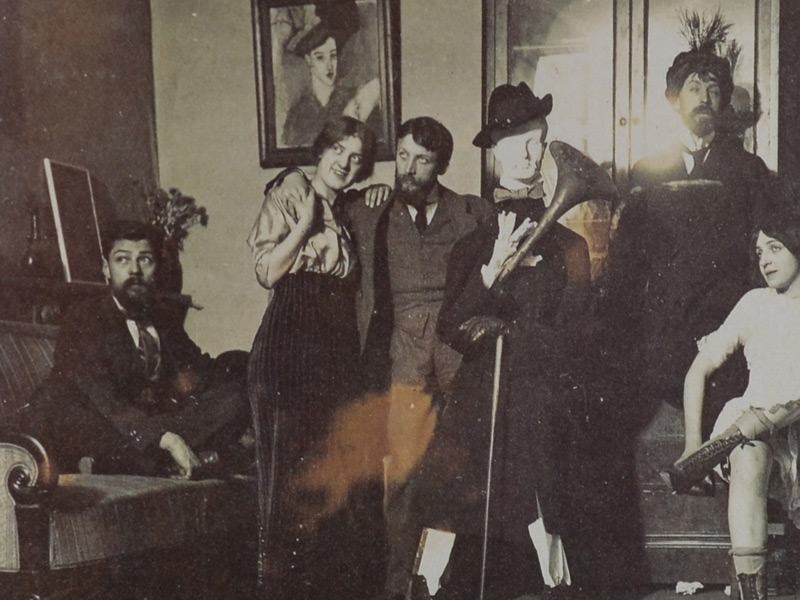
There is a picture at the Alexandre collection that shows the work (Modigliani Unknown, drawings from the Alexandre collection, p. 60)
1.- There is a some sort of rare effects with the shadows, the painting in the wall is the beggar woman and is almost invisible and it is in plain light while the bust of young woman is totally in light and visible.
Light comes from the back of the players?
2.- The shadow of the chess player should place in shadows the painting as it does with the couch but this investigation records it is just a trick of light.
Another picture from the same time shows the same frame in a different position but this time the painting inside is totally different. If we apply a digital infrared to the painting frame area we see a totally different painting: a woman in profile? or maybe its just another frame and painting or a trick of light... More clear: No, it's a woman in profile.
Laboratory examination of the photograph would be required before any conclusion.
Where sources disagree, both readings are given. This is a working research page, not a catalogue raisonné.




Introduction
A young woman faces us, her body cut at the chest, her head held high on an extraordinarily long neck. Her brown hair, parted in the centre, falls in two masses to her shoulders. Her face is pale pink with rose cheeks. Her eyes are two black almond shapes with no pupils. A long nose is drawn with a single dark line, and the mouth is small and dark. Her neck is a pale, blue-grey cylinder, as long as the face. Below it, a white garment with blue shadows meets a yellow-orange bodice at a dark, curved neckline. The background is a deep, scrubbed brown, warmed at the left and right with red-orange.
Ceroni catalogued this work as no. 30, Busto di donna, gives it a precise place in Modigliani's development: "Signed on the verso. A quick study, interesting for the elongation of the neck, although we find this prerogative of Modigliani's already in the two busts of a nude woman of 1908 and in the seated nude executed in the same year." The painting is indeed a study, painted fast and left unfinished in places. But it is also one of the first paintings in which the features of Modigliani's mature style appear together: the long neck, the oval face, the blank almond eyes and the frontal, hieratic pose. It came from Paul Alexandre's collection, was shown at Tate Modern in 2017 lent by the Laterman family, and has an unusual afterlife in the photographs of Alexandre's house, which the Secret Modigliani page on the work examines in detail.
Composition and format
The canvas measures 54.5 by 37.5 centimetres according to the Galerie Charpentier catalogue of 1958, as cited by the Secret Modigliani page, and 55 by 38 centimetres according to most later catalogues. That is the French standard size 10 marine, used upright (my identification). Like the paysage and marine canvases discussed in the 2018 Burlington Magazine introduction to the Modigliani Technical Research Study, it gives a tall and narrow field, and Modigliani uses its height for the neck.
The composition is strictly symmetrical and frontal. The parting of the hair, the nose, the mouth and the centre of the neck all lie on the vertical axis. The hair frames the face on both sides and falls to the shoulders, forming a dark arch. The neck rises from the centre of the garment. The curved neckline below repeats the curve of the jaw above. The head is high in the canvas, close to the top edge, so that the neck and chest take up most of the lower half. The proportions are deliberately unnatural: the neck is roughly as long as the face, and the face is narrower than the neck is long.
The effect is of an icon or a statue. Nothing in the picture suggests movement, emotion or a particular time. The figure is presented frontally, centred and still, against a neutral ground.
Line
Line is used sparingly but decisively. The nose is a single dark stroke from the brow down, with a small hook at the nostril. The eyes are drawn as almond shapes filled with black. The mouth is a short dark mark. The contours of the face and neck are defined partly by dark lines and partly by the contrast of the pale flesh with the dark hair and background. The neckline is a curved dark stroke.
This economy of line is new in Modigliani's painting. In Donna con cappello (Ceroni no. 26), the eyes are blue and the features fully drawn. In Joseph Lévi (no. 27), the line is applied over the colour to sharpen a fully modelled head. Here, line replaces modelling. The features are signs, not descriptions.
Colour
The colour is restricted to a few areas. The face is pale pink, with rose on the cheeks. The neck is a cooler, blue-grey version of the flesh. The hair is brown with auburn tones. The garment is white, shaded with blue. The bodice is yellow-orange. The background is dark brown, scrubbed with red-orange at the sides.
The colour serves the structure. The pale face and neck form a single, light vertical against the dark hair and background. The white and yellow-orange of the garment form a lighter horizontal band at the bottom. The red-orange touches in the background echo the bodice and the cheeks, and connect the figure with the ground. The coolness of the neck, compared with the warmth of the face, emphasises its length and makes it read as a separate, cylindrical form, as it would in a carved head.
Facture
The surface is dry, broken and scumbled. In the background, the brown paint is dragged over the canvas, leaving gaps and an uneven texture, and the red-orange is scrubbed over it. The face is more smoothly painted, but even there the strokes are visible. The garment is laid in with a few broad strokes. Ceroni's phrase "veloce studio", a quick study, describes this well.
The Secret Modigliani page notes "Probably a reused canvas?", without further explanation. The dry, broken surface could reflect painting over an earlier layer, but it could equally reflect a thin, rapid application on a fresh canvas. Without technical examination, the question cannot be answered. It should be noted that the Tate guide's statement that Modigliani "re-used an old canvas upside down" refers to two other works shown nearby, the Bust of Young Girl (1908) and the Nude Study (1908), and not to this one.
Figure and space
There is no space beyond the plane of the figure. The background is dark and undefined. The figure has some volume, especially in the cylindrical neck, but it is shallow, like a relief. The frontal pose, the symmetry and the long neck give it the presence of a sculpture rather than a living person.
The sitter
The sitter is not identified in any of the sources I have opened. Ceroni's title, Busto di donna, is generic, and so are the later titles. Some have connected Modigliani's heads of 1910–11 with the Russian poet Anna Akhmatova, whom he met in 1910. The Jewish Museum's guide to Modigliani Unmasked describes that meeting and quotes Akhmatova's memory of their visit to the Egyptian collection at the Louvre: "He drew my head bedecked with the jewelry of Egyptian queens and dancers, and seemed totally overawed by the majesty of Egyptian art." The guide adds that Egyptian art, "with its symbolism and static, linear stylization, epitomized their mutual attraction". The static, linear stylisation of the present work fits this description, but no source I have opened identifies the sitter as Akhmatova, and the date of 1910, the year they met, is not enough to support such an identification. I mention it only as a context.
Comparisons
Ceroni's note places the work in relation to two busts of nude women of 1908 and a seated nude of the same year. These are presumably among the nudes of 1908 that Ceroni numbers 8 to 11, which include the Nudo dolente (no. 8), the Bust of young nude (no. 10, as the Secret Modigliani list of Ceroni numbers titles it) and the Seated Nude (no. 11), all treated earlier in this series. In those works, the neck is already long, but the face and body are modelled in a more expressive, even violent way. Here the elongation is calm and controlled, and the face has become a mask.
The closest comparison is with the preceding work in Ceroni's sequence, the Testa di giovane donna (no. 29), also from Alexandre's collection and dated 1910. Both show a frontal young woman with long neck and long nose, painted quickly. In no. 29 the eyes are lowered, the colours are bright orange and blue, and the head fills the canvas. In no. 30 the eyes are blank black almonds, the colours are muted, and the neck is longer. Together they show two directions in Modigliani's search for a type at the moment of his concentration on sculpture.
The comparison with the limestone heads of 1910–14 is also unavoidable. The Jewish Museum's Modigliani Unmasked exhibition showed four of them, including a Head of a Woman of 1910–11 from the Chester Dale Collection at the National Gallery of Art, Washington. The long neck, the oval face and the long nose of the painting have clear parallels in those heads. The guide speaks of Modigliani's "visual vocabulary of features—heads, noses, mouths, eyes—drawn from both life and the study of African, Egyptian, and Asian art", and this painting is one of its earliest appearances in oil.
The work in Alexandre's house
The Secret Modigliani page reproduces a photograph from the Alexandre collection, published, according to the page, in Modigliani Unknown: Drawings from the Collection of Paul Alexandre, p. 60, of two men playing chess. On the wall behind them, at the right, a framed painting appears that the page identifies with this work. According to the page, another painting on the wall is The Beggar Woman (Ceroni no. 20). The page notes that the lighting in the photograph is odd: the Beggar Woman is "almost invisible" while the Bust is "totally in light and visible", and the shadow of one chess player should fall on the painting but does not. The page concludes that this is "just a trick of light".
The page then reproduces a second photograph from the same time, which shows the same frame in a different position, containing a different painting. After applying a "digital infrared" filter, the page suggests that the image shows "a woman in profile". A "Laboratory examination of the photograph would be required before any conclusion". The photographs are important as evidence that the painting hung in Alexandre's house, but the manipulations of the image described on the page cannot be checked without the original prints.
Provenance and exhibitions
The Secret Modigliani page gives the provenance as Paul Alexandre, Paris; a private collection, Paris (?), through the Galerie Cazeau-Béraudière, Paris; and Frances and Bernard Laterman, New York. The Ceroni caption, as transcribed by modigliani1909.com, reads "Francia, proprietà privata". The Tate guide of 2017 gives the lender as "The Laterman Family".
The exhibitions listed by the page are: Paris, Galerie Charpentier, Cent tableaux de Modigliani, 1958, no. 11; Modigliani inconnu, various venues, 1993–96; Lugano, Museo d'Arte Moderna, 1999, no. 6; Paris, Musée du Luxembourg, Modigliani: l'ange au visage grave, 2002, no. 11; Milan, Palazzo Reale, 2003, no. 10; New York, The Jewish Museum, Modigliani: Beyond the Myth, 2004; and London, Tate Modern, Modigliani, 2017–18. The Tate exhibition is confirmed by the large-print guide.
A stock image of the painting is distributed by SuperStock, credited to "CIL Art Source", with the caption "Bust of a Young Woman; Buste de Jeune Femme … Painted circa 1910-11. 55 x 38cm". The form of the caption resembles an auction description, but I have not been able to find any sale of the work, and I draw no conclusion from it.
Discrepancies.
- Date. Ceroni give 1910. The Tate guide gives 1911. The SuperStock caption gives c. 1910–11.
- Dimensions. The Charpentier catalogue (1958) gives 54.5 × 37.5 cm. Most later sources give 55 × 38 cm. The difference is small and may be due to rounding.
- Signature. Ceroni's note says "signed on the verso". No image of the verso is published on the page.
Technical analysis
No technical study of this work has been published, as far as I can find. Although the painting was shown at Tate Modern in 2017–18, at the time of the Modigliani Technical Research Study, it is not among the works discussed in the Tate Papers article on hidden paintings or in the 2018 Burlington Magazine introduction. It is not discussed in the 2023 IJCS study.
Comparative evidence. The Tate Papers study found that Modigliani often reused canvases in his early Paris years, sometimes turning them upside down. The Burlington introduction says the canvases studied "seem to have been commercially prepared with an oil-based priming". The Tate Papers authors found that the Rouen Jean-Baptiste Alexandre with a Crucifix of 1909 has a thick lead white ground, possibly applied by the artist himself. The IJCS study of The Cellist (1909) found lead white, zinc white, emerald green, chrome pigments and vermilion. These findings suggest the questions that an examination of the present work should ask, but they cannot be applied to it directly.
What an examination could settle. X-radiography would test the page's suggestion that the canvas was reused, and would show whether the dry, broken surface lies over an earlier painting. The verso should be photographed to confirm the signature mentioned by Ceroni. Infrared reflectography would show whether there is an underdrawing for the neck and face. Pigment analysis would identify the blue-grey of the neck and the red-orange of the background.
Conclusion
Ceroni no. 30 is a quick study, as Ceroni said, but it is also a manifesto. The long cylindrical neck, the oval face, the blank almond eyes, the single-line nose and the strict frontality are all here, assembled for the first time in a painting, in a form that recalls Modigliani's sculpted heads of 1910–14. The muted colour and dry, scrubbed surface emphasise structure over description. The sitter is unknown, and the Akhmatova connection, though suggestive in context, is unsupported. The documentation differs on the date (1910 or 1911), the dimensions and the signature, and the Secret Modigliani page raises interesting but unproven questions about reuse of the canvas and about photographs of Alexandre's house. All of these could be settled by an examination of the canvas and its verso. Until then, the painting stands as one of the clearest early statements of the type that Modigliani would develop for the rest of his life.
Museum, exhibition and image sources
- Tate Modern, Modigliani (23 November 2017–2 April 2018), large-print guide, rooms 1–11 (copy at docslib), https://docslib.org/doc/1601730/modigliani-large-print-guide-room-1-11
- The Jewish Museum, New York, Modigliani Unmasked, large-print exhibition guide, https://thejewishmuseum.org/wp-content/uploads/2025/06/Modigliani_Large_Print_FINAL.pdf
- SuperStock, Bust of a Young Woman; Buste de Jeune Femme, image 866-20021, credited to CIL Art Source, https://www.superstock.com/asset/bust-young-woman-buste-de-jeune-femme-amedeo-modigliani-oil/866-20021
Technical literature (comparative)
- Anaïs Genty-Vincent et al., "Works by Modigliani that have Paintings beneath the Visible Surface", Tate Papers, no. 35, https://www.tate.org.uk/research/tate-papers/35/works-by-modigliani-that-have-paintings-beneath-the-visible-surface
- Annette King, Nancy Ireson, Simonetta Fraquelli and Joyce H. Townsend, "The Modigliani Technical Research Study: An introduction to Modigliani's materials and techniques", The Burlington Magazine, vol. 160, no. 1380 (March 2018), pp. 182–88, https://www.burlington.org.uk/archive/article/the-modigliani-technical-research-study-an-introduction-to-modiglianis-materials-and-techniques
- Greta Garcia, David Juanes and Rafael Romero, "Image Study and Material Characterization of the Two-Sided Painting The Cellist and Portrait of Brancusi by Amedeo Modigliani", International Journal of Conservation Science, vol. 14, no. 3 (2023), pp. 1233–48, https://doi.org/10.36868/ijcs.2023.03.30
Cited but not independently consulted
Pfannstiel, 1929, p. 5, and 1956, no. 19; Galerie Charpentier, Cent tableaux de Modigliani, 1958, no. 11; Ceroni, Amedeo Modigliani peintre, 1958, no. 22; Roy, Modigliani, 1958, p. 31, and 1985, p. 27; Lanthemann, 1970, no. 41; Ceroni and Piccioni, 1970, no. 30; Castieau-Barrielle, 1987, p. 50; Parisot, 1991, no. 2/1910; Patani, 1991–94, no. 34; Chiappini (ed.), Amedeo Modigliani, Lugano, 1999; Krystof, Amedeo Modigliani: The Poetry of Seeing, 2000, p. 23; Modigliani: l'ange au visage grave, Musée du Luxembourg, 2002, pp. 126–27, no. 11; Klein, Modigliani: Beyond the Myth, 2004, p. 92, pl. 7; Soto Caba, 2007; Ireson and Fraquelli, Modigliani, Tate, 2017, p. 27; Modigliani Unknown: Drawings from the Collection of Paul Alexandre, p. 60.
Footnotes
- Arthur Pfannstiel, Modigliani. L’Art et la Vie, preface by Louis Latourette, Paris, Seheur, 1929 (presumed catalogue).
- Arthur Pfannstiel, Modigliani et son œuvre, étude critique et catalogue raisonné, Paris, Bibliothèque des Arts, 1956.
- Ambrogio Ceroni, Amedeo Modigliani: Peintre; suivi des souvenirs de Lunia Czechowska, Milan, Edizioni del Milione, 1958.
- Claude Roy, Modigliani, Lausanne / Paris, Skira / Nathan, 1958–85.
- Joseph Lanthemann, Modigliani, catalogue raisonné: sa vie, son œuvre, son art, Barcelona, G. Condal, 1970.
- Ambrogio Ceroni and Leone Piccioni, I dipinti di Modigliani, Milan, Rizzoli, 1970.
- Thérèse Castieau-Barrielle, La vie et l’œuvre de Amedeo Modigliani, Paris, ACR, 1987.
- Christian Parisot, Catalogue raisonné Modigliani, Livorno, Graphis Arte, 1991.
- Osvaldo Patani, Amedeo Modigliani: catalogo generale, Milan, Leonardo, 1991–94.
- Doris Krystof, Amedeo Modigliani: The Poetry of Seeing, Cologne, Taschen, 2000.
- MR (cited here as MR), Modigliani: l’ange au visage grave, Paris, Musée du Luxembourg, 2002. Cited from the published exhibition catalogue only.
- Mason Klein, Modigliani: Beyond the Myth, New York, The Jewish Museum / Yale University Press, 2004.
- Victoria Soto Caba, Modigliani: The Timeless Face, Madrid, Libsa, 2007.
- Nancy Ireson and Simonetta Fraquelli, Modigliani, London, Tate Modern / Skira Rizzoli, 2017.