Engraver Weill Frontal (Recto - Verso Engraver Weill)
Oil on canvas — 1909?
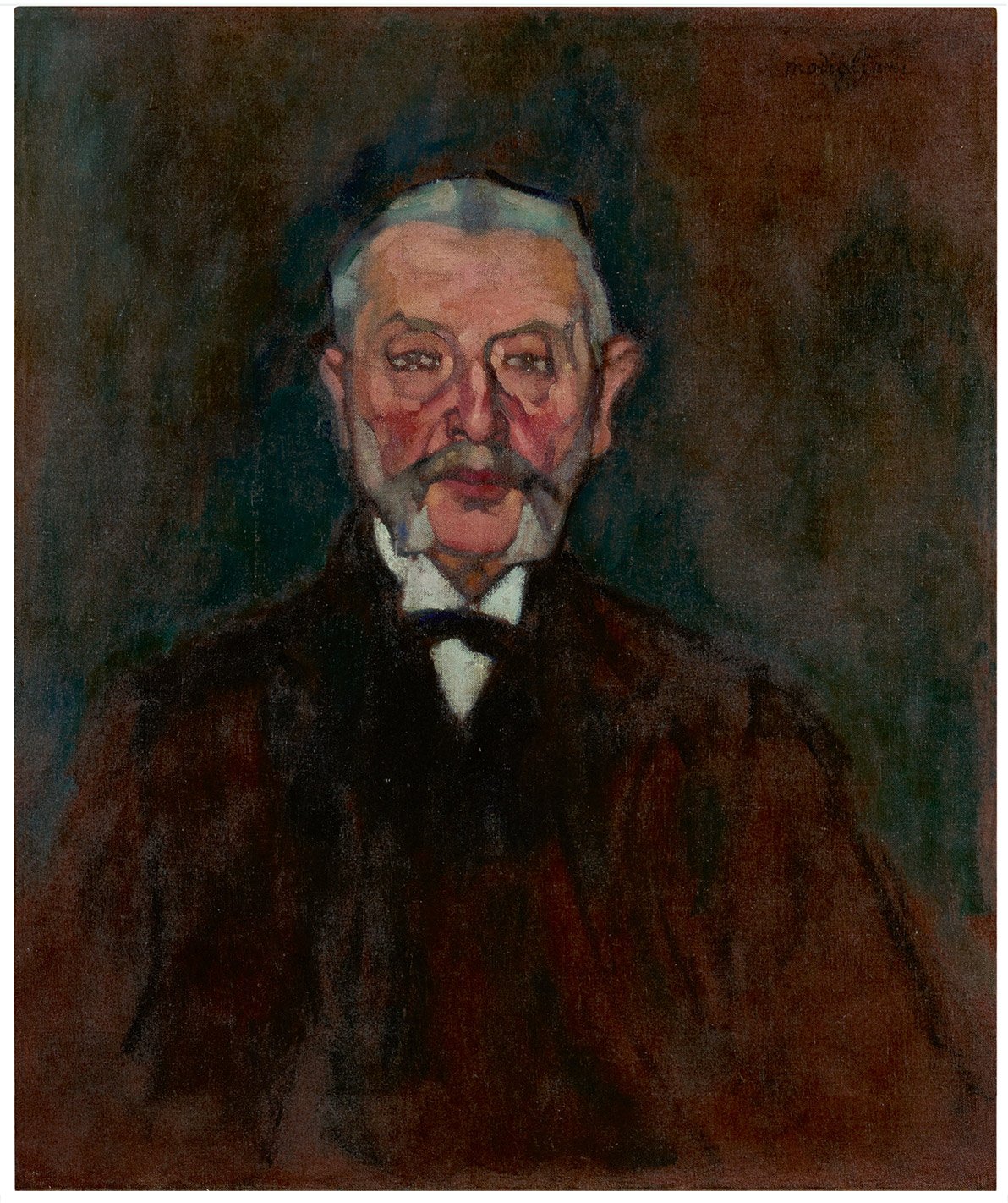 Engraver Weill Recto
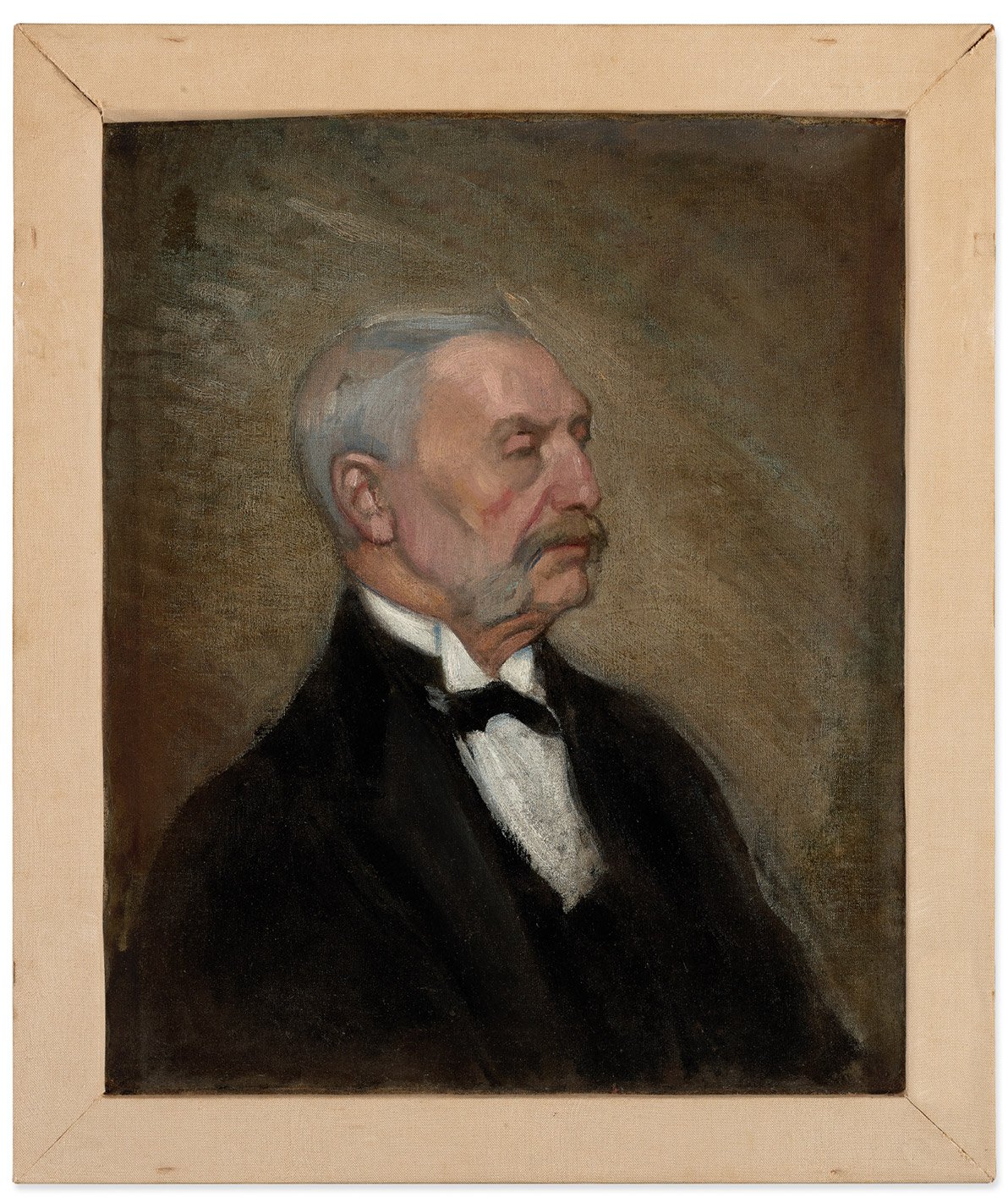 Engraver Weill Verso
Identification
- Title
- English: Engraver Weill frontal ( in verso Engraver Weill 3 / 4 - verso not included by Ceroni, Lanthemann, Pfannstiel, Parisot, Jeanne Modigliani).
French: L'incisore Weill, Portrait d'homme; Portrait du graveur Weill.
Notes: L'incisore Weill (Ceroni 1970); Portrait du graveur Weill (Lanthemann); Portrait d'homme (Charpentier 1958 and Japan 1968). - Date
- 1909?
Notes: 1909 (Ceroni; Kreeger information); 1905–06 (Charpentier 1958), 1907 (Roy 1958; Rome 1959) and 1909–10 (Japan 1968), 1902 (Lanthemann). - Medium
- Oil on canvas
- Dimensions
- 72 × 59 cm.
Notes: 72 x 59 Kreeger Museum (Patani, Ceroni 73 × 60) - Signature
- Signed "modigliani" upper right
- Present location
- Private Collection?
Catalogue numbers
| Compiler | Number |
|---|---|
| Arthur Pfannstiel | NO |
| Joseph Lanthemann | no. 14 (only recto) |
| Ambrogio Ceroni | no. 19 (only recto) |
| Jeanne Modigliani | YES |
| Christian Parisot | ? |
| Osvaldo Patani | no. 21 (only recto) |
| Modigliani Project | ? |
| MR | ? |
| Modigliani Initiative/ AMDC | YES |
Legal note on MR: This investigation has not had access to MR’s catalogue raisonné; all research here is based on open sources, publications and exhibitions. By no means has that catalogue been copied at any point. Modigliani Project and Modigliani Research Project are marked YES when the work is published or otherwise recorded by those projects, even if no catalogue number is assigned; otherwise the field is marked ?.
Provenance
- Engraver Weill, Paris (?)
- Alfred Weinberger, Paris (acquired by 1958)
- Sale: Sotheby’s, London, April 26, 1967, lot 72
- Richard Feigen Gallery, London (acquired at the above sale)
- David Lloyd Kreeger Foundation Acquired from the above circa 1968 (lent to Kreeger Museum, Washington, DC, USA?)
- For sale / private sale Sotheby's Hong Kong selling exhibition Panorama: A New Perspective
- Sale Sotheby´s Modern Day auction - 14 May 2025- Lot 223 - Estimate 600,000 - 800,000 USD -
(no mention to verso portrait in the catalogue sale, but included picture of it)
The sequence follows the published museum, sale, and catalogue record in this investigation. Gaps and uncertain transfers are marked as such.
Selected bibliography
Book-length publications are marked with a footnote giving a full citation. Exhibition catalogues appear in both this list and the exhibition list when this investigation recorded them in both places.
- Roy , Modigliani, Skira, Lausanne, 1958, p. 15 (incorrectly dated 1907)
- Lanthemann, Modigliani, catalogue raisonné: sa vie, son oeuvre, son art, G. Condal, Barcelona, 1970 - no. 14 (only includes recto - incorrectly dated 1902)1
- Ceroni & Piccioni, Il dipinti di Modigliani, Rizzoli, Milano, 1970 - no. 19 (only includes recto)2
- Castieau-Barrielle, La vie et l'oeuvre de Amedeo Modigliani, Editions ACR, Paris, 1987, p 2023
- Patani, Catalogo Generale, Leonardo, Milano, 1991-94 - no. 21 (only includes recto)4
- Soto Caba, Modigliani, the timeless face, Libsa, 2007 (recto and verso)5
Exhibitions
- New York, F. Kleinberger Galleries, Inc., Corot to Picasso: Exhibition of Paintings, 1931, no. 24 (titled Portrait de M. Weill)
- Paris, Cent tableau× de Modigliani, Galerie Charpentier, 1958 - no. 1 Portrait d'homme (collection particuliere) 72 × 60 cm. dated 1905-1906
- Milan,Mostra di Amedeo Modigliani, Palazzo Reale, 1958 - no. 3
- Rome, Galleria Nazionale d’Arte Moderna, Modigliani, 1959 - no. 3, illustrated (incorrectly dated 1907)
- Paris, Musée Nationale d’Art Moderne, Les Sources du XXème Siècle, 1960-61 - no. 458
- Frankfurt, Kunstverein, Steinernes Haus, Modigliani, 1963 - no. 4
- Tokyo, Modigliani, Grand Magazin Seibu, 1968 - no. 1 (dated 1909-1910 and exhibited as Portrait d'homme)
- Kyoto,Modigliani, National Museum of Art , 1968 - no. 1 (dated 1909-1910 and exhibited as Portrait d'homme)
- Fukuoka , Modigliani, Fukuoka Cultural Center , 1968 - no. 1 (dated 1909-1910 and exhibited as Portrait d'homme)
Notes
The work present the same sitter on both sides:
1.- Recto, frontal portrait
2.- Verso, 3/4 portrait
In the Sotheby´s 2025 auction a line reads:
We would like to thank The Modigliani Initiative for their contributions to the bibliography of this work.
Therefore we must asume their acceptance.
Where sources disagree, both readings are given. This is a working research page, not a catalogue raisonné.


Introduction
An elderly man with close-cropped grey hair and a grey moustache faces the viewer squarely. He wears what appears to be a pince-nez, a high white collar, a black bow tie and a dark brown coat that fills the lower half of the canvas. The face is modelled in pinks, reds and ochres, with greenish shadows. Behind him a ground of warm brown is broken by patches of dark green and blue. In the upper right corner, the signature "modigliani" is written in small lower-case letters.
The painting is Ceroni no. 19. Its title, L'incisore Weill ("the engraver Weill"), has never been explained. Ceroni printed it with a question mark, and his note, as transcribed by modigliani1909.com, is candid: "Non risultano ragguagli precisi sul probabile effigiato" ("there is no precise information on the probable sitter"). The work first appeared, Ceroni says, at the Galerie Charpentier exhibition in 1958. It was shown there, simply as Portrait d'homme and dated 1905–06.
The canvas has a second portrait on its reverse: the same man, seen in three-quarter view. Neither Ceroni nor any of the other catalogues of the paintings include it.
This essay concentrates on the recto, Ceroni's no. 19, and discusses the verso separately.
Composition and format
The canvas measures 72 × 59 cm, or 73 × 60 cm according to Ceroni and Patani, which is the size of a standard French no. 20 figure canvas (73 × 60 cm; my identification). As in Le typographe (Pedro) (Ceroni no. 17), Modigliani used a format designed for portraits rather than an upturned landscape or marine canvas.
The sitter is shown at half-length, frontally, with the head a little above the centre and slightly to the left of the vertical axis. His shoulders are broad and sloping; the coat fills the whole lower half and spreads to both side edges. The white collar and shirt-front make a small bright triangle under the chin, closed by the black bow tie. The head is set well below the upper edge. Above it there is a band of empty ground, and the signature sits in that space at the right.
The arrangement is quieter and more conventional than in Pedro or Maurice Drouard (Ceroni no. 18). The head is smaller in relation to the canvas, the pose is less rigid, and the sitter is placed at a more ordinary distance from the viewer. The composition recalls a nineteenth-century bourgeois portrait rather than the near, mask-like heads of the same year.
Line and drawing
The face is drawn with a firm but varied brush line. Dark strokes model the eye sockets and the line of the nose; the pince-nez is suggested by thin dark arcs round the eyes. The moustache is a broad grey shape that hangs over the mouth and turns down at the ends, and a short grey beard or tuft appears at the chin. The ears stand out from the head and are given a strong red. The hair is painted as a flat, light grey cap.
Contour is much less emphatic than in Pedro or Drouard. The jaw is defined by the edge of the beard and by the shadow of the collar rather than by a continuous dark outline. The coat is drawn with a few long, dark strokes that mark the lapels and the fall of the sleeves, and its lower part dissolves into loosely brushed brown. The drawing, in short, is descriptive: it is concerned with the particular structure of an old man's face rather than with a geometric scheme.
Colour
The colour range is narrow and warm. The flesh is built from pink, rose and orange, with patches of strong red on the cheeks, the nose and the ears, and with green and grey in the shadows of the temples and under the eyes. The hair, moustache and beard are grey-white with cool blue touches. The coat is a deep brown that is almost black in places, and the ground is a lighter, reddish brown worked with dark green and blue-green, especially to the left of the head and in the upper right.
The palette has none of the saturated blue of Pedro or Drouard. It is closer to the earth-coloured interiors of the Alexandre portraits of 1909, and in particular to Jean-Baptiste Alexandre with a Crucifix (Ceroni no. 12), another portrait of an elderly man in a dark coat. The greens in the ground and in the flesh shadows give the warm scheme its tension. They are the most modern feature of the colour, and they recall Cézanne's practice of building flesh with cool and warm planes.
Facture
The paint is applied with a loaded brush in short, directional strokes. In the face the strokes follow the planes of the cheek and forehead and are laid side by side without much blending; in the ground they are longer, looser and more transparent, and the brown appears to be scumbled over a darker underlayer in places. The coat is painted in broad, thin strokes. In the lower part of the picture they become summary, suggesting that Modigliani concentrated his effort on the head and let the rest remain sketch-like.
This distribution of finish, with a worked head over a freely brushed body and ground, is typical of Modigliani's portraits of 1908–09. It can be seen in the Alexandre portraits. It is one of the reasons why the date proposed by Ceroni, 1909, is more convincing than the early dates of 1905–07 given in some exhibition catalogues.
Figure, space and expression
The old man's expression is grave and attentive. The eyes behind the pince-nez are small and slightly unfocused, the mouth is hidden under the moustache, and the head is held straight. The mood is one of dignity rather than intensity. Nothing in the picture suggests a profession: there are no tools, no prints and no table. The title's "engraver" is, like the "typographer" of Pedro, a traditional label without visible support.
Space is shallow but not abstract. The ground is a coloured field rather than a room, but its tonal variations and the darker zones around the head create a slight sense of atmosphere behind the figure. The figure is solid and three-dimensional, more naturalistic in modelling than any of the other portraits of 1909 except those of the Alexandre family.
The question of date
The dating of this portrait has moved over time. Charpentier catalogue of 1958 dated it 1905–06, which would place it before Modigliani's arrival in Paris in 1906. Claude Roy's Modigliani (1958) and the Rome exhibition of 1959 dated it 1907, which the site calls incorrect. The Japanese exhibitions of 1968 dated it 1909–10, and Ceroni settled on 1909. The site's own heading is "1907? – 1909?".
A date of 1905–06 is hard to accept. Few paintings by Modigliani from his Italian years survive, and the handling of the face, with its juxtaposed planes of warm and cool colour, belongs to the phase after the Cézanne exhibition of 1907, which, according to the Tate 2017 guide, "left a lasting impression" on him. The closest comparison, Jean-Baptiste Alexandre with a Crucifix, is securely dated 1909. On stylistic grounds, a date of 1908–09 is the most likely, though no document fixes it.
The verso
The reverse of the canvas, reproduced in this page, shows the same elderly man in three-quarter view to the right, with white hair, a white moustache, a white collar and black bow tie, against a muted greenish ground. Judging from the reproduction, it is more smoothly and academically modelled than the recto, with softer transitions and less visible brushwork.
But reflects in some detail clearly Modigliani´s hand.
The verso was not catalogued by Ceroni, Lanthemann, Pfannstiel, Parisot or Jeanne Modigliani. The only publication of it listed on the site is Soto Caba's Modigliani, the timeless face (2007). The site also notes that the Sotheby's Hong Kong selling exhibition made no mention of it. Writing about a similar case in 2015, the verso nude on the portrait of Jean Alexandre (Ceroni no. 16), Christie's observed that "since it was never included in Ceroni's catalogue it cannot be said with certainty to be by the hand of the artist". The same caution applies here. The verso may be an earlier, more conventional attempt by Modigliani at the same sitter, which would be consistent with the more naturalistic manner. It may also be the work of another hand, if the canvas was reused, or a later addition. Without technical examination, its status cannot be decided.
Iconography and the identity of the sitter
No source consulted for this essay identifies an engraver named Weill in Modigliani's circle. Ceroni's question mark, his note that nothing precise is known about the sitter, and the exhibition title Portrait d'homme used in 1958 and 1968 all suggest that the name was attached to the picture through oral tradition or the market. The name should not be confused with that of the dealer Berthe Weill, whose gallery held Modigliani's only solo exhibition in his lifetime, in 1917 (Burlington Magazine, 2018; LaM 2016). No source connects her with this portrait.
The Secret Modigliani page lists "Engraver Weill, Paris (?)" as the first owner. This is a reasonable assumption if the sitter is the man named, since a portrait often stayed with its sitter. But it is an inference from the title, not a documented fact.
Comparisons
The most instructive comparison is with Jean-Baptiste Alexandre with a Crucifix (Ceroni no. 12), painted in 1909 and now in the Musée des Beaux-Arts, Rouen. Both portraits show an elderly bourgeois man in a dark coat, at half-length, against a warm ground, with a face built from reds, pinks and greens. The Alexandre portrait is more elaborate in setting and more firmly constructed. The Weill portrait is simpler but shares its manner, and it would sit comfortably in the same year.
By contrast, Le typographe (Pedro) and Maurice Drouard, nos. 17 and 18 in Ceroni's sequence, show young men in a far more radical style, with saturated blue grounds, frontal masks and heavy contours. The juxtaposition of these three portraits in Ceroni's catalogue shows how wide Modigliani's range was in 1909. He was capable of both a conventional, naturalistic likeness and a schematic, Fauve-coloured icon, apparently depending on the sitter and the occasion.
Provenance and exhibitions
Engraver Weill, Paris (?); Alfred Weinberger, Paris (acquired by 1958); sale, Sotheby's, London, 26 April 1967, lot 72; Richard Feigen, London (acquired at that sale); acquired by the present owner from Feigen around 1968 ("lent to Kreeger Museum, Washington, DC, USA?"); and an offer at Sotheby's Hong Kong in the selling exhibition Panorama: A New Perspective, dated "29 -3/4-2019". Ceroni's 1970 caption, as transcribed, locates the work in "Parigi, proprietà A. Weinberger", which is consistent with the 1958 ownership but takes no account of the 1967 sale.
The exhibition history given by the site begins withan an exhibition in the US (New York, F. Kleinberger Galleries, Inc., Corot to Picasso: Exhibition of Paintings, 1931, no. 24) then jumps to the Charpentier exhibition of 1958 (no. 1, as Portrait d'homme, "collection particulière", 72 × 60 cm). It continues with the Milan exhibition at the Palazzo Reale in 1958, the Rome exhibition of 1959 (no. 3), Les Sources du XXe siècle at the Musée National d'Art Moderne in 1960–61 (no. 458), Frankfurt in 1963, and three Japanese venues in 1968. No exhibition after 1968 is recorded on the site, which is unusual for a work accepted by Ceroni and may reflect the painting's long stay in an American private or foundation collection.
Technical analysis
No technical study of this painting has been published, as far as the sources consulted show. It is not among the works discussed in the Tate Papers article on Modigliani's paintings with earlier compositions beneath the surface, nor in the Burlington Magazine introduction to the Modigliani Technical Research Study.
The double-sided canvas is the main technical question. As comparative evidence, the Tate Papers article and Christie's 2015 essay show that Modigliani reused canvases in 1908–09: sometimes he painted over an earlier composition, and sometimes he turned the canvas on its stretcher and painted the back. Christie's describes the latter procedure for Jean Alexandre, whose canvas already bore a seated nude. Comparison of the two sides by examination of the ground layers, the canvas preparation and the pigments would show whether both portraits were painted on the same occasion, by the same hand, and in what order. Until such a study is published, the relation between the frontal portrait catalogued by Ceroni and the uncatalogued three-quarter portrait on the reverse remains open.
Conclusion
L'incisore Weill is the most traditional of the three male portraits that follow the Alexandre group in Ceroni's catalogue. It is a dignified, warmly coloured, carefully modelled likeness of an elderly man, closer in manner to Jean-Baptiste Alexandre with a Crucifix than to the Fauve-coloured heads of Pedro and Drouard. Its documentation is thin. The sitter's name and trade rest on an unexplained tradition, and Ceroni himself doubted them. The date has wandered from 1905–06 to 1909–10. The unpublished verso portrait of the same sitter adds a further question that only technical examination can answer. The recto, however, is a coherent and convincing work of 1908–09, and it shows the naturalistic side of Modigliani's portraiture at the moment of his first commissions.
Sale and dealer literature
- Sotheby's, "First Look: Hong Kong Spring Sales" (preview of the spring 2018 Hong Kong series, including the selling exhibition Panorama: A New Perspective, 29 March–3 April), https://www.sothebys.com/en/slideshows/first-look-hong-kong-spring-sales
- Christie's, New York, 14 May 2015, sale 3736, lot 3, Modigliani, Jean Alexandre (recto) / Nu assis (verso): lot essay (for the comparative point on uncatalogued versos and canvas reuse), https://www.christies.com/en/lot/lot-5893247
Museum documentation
- The Kreeger Museum, Washington, DC, "Permanent Collection: Painting", https://www.kreegermuseum.org/about-us/collection/painting (accessed 25 October 2026; no Modigliani named)
- Tate Modern, Modigliani (23 November 2017–2 April 2018), large-print guide, rooms 1–11 (copy at docslib), https://docslib.org/doc/1601730/modigliani-large-print-guide-room-1-11
- LaM, Villeneuve-d'Ascq, Amedeo Modigliani: l'œil intérieur, dossier pédagogique (2016), https://www.musee-lam.fr/sites/default/files/2019-01/Dossier-pedago-Modigliani-l-oeil-interieur.pdf
Technical literature (comparative)
- Anaïs Genty-Vincent et al., "Works by Modigliani that have Paintings beneath the Visible Surface", Tate Papers, no. 35, https://www.tate.org.uk/research/tate-papers/35/works-by-modigliani-that-have-paintings-beneath-the-visible-surface
- Annette King, Nancy Ireson, Simonetta Fraquelli and Joyce H. Townsend, "The Modigliani Technical Research Study: An introduction to Modigliani's materials and techniques", The Burlington Magazine, vol. 160, no. 1380 (March 2018), pp. 182–88, https://www.burlington.org.uk/archive/article/the-modigliani-technical-research-study-an-introduction-to-modiglianis-materials-and-techniques
Cited but not independently consulted
Claude Roy, Modigliani, Skira, Lausanne, 1958, p. 154; Lanthemann 1970, no. 14; Ceroni and Piccioni, I dipinti di Modigliani, Milan, 1970, no. 19; Castieau-Barrielle 1987, p. 202; Patani 1991, no. 21; Soto Caba, Modigliani, the timeless face, 2007 (recto and verso); the catalogues of Charpentier 1958 (no. 1), Milan 1958, Rome 1959, Les Sources du XXe siècle 1960–61, Frankfurt 1963 and Tokyo/Kyoto/Fukuoka 1968; Sotheby's, London, 26 April 1967, lot 72; the Sotheby's Hong Kong Panorama catalogue. All are cited from the Secret Modigliani page on the work.
Footnotes
- Joseph Lanthemann, Modigliani, catalogue raisonné: sa vie, son œuvre, son art, Barcelona, G. Condal, 1970.
- Ambrogio Ceroni and Leone Piccioni, I dipinti di Modigliani, Milan, Rizzoli, 1970.
- Thérèse Castieau-Barrielle, La vie et l’œuvre de Amedeo Modigliani, Paris, ACR, 1987.
- Osvaldo Patani, Amedeo Modigliani: catalogo generale, Milan, Leonardo, 1991–94.
- Victoria Soto Caba, Modigliani: The Timeless Face, Madrid, Libsa, 2007.