Joseph Lévi
Oil on canvas — 1909-10 ?
Identification
- Title
- English: Joseph Levi
French: Joseph Lévi; Portrait d'homme; Portrait de Joseph Lévi - Date
- 1909 ? - 1910 ?
Notes: 1909 (Ceroni); c. 1909 (Christie's); 1910 (Pfannstiel) - Medium
- Oil on Canvas
- Dimensions
- 55 x 46 cm (Patani/Klein: 55 x 50 - Decroocq/R: 53.7 x 48.7)
- Signature
- Signed "Modigliani" upper left
- Present location
- Private Collection ?
Catalogue numbers
| Compiler | Number |
|---|---|
| Arthur Pfannstiel | no. 22 |
| Joseph Lanthemann | no. 17 |
| Ambrogio Ceroni | no. 27 |
| Jeanne Modigliani | YES |
| Christian Parisot | 13/1909 |
| Osvaldo Patani | no. 31 |
| Modigliani Project | YES |
| MR | YES |
| Modigliani Initiative/ AMDC | ? |
Legal note on MR: This investigation has not had access to MR’s catalogue raisonné; all research here is based on open sources, publications and exhibitions. By no means has that catalogue been copied at any point. Modigliani Project and Modigliani Research Project are marked YES when the work is published or otherwise recorded by those projects, even if no catalogue number is assigned; otherwise the field is marked ?.
Provenance
- Gaston Levi Collection, NY (until 1955?)
- Collection Etienne Bignou?
- Private collection, Paris
- Ceroni say: Levi Collection, NY - Pfannstiel say Levi Collection > sold to Bignou > Private collection Paris
- Patani say Levi Collection, Paris - Christie's say: Joseph Lévi (the sitter) Paris by decent to the present owner (2008)
- Christie's - London - 7562 - Impressionist and Modern Art Evening Sale | 4 February 2008 Lot 25 - Sold 412,500 GBP
- Private Collection ?
The sequence follows the published museum, sale, and catalogue record in this investigation. Gaps and uncertain transfers are marked as such.
Selected bibliography
Book-length publications are marked with a footnote giving a full citation. Exhibition catalogues appear in both this list and the exhibition list when this investigation recorded them in both places.
- Pfannstiel, "catalogue présumé" Modigliani. L'Art et la Vie. Preface de Louis Latourrettes, Seheur, Paris, 1929, p. 2, as "Portrait of a man"1
- Pfannstiel, Modigliani et son oeuvre, étude critique et catalogue raisonne, Bibliothèque des Arts, Paris, 1956 - no. 222
- Ceroni, Amedeo Modigliani : dessins et sculptures; avec suite du catalogue illustre des peintures, Edizioni del Milione, Milano, 1965 - no. 157
- Werner, Amedeo Modigliani, Garzanti, Milano 1967 - no. º5
- Lanthemann, Modigliani, catalogue raisonné: sa vie, son oeuvre, son art, G. Condal, Barcelona, 1970 - no. 173
- Ceroni & Piccioni, Il dipinti di Modigliani, Rizzoli, Milano, 1970 - no. 274
- Werner, Modigliani, Harry N. Abrahams, NY, 1985, no. 15, page 20 - as in the property of Gaston Levi, NY.
- Parisot, Catalogue Raisonné Modigliani, , Graphis Arte, 1991 - no. 13/19095
- Patani, Catalogo Generale, Leonardo ed. Milano 1991-94 - no. 316
- Decroocq / R, The Melancholy Angel, Éditions Skira/Seuil, Musée du Luxembourg, Paris, 2002-2003 - no. 57
- Klein, Modigliani: Beyond the Myth, The Jewish Museum, 2004-2005 , p. 91, pl. 58
- Soto Caba, Modigliani, the timeless face, Libsa, 20079
Exhibitions
- Bruxelles, Modigliani: Retrospective Exhibition. Palais des beaux-arts, 1933 - no. 6
- Cincinnati, Amedeo Modigliani: Paintings, Sculpture and Drawings, The Contemporary Arts Center, 1959 - no. 2 (illustrated p. 18).
- Paris , L'Ange au visage grave, Musée du Luxembourg, 2002, p.112-113- no. 5
- Milano, Modigliani: l'ange au visage grave, Palazzo Reale, 2003 - no. 4
- Toronto, Modigliani: Beyond the Myth, The Art Gallery of Ontario, 2004 - 2005
- Washington D.C., Modigliani: Beyond the Myth, The Phillips Collection, 2005
Notes
Not in D'Atri papers.
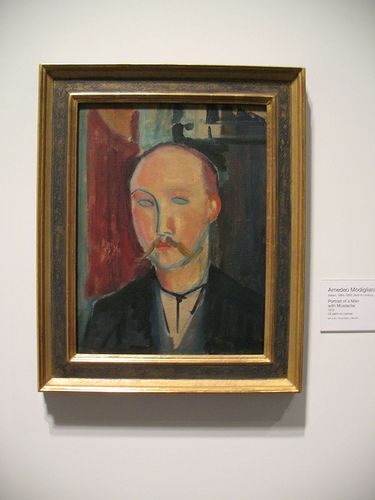
There is painting "man with a moustache" dated 1913 in the Denver art museum that MR recalls as the son of Joseph Levi, is actually named as "mon concierge" since it was for sale at Jacques Seligmann & Co, NY as loaned from Frank Crownishdale? 420 Lexingtron Av. NY - The Denver art museum reflects the provenance only as a gift of Mrs. Rhoda Semo in 1980.
Another painting with expertise by d'Atri could also fit in the description given by the experts but is all on the doubt zone.
Where sources disagree, both readings are given. This is a working research page, not a catalogue raisonné.


Introduction
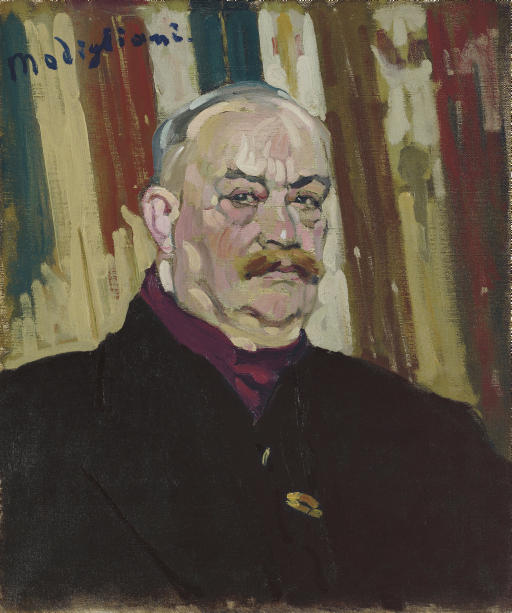
A heavy, bald man with a ginger moustache looks out at us from a canvas striped like a theatre curtain. His head is large and almost frontal, set low in the picture and close to the upper edge. His face is built up in thick strokes of pink, cream, yellow and grey-green. His black coat fills the lower half of the canvas in one dark, almost unbroken mass, relieved only by a purple shirt or scarf at the throat and a small gold pin. Behind him, vertical bands of cream, ochre, brick red, dark green and white run from top to bottom. In the upper left, in dark blue paint, is the signature "Modigliani."
This is Ceroni no. 27, the portrait of Joseph Lévi. Ceroni's note, as transcribed by modigliani1909.com, describes the sitter as "known in the artistic milieu as a restorer" and states that he was "certainly the commissioner of the painting". The Christie's catalogue of 2008 calls him "a fellow artist who also worked as a restorer", and gives a different account of the painting's origin: Lévi "often lent Modigliani money", and the artist "would sometimes repay by giving him pictures". The work thus stands at the point where friendship, patronage and debt meet. It is one of the most vigorous male portraits of Modigliani's early years in Paris, and it shows, more clearly than almost any other, the painter's response to Fauvism.
Composition and format
The canvas is upright, 55 by 46 centimetres according to Christie's. That is the French standard size 10 figure (my identification, not given in the sources). The other dimensions cited, 55 by 50 and 53.7 by 48.7 centimetres, are discussed below.
The composition is simple and frontal. The head is on the vertical axis, slightly left of centre, and its crown almost touches the top edge. The shoulders spread across the full width of the canvas, so that the figure seems too big for its frame. The upper third is head and background; the lower half is coat. This strong division gives the portrait its weight. The sitter is not placed in a room; he is pressed against a flat, patterned ground and pushed forward towards the viewer.
The striped background is the most original element. It is not a wall, a curtain or a window, or at least not clearly any of these. It is a set of vertical bands of different widths and colours, brushed in rapidly, with the strokes running in the direction of the bands. On the right, the bands are warmer, with red and ochre dominant. On the left, they are cooler, with dark green and blue. The head is set against a pale cream band in the centre, so that the face stands out against the lightest part of the ground. The Christie's essay speaks of "the striped background" as a sign of Modigliani's "search for a reduced and harmonious manner of rendering the world".
Line
In this portrait the line is mostly drawn with the brush in dark paint over colour. The contours of the head, the ear, the eyelids and the moustache are reinforced with dark blue-grey or brown strokes that lie on top of the flesh tones. The Secret Modigliani page reproduces a detail of the ear and comments that "the drawing is clearly visible and is painted over the color (on top of the color)". This matters. It means that the drawing was done, at least in part, at the end of the process and not as an underdrawing. Modigliani modelled the head in colour and then sharpened it with line, as he would continue to do in his mature portraits.
The features are rendered with some care. The brows are heavy and slightly raised. The eyes are small and set deep, and are ringed by dark contours that may describe the shadow of the sockets or the rims of spectacles; the reproduction does not settle which. The nose is broad and short. The moustache is a single curved shape of orange-brown, brushed out towards the cheeks. The mouth is almost hidden. The ears are large and pink, and they stand out from the head. The likeness seems real rather than ideal, and the sitter's age and bulk are not disguised.
Colour
The colour is the boldest in Modigliani's early work. The flesh is made of pinks, warm creams and yellows, with green and blue-grey shadows on the temples, cheeks and jowls. The scalp is pale grey-blue, with a dark contour. The moustache is bright orange. The shirt or scarf is a deep magenta-purple. The coat is black, with some dark blue in it. The background bands run through cream, ochre, red, dark green, white and blue.
These colours are not naturalistic. Their purpose is to construct the head through contrasts of warm and cool. The green shadows push the pink planes forward, and the orange moustache sits against the purple of the shirt. Christie's notes that "the thick brushstrokes and bold colour in the portrait of Lévi reveal the continued influence of the Fauve artists". The comparison is apt. The striped ground, the green shadows on the face and the high-keyed colour recall portraits by Matisse, Derain and Van Dongen of 1905–08. But Modigliani's colour is more contained. The coat is a single black mass, and the strongest colours are kept to the head and the background.
Facture
The paint is applied thickly and quickly in the face, and thinly in the coat and background. In the face, short, separate strokes follow the planes: across the forehead, down the cheeks, around the eyes. Some strokes are laid wet into wet, and others over a dry layer. The impasto is heaviest in the highlights on the forehead, nose and cheeks. Christie's describes "a sculptural feel to the intense modelling of the facial features, perhaps hinting at Modigliani's acquaintance with the Romanian sculptor Constantin Brancusi, which began around the time that Portrait de Joseph Lévi was painted".
The background is laid in long, vertical strokes, sometimes with the brush only partly loaded, so that the bands are uneven and the support shows through. At the lower edge, the black of the coat thins out, and in the reproduction the texture of the canvas seems to show through. The handling suggests a single campaign of work, perhaps a few sittings, without extensive reworking.
Figure and space
The space is very shallow. The figure fills the width of the canvas, and the background is a flat screen of colour right behind him. There is no floor, no furniture and no indication of a room. The only depth comes from the modelling of the head, which seems to project forward from the flat stripes. The contrast between the solid head and the flat ground is the key to the picture. Modigliani would later make this contrast between a sculptural head and a flat ground into a constant of his portraits.
The sitter
Little is known of Joseph Lévi beyond what the sources quoted here say. Ceroni describes him as a restorer and as the commissioner of the portrait. Christie's describes him as "a fellow artist who also worked as a restorer" and "a kindly man who often lent Modigliani money". According to Christie's, the painting "has remained in his family's collection since it was given to the sitter by the artist almost a century ago". The Christie's essay also says that Modigliani painted "a portrait of his son, Gaston, three years later, a picture which is now in the Denver Museum of Art".
That last statement is open to question. The Denver Art Museum's own online page for its Modigliani, Portrait of a Man with Moustache, 1913, oil on canvas, 60.96 × 46.36 cm (stretcher), accession number 1980.404, gives only the credit line "Gift of Mrs. Rhoda Semo" and does not name the sitter. The Secret Modigliani page on Joseph Lévi says that this Denver painting, which it reports that the Modigliani Research Project associates with the son of Joseph Lévi, was titled "mon concierge" when it was for sale at Jacques Seligmann & Co., New York. The site has a separate page on it, titled Gaston Levi? – Mon concierge – Man with a moustache. On the evidence I have opened, the identification of the Denver sitter as Gaston Lévi remains unconfirmed.
Comparisons
The portrait belongs to a group of half-length male portraits from 1909: Pedro the Typographer (Ceroni no. 17), Maurice Drouard (no. 18), the engraver Weill (no. 19) and The Beggar of Livorno (no. 24). All are painted with thick strokes and warm colour, and all show their sitters frontally or nearly so, close to the picture plane. The Tate's 2017 guide stresses the impact of Cézanne on The Beggar of Livorno, with its "vibrant colours and lively brushwork". Here, however, the background stripes and the high-keyed colour point more to the Fauves. The portrait of Joseph Lévi is the most colourful of the group.
Another comparison is the portrait of Jean-Baptiste Alexandre with a Crucifix (Ceroni no. 12), also of 1909. That was a formal commission, for which, according to Tate Papers, Modigliani was paid 500 francs. Like Joseph Lévi, it shows an older man, frontally, in a dark coat. But the Alexandre portrait is darker and more sober, and it is set against a background with a crucifix. Joseph Lévi is more relaxed, more colourful and less formal. If Ceroni is right that Lévi commissioned the portrait, the difference may reflect a difference in the relationship between painter and sitter.
The signature also deserves comment. "Modigliani.", in dark blue in the upper left and followed by a full stop according to Christie's, is prominent and confident. Whether the painting was a gift or a commission, a visible signature is what one would expect in a portrait meant for the sitter.
Provenance and exhibitions
Christie's gives the provenance as "Joseph Lévi (the sitter), Paris, and thence by decent [sic] to the present owner". The sale page is headed "Property from a private New York collection". The painting was sold at Christie's London, Impressionist and Modern Art Evening Sale, sale 7562, on 4 February 2008, as lot 25, with an estimate of £400,000–600,000. The price realised was £412,500.
The Secret Modigliani page on the work gives a more complicated history. It lists the "Gaston Levi Collection, NY (until 1955?)", then "Collection Etienne Bignou?", then "Private collection, Paris". It summarises the sources: Ceroni names the Levi collection, New York (the transcribed caption reads "New York, proprietà Gaston Levi"); Pfannstiel names the Levi collection and a sale to Bignou; the d'Atri papers name "Col. J. Lévi until 1933" and a sale to Étienne Bignou, Paris; Patani names the Levi collection, Paris; and Christie's names the sitter and his descendants.
The exhibitions listed by Christie's and the page are: Brussels, Palais des Beaux-Arts, Modigliani, November 1933, no. 6; Cincinnati, Contemporary Arts Center, 1959, no. 2; Paris, Musée du Luxembourg, Modigliani: l'ange au visage grave, 2002–03, no. 5; and Toronto, Art Gallery of Ontario, Modigliani: Beyond the Myth, 2004–05, which travelled to the Phillips Collection, Washington, in 2005. The page adds Milan, Palazzo Reale, 2003, no. 4.
Discrepancies.
- Dimensions. Christie's and the Secret Modigliani page give 55 × 46 cm. Ceroni gives 55 × 50 cm, and the Secret Modigliani list of Ceroni numbers comments "Correct size: 55 x 46 cm". The Paris 2002 catalogue, as cited by the page, gives 53.7 × 48.7 cm. The 2008 sale figure, taken presumably from the object, is the most recent, but I have not seen the canvas measured.
- Commission or gift? Ceroni says the sitter "fu per certo il committente del dipinto", that is, he commissioned it. Christie's says the painting was "given to the sitter by the artist", perhaps in return for loans. Both may contain part of the truth, but they describe different transactions.
- Ownership history. Christie's says the painting stayed in the sitter's family. The d'Atri papers, as reported by the page, say it was sold to Étienne Bignou in 1933, and Pfannstiel also names Bignou. Ceroni places it with Gaston Levi in New York. These accounts can only be reconciled if the work left the family and came back, or if the Bignou sale did not happen. The 2008 sale catalogue does not mention Bignou.
- Exhibition at the Jewish Museum. The Secret Modigliani page cites Klein's catalogue Modigliani: Beyond the Myth (The Jewish Museum, 2004), p. 91, pl. 5. Christie's lists the exhibition only at Toronto and Washington. I have not been able to confirm whether the painting was shown at the Jewish Museum in New York.
- The son's portrait. Christie's identifies the Denver Portrait of a Man with Moustache (1913) as a portrait of Gaston Lévi. The Denver Art Museum's page does not name the sitter, and the page reports the title "mon concierge". The information comes from a later publication by R for an exhibition.
Technical analysis
No technical study of this painting has been published, as far as I can find. The Christie's catalogue contains no condition or technical information in its online text. The painting was not among the works studied in the Tate Papers article on hidden paintings, in the Burlington Magazine introduction to the Modigliani Technical Research Study, or in the 2023 IJCS article on The Cellist.
Visual observations. The only technical observation offered by the Secret Modigliani page is that the drawing of the ear is painted over the colour. This can be seen in the detail it reproduces. It is consistent with a method in which line is used to define form at a late stage. The background stripes seem thinly painted, and the lower part of the coat seems to show the canvas weave, but I have only seen reproductions.
Comparative evidence. The Burlington introduction says that the canvases studied "seem to have been commercially prepared with an oil-based priming", and that French canvas sizes were standardised. A size 10 figure would be a stock canvas, and the work's dimensions are consistent with that. The Tate Papers study shows that Modigliani often reused canvases in this period, even for a commission such as Jean-Baptiste Alexandre with a Crucifix, which has two compositions beneath it. The IJCS study of The Cellist (1909) found a lead-white preparation, zinc white, emerald green, chrome pigments and vermilion. These findings are comparative only. They tell us what materials Modigliani used in other works of the same year; they say nothing directly about Joseph Lévi.
What an examination could settle. X-radiography would show whether the canvas was reused. Infrared reflectography would show whether there is an underdrawing beneath the paint, in addition to the drawing on top that the page describes. Pigment analysis would show whether the bright colours of the background, especially the red and green, are the same as those found in The Cellist. Measurement of the canvas and stretcher would settle the question of dimensions.
Conclusion
Joseph Lévi is one of the most direct and vivid of Modigliani's early portraits. The large, solid head, built up in thick strokes of warm and cool colour and sharpened with line drawn over the paint, is set against a flat, striped ground. The contrast between the two is the core of the image, and it looks forward to Modigliani's later portraits. The bright colour and the stripes show how much he had taken from the Fauves, and the modelling of the head suggests his growing interest in sculpture. The documentation, however, is uneven. The sources disagree on the dimensions, on whether the painting was commissioned or given, on its ownership between 1933 and 2008, and on the identity of the "son" in Denver. The 2008 sale gives a firm point of reference, but it does not resolve these questions. A technical examination and a careful reading of the d'Atri papers and the 1933 Brussels catalogue would be needed to do so.
Auction and museum sources
- Christie's, London, Impressionist and Modern Art Evening Sale, sale 7562, 4 February 2008, lot 25, "Amedeo Modigliani (1884–1920), Portrait de Joseph Lévi", https://www.christies.com/en/lot/lot-5037014
- Denver Art Museum, Portrait of a Man with Moustache, 1913, accession no. 1980.404, https://www.denverartmuseum.org/en/object/1980.404
- Tate Modern, Modigliani (23 November 2017–2 April 2018), large-print guide, rooms 1–11 (copy at docslib), https://docslib.org/doc/1601730/modigliani-large-print-guide-room-1-11
Technical literature (comparative)
- Anaïs Genty-Vincent et al., "Works by Modigliani that have Paintings beneath the Visible Surface", Tate Papers, no. 35, https://www.tate.org.uk/research/tate-papers/35/works-by-modigliani-that-have-paintings-beneath-the-visible-surface
- Annette King, Nancy Ireson, Simonetta Fraquelli and Joyce H. Townsend, "The Modigliani Technical Research Study: An introduction to Modigliani's materials and techniques", The Burlington Magazine, vol. 160, no. 1380 (March 2018), pp. 182–88, https://www.burlington.org.uk/archive/article/the-modigliani-technical-research-study-an-introduction-to-modiglianis-materials-and-techniques
- Greta Garcia, David Juanes and Rafael Romero, "Image Study and Material Characterization of the Two-Sided Painting The Cellist and Portrait of Brancusi by Amedeo Modigliani", International Journal of Conservation Science, vol. 14, no. 3 (2023), pp. 1233–48, https://doi.org/10.36868/ijcs.2023.03.30
Cited but not independently consulted
Pfannstiel, Modigliani, 1929, and Modigliani et son oeuvre, 1956, no. 22; Ceroni, Amedeo Modigliani: dessins et sculptures, 1965, no. 157; Werner, Amedeo Modigliani, 1967, and Modigliani, 1985; Lanthemann, 1970, no. 17; Ceroni and Piccioni, I dipinti di Modigliani, 1970, no. 27; Cachin and Ceroni, Tout l'oeuvre peint de Modigliani, 1972, no. 27; Parisot, Catalogue raisonné, vol. II, 1991, no. 13/1909; Patani, Catalogo generale, 1991, no. 31; Modigliani: l'ange au visage grave, Musée du Luxembourg, 2002; Klein, Modigliani: Beyond the Myth, 2004; Soto Caba, 2007; the catalogues of Brussels, 1933, and Cincinnati, 1959; the d'Atri papers. All are cited from the Christie's sale page or the Secret Modigliani page on the work.
Footnotes
- Arthur Pfannstiel, Modigliani. L’Art et la Vie, preface by Louis Latourette, Paris, Seheur, 1929 (presumed catalogue).
- Arthur Pfannstiel, Modigliani et son œuvre, étude critique et catalogue raisonné, Paris, Bibliothèque des Arts, 1956.
- Joseph Lanthemann, Modigliani, catalogue raisonné: sa vie, son œuvre, son art, Barcelona, G. Condal, 1970.
- Ambrogio Ceroni and Leone Piccioni, I dipinti di Modigliani, Milan, Rizzoli, 1970.
- Christian Parisot, Catalogue raisonné Modigliani, Livorno, Graphis Arte, 1991.
- Osvaldo Patani, Amedeo Modigliani: catalogo generale, Milan, Leonardo, 1991–94.
- MR (cited here as MR), Modigliani: l’ange au visage grave, Paris, Musée du Luxembourg, 2002. Cited from the published exhibition catalogue only.
- Mason Klein, Modigliani: Beyond the Myth, New York, The Jewish Museum / Yale University Press, 2004.
- Victoria Soto Caba, Modigliani: The Timeless Face, Madrid, Libsa, 2007.