Young gypsy
Oil on canvas? — 1909 ?
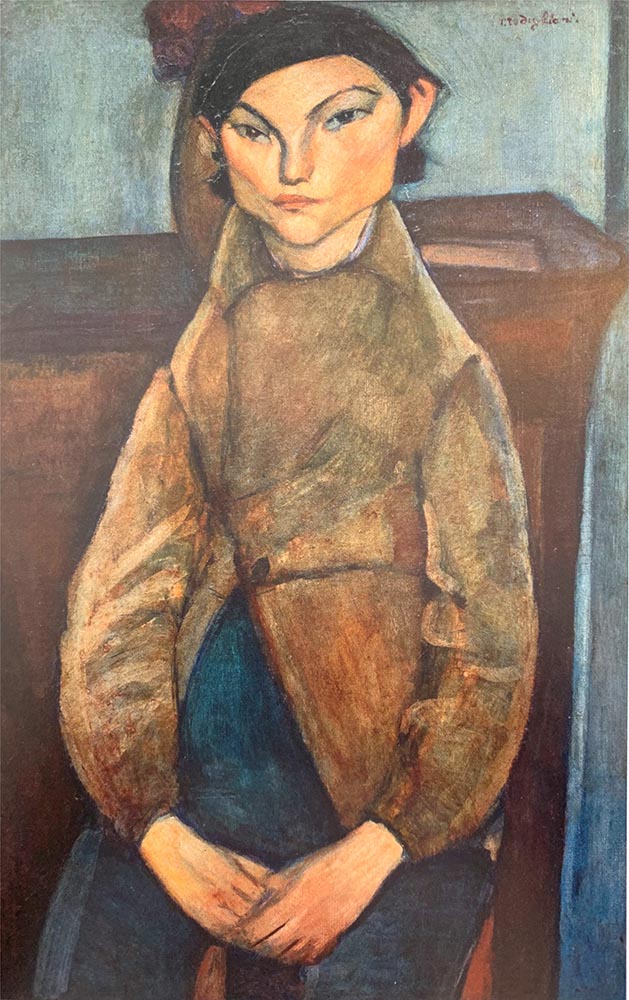
Identification
- Title
- English: Young gypsy.
French: La petite Bohemien / la petite gitan / Le jeune Garçon.
Notes: Giovane zingaro (Ceroni); Young Gypsy (Royal Academy 2006; Tate Modern 2017); The Little Gypsy (MoMA 1951); La petite Bohémienne, La petite gitane, Le jeune garçon (various); Le petit garçon (Ceroni's note)
Not even clear if it is a man or a woman. - Date
- 1909 ?
Notes: 1915 ( Pfannstiel; D'Atri; MOMA 1951) - Medium
- Oil on Canvas?
- Dimensions
- 81 x 54 cm (other sources 79 x 51 cm)
- Signature
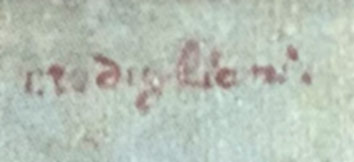
- Signed "modigliani" upper right in red
- Present location
- Private Collection?
Formerly the Earl of Sandwich, Hinchingbrooke, Huntingdon
Catalogue numbers
| Compiler | Number |
|---|---|
| Arthur Pfannstiel | no. 65 |
| Joseph Lanthemann | no. 28 |
| Ambrogio Ceroni | no. 28 |
| Jeanne Modigliani | YES |
| Christian Parisot | ? |
| Osvaldo Patani | no. 30 |
| Modigliani Project | ? |
| MR | ? |
| Modigliani Initiative/ AMDC | ? |
Legal note on MR: This investigation has not had access to MR’s catalogue raisonné; all research here is based on open sources, publications and exhibitions. By no means has that catalogue been copied at any point. Modigliani Project and Modigliani Research Project are marked YES when the work is published or otherwise recorded by those projects, even if no catalogue number is assigned; otherwise the field is marked ?.
Provenance
- Earl of Sandwich Collection, Hinchingbrooke, UK (1933?)
- Private Collection, London ?
The sequence follows the published museum, sale, and catalogue record in this investigation. Gaps and uncertain transfers are marked as such.
Selected bibliography
Book-length publications are marked with a footnote giving a full citation. Exhibition catalogues appear in both this list and the exhibition list when this investigation recorded them in both places.
- Bruxelles, Modigliani: Retrospective Exhibition. Palais des beaux-arts, 1933.no. 12
- T. Soby, Modigliani, Museum of Modern art, New York, catalogue exp. 1951
- Pfannstiel, Modigliani et son oeuvre, étude critique et catalogue raisonne, Bibliothèque des Arts, Paris, 1956, no. 65 (Dated in 1915)1
- Lanthemann, Catalogue Raisonne, G. Condal, Barcelona, 1970,2
- no. 28 ( Dated in 1909, relate the painting to a watercolor dated in 1909 usually said to represent Soutine)
- Ceroni & Piccioni, Il dipinti di Modigliani, Milan. 1970, no. 28 ( Dated in 1909)3
- Patani, Catalogo Generale, Leonardo ed. Milano 1991-94 - no. 30 a Young gypsy boy - dated 19094
- Fraquelli, Modigliani and His Models. Exh. cat., Royal Academy of Arts. London, 2006, p. 80 - no. 45
- Soto Caba, Modigliani, the timeless face, Libsa, 20076
- Ireson, Fraquelli, Modigliani, London, Tate Modern, Skira Rizzoli, London, 2017, p. 397
Exhibitions
- Bruxelles, Modigliani: Retrospective Exhibition. Palais des beaux-arts, 1933 - no. 12
- Basel, Amedeo Modigliani, Kunsthalle, 1934 - no. 5
- Cleveland, Modigliani: Paintings, Drawings, Sculpture, Cleveland Museum of Art,1951
- New York, Modigliani: Paintings, Drawings, Sculpture, The Museum of Modern Art, 1951
- London, Modigliani and his models, Royal Academy of Arts, 2006 - no. 4
- London, Modigliani, Tate Modern, 2017-2018
Notes
no. 12 in D' Atri files as La petit Bohemien / Le jeune garçon - dated 1915 in the Earl of Sandwich since 1933
Lanthemann mention the next watercolor (previously said to represent Soutine) to this work:
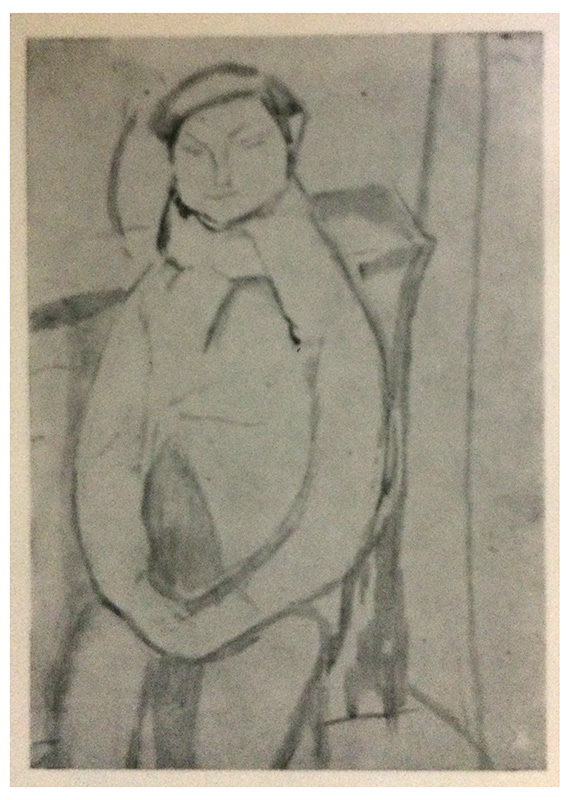
Young gypsy watercolor dated in 1909
Where sources disagree, both readings are given. This is a working research page, not a catalogue raisonné.

Introduction
A young figure sits facing us, knees apart, hands clasped in the lap. A long fawn coat with a wide collar falls open over a blue-green garment. A dark cap is pulled low over the forehead. Under it, the face is a narrow oval with almond eyes, a long, straight nose and a small, closed mouth. The expression is calm, perhaps wary. Behind the figure, a grey-blue wall is broken by a brown form at shoulder height, perhaps the back of a sofa or a chest, by a brownish arc behind the head, by a patch of red at the upper left and by a blue vertical strip along the right edge. The signature is at the upper right.
This is the painting Ceroni catalogued as no. 28, Giovane zingaro. It is one of the few full-length or near full-length seated figures among the works Ceroni assigns to 1909, and its titles are unusually unstable. In English it has been The Little Gypsy and Young Gypsy. In French it has been La petite Bohémienne, La petite gitane, Le jeune garçon and Le petit garçon. Its date has moved between 1909 and 1915. It is also the only work of this batch that has entered the technical literature, though indirectly: the authors of the Tate Papers study of Modigliani's reused canvases compared it with a figure hidden beneath the Jean-Baptiste Alexandre with a Crucifix of 1909. This essay looks first at the painting itself, and then at the documentary and technical questions it raises.
Composition and format
The canvas measures 81 by 54 centimetres according to Ceroni. Those are the dimensions of the French standard size 25 marine (my identification). Used upright, a marine canvas gives a tall, narrow field, much taller in proportion than the figure sizes intended for portraits. The 2018 Burlington Magazine introduction to the Modigliani Technical Research Study notes that of the seventy-six paintings examined with their original strainers, thirty-five were on marine formats. It notes also that Modigliani often turned paysage and marine canvases on their short edges for portraits, with examples "as early as 1908". Young Gypsy fits this pattern. The narrow format suits the elongated seated figure and leaves little room at the sides.
The composition is symmetrical and frontal. The figure is on the central axis. The cap is near the top edge; the clasped hands are a little below the centre; and the lower edge cuts the figure at the knees or a little below. The open coat makes an inverted V, with the blue-green garment inside it, and this shape gives the figure a stable, pyramidal structure. The arms come down along the sides of the body and meet at the hands, closing the form.
The background is divided into horizontal and vertical zones. The brown form behind the shoulders gives a horizontal at the level of the upper arms. The arc behind the head echoes the curve of the cap and frames the face. The red patch at the upper left and the blue strip at the right add accents at the edges. Together they hold the figure in a shallow, almost decorative frame.
Line
The line is drawn with the brush, in dark paint, around the main forms. It is firm and continuous around the outline of the coat, the arms and the face, and looser inside the forms. The face is drawn with particular economy. The eyes are two almond shapes, the nose is one long line with a shadow beside it, and the mouth is a short, curved stroke. Compared with the 1909 portraits of Pedro, Drouard or Joseph Lévi, the face here is less individual and more stylised. It already suggests the mask-like faces of 1910–11, though the eyes still have irises.
The hands are drawn broadly. They are joined in the lap, and the fingers are suggested rather than described. This is an area where the Tate Papers authors saw a likeness to the figure beneath the Alexandre portrait, as discussed below.
Colour
The palette is restrained and earthy. The coat is fawn, khaki or light brown, warmed with ochre and shaded with grey-green. The garment beneath is a cool blue-green. The cap is black or very dark brown. The face is pale, with pink and warm ochre tones and greenish shadows. The background is mainly grey-blue, with brown, red and blue accents.
The colour is organised around a contrast between the warm coat and the cool background and garment. The red patch at the upper left is the only strong warm accent outside the figure, and it balances the warm tones of the face. The blue strip at the right echoes the blue-green of the garment. The overall effect is quieter than that of Joseph Lévi (Ceroni no. 27), with none of its Fauve stripes, and closer to the muted harmonies of the Cellist (no. 23) and the Beggar of Livorno (no. 24). The Tate's 2017 guide speaks of the impact of Cézanne on The Beggar of Livorno, and something of the same restraint is visible here.
Facture
The paint seems to be applied in fairly thin layers, with visible brushstrokes in the coat and background. The coat is built up with long strokes following the folds, and the background with broader, more scrubbed strokes. The face is more smoothly painted. The highlights on the arms, which the Tate Papers authors mention, are laid on as light, thick strokes along the sleeves. In the reproduction, the handling is even and controlled, without the impasto of Joseph Lévi.
Figure and space
The space is shallow. The figure sits close to the picture plane, and the background is a flat wall with a few objects against it. The brown form behind the shoulders gives some depth, as does the arc behind the head, but neither is clearly legible. The seat is not shown. The figure seems to sit on something below the lower edge.
The pose is frontal and still, and this stillness is the key to the picture's character. The sitter does not act or gesture; the hands are folded; the face is calm. In this, the painting looks forward to Modigliani's seated figures of 1916–19, in which a frontal seated figure with folded hands becomes a constant type. This may be one reason why Pfannstiel and the 1951 exhibition dated the work to 1915. The date question is discussed below.
Iconography and title
The sitter's identity and gender are uncertain. The English titles speak of a "gypsy" and the Italian of a zingaro, which is masculine. The French titles vary between the feminine petite Bohémienne and petite gitane and the masculine jeune garçon and petit garçon. Ceroni's note, as transcribed by modigliani1909.com, says that the painting is "also known as Le petit garçon". Patani, as cited by the Secret Modigliani page, calls it "a Young gypsy boy". The painting does not settle the question. The cap, the coat and the short hair suggest a boy, but the face is soft and could be read either way.
The word "gypsy" may describe the sitter's origin, dress or way of life, or may be a title given later. No source I have opened explains it. In Paris in 1909, the word bohémien could also mean simply a bohemian, an artist or a person of irregular life, and the French titles may reflect that double sense. This is a suggestion only.
The Secret Modigliani page reproduces a watercolour, dated 1909, of a seated figure with clasped hands, which it says Lanthemann linked to this painting and which has usually been said to represent Chaim Soutine. The pose of the watercolour is close to that of the painting. I have not been able to verify the identification of the sitter in the watercolour, and the Secret Modigliani page reports it without comment.
Ceroni's note adds that the painting was "preceded by many preparatory drawings, some of which were shown in 1963 at the Modigliani exhibition held in London and Edinburgh". I have not seen those drawings, and I cannot say which of them are meant.
Comparisons
The most important comparison is with the figure beneath Jean-Baptiste Alexandre with a Crucifix (Ceroni no. 12, Rouen). The Tate Papers authors describe the X-radiograph of that painting, which shows, beneath the portrait, a figure that "could be a torso of a naked woman – seated and possibly pregnant – or perhaps the torso of an overweight older man". They continue: "More probably, it could relate to Modigliani's painting Young Gypsy (private collection; C28). Like the figure visible in the X-radiograph, the model in Young Gypsy sits with legs slightly apart, and the rounded abdomen and position of the arms and the hands are similar. Moreover, the highlights in the arms described above are comparable in technique to those of the Young Gypsy." Later they conclude that the composition beneath "cannot be identified with certainty, but it recalls that of the Young Gypsy (C28), which Ceroni dates to 1909".
This comparison has consequences for the date. The Tate Papers authors note that the Rouen canvas carries the stamp of the supplier Hardy-Alan, which "could suggest that the portrait beneath the surface, possibly of a nude, was executed before 15 July 1907, when the supplier changed his business address". They add the necessary caution: "we do not know how long the artist had the canvas before he began painting, or indeed if the supplier kept the previously stamped canvases in stock". If the hidden figure is an early version of the Young Gypsy composition, then the composition existed before the Alexandre portrait was painted in 1909. This would support the early date given by Lanthemann, Ceroni and Patani, against the 1915 date of Pfannstiel and the 1951 exhibition. It is not proof. The authors themselves do not claim that the hidden figure is the same composition, only that it "recalls" it.
The painting also invites comparison with other seated figures of 1909: The Cellist (no. 23) and The Beggar of Livorno (no. 24). All three show a single figure, seated, close to the picture plane, against a plain background. In The Cellist, the figure is in profile and absorbed in playing. In the Beggar, it is frontal and rough. In Young Gypsy, it is frontal and calm. The three together show Modigliani working through the problem of a seated figure in a vertical format, under the influence of Cézanne.
Provenance and exhibitions
The Secret Modigliani page gives the provenance as the Earl of Sandwich, Huntingdon and Hinchingbrooke, England, "since 1933?", and then a private collection, London (with a question mark). Ceroni's caption, as transcribed by modigliani1909.com, reads "London, private property". The 1951 Museum of Modern Art catalogue lists "The Little Gypsy. 1915. Oil" as "Lent by the Earl of Sandwich, Hinchingbrooke, England". The Tate's 2017 guide lists "Young Gypsy 1909 Oil paint on canvas Private Collection".
The exhibitions listed on the page are: Brussels, Palais des Beaux-Arts, 1933, no. 12; Basel, Kunsthalle, 1934, no. 5; Cleveland Museum of Art and New York, Museum of Modern Art, 1951; London, Royal Academy of Arts, Modigliani and His Models, 2006, no. 4; and London, Tate Modern, Modigliani, 2017–18. The 2006 exhibition is confirmed by the exhibition history on the pubhist website, which lists Modigliani and His Models at the Royal Academy, 8 July–15 October 2006, curated by Simonetta Fraquelli and Norman Rosenthal, with "Young Gypsy" as no. 4. The 1951 and 2017 exhibitions are confirmed by the MoMA catalogue and the Tate guide.
Discrepancies.
- Date. Lanthemann, Ceroni, Patani and the Tate guide give 1909. Pfannstiel, the 1951 MoMA catalogue and the d'Atri files (as reported by the Secret Modigliani page) give 1915. The evidence of the Tate Papers comparison, if accepted, favours 1909.
- Title and gender. The titles alternate between masculine and feminine forms, as discussed above.
- Medium. The Secret Modigliani page puts a question mark after "Oil on Canvas". The Tate guide and the MoMA catalogue give oil on canvas without qualification.
Technical analysis
*No technical study of Young Gypsy itself has been published, as far as I can find. The painting is in a private collection. It was shown at Tate Modern in 2017–18, at the time of the Modigliani Technical Research Study, but it is not among the works for which the Tate Papers* article reports X-radiographs or infrared images. Its only presence in the technical literature is the comparison, discussed above, with the figure beneath the Rouen portrait. That comparison is evidence about the Rouen painting, not about this one. It is comparative.
Comparative evidence. The Tate Papers authors describe the Rouen canvas as having "a thick lead white ground layer", which, because of how it reaches the edges, suggests to them that the canvas "was not primed commercially but possibly by Modigliani himself". They also note that the "highlights on the arms are clearly visible on the X-radiograph, suggesting the use of lead white". If the same technique was used in the highlights of Young Gypsy, as the authors imply, those highlights would also show strongly in an X-radiograph. The Burlington introduction notes that the canvases studied "seem to have been commercially prepared with an oil-based priming", and that marine formats were the most common. The 2023 IJCS study of The Cellist, another work of 1909, found a lead-white preparation and a palette including zinc white, emerald green, chrome pigments and vermilion. None of these findings can be transferred to Young Gypsy without examination.
What an examination could settle. An X-radiograph would show whether the canvas was reused, as so many of Modigliani's canvases of these years were, and whether the highlights on the arms are built up in lead white as in the Rouen figure. Infrared reflectography would show whether there is an underdrawing and how it relates to the many preparatory drawings Ceroni mentions. The canvas stamp, if any, could help to settle the date. A comparison of the X-radiographs of Young Gypsy and the Rouen portrait would test the Tate Papers hypothesis directly.
Conclusion
Young Gypsy is a quiet, frontal image of a seated young person in a long coat and cap, set against a shallow, muted background. Its symmetry, its stillness and its tall marine format give it a monumental character out of proportion to its subject. The painting's titles, gender and date have all been unstable. The weight of the catalogues and of the Tate guide supports 1909, and the Tate Papers comparison with the figure beneath Jean-Baptiste Alexandre with a Crucifix adds indirect support to that date. It also places the composition at the very start of Modigliani's long interest in the frontal seated figure, which would dominate his work after 1916. The painting itself has not been technically examined, and the hypothesis of the Tate Papers authors can only be tested by doing so.
Museum and exhibition sources
- The Museum of Modern Art, New York, in collaboration with the Cleveland Museum of Art, Modigliani: Paintings, Drawings, Sculpture, introduction by James Thrall Soby (1951), catalogue of the exhibition, https://assets.moma.org/documents/moma_catalogue_2916_300191634.pdf
- Tate Modern, Modigliani (23 November 2017–2 April 2018), large-print guide, rooms 1–11 (copy at docslib), https://docslib.org/doc/1601730/modigliani-large-print-guide-room-1-11
- Pubhist, exhibition history for Modigliani and His Models, Royal Academy of Arts, London, 8 July–15 October 2006, pubhist.com, page titled "Modigliani and His Models" (consulted and saved during this research, 26 October 2026; site root https://www.pubhist.com)
Technical literature
- Anaïs Genty-Vincent et al., "Works by Modigliani that have Paintings beneath the Visible Surface", Tate Papers, no. 35, https://www.tate.org.uk/research/tate-papers/35/works-by-modigliani-that-have-paintings-beneath-the-visible-surface (discusses this painting by comparison only)
- Annette King, Nancy Ireson, Simonetta Fraquelli and Joyce H. Townsend, "The Modigliani Technical Research Study: An introduction to Modigliani's materials and techniques", The Burlington Magazine, vol. 160, no. 1380 (March 2018), pp. 182–88, https://www.burlington.org.uk/archive/article/the-modigliani-technical-research-study-an-introduction-to-modiglianis-materials-and-techniques (comparative)
- Greta Garcia, David Juanes and Rafael Romero, "Image Study and Material Characterization of the Two-Sided Painting The Cellist and Portrait of Brancusi by Amedeo Modigliani", International Journal of Conservation Science, vol. 14, no. 3 (2023), pp. 1233–48, https://doi.org/10.36868/ijcs.2023.03.30 (comparative)
Cited but not independently consulted
Pfannstiel, Modigliani et son oeuvre, 1956, no. 65; Lanthemann, 1970, no. 28; Ceroni and Piccioni, I dipinti di Modigliani, 1970, no. 28; Patani, Catalogo generale, 1991–94, no. 30; Fraquelli, Modigliani and His Models, Royal Academy, 2006, p. 80; Soto Caba, 2007; Ireson and Fraquelli, Modigliani, Tate, 2017, p. 39; the catalogues of Brussels, 1933, Basel, 1934, and London and Edinburgh, 1963; the d'Atri files.Footnotes
- Arthur Pfannstiel, Modigliani et son œuvre, étude critique et catalogue raisonné, Paris, Bibliothèque des Arts, 1956.
- Joseph Lanthemann, Modigliani, catalogue raisonné: sa vie, son œuvre, son art, Barcelona, G. Condal, 1970.
- Ambrogio Ceroni and Leone Piccioni, I dipinti di Modigliani, Milan, Rizzoli, 1970.
- Osvaldo Patani, Amedeo Modigliani: catalogo generale, Milan, Leonardo, 1991–94.
- Simonetta Fraquelli et al., Modigliani and His Models, London, Royal Academy of Arts, 2006.
- Victoria Soto Caba, Modigliani: The Timeless Face, Madrid, Libsa, 2007.
- Nancy Ireson and Simonetta Fraquelli, Modigliani, London, Tate Modern / Skira Rizzoli, 2017.