Woman bust
Oil on canvas — 1908

Identification
- Title
- English: Woman bust - woman with hat.
French: Buste de jeune femme - Tête de femme au chapeau.
Also mentioned as: Young Girl with Hat (Jeanne Modigliani) - Date
- 1908
- Medium
- Oil on Canvas
- Dimensions
- 58 x 55 cm ?
Notes: 57 × 55 cm (LaM; also Pfannstiel, Patani and Ireson according to the work's documentation); 56 × 55 cm (Ceroni) - Signature
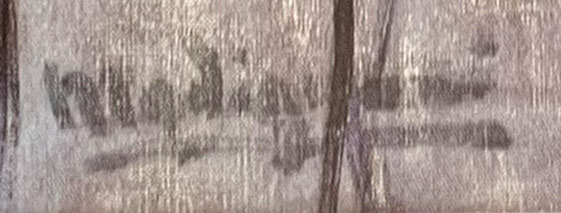
- Signed "Modigliani" underlined lower middle left
On the reverse, the name of the model, Maud Abrantès, in the hand of Roger Dutilleul (LaM, 2021) - Present location
- Villeneuve-d'Ascq, LaM – Lille Métropole Musée d'art moderne, d'art contemporain et d'art brut, inv. 979.4.103; gift of Geneviève and Jean Masurel, 1979.
Catalogue numbers
| Compiler | Number |
|---|---|
| Arthur Pfannstiel | no. 3 |
| Joseph Lanthemann | no. 18 |
| Ambrogio Ceroni | no. 6 |
| Jeanne Modigliani | YES |
| Christian Parisot | 2/1908 |
| Osvaldo Patani | no. 10 |
| Modigliani Project | ? |
| MR | YES |
| Modigliani Initiative/ AMDC | ? |
Legal note on MR: This investigation has not had access to MR’s catalogue raisonné; all research here is based on open sources, publications and exhibitions. By no means has that catalogue been copied at any point. Modigliani Project and Modigliani Research Project are marked YES when the work is published or otherwise recorded by those projects, even if no catalogue number is assigned; otherwise the field is marked ?.
Provenance
- Paul Guillaume, Paris
- Paul Alexandre, Paris
- Roger Dutilleul, Paris (1946-1956 in exchange with Alexandre for portrait Maurice Drouard)
- Jean Masurel Collection (1956- 1979)
- Villeneuve-d'Ascq, Musée d'Art Moderne, Lille Métropole, France (Inv. no. 979.4.103 )
- Donated to Public Collections of France - Jean Masurel Collection 1979
The sequence follows the published museum, sale, and catalogue record in this investigation. Gaps and uncertain transfers are marked as such.
Selected bibliography
Book-length publications are marked with a footnote giving a full citation. Exhibition catalogues appear in both this list and the exhibition list when this investigation recorded them in both places.
- Pfannstiel, "catalogue présumé" Modigliani. L'Art et la Vie. Preface de Louis Latourrettes, Seheur, Paris, 1929, p. 21
- Pfannstiel, Modigliani et son oeuvre, étude critique et catalogue raisonne, Bibliothèque des Arts, Paris, 1956 - no. 32
- Ceroni, Amedeo Modigliani: Peintre; Suivi des Souvenirs de Lunia Czechowska, Edizioni del Milione, 1958 - no. 33
- Russoli, Amedeo Modigliani, Exhib. catalogue Palazzo Reale, Edizioni dell'ente manifestazioni Milanesi, Milano, 1958, pl. 1
- Cat. d'exp. Gand, Museum voor Schone Kunsten, p. 49
- Galerie Charpentier,Cent tableaux de Modigliani, 1958, page 12, no. 8
- Jeanne Modigliani, Modigliani: Man and Myth, Orion Press, New York, 1958, pl. 1 (dated 1908-1909 and titled Young girl with hat)4
- Jeanne Modigliani, Modigliani sans légende 1961, pp. 34-355
- Werner, Amedeo Modigliani, Garzanti, Milano 1967, p. 58
- Werner, Amedeo Modigliani, Cercle d'art, Paris,1968, p. 66
- Geza, Modigliani, Tchekoslovakia, 1969, pl. 1
- Diehl, Modigliani, Ed. Flamarion, Paris, 1969, p. 5
- Lanthemann, Modigliani, catalogue raisonné: sa vie, son oeuvre, son art, G. Condal, Barcelona, 1970 - no. 186
- Ceroni & Piccioni, Il dipinti di Modigliani, Rizzoli, Milano, 1970 - no. 67
- Yasuo, L' art moderne du monde, no.16, Modigliani/ Utrillo. Edition the zauho press, 1971, Japan.
- Le Bateau-Lavoir, berceau de l'art moderne : Paris, Musée Jacquemart-André, Paris : éd. Musée Jacquemart-André, 1975
- Diehl.- Modigliani.- Paris, Editions Flammarion, 1977
- Yasuoka, 1977, pl. 23
- J . Warnod, Tentoonstelling Bâteau-Lavoir: Gand, Museum voor Schone Kunsten, Gand: Museum voor Schone Kunsten, 1978
- Mann, Modigliani, Thames and Hudson, London, 1980, p. 398
- Donation G. et Jean Masurel à la C. Urbaine de Lille : Paris, Musée du Luxembourg, éd. de la Réunion des musées nationaux, 1980
- Musée d'art moderne de de la Ville de Paris,. Amedeo Modigliani. 1884-1920 : Paris, Ed. Musée d'art moderne, 1981
- Werner, Modigliani, Harry N. Abrams, NY, 1985, p. 48-49
- Castieau-Barrielle, Modigliani, Editions ACR Paris, 19879
- Parisot, Modigliani, Editions Graphis Arte, Livorno 1988, page 37
- Diehl, Modigliani, Crown Publishers, New York, 1989, p. 5
- Schmalenbach, Amedeo Modigliani, Prestel , 1990, p. 58 - no. 1010
- Parisot, - Modigliani- Paris : éd. Terrail, 1991 - Reprod. p. 271112
- Parisot, Catalogue Raisonné Modigliani Tome II, Graphis Arte, 1991 no. 1/1902, rep. p. 2011
- Patani, Catalogo Generale, Leonardo ed. Milano 1991-9413
- Modigliani by Modigliani", Edited by Katsunori Fukaya / Nikkei pocket gallery, 1992, Japan. - p.28, p89
- Parisot, Modigliani, Pierre Terrail, Paris, 1992, p. 2712
- Revista "Amedeo Modigliani : retratista del alma" in Saber Ver, no.16, octobre-novembre 1998, Mexico, p. 5
- D. Krystof, Amedeo Modigliani: The Poetry of Seeing, Taschen Cologne, 2006, p. 9
- London, Tate Britain,Century City: Art and Culture in the Twentieth Century Metropolis, 2001, page 411
- Soto Caba, Modigliani, the timeless face, Libsa, 200714
- Ireson, Fraquelli, Modigliani, London, Tate Modern, Skira Rizzoli, London, 2017, p. 2715
Exhibitions
- Paris, Cent Tableaux de Modigliani, Galerie Charpentier, 1958 - no. 8
- Edinburgh, Modigliani, Royal Scottish Academy, 1963 - no. 1
- London, Modigliani, Tate Gallery, 1963 - no. 1
- Paris, Musée Jacquemart-André, Le Bateau-Lavoir, berceau de l'art moderne, 1975
- Osaka, Mitsukoshi,Tokyo, Le Bateau-Lavoir, Nihonbashi Mitsukoshi, 1977
- Gand, Bateau-Lavoir, Museum voor Schone Kunsten,Tentoonstelling 1978
- Paris, Musée du Luxembourg, La donation Geneviève et Jean Masurel à la Communauté Urbaine de Lille, 1980
- Paris, Musée d'art moderne de la Ville de Paris, Amedeo Modigliani. 1884-1920, 1981 - no. 2
- Düsseldorf, Kunstsammlung Nordrhein Westfalen, Amedeo Modigliani. Malerei, Skulpturen, 1991 - no. 2
- Zürich, Kunsthaus, Amedeo Modigliani. Malerei, Skulpturen, 1991 - no. 2
- Le Cateau-Cambrésis, Musée Matisse, Baigneuses et figures, 1998
- London, Tate Modern,Century City: Art and Culture in the Twentieth Century Metropolis, 2001
- Le Cateau-Cambrésis, Musée Matisse, Autour du fauvisme :2005-2006
- Matsuyama , Hiroshima, Akita, Tokyo, Kitakyushu, Osaka, Koriyama, Modigliani, Picasso et leur temps - Collections du musée d'art moderne Lille Métropole 1900-1950, 2006-2007
- Hornu,Belgium, Musée des Arts Contemporains - Grand-Hornu,Des fantomes et des anges : 2008
- Villeneuve d'Ascq, L'oeil intérieur, LaM. Lille Métropole musée d'art moderne, 2016
- Budapest, Modigliani, Hungarian National Gallery, 2016
- Helsinki, Modigliani, Ateneum Art Museum, 2016-2017
- London, Modigliani, Tate Modern, 2017-2018
- Villeneuve-d'Ascq, LaM, Les Secrets de Modigliani, 2021–22
Notes
LaM (Lille Métropole Musée d’art moderne) confirms: Inv. 979.4.103, oil on canvas, 57 × 55 cm, 1908, signed lower left “Modigliani”. Donation Geneviève and Jean Masurel, 1979 (from Roger Dutilleul, previously Paul Alexandre). Title variants include “Buste de jeune femme” / “Tête de femme au chapeau”.
Not in D' Atri files.
Where sources disagree, both readings are given. This is a working research page, not a catalogue raisonné.
Introduction
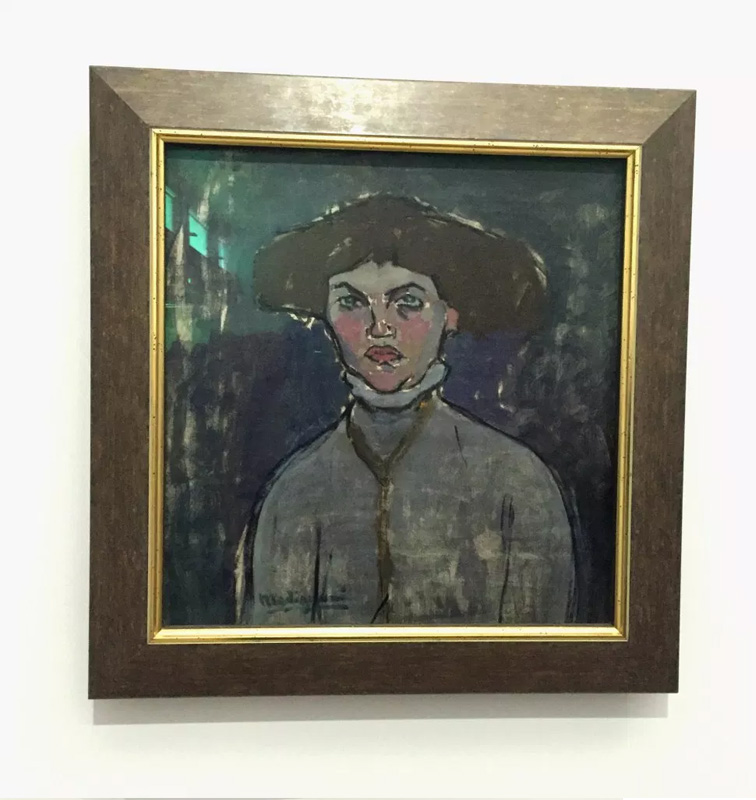
The Buste de jeune femme in the LaM at Villeneuve-d'Ascq is described by the museum as one of the first pictures Modigliani painted after arriving in France. A young woman with a broad brown hat (or, in another reading, a wide mass of piled-up hair), rose-pink cheeks and a full red mouth faces the viewer against a violet ground streaked with lighter paint. Her lilac blouse, with a high white collar and a thin ochre ribbon, is outlined with dark, decisive lines. The picture was owned in turn by three of Modigliani's most important collectors: Paul Alexandre, his first patron; Roger Dutilleul, who exchanged it with Alexandre in 1946; and Dutilleul's nephew Jean Masurel, who gave it to the communauté urbaine of Lille in 1979 with the rest of his collection.
It is also the only work of the early group to have been studied in a published research programme.
Composition and format
The canvas is nearly square. The figure is placed frontally and fills most of the field. The brown form on the head spreads wide, the shoulders are cut by the sides, and the lower edge cuts the blouse. Dark contours define the face, neck and clothing against the violet ground.
Line and drawing
Dark, decisive lines outline the features, the collar and the blouse. The mouth is strongly defined. The LaM's 2016 dossier noted that the line is "particulièrement sensible dans Buste de jeune femme (1908, LaM) dont la bouche charnue et les cheveux relevés en chignon rappelle les courtisanes du Moulin Rouge". The same dossier also saw in the painting "une proximité avec un artiste comme Kees Van Dongen", citing Van Dongen's La femme lippue (c. 1909) in the LaM. Both comparisons fit: the descriptive line recalls Lautrec, while the heavy dark outline around flat, bright colour recalls Van Dongen's and the Fauves' portraits of the same years.
Colour
The palette is high-keyed and decorative. The ground is a deep violet-blue, brushed loosely over a lighter underlayer that shows through as streaks of white, cream and ochre, especially along the left edge and at the upper right. The blouse is a pale lilac-grey, modelled with lighter and darker passages of the same hue, and crossed by the ochre-yellow vertical of the ribbon. The collar is an off-white tinged with grey-blue. The hat or hair is a warm, flat brown, almost uninflected.
The face is built from bold patches of colour rather than continuous modelling: a pale pink base, rose-red on the cheeks, salmon under the cheekbones and along the jaw, blue-grey in the eyes and lilac-grey in the shadows of the eye sockets. The lips are a strong red with a darker dividing line. The flesh thus picks up the violet of the ground and the lilac of the blouse, while mouth and cheeks provide the warmest notes.
Facture and surface
The surface is lively and varied. In the ground the violet paint is dragged in broad, multidirectional strokes, often thinly enough for the lighter layer below to show through; in places it seems to have been scraped or wiped. The blouse is painted more smoothly, with vertical strokes, and the dark contour lines sit on top of the colour. The face is the most worked area, with thicker, overlapping touches of pink, red and lilac. The hat is laid in as a single flat area with a few lighter strokes along its top edge. The signature, "Modigliani", underlined, is painted in dark paint at the lower left over the lilac of the blouse.
Colour laid in quickly and then fixed with dark drawing separates the picture from the scumbled tonal surfaces of Ceroni nos. 1, 2 and 5, and anticipates the brushed grounds and incisive contours of the later portraits.
Figure and space
The space is as shallow as in the other early works, but the figure is far more assertive within it. The shoulders press toward the edges, the hat spreads almost the full width of the head and shoulders, and the frontal stare holds the viewer. There is no setting: the violet ground is a field of moving brushstrokes, not a wall. Volume is suggested mainly by the modelling of the face and the folds of the blouse, but the dark contours flatten it again, so that the figure oscillates between a three-dimensional bust and a flat, poster-like silhouette.
The LaM's 2021 dossier reproduces a C2RMF eye-tracking study of this painting (heat map and gaze-path map, seven participants).
Iconography: the hat, the model and the name on the reverse
Two readings of the brown form on the head have circulated. The Secret Modigliani page on the work titles the painting Woman bust – woman with hat and records the variant Tête de femme au chapeau; Jeanne Modigliani's 1958 title, as cited there, is Young Girl with Hat. The LaM's 2016 dossier speaks of "cheveux relevés en chignon". Looking at the image, the shape's flat top, its projecting edges and its uniform colour make a wide-brimmed hat the more likely reading, but the ambiguity is itself telling: Modigliani reduced the form to a flat, decorative shape in which hat and hair can no longer be clearly separated. A web transcription of the notes to Ceroni's 1970 catalogue (modigliani1909.com) states that the alternative title Donna con cappello is mistaken, "poiché trattasi di pettinatura dell'epoca" (because it is a hairstyle of the period), which supports the LaM's reading. I have not checked this against the printed catalogue.
The identity of the sitter was clarified in 2021. According to the LaM's dossier, the reverse of the canvas bears the name "Maud Abrantès" in the hand of Roger Dutilleul. Maud Abrantès was, in the LaM's words, a singer, the artist's mistress and an occasional model. Recent research has shown that the name was a pseudonym adopted by Léontine Phipps so that she could mix with the Paris artistic bohemia without being compromised. The Jewish Museum's Modigliani Unmasked texts (2017) add that she was Jewish, American and married, that she accompanied Modigliani on his first visit to the rue du Delta studios where he met Paul Alexandre, and that she frequented the colony for about a year before returning to New York. The same exhibition included a double-sided canvas of 1908 from the Hecht Museum, Haifa, with Nude with a Hat on the recto and a Portrait of Maud Abrantès on the verso (81 × 54 cm), together with drawings of her of c. 1907–08.
The identification has to be weighed with care. Dutilleul's inscription was written after he acquired the painting in 1946, almost forty years after it was painted, and presumably reflects information from Alexandre. It is not the artist's own label. Nonetheless, it is consistent with the date of 1908, with the Alexandre provenance and with the themes of Modigliani's work of that year. If accepted, it makes the Buste de jeune femme one of a group of images of the same woman painted and drawn in 1908.
Comparisons
Within Ceroni's sequence, this is the first painting in which frontal pose, flat ground, emphatic contour and a face built from planes of colour appear together. It is larger, brighter and more graphic than the small frontal heads (nos. 1, 2 and 5), and it abandons the subdued harmonies of the 1907 Portrait de femme (no. 4) for colour close to the Fauves.
Its closest relatives are the 1908 images of Maud Abrantès mentioned above, and, more broadly, the portraits of women by Van Dongen proposed by the LaM. Its cut-down format may be related to the Burlington introduction's suggestion that Modigliani cut pieces from a roll of canvas and could have painted them pinned to the studio wall before stretching. That would explain paint running beyond the present edges, though the LaM does not draw this conclusion.
Provenance and exhibitions
The LaM gives the following provenance: Paul Alexandre, Paris, until 1946 ("présent dans la collection Paul Alexandre à partir de 1929 au plus tard"); Roger Dutilleul, Paris, 1946–56, acquired from Alexandre in exchange for Modigliani's portrait of Maurice Drouard; Jean Masurel, Paris, 1956–79, by inheritance from Dutilleul; donated by Geneviève and Jean Masurel to the communauté urbaine of Lille in 1979. The LaM's 2021 dossier notes that Dutilleul owned one of the most important groups of Modigliani's works, with 35 paintings and at least 21 drawings.
The LaM's bibliography also lists the Bateau-Lavoir exhibitions in Paris (Jacquemart-André, 1975), Tokyo and Osaka (1977, no. 26) and Ghent (1978), and a Japanese tour of 2006–07 (cat. 31).
Technical analysis
This is the only painting among Ceroni nos. 1–6 that has been examined within a published research programme. Since 2018 the LaM and the C2RMF, with Chimie ParisTech, the MSAP laboratory (CNRS / Université de Lille) and the Centre de recherche sur la conservation, have studied the 25 paintings and three sculptures by Modigliani in French public collections. The Les Secrets de Modigliani hang presented results for the LaM's four canvases.
Findings published for this work and accessible to me (LaM dossier, 2021):
- The canvas has been cut, and the paint extends beyond the limits of the present frontal portrait, indicating an originally more rectangular format.
- The reverse carries the name of the model, Maud Abrantès, in Roger Dutilleul's hand.
- The painting was used for an eye-tracking (oculomotricity) study by the C2RMF.
The full technical entry appears in the exhibition catalogue Les secrets de Modigliani (2022), pp. 198–201, according to the LaM's bibliography. I was not able to consult that catalogue, so I cannot report pigment, X-ray or infrared results specific to this painting.
Comparative evidence (not specific to this work). The same dossier states that Modigliani bought canvases ready-primed with lead white and sometimes used a blue-grey priming, and that he used commercial tube colours, notably from Sennelier. It lists the raw materials displayed beside period tubes: lead white, barium white, chalk, dolomite, gypsum, quartz, yellow and red ochre, vermilion, azurite, carbon black and bone black. That list illustrates the kinds of materials in commercial paints of the period and is not an analysis of this painting. The Burlington introduction reports lead white grounds (sometimes with an extra zinc white priming), painted borders, pinholes suggesting canvases cut from a roll and pinned to the wall, and dark halos around reserved contours in X-radiographs. Citing Delbourgo and Faillant-Dumas's earlier study of French-collection works, the same article lists chrome or cadmium yellow, ochres, vermilion, chrome green, Prussian blue, organic colours, and lead and zinc whites. The lighter streaks under the violet ground of the Buste de jeune femme are visually consistent with a pale commercial priming, but this is an observation, not a finding.
Conclusion
The Buste de jeune femme is where Modigliani's early experiments come together. The frontal pose of the 1906–07 heads, the warm colour of the profile and the worldly subject of the 1907 portrait are combined with a new, decisive line indebted to Lautrec and close to Van Dongen. Its history, from Alexandre through Dutilleul and Masurel to the LaM, is fully documented. Recent research has given it a name, Maud Abrantès (Léontine Phipps), and has shown that its square format is the result of cutting. Publication of the C2RMF's material findings in accessible form, or consultation of the 2022 catalogue, would complete the picture.
Museum documentation
- LaM, Villeneuve-d'Ascq, collection page "Buste de jeune femme – Amedeo Modigliani" (inv. 979.4.103; provenance, inscriptions, bibliography), https://www.musee-lam.fr/fr/buste-de-jeune-femme (accessed 25 October 2026).
- LaM, Les Secrets de Modigliani, 19 February 2021–20 February 2022, dossier pédagogique (Stéphanie Jolivet and Anne Gaëlle Le Flohic), https://www.musee-lam.fr/sites/default/files/2021-06/LaM_dossier-pedagogique_Secrets-de-Modigliani.pdf
- LaM, Amedeo Modigliani: l'œil intérieur, dossier pédagogique (2016), https://www.musee-lam.fr/sites/default/files/2019-01/Dossier-pedago-Modigliani-l-oeil-interieur.pdf
- The Jewish Museum, New York, Modigliani Unmasked (2017–18), wall texts and object labels, https://thejewishmuseum.org/wp-content/uploads/2025/07/Modigliani_Unmasked_wall_texts_and_object_labels.pdf
Library catalogue records (Bibliothèque nationale de France)
- Les secrets de Modigliani: techniques et pratiques artistiques d'Amedeo Modigliani, Villeneuve-d'Ascq, LaM, 2022. https://catalogue.bnf.fr/ark:/12148/cb47099736d
- Amedeo Modigliani, l'œil intérieur, Paris, Gallimard, 2016. https://catalogue.bnf.fr/ark:/12148/cb45000921m ; English edition The Inner Eye: https://catalogue.bnf.fr/ark:/12148/cb450113264
- Donation Geneviève et Jean Masurel à la Communauté urbaine de Lille, Paris, Musée du Luxembourg, 1980. https://catalogue.bnf.fr/ark:/12148/cb346786093
- Amedeo Modigliani 1884–1920, Paris, Musée d'art moderne de la Ville de Paris, 1981. https://catalogue.bnf.fr/ark:/12148/cb34657923t
- Françoise Cachin and Ambrogio Ceroni, Tout l'œuvre peint de Modigliani, Paris, Flammarion, 1972. https://catalogue.bnf.fr/ark:/12148/cb35281604b
- Ambrogio Ceroni, Amedeo Modigliani, peintre, Milan, Edizioni del Milione, 1958. https://catalogue.bnf.fr/ark:/12148/cb31986813q
- Arthur Pfannstiel, Modigliani et son œuvre, Paris, La Bibliothèque des Arts, 1956. https://catalogue.bnf.fr/ark:/12148/cb32524906f
Technical and scholarly literature
- Annette King, Nancy Ireson, Simonetta Fraquelli and Joyce H. Townsend, "The Modigliani Technical Research Study: An introduction to Modigliani's materials and techniques", The Burlington Magazine, vol. 160, no. 1380 (March 2018), pp. 182–88. https://www.burlington.org.uk/archive/article/the-modigliani-technical-research-study-an-introduction-to-modiglianis-materials-and-techniques
- Anaïs Genty-Vincent et al., "Works by Modigliani that have Paintings beneath the Visible Surface", Tate Papers, no. 35, https://www.tate.org.uk/research/tate-papers/35/works-by-modigliani-that-have-paintings-beneath-the-visible-surface
Cited but not independently consulted
Les secrets de Modigliani (2022), pp. 29 and 198–201 (the catalogue's technical entry on the work); Nancy Ireson and Simonetta Fraquelli (eds), Modigliani, London, Tate, 2017, p. 27; Ceroni and Piccioni, I dipinti di Modigliani, Rizzoli, 1970, no. 6; Lanthemann 1970, no. 18; Patani 1991, no. 10; Parisot 1991; Jeanne Modigliani, Modigliani: Man and Myth, 1958; Galerie Charpentier, Cent tableaux de Modigliani, 1958; Schmalenbach 1990; and the other titles in the LaM bibliography, as cited by the LaM.
Footnotes
- Arthur Pfannstiel, Modigliani. L’Art et la Vie, preface by Louis Latourette, Paris, Seheur, 1929 (presumed catalogue).
- Arthur Pfannstiel, Modigliani et son œuvre, étude critique et catalogue raisonné, Paris, Bibliothèque des Arts, 1956.
- Ambrogio Ceroni, Amedeo Modigliani: Peintre; suivi des souvenirs de Lunia Czechowska, Milan, Edizioni del Milione, 1958.
- Jeanne Modigliani, Modigliani: Man and Myth, New York, Orion Press, 1958.
- Jeanne Modigliani, Modigliani sans légende, Paris, Gründ, 1961.
- Joseph Lanthemann, Modigliani, catalogue raisonné: sa vie, son œuvre, son art, Barcelona, G. Condal, 1970.
- Ambrogio Ceroni and Leone Piccioni, I dipinti di Modigliani, Milan, Rizzoli, 1970.
- Carol Mann, Modigliani, London, Thames and Hudson, 1980.
- Thérèse Castieau-Barrielle, La vie et l’œuvre de Amedeo Modigliani, Paris, ACR, 1987.
- Werner Schmalenbach, Amedeo Modigliani, Munich, Prestel, 1990.
- Christian Parisot, Catalogue raisonné Modigliani, Livorno, Graphis Arte, 1991.
- Christian Parisot, Modigliani, Paris, Pierre Terrail, 1992.
- Osvaldo Patani, Amedeo Modigliani: catalogo generale, Milan, Leonardo, 1991–94.
- Victoria Soto Caba, Modigliani: The Timeless Face, Madrid, Libsa, 2007.
- Nancy Ireson and Simonetta Fraquelli, Modigliani, London, Tate Modern / Skira Rizzoli, 2017.