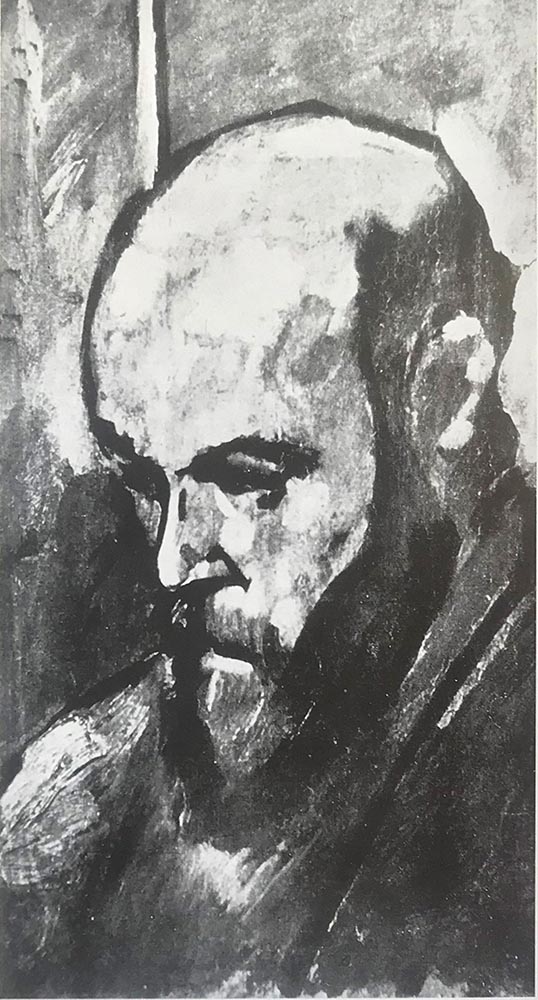
The Engraver Maurice Potin
Oil on canvas? — 1908 ?
Identification
- Title
- English: The Engraver Maurice Potin.
Italian: L'incisore Maurice Potin. - Date
- 1908 ?
Notes: 1909 (Ceroni list and later dated in 1908) - Medium
- Oil on canvas?
- Dimensions
- 42 x 25 cm ?
- Signature
- ?
- Present location
- ?
Catalogue numbers
| Compiler | Number |
|---|---|
| Arthur Pfannstiel | NO |
| Joseph Lanthemann | NO |
| Ambrogio Ceroni | no. 25 |
| Jeanne Modigliani | YES |
| Christian Parisot | ? |
| Osvaldo Patani | no. 24 |
| Modigliani Project | ? |
| MR | ? |
| Modigliani Initiative/ AMDC | ? |
Legal note on MR: This investigation has not had access to MR’s catalogue raisonné; all research here is based on open sources, publications and exhibitions. By no means has that catalogue been copied at any point. Modigliani Project and Modigliani Research Project are marked YES when the work is published or otherwise recorded by those projects, even if no catalogue number is assigned; otherwise the field is marked ?.
Provenance
- First time in the 50's in Paris art market
- Galerie Mouradian- Valloton, Paris (Ceroni)
- Private Collection, France (Patani)
The sequence follows the published museum, sale, and catalogue record in this investigation. Gaps and uncertain transfers are marked as such.
Selected bibliography
Book-length publications are marked with a footnote giving a full citation. Exhibition catalogues appear in both this list and the exhibition list when this investigation recorded them in both places.
- Ceroni & Piccioni, Il dipinti di Modigliani, Rizzoli, Milano, 1970 - no. 251
- Patani, Catalogo Generale, Leonardo, Milano, 1991-94 - no. 242
- Soto Caba, Modigliani, the timeless face, Libsa, 20073
- Castenova G., Modigliani; Giunti editore, 2015
Exhibitions
- Marseille, Modigliani, Musée Cantini, 1958 - no. 1
- Milano, Mostra di Amedeo Modigliani, Palazzo Reale, Curated by Franco Russoli, 1958 - no. 4
- Roma, Modigliani, Galleria Nazionale d'Arte Moderna, 1959 - no. 5
- Paris, Cent ans de portraits 1860-1960, Galerie Bernheim Jeune, 1962 - no. 37
Notes
Only visible in a black and white picture, last time seen in 1962
Where sources disagree, both readings are given. This is a working research page, not a catalogue raisonné.

Introduction
A bald, bearded man is seen close up, his head turned in three-quarter view to the left and his eyes cast down. The dome of his skull is pale and broadly lit, and a heavy dark line runs around it. His brows are thick and dark, his nose long, his moustache and beard short. The lower part of the face and the body sink into shadow, crossed by long diagonal strokes. A pale vertical strip rises at the upper left, and a light form at the lower left, perhaps a hand or a sleeve, comes up towards the chin.
This is the work Ceroni catalogued as no. 25, L'incisore Maurice Potin ("The Engraver Maurice Potin"). It is the least documented painting in this series so far. It is known only from black-and-white photographs. Its medium, dimensions and date are all given with question marks on the Secret Modigliani page on the work, which notes: "Only visible in a black and white picture, last time seen in 1962". It first appeared on the Paris art market around 1950, it is absent from the catalogues of Pfannstiel and Lanthemann, and it has no Alexandre provenance. An essay on such a work must say more about the limits of what can be known than about the painting itself. This one tries to do both.
The evidence
The visual evidence consists of three black-and-white reproductions:
- The image taken from Patani's catalogue.
- A second black-and-white reproduction on the same page, slightly different in tone and cropping, from the Ceroni catalogue.
All three show the same composition. None shows the edges of the canvas with certainty, none is in colour, and none gives any information about the surface beyond what a halftone can convey. Everything said below about composition, line and handling is therefore said about photographs. Nothing can be said about colour except in terms of value.
Composition and format
If the dimensions of 42 × 25 cm are correct, the format is very narrow, with a height of about 1.7 times the width. That is close to a standard no. 6 marine size used upright (my identification, and only provisional, given the question mark on the dimensions). The reproductions are narrower still, at about 1.8 to 1.9 times as high as wide, which suggests that they crop the image or that the dimensions are inexact.
The head is very large in relation to the field. The skull touches the top of the image, and the face fills its width. The composition is a close-up, without the space around the figure that Modigliani gives to his sitters in the portraits of 1908–09. The head is turned to the left and tilted forward, so that the bald crown occupies the upper half of the image and the features are compressed into the lower half. The body is reduced to a dark mass of diagonal strokes descending to the lower right.
Two vertical elements frame the head: the pale strip at the upper left and, at the right, a light patch that seems to be the ear, with another light passage beyond it. The pale strip recalls the orange bar at the upper left of The Beggar of Livorno (Ceroni no. 24), painted in August 1909. The parallel is visual only. No source connects the two pictures.
Line and drawing
Line is the most legible element in the photographs. A heavy dark contour runs around the skull from the forehead to the back of the head. It is as heavy as any contour in Modigliani's work of this period, and it isolates the head from the ground with great force. The brows are drawn as thick dark strokes, the eyes as dark slits under heavy lids, the nose as a long line ending in a dark shadow under the nostril. The moustache and beard are rendered in short dark strokes that blend into the shadow of the jaw.
The drawing is broad and summary. It describes the large forms of the head, the dome of the skull, the projection of the brow, the long nose, without detail. This is closer to the simplified heads of 1909 than to the more naturalistic portraits of 1908, but in a photograph that is a weak basis for dating.
Value, and the problem of colour
In black and white, the picture is built on a strong contrast between the lit skull and forehead and the dark lower face, beard and body. The skull is the lightest area; the background is a middle grey with lighter passages; the body is almost black. The light falls from the upper left.
Nothing can be said about colour. Even the value relationships are uncertain, since black-and-white film of the period did not render all colours at their true values. A red, for instance, could appear much darker than it would to the eye, and a blue much lighter. The heavy dark contour might be blue, as in The Beggar of Livorno, or black, or deep red. The pale skull might be ochre, pink or a greenish white. Any description of the picture's colour would be invention, and I have avoided it.
Facture
The photographs show a loose, rapid handling. The background is scumbled in broad strokes with lighter passages. The body is painted in long diagonal strokes that run parallel to one another down to the lower right. The face is modelled in broad patches of light and shadow. The lit skull appears to have been painted more thickly than the surrounding areas, with visible strokes following its curve.
This handling is consistent with Modigliani's practice in 1908–09: the quick, broad, constructive strokes seen in The Beggar of Livorno and in the oil study for Le Violoncelliste. But it is also the kind of handling most easily imitated, and in a halftone reproduction it is impossible to judge its quality.
Figure and expression
The man's downcast eyes and lowered head give him an air of concentration or fatigue. If the pale form at the lower left is a hand raised to the chin, the pose would be one of thought. The close framing brings the viewer very near, and the large bald skull dominates the image. The effect is of a powerful, brooding head, closer in mood to the Brancusi study (Ceroni no. 22b) than to the more distant portraits of the Alexandre circle.
The sitter
Ceroni's caption identifies the sitter as "the engraver Maurice Potin". The Secret Modigliani page adds that "Maurice Potin was a famous engraver of that time, he was the main engraver for Degas, Chagall, Vollard, etc."
Two sources consulted confirm the existence of a printmaker of that name in the twentieth century. The National Gallery of Art, Washington, lists "Maurice Potin, French, active 20th century", with two works: Marc Chagall's La Fontaine Fables, "published 1952", a portfolio of etchings, and Ludovic Halévy's La Famille Cardinal, "1938/1939", with soft-ground etchings. The Institut national d'histoire de l'art, in an article by Nathalie Muller (last updated December 2024) on the Petit Palais exhibition Édition limitée, Vollard, Petiet et l'estampe de maîtres, praises "Les aquatintes de Maurice Potin d'après les monotypes d'Edgar Degas" for Vollard's editions of Maupassant's La Maison Tellier (1934), Lucian's Mimes des courtisanes (1935) and Valéry's Degas Danse Dessin (1936).
This evidence raises two problems that should be stated plainly.
- Degas. The INHA evidence shows that he made aquatints after Degas's monotypes for Vollard in 1934–36, long after Degas's death in 1917. He reproduced Degas's work; there is no evidence in the sources consulted that he worked for Degas.
- Age. The sources consulted give no dates of birth or death for Potin. He was active as a printmaker at least from 1934 to about 1952. The man in the painting appears bald and bearded, and in the photographs he looks middle-aged or older. If the painting dates from 1908–09, the sitter would have to have been a mature man then, and he would have still been working as a printmaker in his eighties, which is possible but would be remarkable. Alternatively, the sitter is not the printmaker known from the 1930s–50s, or the title is not reliable. I cannot resolve the problem from the sources available. But it bears directly on the identification of the sitter, and it should be investigated before the identification is repeated.
Comparisons
The closest comparisons in Modigliani's work of 1909 are The Beggar of Livorno (Ceroni no. 24), for its heavy contour, broad handling and vertical bar at the upper left, and the Brancusi study (Ceroni no. 22b), for its brooding, downcast head. The close framing and narrow format have few parallels among the early paintings, which usually show the sitter at half length with space around the figure.
These comparisons are made from photographs of one work and reproductions or originals of the others. They show that the composition and handling are plausible for Modigliani in 1908–09, but they do not establish authorship.
Provenance, exhibitions and discrepancies
The provenance as: "First time in the 50's in Paris art market"; Galerie Mouradian-Vallotton, Paris; private collection, France (Patani). Ceroni's caption, as transcribed, gives the location as "Parigi, proprietà Mouradian – Vallotton", and his note reads "Apparso nel 1950 sul mercato parigino" ("Appeared on the Paris market in 1950"). Nothing is known of the picture before 1950.
The page lists four exhibitions: Marseille, Musée Cantini, 1958, no. 1; Milan, Palazzo Reale, Mostra di Amedeo Modigliani, curated by Franco Russoli, 1958, no. 4; Rome, Galleria Nazionale d'Arte Moderna, 1959, no. 5; and Paris, Galerie Bernheim-Jeune, Cent ans de portraits 1860–1960, 1962, no. 37. After 1962 the picture disappears from view. The bibliography consists of Ceroni and Piccioni 1970, Patani, Soto Caba 2007 and Castenova 2015.
Discrepancies and gaps to flag:
- Date. The page gives "1908 ?"; the site's list of Ceroni numbers gives 1909 and adds "Also dated in 1908". The image file on modigliani1909.com is also labelled 1909.
- Medium and dimensions. Both are given with question marks: "Oil on canvas?" and "42 × 25 cm ?".
- Signature. Unknown. No signature is visible in the reproductions.
- Location. Unknown since 1962. Patani's "private collection, France" may describe the situation at the time of his catalogue (1991–94), but I have not been able to check it.
- Pre-1950 history. None. The picture has no documented owner before its appearance on the Paris market about 1950, no Alexandre provenance, and no appearance in the catalogues of Pfannstiel (1929, 1956) or Lanthemann (1970).
- Identity of the sitter. As discussed above, the identification with the printmaker Maurice Potin raises a question of age that the sources consulted do not resolve, the INHA evidence that Potin's Degas aquatints were made in 1934–36.
Technical analysis
No technical study of this painting is known to me, and none could be carried out without access to the object, whose whereabouts have been unknown since 1962. No radiograph, infrared image, pigment analysis or condition report has been published. Even the medium is uncertain.
The only evidence of the surface is the black-and-white photographs. They show broad, directional brushwork and a heavy dark contour. They do not show the weave of the support, the thickness of the paint or any underlying composition.
For comparison: King, Ireson, Fraquelli and Townsend (2018) found that the canvases in the Tate programme "seem to have been commercially prepared with an oil-based priming". Tate Papers no. 35 (Genty-Vincent et al.) documented frequent reuse of canvases. Garcia, Juanes and Romero (2023) found, on the two-sided canvas of Ceroni nos. 22a–22b, lead-white preparations applied over an earlier portrait, a graphite underdrawing, and a palette including zinc white, cobalt blue, chromium-oxide green and emerald green. These findings describe other works and are cited only as the benchmark against which this picture would have to be tested if it reappeared. In a case like this, where the provenance begins in 1950 and the picture is known only from photographs, technical examination would matter more than for any other work in this series.
Conclusion
L'incisore Maurice Potin is, at present, a photograph rather than a painting. The photographs show a powerful, close-up head of a bald, bearded man, drawn with a heavy contour and painted with broad, rapid strokes. The composition and handling are plausible for Modigliani in 1908–09, and the work was accepted by Ceroni and Patani and exhibited in Marseille, Milan, Rome and Paris between 1958 and 1962.
But the documentary basis is thin. Its date, medium, dimensions and signature are all uncertain, and it has no history before 1950 and no known location after 1962. Its sitter is identified with a printmaker whose known activity, from the mid-1930s to the early 1950s, is hard to reconcile with the apparent age of the man in the picture. None of these points proves that the attribution or the identification is wrong. Together, they mean that the work should be cited with all its question marks intact until the painting itself can be found and examined.
On the printmaker Maurice Potin
- National Gallery of Art, Washington, artist page "Maurice Potin", https://www.nga.gov/artists/16809-maurice-potin
- Nathalie Muller, "Édition limitée, Vollard, Petiet et l'estampe de maîtres", Institut national d'histoire de l'art (updated 26 December 2024), https://www.inha.fr/actualites/edition-limitee-vollard-petiet-et-lestampe-de-maitres/
Technical literature (comparative)
- Greta Garcia, David Juanes and Rafael Romero, "Image Study and Material Characterization of the Two-Sided Painting The Cellist and Portrait of Brancusi by Amedeo Modigliani", International Journal of Conservation Science, vol. 14, no. 3 (2023), pp. 1233–48, https://doi.org/10.36868/ijcs.2023.03.30
- Anaïs Genty-Vincent et al., "Works by Modigliani that have Paintings beneath the Visible Surface", Tate Papers, no. 35, https://www.tate.org.uk/research/tate-papers/35/works-by-modigliani-that-have-paintings-beneath-the-visible-surface
- Annette King, Nancy Ireson, Simonetta Fraquelli and Joyce H. Townsend, "The Modigliani Technical Research Study: An introduction to Modigliani's materials and techniques", The Burlington Magazine, vol. 160, no. 1380 (March 2018), pp. 182–88, https://www.burlington.org.uk/archive/article/the-modigliani-technical-research-study-an-introduction-to-modiglianis-materials-and-techniques
Cited but not independently consulted
Ceroni and Piccioni, I dipinti di Modigliani, 1970, no. 25; Patani, Catalogo generale, 1991–94, no. 24; Soto Caba, Modigliani, the timeless face, 2007; Castenova, Modigliani, Giunti, 2015; the catalogues of Marseille, Musée Cantini, 1958; Milan, Palazzo Reale, 1958 (Russoli); Rome, Galleria Nazionale d'Arte Moderna, 1959; Paris, Galerie Bernheim-Jeune, Cent ans de portraits 1860–1960, 1962; the Petit Palais catalogue Édition limitée, Vollard, Petiet et l'estampe de maîtres, 2021. All are cited from the INHA article.
Footnotes
- Ambrogio Ceroni and Leone Piccioni, I dipinti di Modigliani, Milan, Rizzoli, 1970.
- Osvaldo Patani, Amedeo Modigliani: catalogo generale, Milan, Leonardo, 1991–94.
- Victoria Soto Caba, Modigliani: The Timeless Face, Madrid, Libsa, 2007.