Nudo dolente
Oil on canvas — 1908

Identification
- Title
- English: Nudo dolente - Nude sketch.
Italian: Nudo dolente.
French:Nu étude - Nu doloreux.
Notes: Nudo dolente (Ceroni, as transcribed online: "risulta citato anche come Nudo dolente"); Nude Study (Tate Modern, 2017–18; Burlington 2018); Nu doloreux (D'Atri files). - Date
- 1908
(Tate; Burlington) - Medium
- Oil on Canvas
- Dimensions
- 81 x 53.3 cm (Ceroni, Patani 81 x 54)
- Signature
- Signed "Modigliani" lower right in blue underlined
- Present location
- Private Collection?
Catalogue numbers
| Compiler | Number |
|---|---|
| Arthur Pfannstiel | no. 5 |
| Joseph Lanthemann | no. 19 |
| Ambrogio Ceroni | no. 8 |
| Jeanne Modigliani | YES |
| Christian Parisot | 6/1908 |
| Osvaldo Patani | no. 13 |
| Modigliani Project | ? |
| MR | YES |
| Modigliani Initiative/ AMDC | ? |
Legal note on MR: This investigation has not had access to MR’s catalogue raisonné; all research here is based on open sources, publications and exhibitions. By no means has that catalogue been copied at any point. Modigliani Project and Modigliani Research Project are marked YES when the work is published or otherwise recorded by those projects, even if no catalogue number is assigned; otherwise the field is marked ?.
Provenance
- Dr. Paul Alexandre, Paris
- Private Collection, Paris (until 1991?)
- Dr Reuben Hecht, Haifa
- Richard Nathanson, London
- Private Collection
The sequence follows the published museum, sale, and catalogue record in this investigation. Gaps and uncertain transfers are marked as such.
Selected bibliography
Book-length publications are marked with a footnote giving a full citation. Exhibition catalogues appear in both this list and the exhibition list when this investigation recorded them in both places.
- Pfannstiel, "catalogue présumé" Modigliani. L'Art et la Vie. Preface de Louis Latourrettes, Seheur, Paris, 1929, p. 2, (other sources say p. 3 - no. III1
- Pfannstiel, Modigliani et son oeuvre, étude critique et catalogue raisonne, Bibliothèque des Arts, Paris, 1956 - no. 52
- Ceroni, Amedeo Modigliani: Peintre; Suivi des Souvenirs de Lunia Czechowska, Edizioni del Milione, 1958 - no. 63
- Lanthemann, Modigliani, catalogue raisonné: sa vie, son oeuvre, son art, G. Condal, Barcelona, 1970 - no. 194
- Ceroni & Piccioni, Il dipinti di Modigliani, Rizzoli, Milano, 1970 - no. 85
- Mann, Modigliani, Thames & Hudson, 1980, p. 436
- Schmalenbach, Amedeo Modigliani, Prestel Verlag, 1990 p. 577
- Alexandre, The Unknown Modigliani: Drawings from the Collection of Paul Alexandre, 1993, page 38
- Parisot, Catalogue Raisonné Modigliani Tome II, Graphis Arte, 1991 no. 6/19088
- Patani, Catalogo Generale, Leonardo ed. Milano 1991-94 - no. 139
- D. Krystof, Amedeo Modigliani: The Poetry of Seeing, Taschen Cologne, 2000, p. 11
- MR, L'Ange au visage grave, Musée du Luxembourg, Paris, 2002, p.4110
- Soto Caba, Modigliani, the timeless face, Libsa, 200711
- R, La Collection Jonas Netter, Pinacotheque de Paris, 2012, p.101
- Ireson, Fraquelli, Modigliani, London, Tate Modern, Skira Rizzoli, London, 2017, p. 2912
Exhibitions
- Düsseldorf, Kunstsammlung Nordrhein Westfalen, Amedeo Modigliani. Malerei, Skulpturen, 1991 - no. 3
- Zürich, Kunsthaus, Amedeo Modigliani. Malerei, Skulpturen, 1991 - no. 3
- Tokyo, Tobu Museum, 1992
- Kyoto, Musée Daimaru, 1993
- Osaka, Musée Daimaru d’Umeda, 1993
- Ibaraki, Musée d’Art Moderne, 1993
- Cologne, Museum Ludwig, 1994
- Bruges, Centro d’Arte San Giovanni, 1994
- Tokyo, The Ueno Royal Museum, Tokyo 1995?
- Rouen, Musée des Beaux Arts, 1996
- Torino, Modigliani e la Bohème di Parigi, Galleria d’Arte Moderna, 2015
- London, Modigliani, Tate Modern, 2017-2018
Notes
Number 231 as Nu doloreux in D' Atri with a mention that in the back of the painting (VERSO) there is a face of a man sketched, no image availble.
As can be seen at near inspection, the canvas is reused.
Where sources disagree, both readings are given. This is a working research page, not a catalogue raisonné.


.jpg)
Introduction
Among the paintings of Modigliani's first Parisian years, the Nudo dolente is the one that least resembles the artist of popular memory. There is no elongated neck, no almond-eyed serenity, no sensuous reclining body. A gaunt, white figure, cut off at the thighs, throws back her head against a dark ground; her eyes are half shut and her mouth is open as if in a cry or a gasp. Tate Modern, which showed the canvas in 2017–18 under the title Nude Study, described it as "charged with raw expression" and saw in it "the impact that innovative artists, including Henri de Toulouse-Lautrec, had on Modigliani's work". The Italian title recorded by Ceroni, "sorrowful nude", names the emotional register that strikes every viewer.
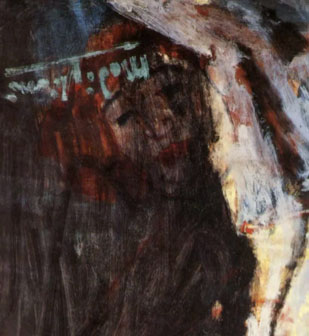
The painting is also a reused canvas. Turned through 180 degrees, its lower right corner reveals the head of another woman, and Tate Papers suggests that the underlying picture may be by another artist. This essay examines the picture's composition, drawing, colour and surface; considers its iconography and its place among the early nudes; reviews a provenance and exhibition history that is sparsely documented; and sets out what the published technical literature says about it.
Composition and format
The canvas is tall and narrow, close to the proportions of Ceroni no. 7, and the figure occupies its central and left-hand portion from the top edge to the bottom. The head is high up, almost touching the upper edge, and is thrown back so that the chin, the line of the jaw and the throat form the most prominent shapes. The body descends in a long, slightly twisted column. The shoulders tilt, the right shoulder (on the viewer's right) rising higher, and the torso turns slightly to the right. At the bottom, the thighs, one bent forward, are cut off by the lower edge. The figure seems to be kneeling or half rising rather than standing, though the pose cannot be read with certainty.
The right half of the canvas is almost entirely dark ground, broken by reddish-brown strokes. This asymmetry pushes the figure to the left and creates a vertical tension between the pale body and the dark void beside it. The signature, in light blue, sits in the lower right corner of that void, and its underlining is drawn with the same speed as the figure.
Line and drawing
The drawing is the most aggressive of the early works. Contours are laid in dark blue-black or brown, in heavy, broken strokes that do not close. The outline of the left side of the body is a single wavering line from armpit to thigh; on the right, a dark contour separates the body from the ground only intermittently. Within the figure, short dark strokes mark the ribs, the navel and the fold of the groin, and a reddish line runs down the centre of the abdomen.
The head is drawn with particular violence. The eyebrows are reduced to two dark curves, the eyes to slits under heavy lids, the nostrils to two dark points, and the mouth to a dark, open oval. A bony jaw and a dark line under the chin turn the throat into a separate, almost anatomical form. Secret Modigliani reproduces a detail of the ears and observes that the drawing there "is clearly visible and is painted over the color", that is, the line was added on top of the paint layer rather than laid down first and covered. If correct, this means that Modigliani returned to the figure with the brush after colouring it, using line to sharpen and harden the forms.
Colour
The palette is reduced to three zones. The ground is a dark mixture of blue-black, deep blue and maroon, applied in vertical and diagonal strokes, with a patch of brighter ultramarine to the left of the head that acts as a halo or a window of light. The hair is dark brown, blending with the ground. The body is painted in white and pale cream, with streaks of blue-grey, pink, red and ochre that model the forms without warming them. Red lines appear at the edge of the thighs and along the left side of the body, and touches of yellow in the abdomen.
The effect is of a body drained of colour, almost spectral, set against a night-like background. It differs both from the cool, cosmetic contrasts of the Nude with a Hat (Ceroni no. 7A) and from the warm, orange-ochre flesh of the Seated Nude (no. 11). Where those works treat the nude as a social type or as a sculptural volume, here the whiteness of the body reads as exposure and suffering.
Facture and surface
The paint is applied with great freedom. The white of the body is laid on in thick, dragged strokes that let the dark underlayers show through in places, and the edges of the strokes are ragged. The ground around the figure is scrubbed and hatched, and in the upper right corner it is lighter and more broken. The surface looks rapidly made and unrevised in parts, and the lower edge, especially at the left, is left rough and incomplete.
This handling, which has little to do with the smooth, matt surfaces of the later portraits, explains the title "study" used by Tate, Burlington and the Secret Modigliani page. It also complicates the reading of the canvas. Because the white is thin in places and the canvas has been reused, it is not always clear which marks belong to this painting and which to the one beneath.
Figure and space
The figure is not placed in an interior. There is no floor, no bed, no drapery; the only spatial cue is the overlap of the body over the dark ground. The thrown-back head and the twisted torso suggest movement in depth, but the body is flattened by the white paint and the heavy contour. The space is therefore less a room than a field of darkness against which the figure appears, as in a theatrical spotlight.
Iconography: the sorrowful nude
The iconography of the Nudo dolente is unusual for Modigliani. The head flung back, the open mouth and the closed eyes belong to a tradition of expressive gesture that runs from Baroque martyrs and ecstatic saints to the anguished figures of Symbolist and early Expressionist art. Tate's mention of Toulouse-Lautrec points to another source: the unflattering, emaciated bodies of Lautrec's brothel and cabaret scenes, in which the nude is stripped of academic idealisation. The thin body, with its prominent ribs, clavicles and jaw, also recalls the gaunt figures of Picasso's Blue Period, which Christie's names as a source for La Juive.
The model is unidentified, in the D'Atri files list the work as no. 231, "Nu doloreux", and say that the reverse bears a sketched man's face; no image of the verso is available. The traditional title is descriptive, not documentary, and its source is unknown.
Comparisons
Within Ceroni's sequence, the closest relative is the Bust of a Young Girl (no. 10), which hung beside it at Tate Modern. The Tate guide explains: "For this painting and the one to its left, he re-used an old canvas upside down. In both works a face is visible on the lower right-hand side." The two works share a reused support, a dark blue ground and a vigorous, unfinished handling, though no. 10 is calmer and frontal.
A second comparison is with the Nude with a Hat (no. 7A) of the same dimensions. Both are tall nudes of about 81 × 54 cm, both thinly and rapidly painted, both explore the female body without idealisation. But where the Nude with a Hat uses the make-up and accessories of fashionable Paris, the Nudo dolente uses only the body and its gesture. The two seated and half-length nudes of "la petite Jeanne" (nos. 10 and 11), on the other hand, show Modigliani moving towards a more sculptural, contained treatment of the figure in the same year.
Provenance and exhibitions
Dr Paul Alexandre, Paris; private collection, Paris (until 1991?); Dr Reuben Hecht, Haifa; Richard Nathanson, London; private collection.
The 2018 Burlington article and the Tate guide describe the work only as being in a private collection.
Technical analysis
There is no published monograph-style technical study of this painting, but two publications by the Tate-led Modigliani Technical Research Study refer to it directly, and they are cited here as direct evidence.
Reused canvas. Tate Papers no. 35 states that in some of his earliest works, "such as two from 1908 now in private collections, Bust of a Young Girl (C10) and Nude Study (C8), Modigliani seems to have used works by other artists, turned 180 degrees, as supports". The 2018 Burlington article adds that the head of an underlying figure is visible "at the bottom right of Nude study (C8; Fig.7), which is upside down, so that the canvas must have been reorientated". It suggests two explanations: the covering paint may have "become more transparent with age", or Modigliani may not have troubled to conceal the earlier composition. Secret Modigliani reproduces a detail of the signature area turned through 180 degrees, in which, according to the page, the portrait of a red-haired woman is visible. These three sources agree on the position and orientation of the underlying head. Only Tate Papers suggests that it is by another artist, and it does so tentatively ("seems").
Drawing over paint. The observation that the drawing at the ears lies on top of the colour comes from Secret Modigliani's examination of a photograph and has not been confirmed by a technical publication.
Support format. The 81 × 54 cm format matches the French standard "25 marine" canvas used vertically. The Burlington article notes that Modigliani often used landscape and marine strainers turned upright, with "examples from as early as 1908". It does not say that this canvas is one of them, and the comparison is mine.
What is not known. I found no published X-radiograph, infrared reflectogram, pigment analysis or cross-section of the work, and no study of the verso and its reported sketch. The general findings of the Burlington study on grounds and materials (lead white grounds, commercially primed canvas) are comparative evidence only.
Conclusion
The Nudo dolente is the most raw and expressive of Modigliani's early nudes: a white, emaciated figure with head thrown back, painted rapidly over an earlier portrait, probably by another artist, on a dark ground that gives it the force of a cry. Its importance lies partly in its difference from what followed. Within months Modigliani would turn towards the contained, sculptural figure of the Seated Nude and then to stone. The work's documentation is thin: an uncertain provenance after Paul Alexandre, no sale record, a possible but unproven link with the 1908 Salon, and technical evidence limited to visual observations published by Tate and The Burlington Magazine. Imaging of the canvas and its verso would greatly help to clarify what lies beneath this anguished figure.
Museum documentation
- Tate Modern, Modigliani (23 November 2017–2 April 2018), large-print guide, rooms 1–11 (copy at docslib), https://docslib.org/doc/1601730/modigliani-large-print-guide-room-1-11
Technical and scholarly literature
- Anaïs Genty-Vincent et al., "Works by Modigliani that have Paintings beneath the Visible Surface", Tate Papers, no. 35, https://www.tate.org.uk/research/tate-papers/35/works-by-modigliani-that-have-paintings-beneath-the-visible-surface
- Annette King, Nancy Ireson, Simonetta Fraquelli and Joyce H. Townsend, "The Modigliani Technical Research Study: An introduction to Modigliani's materials and techniques", The Burlington Magazine, vol. 160, no. 1380 (March 2018), pp. 182–88, https://www.burlington.org.uk/archive/article/the-modigliani-technical-research-study-an-introduction-to-modiglianis-materials-and-techniques
- Christie's, New York, Impressionist & Modern Evening Sale, 8 May 2013, lot essay for Modigliani, La Juive, https://www.christies.com/en/lot/lot-5677506
Cited but not independently consulted
Ceroni and Piccioni, I dipinti di Modigliani, Rizzoli, 1970, no. 8; Ceroni 1958, no. 6; Pfannstiel 1929 and 1956 (no. 5); Lanthemann 1970, no. 19; Parisot 1991, 6/1908; Patani 1991, no. 13; Carol Mann, Modigliani, 1980, p. 43; Werner Schmalenbach, Amedeo Modigliani, Prestel, 1990, p. 57, no. 9; Noël Alexandre, The Unknown Modigliani, 1993, p. 38; Doris Krystof, Modigliani, Taschen, 2000, p. 11; Modigliani: l'ange au visage grave, 2002, p. 41; La collection Jonas Netter, Pinacothèque de Paris, 2012, p. 101; Nancy Ireson and Simonetta Fraquelli (eds), Modigliani, London, Tate, 2017, p. 29; the D'Atri files (no. 231); the exhibition catalogues listed in the title block. All are cited from the Secret Modigliani page on the work.
Footnotes
- Arthur Pfannstiel, Modigliani. L’Art et la Vie, preface by Louis Latourette, Paris, Seheur, 1929 (presumed catalogue).
- Arthur Pfannstiel, Modigliani et son œuvre, étude critique et catalogue raisonné, Paris, Bibliothèque des Arts, 1956.
- Ambrogio Ceroni, Amedeo Modigliani: Peintre; suivi des souvenirs de Lunia Czechowska, Milan, Edizioni del Milione, 1958.
- Joseph Lanthemann, Modigliani, catalogue raisonné: sa vie, son œuvre, son art, Barcelona, G. Condal, 1970.
- Ambrogio Ceroni and Leone Piccioni, I dipinti di Modigliani, Milan, Rizzoli, 1970.
- Carol Mann, Modigliani, London, Thames and Hudson, 1980.
- Werner Schmalenbach, Amedeo Modigliani, Munich, Prestel, 1990.
- Christian Parisot, Catalogue raisonné Modigliani, Livorno, Graphis Arte, 1991.
- Osvaldo Patani, Amedeo Modigliani: catalogo generale, Milan, Leonardo, 1991–94.
- MR (cited here as MR), Modigliani: l’ange au visage grave, Paris, Musée du Luxembourg, 2002. Cited from the published exhibition catalogue only.
- Victoria Soto Caba, Modigliani: The Timeless Face, Madrid, Libsa, 2007.
- Nancy Ireson and Simonetta Fraquelli, Modigliani, London, Tate Modern / Skira Rizzoli, 2017.