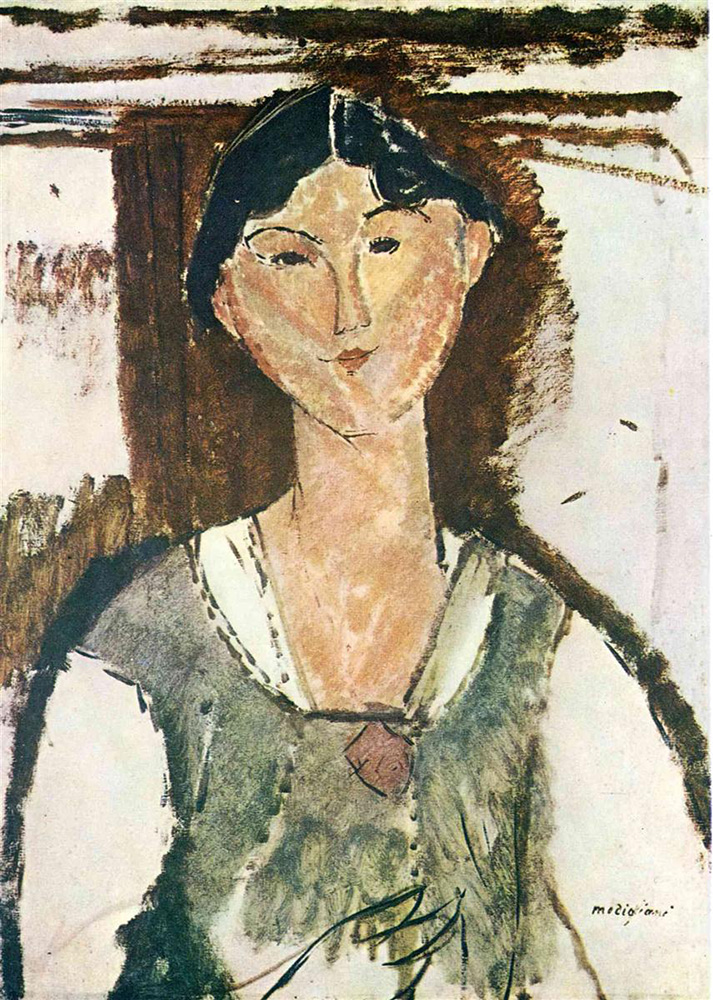
Beatrice Hastings half figure
Oil on cardboard— 1915
Identification
- Title
- English: Beatrice Hastings half figure.
Notes: Hastings a mezza figura (Ceroni) - Date
- 1915
- Medium
- Oil on cardboard
Notes: oil on paper (Ceroni) - Dimensions
- 69 x 49 cm?
Notes: 70 x 49 cm (1958 exhib.) - Signature
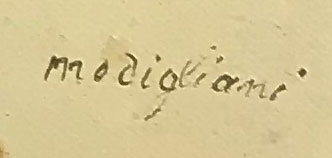
- Signed "modigliani" in lower right
- Present location
- Mazzotta Collection, Milano?
Catalogue numbers
| Compiler | Number |
|---|---|
| Arthur Pfannstiel | NO? |
| Joseph Lanthemann | no. 95 |
| Ambrogio Ceroni | 1958 / no. 38 - 1970 / no. 77 |
| Jeanne Modigliani | YES |
| Christian Parisot | YES |
| Osvaldo Patani | no. 78 |
| Modigliani Project | ? |
| MR | YES |
| Modigliani Initiative/AMDC | ? |
Legal note on MR: This investigation has not had access to MR’s catalogue raisonné; all research here is based on open sources, publications and exhibitions. By no means has that catalogue been copied at any point. Modigliani Project and Modigliani Initiative are marked YES when the work is published or otherwise recorded by those projects, even if no catalogue number is assigned; otherwise the field is marked ?.
Provenance
- Paul Guillaume, Paris
- Private Collection or Fondazione Antonio Mazzotta, Milano?
- Galleria d'Arte Moderna Bolonia, Italia. ?
The sequence follows the published museum, sale, and catalogue record in this investigation. Gaps and uncertain transfers are marked as such.
Selected bibliography
Book-length publications are marked with a footnote giving a full citation. Exhibition catalogues appear in both this list and the exhibition list when this investigation recorded them in both places.
- Ceroni, Amedeo Modigliani: Peintre; Suivi des Souvenirs de Lunia Czechowska, Edizioni del Milione, 1958 - no. 381
- Gindertael, Modigliani e Montparnasse, Milan, 1969, p, 39
- Ponente, Modigliani, Ed. Toray, Barcelona, 1969 - no. 16
- Lanthemann, Modigliani, catalogue raisonné: sa vie, son oeuvre, son art, G. Condal, Barcelona, 1970 - no. 952
- Ceroni & Piccioni, Il dipinti di Modigliani, Rizzoli, Milano, 1970 - no. 773
- Hubbard, Modigliani and the painters of Montparnasse, Lamplight Publ. New York, 1975, p. 23, pl. 13
- Carluccio, Leymarie, Negri, Russoli, Brunhammer, École de Paris, Rive Gauche, Paris, 1981, p. 205
- Patani, Modigliani. Dipinti e disegni. Incontri Italiani 1900-1920, Mazzotta, 19844
- Castieau-Barrielle, La vie et l'oeuvre de Amedeo Modigliani, Editions ACR, Paris, 1987, p. 1245
- Patani, Catalogo Generale, Leonardo, Milano, 1991-94 - no. 784
- Patani, Amadeo Modigliani, catalogo generale, disegni, 1906-1920, Leonardo Editore, Milano, 19944
- Krystof, Amedeo Modigliani: The Poetry of Seeing, Taschen, Cologne, 2000 (as study for a portrait of Beatrice Hastings), p. 526
- Soto Caba, Modigliani, The timeless face, Libsa, Madrid, 20077
Exhibitions
- Roma, Modigliani, VII Quadriennale, Palazzo delle Exposizioni, 1955-56
- Monaco, 1957
- Milano, Mostra di Amedeo Modigliani, Palazzo Reale, Curated by Franco Russoli, 1958 - no. 14
- Paris, Cent Tableaux de Modigliani, Galerie Charpentier, 1958 - ?? (with doubts about the presence of this painting)
- Roma, Modigliani, Galleria Nazionale d'Arte Moderna, 1959 - no. 9
- Frankfurt, Amedeo Modigliani, Steinernes Haus, 1963 - no. 11
- Edinburgh, Modigliani, Royal Scottish Academy, 1963 - no. 6
- London, Modigliani, Tate Gallery, 1963 - no. 6
- Tokyo, Modigliani, Grand Magazin Seibu, 1968 - no. 15
- Kyoto,Modigliani, National Museum of Art , 1968
- Barcelona, Modigliani, Centro Cultural de la Caixa de pensiones,Curated by Christian Parisot, 1983 - no. 19
- Madrid, Modigliani, Sala de exposiciones la caja de pensiones, Curated by Christian Parisot, 1983 - no. 19
- Verona, Incontri Italiani, Galleria dello Scudo, 1984 - no. 29
- Torino, Incontri Italiani, Palazzo Reale, 1985
Notes
As no. 274 in D' Atri papers as portrait unfinished of Beatrice Hastings seated size 51 x 33 - dated 1915 and provenance in Paul Guillaume in 1929
Also could possible be no. 87 in Pfannstiel?
Where sources disagree, both readings are given. This is a working research page, not a catalogue raisonné.
Introduction
The half-length portrait of Beatrice Hastings in Milan is the largest and, in its present state, the most open of the portraits of her that Ceroni catalogued as nos. 76 to 81. The sitter is shown from the waist up, her head slightly tilted, her shoulders framed by the curve of a chair back. Behind her head stands a dark brown upright form, and above it broad horizontal strokes of brown cross the top of the picture. Large areas of the support remain pale and almost bare, and the lower part of the figure is indicated by a few dark strokes. The painting is signed at the lower right.
Ceroni's caption, gives "Beatrice Hastings a mezza figura, Milano, proprietà Mazzotta" (Beatrice Hastings, half-length, Milan, property of Mazzotta). The Secret Modigliani page on the work gives a long exhibition history in Italy and abroad between 1955 and 1985, but a provenance with only two or three names, and it raises the possibility that the painting is the unfinished portrait of Hastings seated described in the d'Atri papers. Doris Krystof, according to the same page, published it in 2000 as a study for a portrait of Beatrice Hastings.
This essay describes the painting from the reproduction on the Secret Modigliani page and asks what its unfinished state reveals about Modigliani's way of building a portrait in 1915. Descriptions of the image are my reading unless otherwise attributed.
Composition and format
The format is vertical. In my measurement, the reproduction on the Secret Modigliani page has a proportion of height to width of 1.403, and the Ceroni plate a proportion of 1.404. Both agree closely with the size of 69 × 49 cm, which gives 1.408, and reasonably with the 70 × 49 cm of the 1958 exhibition, which gives 1.429. The proportions of the photographs thus support the size given by the Secret Modigliani page.
The figure is placed on the vertical axis. The head, in the upper third, is set slightly to the left of centre and tilted a little towards the right. The neck descends to an open collar, and the torso widens to fill the lower half of the picture. A dark curved line encloses the figure on both sides: it rises from the lower left, passes behind the left shoulder, and descends again on the right towards the lower edge. In my reading, this curve is the back of an armchair seen from the front, which wraps around the sitter's shoulders. The composition is therefore built on a set of nested curves: the oval of the face, the curve of the collar, the curve of the shoulders and the larger curve of the chair.
Against these curves, the background introduces straight lines. Behind the head, a dark brown upright shape with a vertical edge on the left rises from the shoulders to the top of the picture. At the top, broad horizontal strokes of brown cross the whole width, forming something like a lintel. In my reading, the upright and the horizontal strokes may represent a door frame, an element that appears in several portraits of Hastings. The rest of the background is pale cream, with a patch of reddish strokes at the left and a few brown marks at the right.
Line
Line plays a larger role here than in most of the portraits of Hastings, because so much of the surface is unpainted. The face is drawn with fine dark lines. The eyebrows are thin arcs; the left one continues downward into the long line of the nose, which ends in a small curve. The eyes are almond shapes, the right one slightly lower than the left. The mouth is small, a short red shape with a darker line between the lips. The jaw and chin are defined by a fine contour, and a short line at the chin marks the transition to the neck.
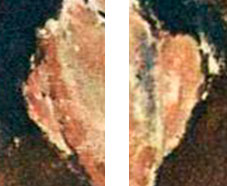
The hair is painted rather than drawn, as a dark mass with a centre parting. A lock falls from the parting towards the right temple, and the hair encloses the face on both sides. The ears are not clearly visible in the reproduction. The Secret Modigliani page, however, reproduces a detail of the ear, with the note: "Detail of the ear where the drawing is clearly visible and is painted in color".
In the lower half, line takes over almost entirely. The collar is drawn with two dark lines, and its edges are marked by rows of small dots. A further vertical row of dots descends from the collar down the centre of the bodice, which I read as a line of buttons. A brown diamond shape, outlined in dark lines, sits at the base of the collar. At the bottom of the picture, a few dark, curved strokes suggest a hand or a forearm crossing the waist. The chair back is drawn with a single broad dark brushstroke on each side.
Colour
The face is a pale ochre-pink, with warmer orange on the cheeks and a cooler tone at the temples. The neck is a similar but slightly warmer flesh colour. The lips are red, the eyes and hair dark brown or black. The collar is white or cream. The bodice is a grey-green, painted thinly, with darker green at the edges and lighter areas where the ground shows through. The brown of the door frame and of the horizontal strokes is a warm, reddish brown, close to burnt sienna. The chair is drawn in dark brown, and the background is a pale cream, which I read as the colour of the support or of a thin ground.
The range of colour is therefore limited: flesh, brown, grey-green and cream, with small accents of red and black. In comparison with the other portraits of Hastings in this part of Ceroni's catalogue, where the backgrounds are dark or strongly coloured, the present work is light in tone. In my reading, this lightness results from the unfinished state of the painting rather than from a deliberate choice of a light key.
Facture
The paint is thin throughout. On the face, it is applied in short strokes that follow the forms; the cheeks show a slight hatching. The bodice is brushed loosely, with the strokes running downwards and the ground showing through. The brown of the door frame and of the top of the picture is applied in broad, dry strokes, which leave a ragged edge. The cream background is almost untouched.
The most finished part of the picture is the head, and the least finished the lower torso and the background. In my reading, this order, from the head outwards, suggests that Modigliani began with the face and worked towards the edges. The drawing in the lower half, in which the dots of the collar and the buttons are already placed, shows that the composition was planned in line before the colour was applied. The signature at the lower right, written in dark paint in a cursive hand, suggests that the painting was considered complete enough to be signed, although the signature could have been added later.
Figure and space
The figure is close to the picture plane and fills most of the width. The head is relatively small in relation to the torso. The long neck, the sloping shoulders and the slight tilt of the head give the figure a quiet, attentive pose.
The space is shallow but more articulated than in the heads of Hastings. The chair back encloses the figure and places it in front of the door frame, which is in turn set against the pale wall. In my reading, three planes can be distinguished: the figure, the chair around it, and the frame and wall behind. The horizontal strokes at the top may also be read as the top of a doorway seen from close up. The unpainted areas of the background, however, keep these planes from becoming a fully described interior.
Iconography and sitter
Beatrice Hastings was the pen name of the English writer Wikipedia identifies as Emily Alice Haigh, born in London on 27 January 1879 and raised in South Africa. Tate Papers, no. 35, by Anaïs Genty-Vincent et al., describes her as "a fellow foreigner in the bohemian avant-garde of Paris during the war" and as Modigliani's partner from mid-1914 to mid-1916. She came to Paris in 1914 as correspondent of The New Age.
The Christie's catalogue essay of 2019 describes the seated portrait of Hastings, Ceroni no. 80, as "one in the sequence of eleven such works that Modigliani painted of Beatrice Hastings", while Tate Etc. speaks of 14 portraits. The present painting belongs to the subgroup in which she is seated in an armchair. Tate Etc. describes such a portrait in which "she sits in the mesh of a gilt armchair". The chair in the present work is drawn only in outline, and its material cannot be determined.
The details of costume, the open white collar with its dotted edge, the line of buttons and the brooch or ornament at the neck, are among the most specific in the series. Tate Etc. describes another portrait in which Hastings wears "a pale blue, checked shirt with white collar". In my reading, the white collar here may belong to a similar blouse worn under a bodice or jacket.
Comparisons
Beatrice Hastings seated (Ceroni no. 80). The seated portrait sold at Christie's in 2019 shows Hastings in a very similar pose, with her arms folded at the waist and an armchair behind her right shoulder. In the present work, the chair back encloses the figure on both sides, and the arms are only suggested. The seated portrait is painted over the whole surface, in strong reds and oranges.
Beatrice Hastings, Toronto (Ceroni no. 79). In the Toronto portrait, a latticed chair back appears at the right and the figure is cut at the chest. The face has the same pale complexion and long neck as the present work. In my reading, the three portraits, nos. 77, 79 and 80, form a group in which Hastings sits in the same chair.
Beatrice Hastings with wallpaper collage (Ceroni no. 76). The small head shares the upright brown band behind the figure, which in both works may be read as part of a door frame.
Ear drawings. The Secret Modigliani page on the present work, like its pages on Ceroni nos. 78 and 79, describes the drawing of the ear as visible through the paint. In the present work, according to the page, the drawing is painted in colour; on the page for no. 79 the drawing is said to be painted over the colour. These notes suggest a shared method of drawing the ears in all three works.
Provenance and exhibitions
The Secret Modigliani page gives the provenance as Paul Guillaume, Paris; then "Private Collection or Fondazione Antonio Mazzotta, Milano?"; and finally "Probably Galleria d'Arte Moderna Bolonia, Italia. ???". Ceroni's caption gives the Mazzotta property in Milan.
The exhibitions listed on the page are Rome, VII Quadriennale, 1955–1956; Monaco, 1957; Milan, Palazzo Reale, 1958, no. 14; Paris, Galerie Charpentier, 1958, with doubts; Rome, Galleria Nazionale d'Arte Moderna, 1959, no. 9; Frankfurt, Steinernes Haus, 1963, no. 11; Edinburgh, Royal Scottish Academy, and London, Tate Gallery, 1963, no. 6; Tokyo, Seibu, 1968, no. 15; Kyoto, 1968; Barcelona and Madrid, 1983, no. 19; Verona, Galleria dello Scudo, 1984, no. 29; and Turin, Palazzo Reale, 1985.
The Secret Modigliani page on the Milan exhibition of 1958 lists no. 14 as Beatrice Hastings, which agrees with the page on the work. The page on the Charpentier exhibition of 1958 lists no. 21 as "Madame Hastings P. C., Milan 1915 No size" and no. 22 as a portrait from a private collection in Milan. The page on the work for Ceroni no. 78 claims Charpentier no. 21 for that painting, which leaves the presence of the present work at Charpentier unresolved, as the page itself acknowledges.
Discrepancies
- The d'Atri note. The page on the work notes that the d'Atri papers list, as no. 274, an unfinished portrait of Beatrice Hastings seated, 51 x 33, dated 1915, with provenance Paul Guillaume in 1929. The same size, 51 × 33 cm, appears on the page for Ceroni no. 80 as Pfannstiel's size for that work, which Pfannstiel, according to that page, described as an unfinished young girl on a chair. In my measurement, 51 × 33 cm (proportion 1.545) is closer to the proportions of no. 80 (1.484) than to those of the present work (1.408), but it matches neither closely. The d'Atri entry and Pfannstiel no. 56 may therefore refer to the same painting, and it is not established which of the two portraits it is.
- Support. The page gives oil on cardboard, Ceroni oil on paper.
- Size. The page gives 69 × 49 cm with a query, and 70 × 49 cm for an exhibition of 1958.
- Location. The page gives a private collection or the Fondazione Antonio Mazzotta, and then, with three question marks, the Galleria d'Arte Moderna in Bologna.
- Status. The page reports that Krystof published the work as a study for a portrait of Hastings, while Ceroni and the other catalogues list it as a portrait.
Technical analysis
No technical report on the painting has been opened. The following remarks are based on the reproduction and on comparative literature.
Support. The pale cream of the background, visible over large areas, appears to be the support or a thin ground. The Secret Modigliani page gives cardboard and Ceroni paper. Tate Papers, no. 35, by Anaïs Genty-Vincent et al., notes that "During the early years of his career, Modigliani painted on various kinds of support, from cardboard to canvas". This is comparative evidence; it does not determine the support of the present work.
Drawing. The painting is unusually informative about drawing. The dotted edges of the collar, the row of buttons, the outline of the brooch and the strokes of the hand are all drawn in dark paint with a fine brush. The Burlington Magazine article by Annette King, Nancy Ireson, Simonetta Fraquelli and Joyce H. Townsend, vol. 160, no. 1380 (March 2018), reports that preparatory drawing in the works studied "varied from clean graphite lines to ones made with thin brushes in paint of varying colours". In my reading, the present work shows such a brush drawing laid over the support in areas that were never covered with colour.
Sequence of work. If the work is unfinished, as Krystof and the d'Atri entry, if it refers to this work, suggest, it shows Modigliani at an intermediate stage: the head modelled, the bodice laid in, the background blocked in at the top and behind the head, and the rest left as drawing. This observation is my inference from the reproduction.
Format. The Burlington article notes that "French canvas sizes were standardised in the nineteenth century". If the support is cardboard or paper, standard canvas formats are not directly relevant.
Conclusion
The half-length portrait of Beatrice Hastings is a painting in which much of the process remains visible. The head is fully drawn and modelled, the bodice laid in with thin grey-green paint, and the chair, the door frame and the lower part of the figure are indicated in a few strokes. The open composition, the nested curves of collar, shoulders and chair, and the straight lines of the door frame show the structure on which the other portraits of Hastings in an armchair are built.
The documentation of the work is thinner than its exhibition history might suggest. Its provenance is limited to Paul Guillaume and an uncertain Milanese owner. Its participation in the Rome exhibition of 1959 and the Charpentier exhibition of 1958 is not confirmed by the Secret Modigliani pages on those exhibitions. The d'Atri entry for an unfinished portrait of Hastings seated may refer to the present work or to Ceroni no. 80. The sources opened for this essay do not resolve these questions.
Museum, auction and exhibition sources
- Christie's, New York, sale 17658, 11 November 2019, lot 33A, Beatrice Hastings assise, https://www.christies.com/en/lot/lot-6233800
- Chloe Aridjis, "Modigliani and 'La Poétesse Anglaise'", Tate Etc., issue 41 (Autumn 2017), https://www.tate.org.uk/tate-etc/issue-41-autumn-2017/modigliani-beatrice-hastings-la-poetesse-anglaise
- Wikipedia, "Beatrice Hastings", https://en.wikipedia.org/wiki/Beatrice_Hastings (biographical source)
Technical literature (comparative)
- Annette King, Nancy Ireson, Simonetta Fraquelli and Joyce H. Townsend, "The Modigliani Technical Research Study. An introduction to Modigliani's materials and techniques", The Burlington Magazine, vol. 160, no. 1380 (March 2018) (comparative)
- Anaïs Genty-Vincent et al., "Works by Modigliani that have Paintings beneath the Visible Surface", Tate Papers, no. 35, https://www.tate.org.uk/research/tate-papers/35/works-by-modigliani-that-have-paintings-beneath-the-visible-surface (comparative)
Sources that could not be opened
The painting itself; the d'Atri papers; the catalogues of the exhibitions listed, including Rome 1955–1956, Milan 1958, Rome 1959, Edinburgh and London 1963, Tokyo 1968, Barcelona and Madrid 1983 and Verona 1984; Krystof's monograph of 2000; any page of the Fondazione Antonio Mazzotta or of the Bologna gallery on the work.
Cited but not independently consulted
Ceroni, Amedeo Modigliani: Peintre; Suivi des Souvenirs de Lunia Czechowska, Edizioni del Milione, 1958 - no. 38; Gindertael, Modigliani e Montparnasse, Milan, 1969, p, 39; Ponente, Modigliani, Ed. Toray, Barcelona, 1969 - no. 16; Lanthemann, Modigliani, catalogue raisonné: sa vie, son oeuvre, son art, G. Condal, Barcelona, 1970 - no. 95; Ceroni & Piccioni, Il dipinti di Modigliani, Rizzoli, Milano, 1970 - no. 77; Hubbard, Modigliani and the painters of Montparnasse, Lamplight Publ. New York, 1975, p. 23, pl. 13; Carluccio, Leymarie, Negri, Russoli, Brunhammer, École de Paris, Rive Gauche, Paris, 1981, p. 205; Patani, Modigliani. Dipinti e disegni. Incontri Italiani 1900–1920, Mazzotta, 1984; Castieau-Barrielle, La vie et l'oeuvre de Amedeo Modigliani, Editions ACR, Paris, 1987, p. 124; Patani, Catalogo Generale, Leonardo, Milano, 1991–1994 - no. 78; Patani, Amadeo Modigliani, catalogo generale, disegni, 1906–1920, Leonardo Editore, Milano, 1994; Krystof, Amedeo Modigliani: The Poetry of Seeing, Taschen, Cologne, 2000, p. 52; Soto Caba, Modigliani, The timeless face, Libsa, Madrid, 2007. Titles are given as the page gives them, without the footnote digits it attaches to them. All are cited from thFootnotes
- Ambrogio Ceroni, Amedeo Modigliani: Peintre; suivi des souvenirs de Lunia Czechowska, Milan, Edizioni del Milione, 1958.
- Joseph Lanthemann, Modigliani, catalogue raisonné: sa vie, son œuvre, son art, Barcelona, G. Condal, 1970.
- Ambrogio Ceroni and Leone Piccioni, I dipinti di Modigliani, Milan, Rizzoli, 1970.
- Osvaldo Patani, Amedeo Modigliani: catalogo generale, Milan, Leonardo, 1991–94.
- Thérèse Castieau-Barrielle, La vie et l’œuvre de Amedeo Modigliani, Paris, ACR, 1987.
- Doris Krystof, Amedeo Modigliani: The Poetry of Seeing, Cologne, Taschen, 2000.
- Victoria Soto Caba, Modigliani: The Timeless Face, Madrid, Libsa, 2007.