Beatrice Hastings Head
Oil on canvas?— 1915 ?
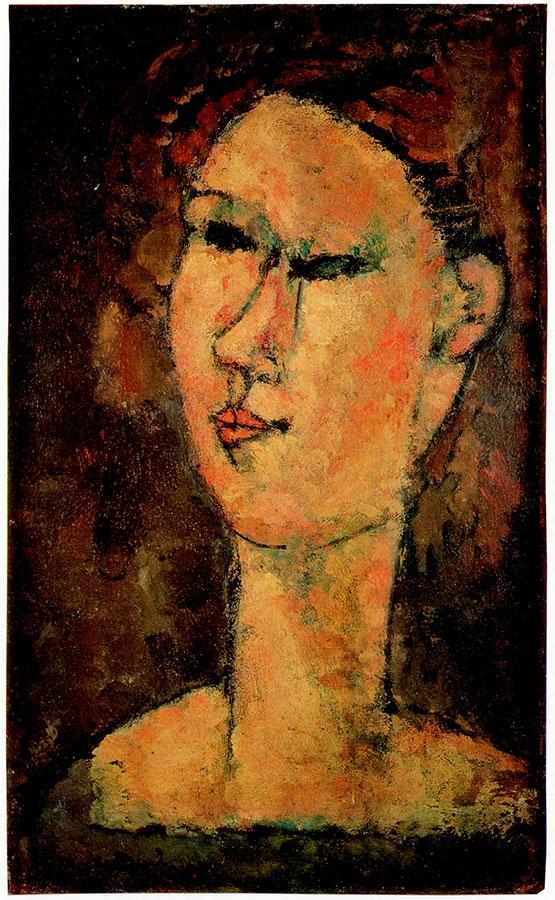
Identification
- Title
- English: Beatrice Hastings Head.
Notes:Woman head; Testa di donna (Ceroni). - Date
- 1915? (Ceroni)
- Medium
- Oil on canvas? (Ceroni)
- Dimensions
- 46.5 x 28,5 cm ? (Ceroni)
- Signature
- Signed "modigliani" lower left
- Present location
- Private Collection?
Catalogue numbers
| Compiler | Number |
|---|---|
| Arthur Pfannstiel | NO |
| Joseph Lanthemann | no. 63 |
| Ambrogio Ceroni | no. 66 |
| Jeanne Modigliani | YES |
| Christian Parisot | ? |
| Osvaldo Patani | no. 68 |
| Modigliani Project | ? |
| MR | ? |
| Modigliani Initiative/AMDC | ? |
Legal note on MR: This investigation has not had access to MR’s catalogue raisonné; all research here is based on open sources, publications and exhibitions. By no means has that catalogue been copied at any point. Modigliani Project and Modigliani Initiative are marked YES when the work is published or otherwise recorded by those projects, even if no catalogue number is assigned; otherwise the field is marked ?.
Provenance
- Private Coll. Geneva
- Sale: Drouot - Paris -16 /06 / 1959
- Léon Rosenberg Collection, Paris?
- Sale: Sotheby's - London 03 / 07 / 1968
- Unknown?
The sequence follows the published museum, sale, and catalogue record in this investigation. Gaps and uncertain transfers are marked as such.
Selected bibliography
Book-length publications are marked with a footnote giving a full citation. Exhibition catalogues appear in both this list and the exhibition list when this investigation recorded them in both places.
- Lanthemann, Modigliani, catalogue raisonné: sa vie, son oeuvre, son art, G. Condal, Barcelona, 1970 - no. 631
- Ceroni & Piccioni, Il dipinti di Modigliani, Rizzoli, Milano, 1970 - no. 66 (46.5 x 28 - woman head - PC Geneva)2
- Patani, Catalogo Generale, Leonardo, Milano, 1991-94 - no. 68 - titled Woman head - 46.5 x 28.53
Exhibitions
- Milano, Mostra di Amedeo Modigliani, Palazzo Reale, Curated by Franco Russoli, 1958 - no. 17
- Roma, Modigliani, Galleria Nazionale d'Arte Moderna, 1959 - no. 12
Notes
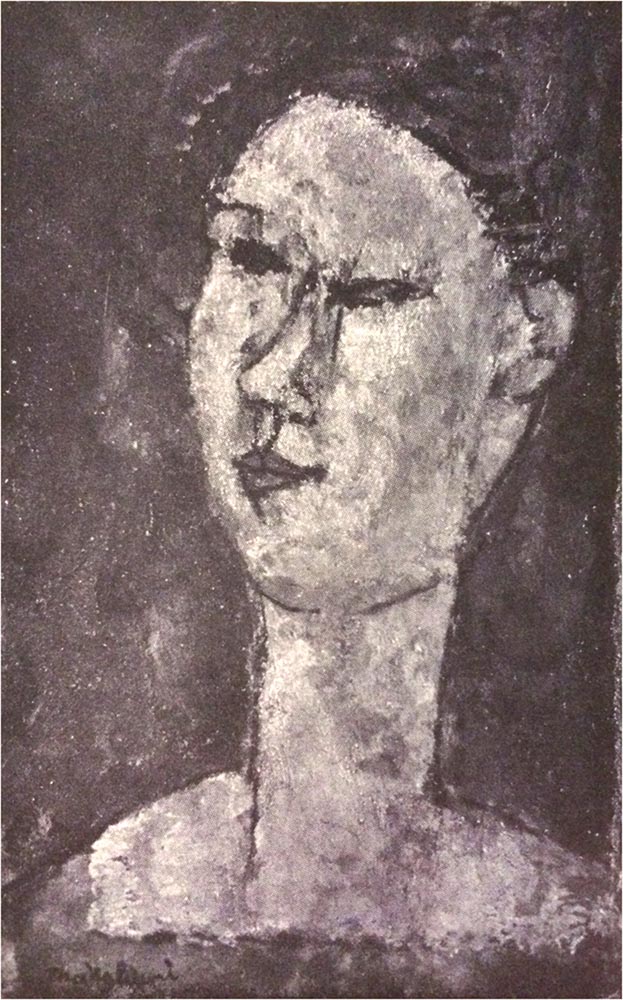
Image in black and white:
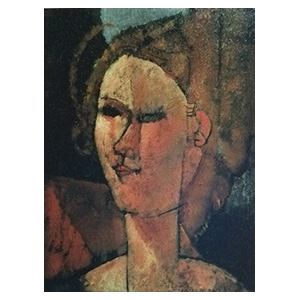
There is a very similar composition:
Where sources disagree, both readings are given. This is a working research page, not a catalogue raisonné.
Introduction
This narrow upright canvas shows the head, long neck and shoulders of a woman, set against a dark ground. The head is turned in three-quarter view to our left, and it fills the upper half of the picture. The eyes are reduced to two dark horizontal slits. A single long line runs from the forehead down the bridge of the nose and divides the face into two planes. The mouth is small and red, and the ear at the right is drawn as a broad curl. At the bottom the shoulders spread out as a pale, rounded mass, like the base of a sculpted bust.
Ambrogio Ceroni catalogued the picture in 1970 as no. 66, Testa di donna, in a private collection in Geneva. He placed it directly after no. 65, a smaller Studio per testa di donna then in London. To no. 66 he added the brief note "Opera studiata nel N°65" (work studied in no. 65). The Secret Modigliani page on the work calls the painting Beatrice Hastings Head, as it does no. 65, and so identifies the sitter as the English writer Beatrice Hastings, Modigliani's companion in these years.
The present essay complements the essay on Ceroni no. 65 in this series, where no. 66 was examined as a comparison. Here the larger version is the subject. The essay describes the picture from the reproductions available, considers the identification of the sitter, and examines the evidence for its exhibitions and sales. The documentation is thin, and much of it is queried. No museum holds the work, and no sale catalogue for it could be opened. The visual evidence of three reproductions therefore carries much of the argument, and the essay states clearly where an observation is my own reading.
Composition and format
Ceroni gives 46.5 × 28 cm. The proportion of height to width is therefore about 1.63 to 1.66, which makes the picture unusually tall and narrow for a head. The format is closer to that of a standing figure than to the more nearly square formats Modigliani often used for heads of 1915. The black-and-white reproduction on the Secret Modigliani page has a proportion of about 1.61, and the colour plate on modigliani1909.com one of about 1.65, so both appear to show the whole, or nearly the whole, of the canvas.
The composition is built on a vertical axis. The head occupies the upper half, slightly to the left of centre because of the three-quarter turn. The neck rises as a long, nearly cylindrical column from the shoulders to the jaw. The shoulders run across the bottom fifth of the picture, almost from edge to edge, and are cut by the lower edge. The upper part of the canvas is filled by the dark mass of the hair and the darker ground behind it. There is no setting, no furniture and no indication of a room.
The effect is of a bust on a pedestal rather than of a person seated in a space. The broad, rounded shoulders, the long neck and the clear separation of head from ground recall Modigliani's carved stone heads of 1911–1913. That comparison is a common one in the literature, but it suits this picture particularly well, because the lower edge cuts the figure where a sculptor would cut the base of a bust.
Line
The drawing is reduced to a few dark lines. The most important is the long line that runs from the upper forehead down the left side of the nose to its tip. It is continued below by a short line for the nostril and by the outline of the upper lip. This single stroke, like the one in no. 65, both describes the profile of the nose and divides the face into a lit and a shadowed plane.
The eyes are two narrow dark strokes. The eye on the left is a short horizontal line that turns slightly downward at the outer corner; the one on the right is longer and joins a dark eyebrow line above it. In the colour plate a greenish shadow surrounds both eyes. There are no pupils or irises. The mouth is drawn with a dark contour, and the chin and jaw are defined by a soft line that runs from the left of the mouth to the neck.
The outline of the face is not sharply drawn. It emerges where the pale flesh meets the dark hair and ground, and in places the edge is broken and granular. The neck is bounded on both sides by thin dark lines, and a curved line marks the junction of jaw and neck. The ear at the right is a broad, curling shape with a dark inner line. Compared with no. 65, the line in no. 66 is more continuous and controlled, and the forms it describes are fuller.
Colour
Two colour reproductions are available. The one reproduced from Ceroni's catalogue, shows a warm pinkish-orange face and neck, flecked with red, against a ground of deep blue-black at the left and dark brown at the right. The hair is a dark red-brown, with brighter red touches at the top of the head and at the right beside the neck. The mouth is a bright red. The shoulders repeat the pink and orange of the face, with greyish and yellowish touches, and a band of dark blue-grey lies along the lower edge.
The second colour image was received from a reader, associated with the 1981 Paris exhibition. It shows the same composition, with a warmer and more orange face, greenish shadows in the eye sockets and along the nose line, and a ground of dark brown and red-brown. In my reading it is the same picture or a very close version of it; the differences of tone are of the kind that separate two photographs of one painting. I cannot see the signature in it, however, and the question cannot be settled from the images alone.
In both images the palette is narrow: warm flesh tones, dark red-brown and blue-black. Colour is used to separate the head from the ground and to model the face in two planes, not to describe a setting or a costume. The black-and-white reproduction confirms the strong contrast between the pale head and neck and the dark surroundings.
Facture
All three reproductions show a granular, broken surface. The paint of the face and neck appears to be laid on in short, dry touches that leave a speckled texture, so that the flesh looks rough rather than smooth. In the black-and-white image this texture is especially clear: the face and shoulders read as a field of small light flecks over a darker underlayer. The dark ground seems to be painted more thinly and more evenly.
In my reading of the images, the texture suggests that the paint was dragged over a dry underlayer, or worked over with a dry brush, so that the canvas weave and the earlier layers show through. Tate Papers, no. 35, by Anaïs Genty-Vincent et al., describes how Modigliani deliberately modified the surface of other paintings "through scraping, wiping, blotting and scratching". Whether any such technique was used here cannot be confirmed from reproductions, and the comparison is offered only as comparative evidence.
The edges of the shapes are soft and irregular. The boundary between the hair and the ground is a zone of mingled dark strokes, and the edge of the shoulders against the lower band is uneven. The signature at the lower left, visible in the black-and-white image and in the Ceroni plate, is written in dark paint in a small cursive hand.
Figure and space
The figure has almost no spatial setting. The dark ground is flat and undefined, and nothing indicates the depth of the room or the position of the sitter. The modelling of the head creates a limited sense of volume: the dividing line and the change of tone on either side of it suggest that the face is turned and that one side recedes. The ear, placed far to the right, reinforces the turn.
The neck and shoulders, by contrast, are frontal. The head is turned to our left while the bust faces us, and this slight torsion gives the figure life. The long neck lifts the head away from the shoulders, and the pale bust stands out against the dark ground like a carved form against a wall. The space of the picture is therefore that of a relief, shallow and frontal, in which the figure is pressed close to the picture plane.
Iconography and sitter
Ceroni's title is neutral: Testa di donna (head of a woman). The Secret Modigliani page titles the work Beatrice Hastings Head. In the essay on no. 65 it was noted that this identification depends there on an inscription with the sitter's first name reported by Pfannstiel; for no. 66.
The Secret Modigliani page on the 1958 Milan exhibition, however, gives the identification an earlier date than might be supposed. That page lists the catalogue of the Palazzo Reale exhibition, curated by Franco Russoli, and no. 17 in its list of paintings is "Beatrice Hastings". The page on the work gives no. 17 as the number of the present painting in that exhibition. If both pieces of information are correct, the painting was already shown as a portrait of Beatrice Hastings in 1958, twelve years before Ceroni gave it a neutral title. The same Milan list has two other works called Beatrice Hastings (nos. 11 and 14), so the title was used for several pictures in that exhibition.
Beatrice Hastings was the subject of a number of Modigliani's portraits of 1915. The face in no. 66, with its long nose line, narrow eyes and small mouth, is close in type to some of those portraits, but the drawing is so simplified that a resemblance cannot establish identity. The identification should therefore be regarded as traditional and plausible, not as proven.
Comparisons
*Ceroni no. 65, Studio per testa di donna. The smaller version, 35 × 27 cm in Ceroni's catalogue, shows the same head in the same pose, with the same dividing line, the same narrow eyes and the same ear. It is a rapid, incomplete picture, with a warm red-orange shape at the left and a patch of blue-grey at the top of the ground. No. 66 is taller and narrower, the face is wider and more massive, the shoulders are fully developed, and the ground is plain and dark. Ceroni's note "Opera studiata nel N°65" implies that he saw no. 65 as the study and no. 66 as the finished work, and the visual comparison supports that view. The Secret Modigliani page on no. 66 publishes a small image of no. 65 with the note "There is a very similar composition:"
Modigliani's sculpture. The pedestal-like shoulders, the long neck and the mask-like face recall the stone heads of 1911–1913, as noted above. This comparison is general; it does not depend on any particular sculpture.
Antonia. The Musée de l'Orangerie describes the face and neck in its Antonia (Ceroni no. 59) as "animated by various techniques inspired by Cubism", and the eyes as "devoid of pupils". The same terms apply here. The division of the face into two planes by a single line is a simplified Cubist device, and the eyes of no. 66 are similarly blind. Antonia, however, is a frontal, seated half-length figure with a geometric background, while no. 66 is a head and bust with no setting at all.
Louise. A Phillips sale catalogue of the Triton Collection Foundation gives the exhibition history of another head, Tête de jeune fille (Louise), which it lists as no. 94 in Piccioni and Ceroni (1970). It was shown in Milan in 1958 as no. 16. The Secret Modigliani list of the Milan exhibition gives no. 16 as Girl head, immediately before no. 17, Beatrice Hastings. The agreement between the two sources does not prove that the present painting was no. 17, but it suggests that the Secret Modigliani transcription of the Milan numbering is reliable at this point. The two heads are not closely related in design.
Provenance and exhibitions
The following provenance: a private collection in Geneva; a sale at Drouot, Paris, on 16 June 1959; the Léon Rosenberg collection, Paris, with a query; and a sale at Sotheby's, London, on 3 July 1968. It lists two exhibitions: the Milan exhibition at the Palazzo Reale, curated by Franco Russoli, in 1958 (no. 17), and the Rome exhibition at the Galleria Nazionale d'Arte Moderna in 1959 (no. 12).
The bibliography on the page consists of three catalogues: Lanthemann (1970), no. 63; Ceroni and Piccioni (1970), no. 66, with the details "46.5 x 28 - woman head - PC Geneva"; and Patani (1991–94), no. 68, "titled Woman head - 46.5 x 28.5". The painting is not in Pfannstiel's catalogue of 1956, according to the page.
Discrepancies
- Title. Ceroni and Patani use neutral titles; the Secret Modigliani page and, it seems, the 1958 Milan catalogue name Beatrice Hastings. If the Milan number is correct, the neutral title is the later one.
- Dimensions. Ceroni gives a width of 28 cm, Patani and the Secret Modigliani page 28.5 cm. The difference is small and may be one of rounding.
- Order of the provenance. The page lists the Geneva collection first, then the 1959 Drouot sale, then Léon Rosenberg with a query, then the 1968 Sotheby's sale. Ceroni, writing in 1970, gives the owner as a private collector in Geneva. If the list is chronological, the Geneva owner should be the earliest; if Ceroni's information was current, the Geneva collector may instead have acquired the picture at or after the 1968 sale. The sources opened do not resolve the order.
- Rome, 1959. The page on the work gives Rome 1959, no. 12. The Secret Modigliani page on the Rome exhibition, curated by Nello Ponente, gives a partial list of works and does not include a no. 12. The exhibition cannot be confirmed from that list.
- Colour image. The colour image in the folder associated with the 1981 Paris exhibition does not show a visible signature, while the black-and-white image and the Ceroni plate do. The Secret Modigliani page on the 1981 exhibition lists a no. 23, Beatrice hastings, dated 1915, but the page on the work does not list that exhibition, and nothing I opened links the two.
- Patani. Patani numbers the work 68, Ceroni 66 and Lanthemann 63; the differences are those of separate numbering systems, not of conflicting identifications.
Technical analysis
No technical examination of this painting has been published in any source that could be opened. No X-radiograph, infrared image or report on the support is available, and the page queries even the medium. The following remarks are therefore limited to what the reproductions show and to comparative evidence from published studies of other works by Modigliani.
Support. The page and Ceroni give oil on canvas, with a query on the page. The narrow format, 46.5 × 28 or 28.5 cm, does not correspond to a standard French size. The Burlington article by Annette King, Nancy Ireson, Simonetta Fraquelli and Joyce H. Townsend, The Burlington Magazine, vol. 160, no. 1380 (March 2018), reports that some canvases in the Modigliani Technical Research Study "have pinholes in all four corners", which it relates to the cutting of pieces from a large roll and pinning them to the studio wall. A non-standard format is consistent with such a practice, but no corner holes are visible in the reproductions, and the point remains comparative.
Drawing. The Burlington article states that preparatory drawing in the works studied "varied from clean graphite lines to ones made with thin brushes in paint of varying colours". In no. 66 the visible lines of the nose, eyes and neck appear to be brushed in dark paint. Whether there is an underdrawing beneath the paint, and whether it repeats the design of no. 65, could be determined only by infrared examination.
Surface. As described above, the granular surface suggests a dry, broken application of paint over a darker underlayer. In my reading, the dark ground may have been laid in before the flesh was painted, since the flecks of pale paint seem to lie over a dark tone. This is an inference from photographs and should be treated as such.
Relation to no. 65. Ceroni's note raises the technical question of how the two versions are related. A comparison of infrared images or X-radiographs could show whether the design of no. 66 was transferred from no. 65 or drawn afresh, and whether either canvas has an earlier image beneath it. Tate Papers, no. 35, by Anaïs Genty-Vincent et al., shows that such examination has revealed hidden compositions in other works. These are comparative considerations, not findings about this painting.
Conclusion
Ceroni no. 66 is a tall, narrow head and bust in which Modigliani reduced the face of a woman to a divided mask, with blind slit eyes, a long nose line and a small red mouth, set on a pale, pedestal-like neck and shoulders against a dark ground. It is the resolved version of the small study that Ceroni placed beside it as no. 65, and the comparison shows how the artist moved from a rapid sketch to a monumental and sculptural image.
The identification of the sitter as Beatrice Hastings is not Ceroni's, but it appears to go back at least to the Milan exhibition of 1958. The documentation of the provenance and exhibitions is fragmentary, the two sales of 1959 and 1968 could not be checked, and the Rome exhibition of 1959 cannot be confirmed from the Secret Modigliani page on it. The painting is therefore best understood through its visual relationship with no. 65 and through its place among the sculptural heads of 1915.
Museum, auction and exhibition sources
- Musée de l'Orangerie, Antonia, https://www.musee-orangerie.fr/en/artworks/antonia-196298 (comparison)
- Phillips, Living the Avant-Garde: The Triton Collection Foundation, sale catalogue (PDF), lot Tête de jeune fille (Louise), https://www.dist.phillips.com/content/web/auctions/NY011123/NY011123_zh_3.pdf (comparison)
Technical literature (comparative)
- Annette King, Nancy Ireson, Simonetta Fraquelli and Joyce H. Townsend, "The Modigliani Technical Research Study: An introduction to Modigliani's materials and techniques", The Burlington Magazine, vol. 160, no. 1380 (March 2018) (comparative)
- Anaïs Genty-Vincent et al., "Works by Modigliani that have Paintings beneath the Visible Surface", Tate Papers, no. 35, https://www.tate.org.uk/research/tate-papers/35/works-by-modigliani-that-have-paintings-beneath-the-visible-surface (comparative)
Sources that could not be opened
The Drouot sale catalogue of 16 June 1959 and the Sotheby's London sale catalogue of 3 July 1968; the catalogues of the Milan exhibition of 1958 and the Rome exhibition of 1959; any document of the Léon Rosenberg collection; the 1981 Paris exhibition catalogue; Pfannstiel's catalogues; Patani's Catalogo generale; Ceroni's catalogues beyond the captions, plate titles and notes. No museum or auction page for this painting was found.
Cited but not independently consulted
Lanthemann, Modigliani, catalogue raisonné: sa vie, son oeuvre, son art, G. Condal, Barcelona, 1970, no. 63; Ceroni and Piccioni, I dipinti di Modigliani, Rizzoli, Milano, 1970, no. 66; Patani, Catalogo Generale, Leonardo, Milano, 1991–94, no. 68. Titles are given as the page gives them, without the footnote digits it attaches to them.Footnotes
- Joseph Lanthemann, Modigliani, catalogue raisonné: sa vie, son œuvre, son art, Barcelona, G. Condal, 1970.
- Ambrogio Ceroni and Leone Piccioni, I dipinti di Modigliani, Milan, Rizzoli, 1970.
- Osvaldo Patani, Amedeo Modigliani: catalogo generale, Milan, Leonardo, 1991–94.