Juan Gris
Oil on canvas? — 1915 ?
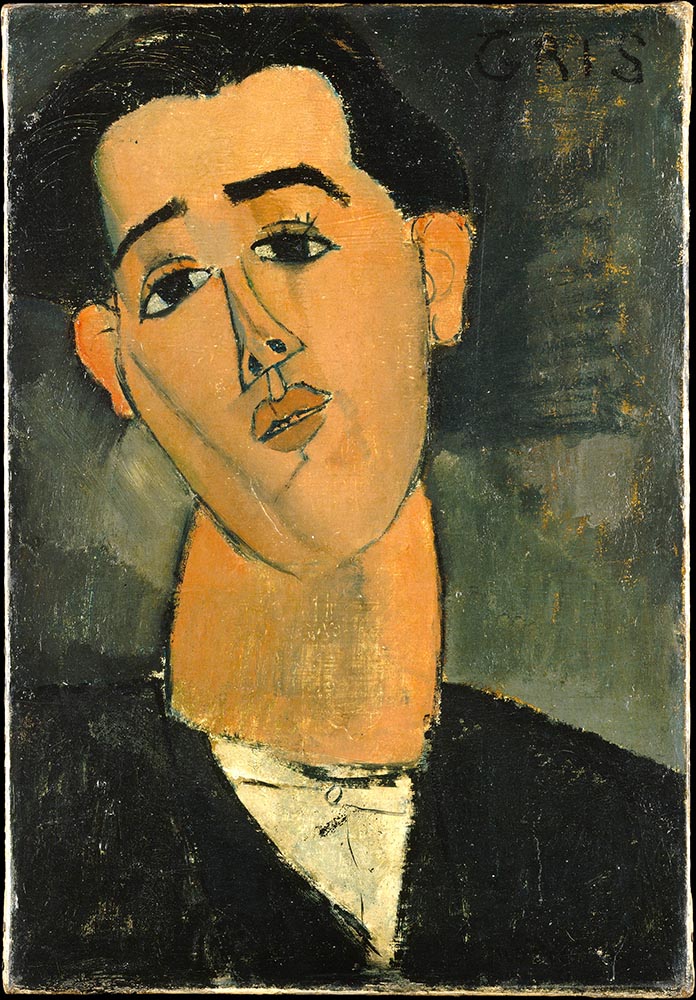
Identification
- Title
- English: Juan Gris.
Notes: Juan Gris (The Metropolitan Museum of Art; Modigliani Initiative, Ceroni); alternate titles Juan Gris (peintre), Le peintre Juan Gris, Portrait de Juan Gris, Portrait of Juan Gris. - Date
- 1915
- Medium
- Oil on canvas
- Dimensions
- 55.2 × 38.3 cm
Notes: 55.2 × 38.3 cm (The Metropolitan Museum of Art; AMDC 31); 55.5 × 38 cm (Ceroni); French standard canvas size 10 paysage. - Signature
- Unsigned
Notes: GRIS, upper right; unsigned; reverse not inscribed - Present location
- The Metropolitan Museum of Art, New York, 67.187.85, Bequest of Miss Adelaide Milton de Groot, 1967.
Catalogue numbers
| Compiler | Number |
|---|---|
| Arthur Pfannstiel | no. 114 |
| Joseph Lanthemann | no. 108 |
| Ambrogio Ceroni | no. 99 - (no. 173 /1965) |
| Jeanne Modigliani | YES |
| Christian Parisot | 37/1915 |
| Osvaldo Patani | no. 104 |
| Modigliani Project | YES |
| MR | YES |
| Modigliani Initiative/AMDC | 31 |
Legal note on MR: This investigation has not had access to MR’s catalogue raisonné; all research here is based on open sources, publications and exhibitions. By no means has that catalogue been copied at any point. Modigliani Project and Modigliani Initiative are marked YES when the work is published or otherwise recorded by those projects, even if no catalogue number is assigned; otherwise the field is marked ?.
Provenance
- Paul Guillaume, Paris
- Private Collection, USA (1947)
- Perls Galleries, New Yok (1950- stock no. 4695 sold for 6.200 USD to de Groot)
- Adelaide Milton de Groot, New York (1950-1967)
- Bequest by de Groot to Metropolitan Art Museum, New York in 1967
- Metropolitan Art Museum, NY ( Inv. no. 67.187.85)
The sequence follows the published museum, sale, and catalogue record in this investigation. Gaps and uncertain transfers are marked as such.
Selected bibliography
Book-length publications are marked with a footnote giving a full citation. Exhibition catalogues appear in both this list and the exhibition list when this investigation recorded them in both places.
- Kahnweiler. Juan Gris: His Life and Work. New York, 1947, p. 9, fig. 7 (dated in 1918 and locates it in a private collection, USA )
- Devree. "Both Old and New: From the Early Renaissance to Picasso Range the New Exhibitions." New York Times (March 5, 1950), p. 104.
- Lipchitz, Amedeo Modigliani, H.N. Abrams, New York, 1954, pl. 60 (dated in 1916)1
- Pfannstiel, Modigliani et son oeuvre, etude critique et catalogue raisonne, bibliotheque des arts, Paris, 1956 - no. 114 (dated in 1916)2
- Modigliani J. , Modigliani: Man and Myth, Orion Press, New York, 1958, pp. 67, 72 (dated in 1916)34
- Wight. Modigliani: Paintings and Drawings. Exh. cat., Museum of Fine Arts, Boston/ Los Angeles, 1961, pp. 22, 34, no. 8, ill. p. 15 (dated in 1915)
- Modigliani J. , Modigliani sans légende, Gruend, Paris, 1961, p 773
- Russell. Modigliani. Exh. cat., Royal Scottish Academy, Edinburgh. 1963, pp. 14-15 - no. 8, pl. 6 (dated in 1915)
- Ceroni, Amedeo Modigliani: Peintre; Suivi des Souvenirs de Lunia Czechowska, Edizioni del Milione, 1958, p. 42 - no. 173 (dated in 1916)5
- Werner, Amedeo Modigliani , H. Abrams, New York 1966, fig. 46 (dated in 1918)6
- Ceroni & Piccioni, Il dipinti di Modigliani, Rizzoli, Milano, 1970 - no. 99 (dated in 1915)7
- Lanthemann, Modigliani, catalogue raisonné: sa vie, son oeuvre, son art, G. Condal, Barcelona, 1970 - no. 108 (mentions another portrait of Gris)8
- Schlotterback. 5000 Years of Art: An Exhibition from the Collections of The Metropolitan Museum of Art. Exh. cat., Whatcom Museum of History and Art. Bellingham, Wash., 1976, p. 99, no. 73, ill., (dated in 1918)
- Fifield. Modigliani. New York, 1976, p. 191
- Schlotterback in Five Thousand Years of Faces. Exh. cat., Bellevue Art Museum. Bellevue, Wash., 1983, unpaginated
- Parisot, Modigliani, 1884–1920. Exh. cat., Centre Cultural de la Caixa de Pensions. Barcelona, 1983, p. 21, fig. 4
- Howard, ed. The Metropolitan Museum of Art Guide. New York, 1983, p. 412, no. 5
- Hall. Modigliani. Oxford, 1984, color pl. 24
- Modigliani J. Racconta Modigliani, d. Giorgio and Guido Guastalla. Livorno, 1984, p. 983
- Measham, 20th Century Masters from The Metropolitan Museum of Art, New York. Exh. cat., Australian National Gallery. Canberra, 1986, p. 36
- Benezra. "A Study in Irony: Modigliani's 'Jacques and Berthe Lipchitz'." Art Institute of Chicago Museum Studies 12, no. 2 (1986), p. 1911
- Castieau-Barrielle, La vie et l'oeuvre de Amedeo Modigliani, Editions ACR, Paris, 1987, p. 1079
- Diehl, Modigliani, Crown Publishers, New York, 1989, p. 6410
- Royal Academy of Arts, Italian Art in the 20th Century: painting and Sculpture, 1900-1988, Prestel, London, 1989, p. 134
- Schmalenbach, Amedeo Modigliani, Prestel, Munich, 1990, p. 80 - no. 3211
- Patani, Catalogo Generale, Leonardo, Milano, 1991-94 - no. 10412
- Parisot, Catalogue Raisonee Modigliani, Graphis Arte, 1991 no. 37/191513
- Kruszynski. Amedeo Modigliani: Portraits and Nudes. Munich, 1996, pp. 34, 36, 40, 45, 118, ill. p. 38
- Wayne, Modigliani & the Artists of Montparnasse, Abrams-Albright-knox gallery, New York, 2002, pp. 32-33, f. 714
- MR, L'Ange au visage grave, Musée du Luxembourg, Paris, 2002 p. 3715
- Klein / Garb, Modigliani: Beyond the Myth. Ed. Mason Klein. Exh. cat., Jewish Museum, New York. New Haven, 2004, pp.8, 45–46, fig. 2
- Soto Caba, Modigliani, The timeless face, Libsa, Madrid, 200716
- Chiappini, Modigliani, exh. cat., Complesso del Vittoriano, Rome, 2006, pp. 25-26, f. 6
- Fraquelli / Brunner, Modigliani and His Models. Exh. cat., Royal Academy of Arts. London, 2006, pp. 32, 82,149, 155, no. 7, ill. p. 8317
- J. Meyers, Modigliani: A Life, Orlando, 2006, pp.110,161-162
- Jiménez-Blanco, ed. Juan Gris: Correspondencia y escritos. Barcelona, 2008, p. 86 n. 105, p. 502.
- Vitali, ed. Amedeo Modigliani: Ein Mythos der Moderne. Exh. cat., Kunst und Ausstellungshalle der Bundesrepublik Deutschland, Bonn. Cologne, 2009, pp. 69, 176, no. 48, ill.
- Ireson, Fraquelli, Modigliani, London, Tate Modern, Skira Rizzoli, London, 2017, p. 10718
Exhibitions
- New York. Perls Galleries. "The Perls Galleries Collection of Modern French Paintings," February 27–March 25, 1950 - no. 75
- New York. Perls Galleries. "Masterpieces from the Collection of Adelaide Milton de Groot," April 14–May 3, 1958 - no. 27
- Columbus Gallery of Fine Arts. "Masterpieces from the Adelaide Milton de Groot Collection," December 2, 1958–March 1, 1959 - no. 26
- Chicago, Amedeo Modigliani, Arts Club of Chicago, 1959
- Milwaukee, Amedeo Modigliani, Milwaukee Art Center, 1959
- Cincinnati,Amedeo Modigliani, Contemporary Arts Center, Cincinnati Art Museum,1959 - no. 8
- Boston, Modigliani: Paintings and Drawings, Museum of Fine Arts, 1961 - no. 8
- Los Angeles, Modigliani: Paintings and Drawings, Los Angeles County Museum of Art, 1961 - no. 8
- Edinburgh, Modigliani,Royal Scottish Academy, 1963 - no. 8
- London, Modigliani, Tate Gallery, 1968 - no. 8
- Tokyo, Modigliani, Grand Magazin Seibu, 1963 - no. 23
- Kyoto, Modigliani, National Museum of Art , 1968 - no. 23
- Fukuoka , Modigliani, Fukuoka Cultural Center , 1968 - no. 23
- Paris, Le Bateaux-Lavoir: Berceau de l'art moderne, Musée Jacquemart-André, 1975–1976 - no. 48
- Bellingham, 5000 Years of Art: An Exhibition from the Collections of The Metropolitan Museum of Art, Whatcom Museum of History and Art. ", 1976–1977 - no. 73
- Oklahoma City, Masters of the Portrait, Oklahoma Museum of Art, 1979 - no. 35
- Tokyo, Modigliani exhibition, Daimaru, 1979 - no. 5
- Osaka, Modigliani exhibition, Daimaru, 1979 - no. 5
- Paris, Modigliani, Musée de Art Moderne de la Ville de Paris, 1981 - no. 28
- Saitama, From Impressionism to École de Paris: Its Passion and Struggle, Museum of Modern Art, 1982 - no. 48
- Bellevue, Five Thousand Years of Faces, Bellevue Art Museum, 1983
- Tokyo, Modigliani exhibition, National Museum, 1985 - no. 51
- Nagoya, Modigliani exhibition, Aichi Prefectural Art Gallery, 1985 - no. 51
- Canberra, 20th Century Masters from The Metropolitan Museum of Art, New York, Australian National Gallery, 1986
- Brisbane, 20th Century Masters from The Metropolitan Museum of Art, New York, Queensland Art Gallery, 1986
- London, Italian Art in the 20th Century: Painting and Sculpture 1900–1988, Royal Academy of Arts, 1989 - no. 58
- Venice, Italian Art, 1900–1945, Palazzo Grassi, 1989
- Düsseldorf, Amedeo Modigliani: Malerei, Skulpturen, Zeichnungen, Kunstsammlung Nordrhein-Westfalen, 1991 - no. 30
- Zurich, Amedeo Modigliani: Malerei, Skulpturen, Zeichnungen, Kunsthaus, 1991 - no. 30
- New York, Painters in Paris: 1895–1950, The Metropolitan Museum of Art, 2000-2001
- Kyoto, Picasso and the School of Paris: Paintings from The Metropolitan Museum of Art, New York, Kyoto Municipal Museum of Art, 2002 - no. 33
- Tokyo, Picasso and the School of Paris: Paintings from The Metropolitan Museum of Art, New York, Bunkamura Museum of Art, 2003 - no. 33
- New York, Artists' Artists, The Metropolitan Museum of Art, 2004
- London, Modigliani and his models, Royal Academy of Arts, 2006 - no. 7
- Moscow, Meeting Modigliani, Pushkin State Museum of Fine Arts, 2007 - no. 26
- Madrid, Modigliani y su tiempo, Museo Nacional Thyssen Bornemisza, 2008
- Bonn, Amedeo Modigliani: Ein Mythos der Moderne, Bundesrepublik, 2009 - no. 48
- London, Modigliani, Tate Modern, 2017-2018
Notes
Not in D'Atri papers?
The Metropolitan Museum of Art confirms Juan Gris, oil on canvas, 54.9 × 38.1 cm, inscribed “GRIS” upper right, accession 67.187.85, bequest of Adelaide Milton de Groot, 1967.
This painting probably has another painting under the visible paint layer ( X ray whould reveal it)
Where sources disagree, both readings are given. This is a working research page, not a catalogue raisonné.


Introduction
The Metropolitan Museum's portrait of Juan Gris shows the Spanish painter as a half-bust, his head leaning towards the left of the picture, set on a long neck that rises from the open collar of a white shirt and a dark jacket. His face is a long, tapering oval with a high forehead, framed by dark hair swept back from the brow; one eyebrow is lifted in a high arch, the other drawn lower and straighter, and the two eyes are unequal, the left one in the picture larger and lower, its iris pushed to the side, the right one smaller and higher. A long, straight nose drawn in a single diagonal line descends to small dark nostrils, and a small, pursed orange mouth sits above a narrow chin. The background is a dark grey-green, broken with ochre flecks and lighter, smoky patches, and the sitter's name, GRIS, is painted in dark capitals at the upper right. The painting is not signed.
The Metropolitan Museum gives the date as 1915 and states that Modigliani "is said to have met the Spanish artist Juan Gris at the apartment of writer and art patron Gertrude Stein in 1909 or 1910". The Modigliani Initiative's digital catalogue, AMDC 31, places the work in Paris and notes that, by November 1915, the two artists lived in the same building. The work is Ceroni no. 99; the Ceroni caption, places it in New York with its last private owner: "Juan Gris, New York, proprietà Adelaide Milton de Groot - Ceroni N°99", and the Ceroni note adds: "Altra effige di una futura celebrità nel campo delle pittura." (Another effigy of a future celebrity in the field of painting.)
Composition and format
In my measurement, the reproduction on the Secret Modigliani page on the work has a proportion of height to width of 1.437, and the Ceroni plate on modigliani1909.com 1.459. The Met's size, 55.2 × 38.3 cm, and the size on the Secret Modigliani page on the work, 54.9 × 38.1 cm, both give 1.441; Ceroni's size, 55.5 × 38 cm, gives 1.461. The Secret Modigliani reproduction, which shows the edges of the canvas, thus matches the museum's proportion closely, while the Ceroni plate matches Ceroni's own measurement. In my reading, this is a further instance, as with the Chaïm Soutine, of a Ceroni plate whose proportion agrees with Ceroni's stated size rather than with the size given by the present owner, which suggests that the photographs and the measurements in the catalogue came from the same source.
AMDC 31 identifies the format as a French standard canvas size 10 paysage. The Burlington study notes that a paysage canvas is longer on the horizontal edge, and that Modigliani often turned paysage and marine strainers on their shorter edges in order to use them for portraits. The Juan Gris, a vertical portrait on a landscape format, would thus be an example of this practice. This is comparative.
The composition is more elongated than that of the other heads of 1915 discussed in this group. In my measurement, the face occupies about a third of the height, the neck about a sixth, and the white shirt and dark jacket most of the lower half. The head is not on the central axis: the forehead lies to the left of centre and the chin close to it, so that the axis of the face inclines from upper left to lower centre, while the neck rises vertically. The ears, drawn at the two sides of the head, are at different heights, the left one in the picture lower than the right. In my reading, these displacements give the figure a mobile, unstable quality, which the lifted eyebrow and the unequal eyes reinforce.
The V-shaped opening of the jacket and the vertical of the shirt front, with a single button, lead the eye up to the neck and the face. The inscription GRIS, at the upper right, balances the inclination of the head to the left.
Line
Line is the dominant means of construction in this portrait. The long diagonal of the nose, drawn in a single dark stroke from the inner end of the left brow to the nostril, is the most conspicuous line in the picture, and, in my reading, it carries the inclination of the head. The eyebrows are drawn in thick dark strokes, one arched, one straighter; the eyes in dark outlines with heavy upper lids and dark irises; the mouth in a thin outline around the small orange lips. The left contour of the face is drawn from the temple to the chin in one long, slightly curving line that meets, at the chin, the shorter line of the right jaw.
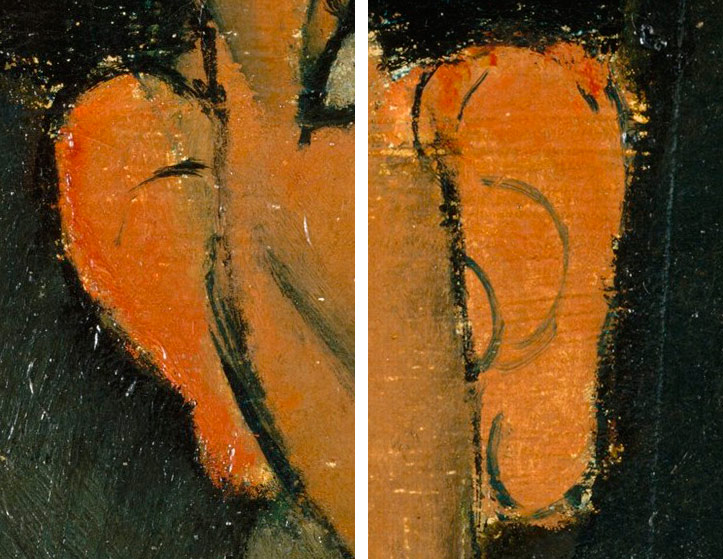
The neck is outlined by two dark lines, the one at the right continuing down beside the collar. The shirt is drawn with dark lines over white, marking the edges of the collar and the button. The jacket is given by broad dark areas rather than by contour. The ears are drawn as simple open curves with an inner line; the Secret Modigliani page on the work includes a detail of the ears. The inscription GRIS is written in tall, slightly uneven capitals.
Colour
The palette is dark and subdued, with the face as the only warm area. The flesh is a pale orange-ochre, warmer on the cheek at the left and on the neck, lighter and pinker on the forehead; the lips are a deeper orange. The hair and jacket are a very dark brown-black, the shirt a broken white with grey shadows. The background is a dark grey-green, lighter and greener at the right, where smoky patches of grey and touches of ochre break its surface, and darker at the left, behind the hair.
In my reading, the warm orange of the face and neck is set against the cool grey-green of the background in the strongest temperature contrast of the picture, and the white of the shirt forms a second, lighter area that ties the figure to the lower edge. The ochre flecks in the background repeat, faintly, the colour of the flesh. The overall effect is more sombre than that of the Soutine or the Kisling.
Facture
The paint is applied thinly in the background and the jacket, where the weave of the canvas and the underlying layers show through, and more thickly in the face, the neck and the shirt. The background is brushed in loose, irregular strokes that leave lighter patches, which, in my reading, could be either underlying paint showing through a thin top layer or deliberate scumbles. The face is painted in smooth, fairly opaque layers, and the dark lines are drawn over them.
The Secret Modigliani page on the work states that the painting "probably has another painting under the visible paint layer", and that an X-ray would reveal it. In the reproduction, the irregular patches of the background, especially at the right, and some raised textures that do not correspond to the visible forms, could be read as traces of an earlier composition, but they could equally result from the scumbled handling of the background. No radiograph has been published in the sources opened, and the suggestion remains the page's hypothesis.
Figure and space
The figure is set close to the picture plane against a background that gives no indication of a room. The dark jacket merges at the left with the dark background, while at the right a lighter band of grey-green separates the shoulder from the background. In my reading, the space is a shallow one, defined only by the overlapping of the head over the background and of the shirt over the jacket.
The figure's presence depends on its asymmetry. The tilt of the head, the lifted brow and the unequal eyes give the face an expression that, in my reading, is at once questioning and melancholy. The eyes do not meet the viewer's directly: the larger one looks slightly to the side, the smaller one is half hidden by its lid. The Met describes Modigliani's subjects of this period as presented "with simple contours, elongated forms, and spare, stylized features that parallel those in his three-dimensional art", and the long face, the long neck and the single line of the nose correspond to that description.
Iconography and sitter
Juan Gris was a Spanish painter, one of the principal Cubists. AMDC 31 states that when Modigliani returned to painting in 1914, after the war had begun, he turned to those who remained in Paris as his models, "including the Spanish painter Juan Gris", who arrived in Paris in 1906, the same year as Modigliani. It adds: "By November 1915, Modigliani lived in a studio at 13, place Emile Goudeau, the infamous Bateau-Lavoir, where Gris also resided." The Met states that "At the time of this portrait, Gris was twenty-seven and Modigliani thirty", and that, "Although he was influenced by Cubist painters such as Gris, Modigliani also briefly worked in sculpture under the tutelage of Constantin Brancusi".
The inscription GRIS identifies the sitter by the name under which he exhibited, rather than by his full name. In my reading, the portrait does not quote Gris's Cubism: there is no faceting of the face and no fragmentation of the background, and the stylisation is that of Modigliani's own heads. The unequal eyes and the tilt of the head, however, introduce an asymmetry that may be read as an acknowledgement of the Cubist practice of showing a face from more than one view, though no source opened makes this connection.
The Secret Modigliani page on the work reproduces a photograph of Gris taken by Man Ray in 1922, and states that there is another portrait of Gris, published by Lanthemann, now at an unknown location. The Secret Modigliani page on that second work, investigation 15-53, describes it as oil on paper glued to canvas, with a query, about 46 × 38 cm, with a query, signed modigliani at the lower right and inscribed GRIS at the centre left, not in Ceroni, and given Lanthemann no. 106. That work has not been examined for this essay.
Comparisons
The Juan Gris shares with the Moïse Kisling in Milan (Ceroni no. 98) and the Chaïm Soutine in Stuttgart (Ceroni no. 97) the inscription of the sitter's name in the upper part of the picture, and with the Celso Lagar in Jerusalem (Ceroni no. 96) the tilt of the head and the unequal eyes. It is, however, larger than all three, 55.2 × 38.3 cm against about 35 to 37 × 27 to 29 cm, and it shows more of the figure, with the shirt and jacket occupying the lower half. In my reading, this places it between the close-up heads of 1915 and the half-length portraits of the following years.
The Italian state catalogue of the Brera Kisling includes Gris among the artists of the frontal series of 1915, in which "il volto che occupa quasi tutta la superficie del dipinto" (the face occupies almost the whole surface of the painting). In the Gris, in my reading, the face occupies a smaller part of the surface than in the other heads, so that the work is the least typical of the series in this respect.
Provenance and exhibitions
The Secret Modigliani page on the work gives the provenance as: Paul Guillaume, Paris; private collection, United States (1947); Perls Galleries, New York (1950, stock no. 4695, sold for 6,200 USD to de Groot); Adelaide Milton de Groot, New York (1950–1967); and the Metropolitan Museum, by bequest of de Groot in 1967. It notes, with a query, that the work is not in the d'Atri papers.
AMDC 31 gives a different beginning. It lists Georges Dorival, Paris (after December 1923); the estate of Georges Dorival (1939), citing the catalogue of the sale of the Dorival collection at the Hôtel des Ventes de Monte Carlo on 13 December 2018; likely Paul Viard, Paris, by gift (1939); a private collection in the United States (by 1947), citing Kahnweiler's book on Gris of 1947; Perls Galleries, New York (by February 1950); Adelaide Milton de Groot, New York (27 February 1950); and the Metropolitan Museum, by bequest (1967). Its commentary identifies Dorival as the stage name of the Comédie-Française actor Georges Édouard Lemarchand, an early collector of Modigliani whose wife, Blanche Antonia James, sat for two portraits (Ceroni nos. 121 and 122), and states that by 1923 Dorival reportedly owned six paintings by the artist, citing an article by Charensol in Paris-Journal of 28 December 1923. It describes Viard as a doctor, a friend of Dorival and a patron of Robert Delaunay. AMDC 31 does not mention Guillaume.
The Met's credit line reads "Bequest of Miss Adelaide Milton de Groot (1876–1967), 1967". The exhibitions listed on the Secret Modigliani page on the work begin with the Perls Galleries, New York, 1950, no. 75, and 1958, no. 27, and the Columbus Gallery of Fine Arts, 1958–1959, no. 26; they continue through Chicago, Milwaukee and Cincinnati, 1959; Boston and Los Angeles, 1961, no. 8; Edinburgh, 1963, no. 8; London, Tate Gallery, given as 1968, no. 8; Tokyo, 1963, and Kyoto and Fukuoka, 1968, no. 23; Paris, Musée Jacquemart-André, 1975–1976, no. 48; Paris, Musée d'Art Moderne de la Ville de Paris, 1981, no. 28; Tokyo and Nagoya, 1985, no. 51; London, Royal Academy, 1989, no. 58; Düsseldorf and Zurich, 1991, no. 30; London, Royal Academy, Modigliani and his Models, 2006, no. 7; Moscow, 2007, no. 26; Madrid, 2008; Bonn, 2009, no. 48; and London, Tate Modern, 2017–2018. AMDC 31 gives the two Perls exhibitions as no. 75, dated 1918, and no. 27, dated 1916.
Discrepancies
- First owner. The Secret Modigliani page on the work gives Paul Guillaume; AMDC 31 gives Georges Dorival, followed by his estate and, likely, Paul Viard, and does not mention Guillaume.
- Date. The literature cited gives 1915, 1916, 1917 and 1918; the Met and AMDC 31 give 1915, and the Met's ages for the two artists, twenty-seven and thirty, are consistent with it.
Technical analysis
No technical report on the work has been opened. The following remarks are based on the reproduction on the Secret Modigliani page on the work, on the museum data and on comparative literature.
Format. AMDC 31's identification of a standard 10 paysage canvas, used vertically, agrees with the Burlington study's observation that Modigliani often turned paysage strainers on their shorter edges for portraits. The Secret Modigliani reproduction shows the edges of the canvas on all four sides, which, in my reading, suggests that the dimensions have not been reduced. This is comparative.
A painting beneath? The Secret Modigliani page on the work suggests that another painting lies beneath the visible layer. Tate Papers, no. 35, states that Modigliani "frequently used canvas supports that already had paintings on them", and that the dimensions of an underlying composition can sometimes be related to the French system of standard canvases. The suggestion is therefore plausible in general, but no radiograph of the Juan Gris has been opened, and the irregular background may have other explanations. This is comparative.
Contours. The Burlington study reports that Modigliani often left "a thin border of unpainted ground around the figure, which he might later reinforce with thin black painted lines". In my reading, the dark line along the left side of the face and the lines of the neck, drawn over the flesh, correspond to such a final reinforcement. This is comparative.
Handling. The Burlington study describes passages worked "through scraping, wiping, blotting and scratching – reductive techniques that recall the artist's beginnings as a sculptor". In my reading, the smoky lighter patches of the background could result from wiping or blotting, but the reproduction does not allow a firm judgement. This is comparative.
Conclusion
The Juan Gris in the Metropolitan Museum is a portrait in which a long, tilted face with a lifted brow, unequal eyes and a nose drawn in a single diagonal line rises on a long neck from a white shirt and dark jacket, against a dark grey-green background with the sitter's name at the upper right. In my reading, it is the most mobile and the most melancholy of the portraits of artists of 1915, larger and more elongated than the others, and painted on a standard landscape canvas turned upright.
The museum data and AMDC 31 agree on its size, its medium and its date, and the Met's account of the two artists' ages supports the date. The sources disagree on its early owner: the Secret Modigliani page on the work gives Paul Guillaume, while AMDC 31 gives the actor Georges Dorival and his circle, with a documented sale of his collection in 2018. They also disagree on the edition of Ceroni in which it first appeared, on Pfannstiel's date and on the page in Kahnweiler. The suggestion of a painting beneath the visible surface remains a hypothesis of the Secret Modigliani page on the work, which only a published radiograph could test.
Museum, auction and exhibition sources
- The Metropolitan Museum of Art, Amedeo Modigliani, Juan Gris, 67.187.85, https://www.metmuseum.org/art/collection/search/489643 (page opened via WebFetch; data also opened through the museum's collection API, https://collectionapi.metmuseum.org/public/collection/v1/objects/489643)
- Modigliani Initiative, "Juan Gris, 1915 (AMDC 31)", Amedeo Modigliani Digital Catalogue, https://catalogue.modigliani-initiative.org/catalogue/entry.php?id=31
- Catalogo generale dei Beni Culturali, Ritratto del pittore Moisé Kisling, Pinacoteca di Brera, Reg. Cron. 5037, https://sigecweb.beniculturali.it/sigec/item/print/ICCD3308105 (comparative; opened via WebFetch)
- Musée de l'Orangerie, Amedeo Modigliani, Paul Guillaume, Novo Pilota, RF 1960 44, https://www.musee-orangerie.fr/fr/oeuvres/paul-guillaume-novo-pilota-196295 (comparative, for Ceroni 1958 no. 55)
Technical literature (comparative)
- Annette King, Nancy Ireson, Simonetta Fraquelli and Joyce H. Townsend, "The Modigliani Technical Research Study. An introduction to Modigliani's materials and techniques", The Burlington Magazine, vol. 160, no. 1380 (March 2018) (comparative)
- Anaïs Genty-Vincent et al., "Works by Modigliani that have Paintings beneath the Visible Surface", Tate Papers, no. 35, https://www.tate.org.uk/research/tate-papers/35/works-by-modigliani-that-have-paintings-beneath-the-visible-surface (comparative)
Sources that could not be opened
The catalogue of the Dorival sale, Hôtel des Ventes de Monte Carlo, 13 December 2018; Charensol's article in Paris-Journal, 28 December 1923; the Perls Galleries catalogues of 1950 and 1958 and the Perls stock books; Kahnweiler's Juan Gris: His Life and Work of 1947; the d'Atri papers; any radiograph or technical report on the work; the second portrait of Gris published by Lanthemann.
Cited but not independently consulted
Kahnweiler. Juan Gris: His Life and Work. New York, 1947, p. 9, fig. 7 (dated in 1918 and locates it in a private collection, USA); Devree. Both Old and New: From the Early Renaissance to Picasso Range the New Exhibitions. New York Times (March 5, 1950), p. 104; Lipchitz, Amedeo Modigliani, H.N. Abrams, New York, 1954, pl. 60 (dated in 1916); Pfannstiel, Modigliani et son oeuvre, etude critique et catalogue raisonne, bibliotheque des arts, Paris, 1956, no. 114 (dated in 1916); Modigliani J., Modigliani: Man and Myth, Orion Press, New York, 1958, pp. 67, 72 (dated in 1916); Wight. Modigliani: Paintings and Drawings. Exh. cat., Museum of Fine Arts, Boston/ Los Angeles, 1961, pp. 22, 34, no. 8, ill. p. 15 (dated in 1915); Modigliani J., Modigliani sans légende, Gruend, Paris, 1961, p 77; Russell. Modigliani. Exh. cat., Royal Scottish Academy, Edinburgh. 1963, pp. 14–15, no. 8, pl. 6 (dated in 1915); Ceroni, Amedeo Modigliani: Peintre; Suivi des Souvenirs de Lunia Czechowska, Edizioni del Milione, 1958, p. 42, no. 173 (dated in 1916); Werner, Amedeo Modigliani, H. Abrams, New York 1966, fig. 46 (dated in 1918); Ceroni & Piccioni, Il dipinti di Modigliani, Rizzoli, Milano, 1970, no. 99 (dated in 1915); Lanthemann, Modigliani, catalogue raisonné: sa vie, son oeuvre, son art, G. Condal, Barcelona, 1970, no. 108 (mentions another portrait of Gris); Schlotterback. 5000 Years of Art: An Exhibition from the Collections of The Metropolitan Museum of Art. Exh. cat., Whatcom Museum of History and Art. Bellingham, Wash., 1976, p. 99, no. 73, ill. (dated in 1918); Fifield. Modigliani. New York, 1976, p. 191; Schlotterback in Five Thousand Years of Faces. Exh. cat., Bellevue Art Museum. Bellevue, Wash., 1983, unpaginated; Parisot, Modigliani, 1884–1920. Exh. cat., Centre Cultural de la Caixa de Pensions. Barcelona, 1983, p. 21, fig. 4; Howard, ed. The Metropolitan Museum of Art Guide. New York, 1983, p. 412, no. 5; Hall. Modigliani. Oxford, 1984, color pl. 24; Modigliani J. Racconta Modigliani, d. Giorgio and Guido Guastalla. Livorno, 1984, p. 98; Measham, 20th Century Masters from The Metropolitan Museum of Art, New York. Exh. cat., Australian National Gallery. Canberra, 1986, p. 36; Benezra. A Study in Irony: Modigliani's Jacques and Berthe Lipchitz. Art Institute of Chicago Museum Studies 12, no. 2 (1986), p. 191; Castieau-Barrielle, La vie et l'oeuvre de Amedeo Modigliani, Editions ACR, Paris, 1987, p. 107; Diehl, Modigliani, Crown Publishers, New York, 1989, p. 64; Royal Academy of Arts, Italian Art in the 20th Century: painting and Sculpture, 1900–1988, Prestel, London, 1989, p. 134; Schmalenbach, Amedeo Modigliani, Prestel, Munich, 1990, p. 80, no. 32; Patani, Catalogo Generale, Leonardo, Milano, 1991–1994, no. 104; Parisot, Catalogue Raisonee Modigliani, Graphis Arte, 1991, no. 37/1915; Kruszynski. Amedeo Modigliani: Portraits and Nudes. Munich, 1996, pp. 34, 36, 40, 45, 118, ill. p. 38; Wayne, Modigliani & the Artists of Montparnasse, Abrams-Albright-knox gallery, New York, 2002, pp. 32–33, f. 7; MR, L'Ange au visage grave, Musée du Luxembourg, Paris, 2002, p. 37; Klein / Garb, Modigliani: Beyond the Myth. Ed. Mason Klein. Exh. cat., Jewish Museum, New York. New Haven, 2004, pp. 8, 45–46, fig. 2; Soto Caba, Modigliani, The timeless face, Libsa, Madrid, 2007; Chiappini, Modigliani, exh. cat., Complesso del Vittoriano, Rome, 2006, pp. 25–26, f. 6; Fraquelli / Brunner, Modigliani and His Models. Exh. cat., Royal Academy of Arts. London, 2006, pp. 32, 82, 149, 155, no. 7, ill. p. 83; J. Meyers, Modigliani: A Life, Orlando, 2006, pp. 110, 161–162; Jiménez-Blanco, ed. Juan Gris: Correspondencia y escritos. Barcelona, 2008, p. 86 n. 105, p. 502; Vitali, ed. Amedeo Modigliani: Ein Mythos der Moderne. Exh. cat., Kunst und Ausstellungshalle der Bundesrepublik Deutschland, Bonn. Cologne, 2009, pp. 69, 176, no. 48, ill.; Ireson, Fraquelli, Modigliani, London, Tate Modern, Skira Rizzoli, London, 2017, p. 107.Footnotes
- Jacques Lipchitz, Amedeo Modigliani, New York, Harry N. Abrams, 1953.
- Arthur Pfannstiel, Modigliani et son œuvre, étude critique et catalogue raisonné, Paris, Bibliothèque des Arts, 1956.
- Jeanne Modigliani, Modigliani sans légende, Paris, Gründ, 1961.
- Jeanne Modigliani, Modigliani: Man and Myth, New York, Orion Press, 1958.
- Ambrogio Ceroni, Amedeo Modigliani: Peintre; suivi des souvenirs de Lunia Czechowska, Milan, Edizioni del Milione, 1958.
- Alfred Werner, Amedeo Modigliani, New York, Harry N. Abrams, 1966.
- Ambrogio Ceroni and Leone Piccioni, I dipinti di Modigliani, Milan, Rizzoli, 1970.
- Joseph Lanthemann, Modigliani, catalogue raisonné: sa vie, son œuvre, son art, Barcelona, G. Condal, 1970.
- Thérèse Castieau-Barrielle, La vie et l’œuvre de Amedeo Modigliani, Paris, ACR, 1987.
- Gaston Diehl, Modigliani, Paris, Flammarion, 1969.
- Werner Schmalenbach, Amedeo Modigliani, Munich, Prestel, 1990.
- Osvaldo Patani, Amedeo Modigliani: catalogo generale, Milan, Leonardo, 1991–94.
- Christian Parisot, Catalogue raisonné Modigliani, Livorno, Graphis Arte, 1991.
- Kenneth Wayne, Modigliani and the Artists of Montparnasse, New York, Abrams / Albright-Knox Art Gallery, 2002.
- MR (cited here as MR), Modigliani: l’ange au visage grave, Paris, Musée du Luxembourg, 2002. Cited from the published exhibition catalogue only.
- Victoria Soto Caba, Modigliani: The Timeless Face, Madrid, Libsa, 2007.
- Simonetta Fraquelli et al., Modigliani and His Models, London, Royal Academy of Arts, 2006.
- Nancy Ireson and Simonetta Fraquelli, Modigliani, London, Tate Modern / Skira Rizzoli, 2017.