André Rouveyre
Oil on canvas — 1915
Identification
- Title
- English: André Rouveyre.
Notes: André Rouveyre (Ceroni 1958; Piccioni and Ceroni, 1970, according to Christie's); Portrait du peintre Rouveyre (Sotheby's, London, 2007; Christie's, New York, 2012) - Date
- 1915
- Medium
- Oil on canvas
- Dimensions
- 65 x 42.5 cm
Notes: 65 × 42 cm (Ceroni). - Signature
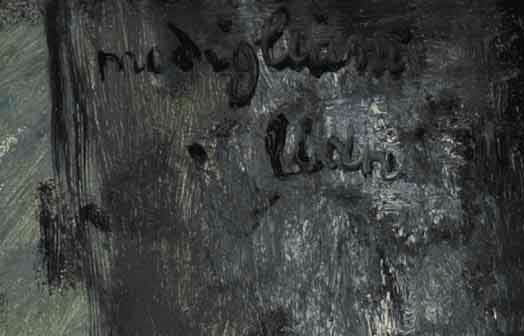
- Signed "modigliani" upper left and the letters "Andre" or "Pedro"?
Notes: Signed and indistinctly inscribed Modigliani, upper left (Christie's, 2012); signed Modigliani and indistinctly inscribed, upper left (Sotheby's, 2007); - Present location
- Private Collection?
Catalogue numbers
| Compiler | Number |
|---|---|
| Arthur Pfannstiel | no. 50 |
| Joseph Lanthemann | NO |
| Ambrogio Ceroni | no. 90 |
| Jeanne Modigliani | NO |
| Christian Parisot | ? |
| Osvaldo Patani | no. 93 |
| Modigliani Project | ? |
| MR | YES |
| Modigliani Initiative/AMDC | ? |
Legal note on MR: This investigation has not had access to MR’s catalogue raisonné; all research here is based on open sources, publications and exhibitions. By no means has that catalogue been copied at any point. Modigliani Project and Modigliani Initiative are marked YES when the work is published or otherwise recorded by those projects, even if no catalogue number is assigned; otherwise the field is marked ?.
Provenance
- Guillaume Collection, Paris
- Valentine Dudensing Gallery, New York
- M. Martins Collection, London (1963)
- Sale Parke -Bernet Gall. NY
- 9th December 1965, lot 110
- Eugene V. Thaw & Co., Inc., New York
- Herbert Singer Collection, New York (acquired from the above in December 1967)
- Nell Singer Collection, New York
- Sale: Sotheby's London, 5 / February / 2007 - Modern art, evening sale- Lot 34 - Estimate 1.400.000 - 1.800.000 GBP
- Private Collection?
- Sale Christie's New York, Sale 2554 - Impressionist and moder art evening sale - 1st May 2012 - Lot 29 - Sold: 2.770.500 USD.
- Private Collection ?
The sequence follows the published museum, sale, and catalogue record in this investigation. Gaps and uncertain transfers are marked as such.
Selected bibliography
Book-length publications are marked with a footnote giving a full citation. Exhibition catalogues appear in both this list and the exhibition list when this investigation recorded them in both places.
- Pfannstiel, "catalogue presume" Modigliani. L'Art et la Vie. Preface de Louis Latourrettes, Seheur, Paris, 1929 p. 81
- Pfannstiel, Modigliani et son oeuvre, etude critique et catalogue raisonne, bibliotheque des arts, Paris, 1956 - no. 502
- Ceroni & Piccioni, Il dipinti di Modigliani, Rizzoli, Milano, 1970 - no. 903
- Patani, Catalogo Generale, Leonardo, Milano, 1991-94 - no. 934
Exhibitions
No exhibitions were listed in this investigation.
Notes
As no. 194 in D'Atri papers as Rouveyre- dated 1915 - Paul Guillaume Collection 1929.
Where sources disagree, both readings are given. This is a working research page, not a catalogue raisonné.

Introduction
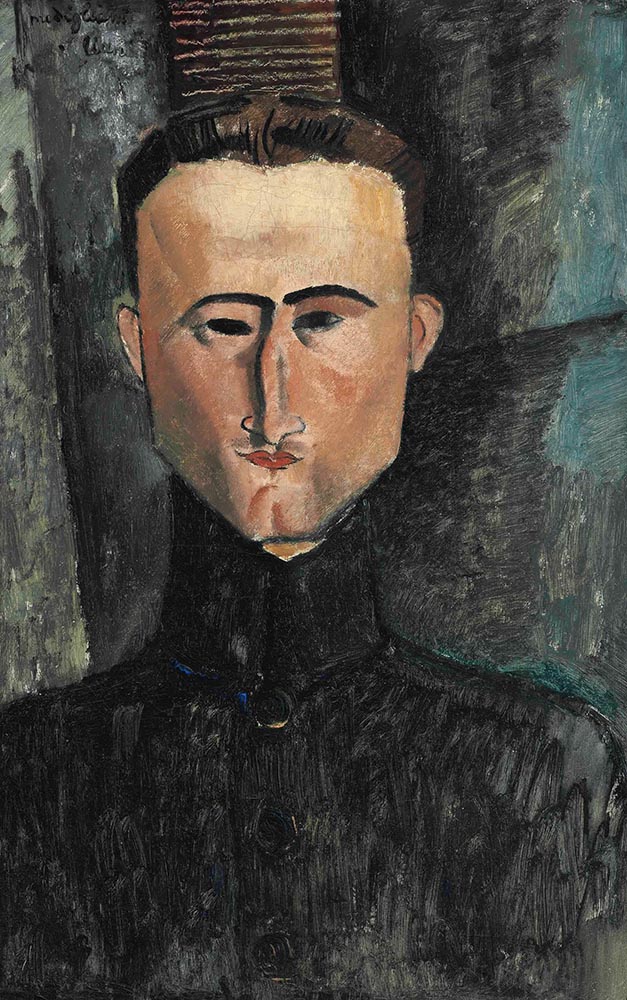
The Portrait of André Rouveyre shows the writer and caricaturist frontally, at half length, with a broad, flat face under short brown hair, narrow dark eyes and pursed red lips, wearing a black jacket buttoned to a high standing collar. Behind his head, at the upper centre, a vertical element with horizontal red and dark stripes rises to the upper edge, and the background is painted in grey, dark green and blue-green. The signature at the upper left is accompanied by a second line of writing that no source has been able to read. The portrait was sold at Sotheby's in London in 2007 and at Christie's in New York in 2012, and both auction houses titled it Portrait du peintre Rouveyre.
For this essay I opened the Secret Modigliani page on the work and its list of the paintings published by Ceroni, Sotheby's page for the sale of 5 February 2007, Christie's page for the sale of 1 May 2012, theartwolf's page on the Sotheby's sale of 2007, the transcription of Ceroni's catalogue, The Burlington Magazine article of March 2018 on the Modigliani Technical Research Study, and Tate Papers, no. 35. Descriptions of the image are my reading of the reproduction on the Secret Modigliani page on the work, unless attributed to another source.
Composition and format
In my measurement, the reproduction used here has a proportion of height to width of 1.595, and the Ceroni plate about 1.600. The size given by both auction houses, 65 × 42.5 cm, gives 1.529, and Ceroni's 65 × 42 cm gives 1.548. Both photographs are thus narrower, by about four per cent, than the stated size. In my reading, the most likely explanation is that the photographs omit a strip at one or both sides, perhaps covered by a frame or rebate, but none of the sources opened discusses the difference.
The format is narrow and tall, unusually so for a half-length portrait of this period, and the figure fills it. The head is set high and on the central axis, with the hair about a tenth of the height from the upper edge and the chin a little above the middle. Below, the black jacket fills the whole lower half, its shoulders reaching the side edges. The striped element above the head continues the central axis to the upper edge, and the signature occupies the upper left corner.
In my reading, the composition is built on a strong vertical axis, running from the striped element through the hair, the nose and the line of buttons to the lower edge. The face, which is broad at the forehead and narrows to the chin, forms a pale shield shape centred on that axis, and the black mass of the jacket forms a broad base. The effect is of a figure that is monumental despite the small size of the canvas.
Line
The drawing is concentrated in the face. The contour of the face is a firm dark line, running from the temples along the cheeks to a square chin. The eyebrows are two straight black lines, almost horizontal, separated by a short gap above the nose. The eyes are narrow, dark shapes beneath them, set close to the nose and slightly uneven. Christie's lot essay describes them: "His eyes are blank and slightly asymmetrical". Sotheby's refers to "the blank, hollowed out eyes of the figure". In my reading, the left eye, from the viewer's point of view, is a little lower and narrower than the right.
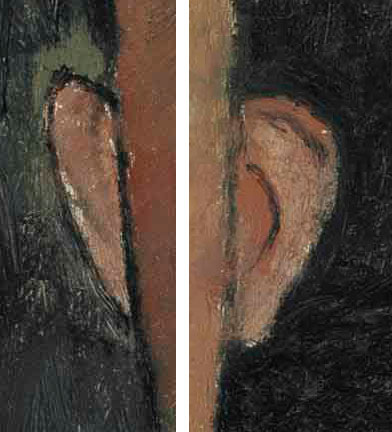
The nose is drawn as a long, thin form, with a dark line on its shadowed side that runs from the left eyebrow to the tip, and a small rounded end with two nostrils. The mouth is small and pursed, with a red upper lip shaped like a bow and a fuller lower lip. Below the mouth, a short vertical line marks the chin. The ears are drawn as simple curved shapes at either side of the head, and the Secret Modigliani page reproduces a detail of them, with the note that the drawing is clearly visible and is painted in colour.
Christie's observes that "the high, dark collar that he wears accentuates the sculptural, linear contours of his face, recalling Modigliani's lengthy experience as a stone-carver". Sotheby's speaks of a "strong sense of line and contour, accentuating the linearity of the sitter's jaw, sharp nose, eyebrows and hairline". In my reading, the contours of the face are indeed unusually hard and continuous, and the face is treated almost as a flat plane bounded by lines, with modelling only on the nose and the cheeks.
Colour
The face is a pale, warm flesh, almost cream on the forehead and pinker on the cheeks and nose, with grey shadows on the left side and under the jaw. The mouth is a bright red. The hair is a warm brown, with a few lighter strokes. The jacket is a deep black, with grey-green highlights on the shoulders and a touch of blue at the collar, and a small passage of blue visible in the opening of the collar at the left. The buttons are black with grey edges.
The background is divided into areas of different colour. In my reading, at the left a grey and grey-green field is crossed by a dark vertical band; at the upper centre, the striped element is painted in horizontal lines of red, pink and dark brown; at the right, a dark grey area meets a blue-green field, with a dark diagonal shape crossing behind the shoulder. The cool greens and blues of the background set off the warm pale face, and the red of the striped element echoes the red of the mouth.
Facture
The paint is applied in different ways in different areas. The face is painted with smooth, blended strokes, and in the reproduction a fine network of cracks is visible on the forehead. The background is painted in long, vertical strokes with a broad brush, leaving visible brushmarks. The jacket is painted in vertical and diagonal strokes of black, thinned in places to show the grey-green beneath, and its texture contrasts with the smoothness of the face.
The Burlington article by Annette King, Nancy Ireson, Simonetta Fraquelli and Joyce H. Townsend, "The Modigliani Technical Research Study. An introduction to Modigliani's materials and techniques", vol. 160, no. 1380 (March 2018), describes in the works studied "distinctive stabbing brushstrokes, made with large round brushes; overlapping brushstrokes with square-tipped stiff brushes". In my reading, the strokes of the background and the jacket here are of the second kind, long and overlapping. This is comparative.
The striped element at the upper centre is painted with short horizontal strokes of red and pink over a dark ground, and its edges are irregular. In my reading, the stripes are painted rather than drawn, and they have the character of a decorative pattern, such as a textile, a radiator or the slats of a blind, rather than of an architectural feature.
Figure and space
The space is shallow. The figure is placed immediately in front of the background, and there is no floor or furniture. The background areas may represent a wall, a door frame and a window, but they are not clearly legible, and their edges do not form a consistent perspective. Christie's writes that "The vertical element behind his head (most likely part of a window, mantle, or stretcher) even suggests an unsettling parallel with one of Modigliani's sculpted caryatids". In my reading, the striped element, placed directly above the head, does give the effect of a column or support carried by the head, though the parallel with the caryatids is Christie's interpretation.
The expression is reserved and a little ironic. Christie's writes that the sitter gazes straight ahead, "his eyes close-set and narrow, his lips pursed, as though sizing up the viewer for one of his incisive (even cruel) caricatures". In my reading, the pursed mouth and the narrow eyes do give an impression of watchfulness, and the frontal pose and the buttoned-up jacket of reserve.
Iconography and sitter
The sitter is identified as André Rouveyre in all the sources opened for this essay. Ceroni's note, as transcribed by modigliani1909.com, gives the basis: "L'effigiato è il noto scrittore e disegnatore, nato a Parigi nel 1879" (the sitter is the well-known writer and draughtsman, born in Paris in 1879), and "L'identificazioni si deve ai catalogatori dell'asta a New York, per la quale l'opera è passata nel 1965" (the identification is due to the cataloguers of the New York sale through which the work passed in 1965). The Secret Modigliani page adds that the work is no. 194 in the d'Atri papers, as Rouveyre, dated 1915, in the Paul Guillaume collection in 1929, which would place the identification earlier than the 1965 sale.
Christie's lot essay of 2012 describes Rouveyre as "a fierce parodist of upper-crust social manners", in satirical writings and witty caricatures, and gives his dates as 1879–1962. It mentions Marquet's full-length portrait of him of 1904, in the Musée national d'art moderne, and adds that "Matisse made a charcoal drawing of him wearing a monocle in 1912", as well as some twelve hundred letters that Rouveyre and Matisse exchanged between 1941 and 1954. Sotheby's catalogue note of 2007 gives his dates as 1896–1962 and describes him as a close friend of Modigliani, Apollinaire and Matisse. The birth year of 1879 given by Christie's and by Ceroni is more consistent with a caricaturist whose work, as Sotheby's itself says, was published at the beginning of the twentieth century.
The title Portrait du peintre Rouveyre, used by both auction houses, describes Rouveyre as a painter. All the sources opened describe him as a caricaturist, draughtsman and writer, and, in my reading, the title may reflect an early catalogue or label rather than his principal activity, though no source explains it.
The inscription below the signature remains unread. Ceroni writes: "Sotto la firma in alto a sinistra, appare una scritta indecifrabile" (below the signature at the upper left there is an indecipherable inscription). Christie's and Sotheby's call it indistinct. The Secret Modigliani page suggests Andre or Pedro, with a query, and reproduces a detail. In my reading of the detail, the second line begins with a capital letter that might be a U or a P, followed by a few small letters; I cannot read it with confidence.
Comparisons
Man with Hat (Ceroni no. 88). The two portraits share the frontal pose, the pale face set against dark clothing and the blank eyes. In Man with Hat, the face is long and oval and the background dark; here, the face is broad and flat and the background lighter and more varied. In my reading, the two works show how Modigliani varied the proportions of the face from sitter to sitter within a common pose.
Portrait of Mateo Ruiz de Alegría (Ceroni no. 89). The portrait at Oberlin also has a dark vertical bar above the head, extending the axis of the face to the upper edge, and a background divided into vertical bands. The parallel suggests, in my reading, a compositional device used in several portraits of 1915–1916.
Jean Cocteau (Ceroni no. 106). Christie's quotes Cocteau, whose portrait Modigliani painted in 1916 (Ceroni no. 106), on the way Modigliani's drawing subordinated all his sitters to his style. Tate Papers, no. 35, reports that the Portrait of Jean Cocteau was painted over a work by Kisling. The present portrait has not, so far as the sources opened show, been examined. This is comparative.
Provenance and exhibitions
Christie's gives the provenance as: Paul Guillaume, Paris; Valentine Gallery, New York; Maria Martins, London (1963); anonymous sale, Parke-Bernet Galleries, New York, 9 December 1965, lot 110; E.V. Thaw & Co., Inc., New York; Herbert Singer, New York, acquired from the above, December 1967; Nell Singer, New York, by descent; acquired by the present owner, 2007. Sotheby's gives the same sequence to Herbert Singer, naming the gallery as Valentine Dudensing Gallery and ending with thence by descent. The Secret Modigliani page gives the same sequence and adds the two sales: Sotheby's, London, 5 February 2007, lot 34, estimate GBP 1,400,000–1,800,000, without a result; and Christie's, New York, sale 2554, 1 May 2012, lot 29, estimate USD 2,500,000–3,500,000, sold for USD 2,770,500. The lot data on Christie's page give the same estimate and price. Sotheby's page does not give a result, and theartwolf's preview of the 2007 sale gives the same estimate and states that the work was offered from the estate of Herbert and Nell Singer.
Discrepancies
- Rouveyre's birth year. Christie's gives 1879, and Ceroni states that he was born in Paris in 1879; Sotheby's gives 1896.
- Guillaume and Modigliani. Christie's states that Guillaume met Modigliani through Max Jacob in 1915; Sotheby's states that he was introduced to Guillaume by Jacob in 1914.
- Ceroni and Piccioni. The Secret Modigliani page cites I dipinti di Modigliani, Rizzoli, Milano, 1970, no. 90; Christie's cites L. Piccione and A. Ceroni, Tout l'oeuvre peint de Modigliani, Paris, 1970, p. 92, no. 90; Sotheby's cites Leone Piccioni and Ambrogio Ceroni, Tout l'oeuvre peint de Modigliani, Paris, 1972, no. 90, illustrated p. 92. Christie's spelling Piccione and its date of 1970 for the French edition differ from Sotheby's.
- Valentine. Christie's gives Valentine Gallery; Sotheby's and the Secret Modigliani page give Valentine Dudensing Gallery.
- Inscription. Ceroni calls the second line indecipherable; Christie's and Sotheby's call it indistinct; the Secret Modigliani page suggests Andre or Pedro.
- Size. Ceroni gives 65 × 42 cm, according to the Secret Modigliani list, and the other sources 65 × 42.5 cm; both photographs opened are narrower than either size.
- Title. The auction houses call Rouveyre a painter in their title; the other sources describe him as a writer and caricaturist.
- Identification. Ceroni attributes the identification to the cataloguers of the 1965 sale; the Secret Modigliani page cites the d'Atri papers of 1929, which name Rouveyre.
Technical analysis
No technical examination of the work has been opened. The following remarks are based on the reproduction and on comparative literature.
Support and ground. All the sources give oil on canvas, except the Secret Modigliani page, which adds a query. In the reproduction, a network of cracks is visible on the forehead, which suggests a relatively thick paint or ground layer in that area. Tate Papers, no. 35, by Anaïs Genty-Vincent et al., reports that Modigliani "frequently used canvas supports that already had paintings on them". Whether this canvas was reused is unknown. This is comparative.
Contours. The Burlington article reports that in many works Modigliani painted around his initial drawing, leaving "a thin border of unpainted ground around the figure, which he might later reinforce with thin black painted lines". In my reading, the dark contour of the face here may correspond to such reinforcement, but this cannot be confirmed without technical examination. This is comparative.
Inscription. The indecipherable second line of the inscription might be legible under infrared or raking light. No such examination has been opened.
Conclusion
The Portrait of André Rouveyre is a narrow, frontal half-length in which a broad, flat, pale face with narrow eyes and pursed lips is set above a black jacket buttoned to a high collar, with a striped vertical element above the head and a background of grey, green and blue. The contours of the face are hard and continuous, the face is treated almost as a flat plane, and the black of the jacket forms a monumental base. Christie's and Sotheby's both read the face in terms of sculpture and masks, and Christie's relates the striped element to the caryatids, an interpretation the composition supports but does not require.
The sources agree on the provenance from Paul Guillaume to the Singer family, but disagree on Rouveyre's birth year, on the date of Guillaume's meeting with Modigliani, on the edition of Ceroni and Piccioni and on the name of the Valentine gallery. The inscription below the signature remains unread, no exhibition of the work is known from the sources opened, and the photographs are narrower than the stated size.
Museum, auction and exhibition sources
- Sotheby's, London, sale L07002, 5 February 2007, Impressionist and Modern Art, Evening Sale, lot 34, Amedeo Modigliani, Portrait du peintre Rouveyre, https://www.sothebys.com/en/auctions/ecatalogue/2007/impressionist-and-modern-art-evening-sale-l07002/lot.34.html
- Christie's, New York, Impressionist and Modern Art Evening Sale, sale 2554, 1 May 2012, lot 29, Amedeo Modigliani, Portrait du peintre Rouveyre, https://www.christies.com/en/lot/lot-5553471
- theartwolf, "Impressionist and modern Art at Sotheby's London, February 2007", https://theartwolf.com/news/sothebys-imp-2-2007/
Technical literature (comparative)
- Annette King, Nancy Ireson, Simonetta Fraquelli and Joyce H. Townsend, "The Modigliani Technical Research Study. An introduction to Modigliani's materials and techniques", The Burlington Magazine, vol. 160, no. 1380 (March 2018) (comparative)
- Anaïs Genty-Vincent et al., "Works by Modigliani that have Paintings beneath the Visible Surface", Tate Papers, no. 35, https://www.tate.org.uk/research/tate-papers/35/works-by-modigliani-that-have-paintings-beneath-the-visible-surface (comparative)
Sources that could not be opened
The result of the Sotheby's sale of 2007; the Parke-Bernet sale catalogue of 1965; the d'Atri papers; Matisse's drawing of Rouveyre of 1912 and Marquet's portrait of 1904 in the museum's own pages; any technical study of the work.
Cited but not independently consulted
Pfannstiel, catalogue presume, Modigliani. L'Art et la Vie. Preface de Louis Latourrettes, Seheur, Paris, 1929, p. 8; Pfannstiel, Modigliani et son oeuvre, etude critique et catalogue raisonne, bibliotheque des arts, Paris, 1956, no. 50; Ceroni & Piccioni, Il dipinti di Modigliani, Rizzoli, Milano, 1970, no. 90; Patani, Catalogo Generale, Leonardo, Milano, 1991–1994, no. 93. Titles are given as the page gives them, without the footnote digits it attaches to them.Footnotes
- Arthur Pfannstiel, Modigliani. L’Art et la Vie, preface by Louis Latourette, Paris, Seheur, 1929 (presumed catalogue).
- Arthur Pfannstiel, Modigliani et son œuvre, étude critique et catalogue raisonné, Paris, Bibliothèque des Arts, 1956.
- Ambrogio Ceroni and Leone Piccioni, I dipinti di Modigliani, Milan, Rizzoli, 1970.
- Osvaldo Patani, Amedeo Modigliani: catalogo generale, Milan, Leonardo, 1991–94.