Pierrot
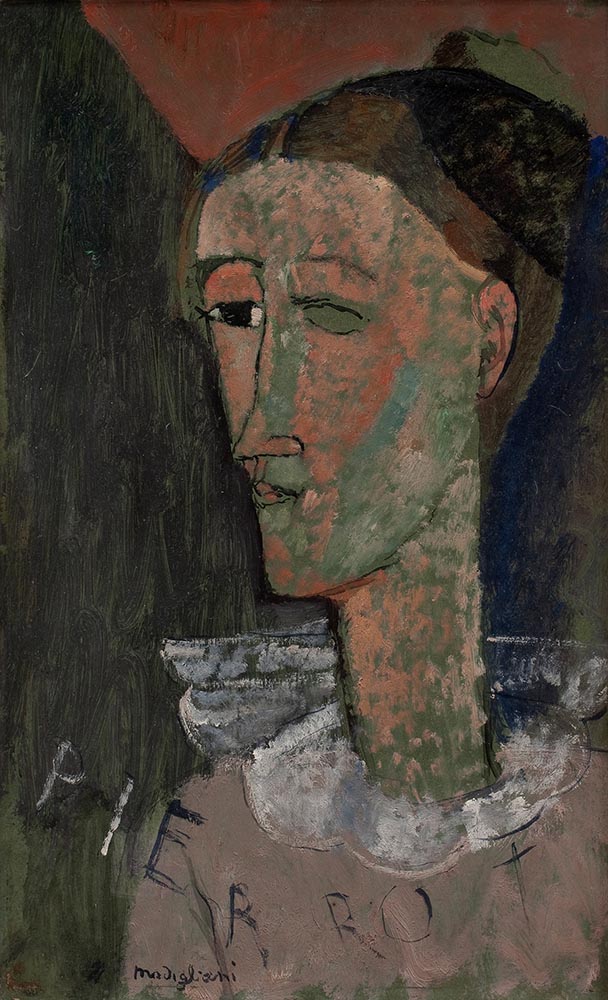
Oil on cardboard — 1915
Identification
- Title
- English: Pierrot - Self portrait as Pierrot.
Notes: Selvportræt som Pierrot and Portrait de l'artiste en costume de Pierrot (Statens Museum for Kunst); Pierrot (Ceroni); Self-Portrait as Pierrot (Tate Modern, 2017–18). - Date
- 1915
- Medium
- Oil on cardboard
Notes: cardboard (Pfannstiel); "Olie på pap" (Statens Museum for Kunst); paper (Ceroni and Parisot,); "olive green paper support" (Tate Papers, no. 35). - Dimensions
- 43 x 27 cm
- Signature
- "PIERROT Modigliani; verso: MODIGLIANI 1915" (Statens Museum for Kunst)
- Present location
- Statens Museum for Kunst, Copenhagen, Denmark (no. inv. KMSr88)
Catalogue numbers
| Compiler | Number |
|---|---|
| Arthur Pfannstiel | no. 61 |
| Joseph Lanthemann | no. 46 |
| Ambrogio Ceroni | no. 52 |
| Jeanne Modigliani | YES |
| Christian Parisot | 9/1915 |
| Osvaldo Patani | no. 56 |
| Modigliani Project | YES |
| MR | YES |
| Modigliani Initiative/ AMDC | ? |
Legal note on MR: This investigation has not had access to MR’s catalogue raisonné; all research here is based on open sources, publications and exhibitions. By no means has that catalogue been copied at any point. Modigliani Project and Modigliani Initiative are marked YES when the work is published or otherwise recorded by those projects, even if no catalogue number is assigned; otherwise the field is marked ?.
Provenance
- G. Aubry Collection. Paris
- Sale Aubry Coll. Drouot, Paris - November 24-25/ 11 / 1924- Lot 114
- Johannes C. Magnus Rump (1924-1928)
- Donation by Johannes Rump in 1928
- Statens Museum for Kunst, Copenhagen, Denmark - no. inv. KMSr88
The sequence follows the published museum, sale, and catalogue record in this investigation. Gaps and uncertain transfers are marked as such.
Selected bibliography
Book-length publications are marked with a footnote giving a full citation. Exhibition catalogues appear in both this list and the exhibition list when this investigation recorded them in both places.
- Pfannstiel, catalogue presume, Paris, 1929, p. 9 (as Portrait de l'Artiste (en costume de Pierrot)1
- Staten Museum for Kunst, Katalog over J. Rumps Samling af Modern Fransk Kunst, Copenhagen, 1948, p. 99
- Pfannstiel, Modigliani et son œuvre, étude critique et catalogue raisonné, Bibliothèque des Arts, Paris, 1956, no. 612
- Ragghianti, Ivrea, 1958, p. 42
- Roy, Modigliani, Lausanne 1958, p. 343
- Ceroni, Amedeo Modigliani : dessins et sculptures ; avec suite du catalogue illustre des peintures, Edizioni del Milione, 1965, p. 160
- Diehl, Modigliani, Ed. Flammarion 1969, p. 334
- Diehl, Modigliani, Ed. Flammarion 1977, p. 214
- Lanthemann, Modigliani, catalogue raisonné: sa vie, son œuvre, son art, Barcelona, 1970, no. 465
- Ceroni & Piccioni, I dipinti di Modigliani, Milan. 1970, no. 526
- Nakayahama, 1974, p. 7
- Lanthemann-Parisot. MODIGLIANI INCONNU: suivi de précisions et documents inédits. Brescia, Shakespeare and Company, 1978, p. 185
- Mann, Modigliani, Thames and Hudson, London, 1980 - no. 827
- Hall, Modigliani, Phaidon, Oxford, 1984, no. 158
- Castieau-Barrielle, Modigliani, ACR Editions Paris 1987, p. 1359
- Diehl, Modigliani, Crown Publishers, New York, 1989, p. 354
- Schmalenbach, Amedeo Modigliani, Prestel Verlag, 1990 p. 79 - no. 3110
- Parisot, Catalogue Raisonné Modigliani, Graphis Arte, 1991 no. 9/191511
- Patani, Catalogo Generale, Leonardo ed. Milano 1991-94 - no. 5612
- Krystof, Amedeo Modigliani: The Poetry of Seeing, Taschen Cologne, 2000, p. 4113
- MR, L'Ange au visage grave, Musée du Luxembourg, Paris, 2002, pp. 218-21914
- Klein, Modigliani: Beyond the Myth, The Jewish Museum, 2004-2005, p. 121, pl. 3615
- Soto Caba, Modigliani, the timeless face, Libsa, 200716
- Marini, Modigliani , Skira, France, 2008 - no. 24, p. 5817
- Simonetta Fraquelli, Modigliani, London, Tate Modern, Skira Rizzoli, London, 2017, pp. 74 and 81, p. 8118
Exhibitions
- Düsseldorf, Kunstsammlung Nordrhein-Westfalen, Amedeo Modigliani: Malerei, Skulpturen, Zeichnungen, 1991 - no. 16
- Zurich, Kunsthaus, Amedeo Modigliani: Malerei, Skulpturen, Zeichnungen, 1991 - no. 16
- Paris, Modigliani: l'ange au visage grave, Musée du Luxembourg, 2002 - no. 37
- Milano, Modigliani: l'ange au visage grave, Palazzo Reale, 2003 - no. 29
- New York, Modigliani: Beyond the Myth, The Jewish Museum, 2004
- Toronto, Modigliani: Beyond the Myth, The Art Gallery of Ontario, 2004 - 2005
- Villeneuve d'Ascq, L'oeil intérieur, LaM. Lille Métropole musée d'art moderne, 2016
- Budapest, Modigliani, Hungarian National Gallery, 2016
- Helsinki, Modigliani, Ateneum Art Museum, 2016-2017
- London, Modigliani, Tate Modern, 2017-2018
Notes
Not in D'Atri papers?
This painting presents holes in the 4 corners (2 covered by restoration)
Statens Museum for Kunst, Copenhagen, confirms Self-Portrait as Pierrot (inv. KMSr88), oil on millboard, 43 × 27 cm, 1915, donation of Johannes Rump, 1928. Inscriptions: “PIERROT Modigliani”; verso “MODIGLIANI 1915”.
Where sources disagree, both readings are given. This is a working research page, not a catalogue raisonné.
Introduction
Self-Portrait as Pierrot is the first painted self-portrait by Modigliani, and one of only two. The Jewish Museum's wall texts for Modigliani Unmasked state that "In 1915 Modigliani painted his first self-portrait, showing himself in the guise of Pierrot, the sad, naïve clown of the Commedia dell'Arte", and that, apart from "his two paintings (Self-Portrait as Pierrot, 1915, and Self-Portrait, 1919) and the c. 1911 Pierrot drawing, the only other known self-portraits by Modigliani are the early sketches reproduced here". The painting has belonged to the Statens Museum for Kunst in Copenhagen since 1928, when Johannes Rump gave his collection of modern French art to the museum. It was chosen to open Tate Modern's retrospective of 2017–18.
Ceroni did not treat the picture as a self-portrait. His caption gives the title simply as "Pierrot". His note adds that "Alla prima catalogazione fu citata col titolo Ritratto dell'artista in costume di Pierrot. Certamente si tratta del ricordo di una serata al teatro o al circo" (At its first cataloguing it was cited under the title Portrait of the artist in Pierrot costume. It is certainly the memory of an evening at the theatre or the circus). The tension between these two readings, a self-portrait in disguise or a stage figure remembered, runs through the literature. This essay examines how the picture is made and argues that its construction supports both readings at once.
Composition and format
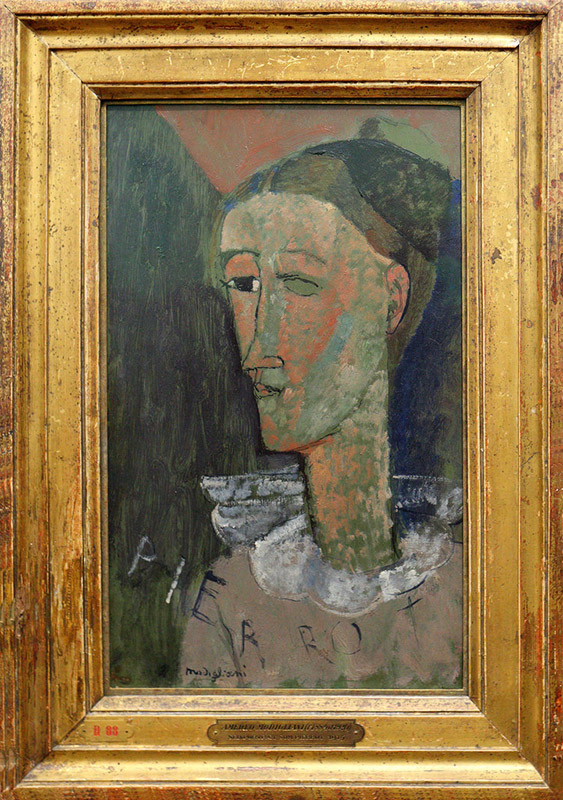
The support is a small upright sheet, 43 × 27 cm according to the museum, a ratio of about 1 : 1.59. This narrow format is unusual for Modigliani's portraits of 1915. The Secret Modigliani page's large reproduction has a width-to-height ratio of 0.61, close to the 0.63 of the museum's dimensions; the slight difference may be due to cropping.
The head occupies the upper two-thirds of the sheet. It is turned three-quarters to the viewer's left, and it rises on a long, thick neck from a large white ruff. Below the ruff, the costume fills the bottom of the sheet as a pale mauve-grey field. The background is divided into three areas. At the left, a dark green-black mass rises from the bottom edge to near the top, its edge sloping behind the head. At the right, a dark blue band runs down the edge of the sheet. At the top, between them, a red-orange field forms an inverted triangle, whose point is hidden behind the head.
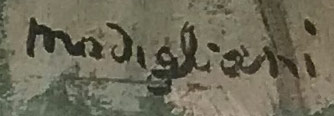
Across the lower part of the picture runs the word "PIERROT", painted in large, separate capitals. The first three letters, "PIE", are in pale grey on the dark green at the left. The rest, "RROT", are in dark blue-black on the mauve costume, the last letters approaching the right edge. The signature, "modigliani", is written small in dark paint at the bottom left. The inscription is thus part of the composition: it crosses the boundary between background and figure, and it labels the image as a stage character.
Line
The drawing is done with a thin, dark brush, and it is unusually explicit. A continuous line runs down the left side of the face from the forehead to the chin, describing the long, straight bridge of the nose and the sharp angle of its tip. The brows are thin arcs; the one over the viewer's left eye joins the line of the nose. The mouth is small, drawn with a dark line that separates the lips.
The two eyes are drawn differently. The viewer's left eye is open, a long almond with a dark pupil and a little white. The viewer's right eye is closed, or reduced to a single curved line under a green lid. The face therefore combines a look and a wink, or a seeing and a blind eye. Modigliani used this asymmetry repeatedly in 1915, but here, in a self-portrait, it acquires an additional resonance: the open eye looks out, the closed one turns inward.
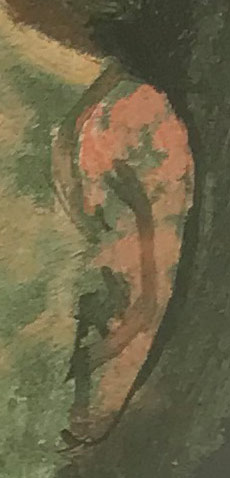
The ear, on the right side of the head, is drawn in dark lines over the colour. The Secret Modigliani page on the work reproduces a detail of it, with the comment "Detail of the ear where the drawing is clearly visible and is painted over the color". The detail shows a pink and green ear outlined by a dark brown line that winds through it and continues below. The neck is outlined by two lines that descend straight from the jaw to the ruff. The ruff itself is drawn in loose, scalloped curves.
Colour
The colour is the most striking feature of the picture. The face and neck are not painted in a uniform flesh tone. They are made of small dabs of pink and salmon laid over a green ground, so that the flesh appears mottled, as if seen through a veil. In some areas, especially on the cheek and the neck, the green predominates. In others, on the forehead and around the eye, the pink is denser. A paler, almost turquoise patch lies on the cheek on the right.
Tate Papers, no. 35 explains the effect. In their study of works with paintings beneath the visible surface, Anaïs Genty-Vincent et al. note that "Self-Portrait as Pierrot 1915 (National Gallery of Denmark, Copenhagen; C52) has an olive green paper support, left exposed to form the mid-tones, which are modulated with paler highlights and black". The green of the face is therefore not paint at all, or not only paint. It is the colour of the support, which Modigliani left visible as the middle value of the flesh. The pink dabs and the dark lines were laid over it.
The colour of the setting is strong and saturated. The red-orange of the upper field is the warmest note, and it sets off the dark brown-black of the skullcap. The dark green at the left and the dark blue at the right frame the head with cool colour. The ruff is a cold white with grey and blue shadows, and the costume a soft mauve-grey. The relation of the mottled face to the strong surrounding colours gives the head a pallor that suits Pierrot, the white-faced clown, while avoiding the conventional white make-up.
Facture
The handling varies with each area. The background is painted fairly thinly in long strokes; in the dark green at the left the strokes are vertical and broad, and in the red-orange at the top they run in several directions. The skullcap is painted in denser, darker strokes, with a dark outline. The face, as noted, is made of small, separate dabs over the green support, an almost pointillist touch that is unusual in Modigliani's work.
The ruff is the most heavily painted area. It is built up of thick white strokes, with blue-grey in the folds and a scalloped dark line at the lower edge. The costume below is painted more thinly, and the letters of "PIERROT" are laid on top of it with a loaded brush. The ear detail on the Secret Modigliani page shows that the dark contour lines were added after the colour, and the same appears to be true of the face.
Figure and space
The figure is shown as a bust, cut off below the ruff. The head is turned to the viewer's left but the open eye looks towards the viewer. The pose is static and frontal in its general effect, but the turn of the head and the slope of the dark mass at the left give it a slight movement.
The space is flat and stage-like. The three background areas do not describe any recognisable setting. They might be read as theatre flats or curtains, or as the planes of a wall, but they function chiefly as fields of colour. The figure stands in front of them without any indication of depth, and the inscription "PIERROT", laid across both figure and ground, insists on the surface. The picture is less a portrait in a room than a figure on a poster or a playbill.
Iconography and sitter
The identification of the sitter as Modigliani himself rests on the early title of the picture. The Secret Modigliani page on the work cites Pfannstiel's presumed catalogue of 1929, p. 9, "as Portrait de l'Artiste (en costume de Pierrot)", and the museum keeps that French title alongside the Danish "Selvportræt som Pierrot". Ceroni's note confirms that the first cataloguing used this title, but proposes that the picture is the memory of an evening at the theatre or circus.
The likeness itself is weak. The museum's documentation summarises a passage in Anette Kruszynski's book of 1996: "Pierro is often taken to be a self-portrait in a symbolic sense. Pierrot bears no outward resemblance to the artist". The face is long and schematic, with the elongated nose and the almond eyes that Modigliani gave many sitters in 1915. Whatever its title, it is a type rather than a likeness.
The Jewish Museum's wall texts connect the picture with a drawing. They describe Pierrot with a Ruff, "c. 1911, black crayon on paper", and state that "The painting was based on this drawing from about 1911". The same text interprets the choice of character: "The stock characters of the Commedia were familiar to French audiences; Modigliani chose to portray himself as the character most associated with the anguished, romantic artist". Another wall text in the same exhibition notes that "The figures of the traditional Commedia were often employed by avant-garde artists at this time as an expression of bohemian creative life".
Tate's large-print guide for the 2017–18 exhibition, which opened with this painting, offers a broader reading. It says that Modigliani "presents himself as the tragic clown Pierrot. His contemporaries would have recognised the reference instantly as, at the time, the figure appeared in countless pictures, plays and films". It goes on: "Pierrot could be comedic, melancholy or romantic, played by any actor or painted by any artist. In a new place, among new people, the work signals that Modigliani was ready to invent himself". The LaM's educational dossier for L'œil intérieur (2016) reproduces the painting in its section on "« Modi » le maudit", the myth of the cursed artist, with the caption "Portrait de l'artiste en costume de Pierrot".
These readings are not incompatible with Ceroni's. A figure seen at the theatre or circus could be the starting point for an image in which the painter projects himself into the role. The picture's construction supports this double reading. The inscription "PIERROT" names the character, not the painter; the signature "modigliani" at the bottom left names the painter; and the face belongs to neither, being a mask of the type Modigliani used for many sitters that year.
Comparisons
The closest comparison within Ceroni's sequence is Lola de Valence (Ceroni no. 49), in the Metropolitan Museum of Art, discussed earlier in this series. It too is painted on paper, it too is an upright of narrow proportions, and its title, taken from Manet's painting of a dancer, names a stage performer rather than a sitter. In both pictures the name is painted in large capitals beside or across the head, broken into fragments ("LOL", "DE", "VALEN" in the Lola; "PIE" and "RROT" here), and in both the lettering interacts with the figure. The function is the same: the word does not identify a sitter, it labels the picture as a performance. In the Lola the letters stand in the background and are cut by the face; in the Pierrot they pass in front of the costume, so that the figure itself carries its name.
A second comparison is with the head of a woman with a curtain (Ceroni no. 51), discussed in the previous essay in this series. Both show a long, schematic face with divided eyes against a background divided into a dark and a lighter area. In the present picture, however, the division is more complex and the colour stronger, and the face is built of separate dabs rather than smooth paint.
The use of an exposed coloured support as the middle tone is a technical comparison of a different kind. Tate Papers, no. 35 mentions the Pierrot in a discussion of the olive green tones that appear in several works of 1915, including The Pretty Housewife (Barnes Foundation; Ceroni no. 60). The coincidence suggests that olive green was a favoured base colour for Modigliani that year, whether it came from a paper support or from paint.
Provenance and exhibitions
The Secret Modigliani page on the work gives the provenance as "G. Aubry Collection. Paris", the sale of the Aubry collection at the Hôtel Drouot, Paris, in November 1924, lot 114, then "Johannes C. Magnus Rump (1924-1928)" and "Donation by Johannes Rump in 1928". The Statens Museum for Kunst gives the acquisition year as 1928. The painting is on display in room 215 of the museum, according to the museum's data.
The Secret Modigliani page lists the exhibitions in Düsseldorf and Zurich, 1991 (no. 16 in both); Paris, Musée du Luxembourg, 2002 (no. 37); Milan, Palazzo Reale, 2003 (no. 29); New York, The Jewish Museum, 2004; Toronto, Art Gallery of Ontario, 2004–05; Villeneuve-d'Ascq, LaM, 2016; Budapest, Hungarian National Gallery, 2016; Helsinki, Ateneum, 2016–17; and London, Tate Modern, 2017–18. The museum's data add ARoS Aarhus Kunstmuseum, 1996–97; MART, Modigliani Scultore, 2010–11; Albertina, Vienna, Modigliani and the Primitivist Revolution, 2021–22; Nakanoshima Museum of Art, Osaka, 2022; The Barnes Foundation, Philadelphia, Modigliani Under the Microscope, 16 October 2022–29 January 2023; and SMK Thy, Rejsen fra Paris, 2025.
Discrepancies
- Support. The Secret Modigliani page gives "Oil on cardboard (Pfannstiel: cardboard - Ceroni, Parisot: paper )". The museum gives "Olie på pap" and lists the material as "Pap" (cardboard, pasteboard). Tate's 2017–18 label gives "Oil paint on cardboard". Tate Papers, no. 35 describes "an olive green paper support". The notes on the Secret Modigliani page say that the museum "confirms" the painting as "oil on millboard". The likeliest explanation is that the support is a board faced with, or consisting of, olive green paper, but I could not consult a technical report that settles the point.
- Exhibitions. The museum lists six exhibitions not on the Secret Modigliani page (Aarhus 1996–97, MART 2010–11, Vienna 2021–22, Osaka 2022, Philadelphia 2022–2023 and SMK Thy 2025). The Secret Modigliani page lists Düsseldorf and Zurich 1991 and Helsinki 2016–17, which are not among the museum's exhibitions (although the museum's bibliography includes a 2016 publication by Bonsdorff and Huusko, which may be the Helsinki catalogue).
- Title. Ceroni gives the title as "Pierrot" and suggests a memory of the theatre or circus, while the earliest title, cited by Ceroni himself and from Pfannstiel 1929, describes the work as a portrait of the artist.
Technical analysis
This is the only work in the present batch for which a direct technical observation has been published. Tate Papers, no. 35, as quoted above, states that the picture has "an olive green paper support, left exposed to form the mid-tones, which are modulated with paler highlights and black". This is consistent with what the reproduction shows: the green that shows through the pink dabs of the face, and the dark contours drawn over them. The Ministry of Culture Research Portal of Denmark lists a chapter titled "Self-portrait as Pierrot", by Nancy Ireson, Annette King, Annette Suleika Ortiz Miranda and Jesper Svenningsen, in Modigliani Up Close: Exhibition Catalogue (Philadelphia, The Barnes Foundation, 2022), pp. 48–51. I could not open that chapter, and I do not know what it reports.
The Secret Modigliani page reports two further physical facts. The first is the ear detail mentioned above, in which the drawing is "painted over the color". The second is that "This painting presents holes in the 4 corners (2 covered by restoration)". As comparative evidence, the introduction to the Modigliani Technical Research Study, by King, Ireson, Fraquelli and Townsend, notes that "Some of the paintings in our study have pinholes in all four corners which suggests that, having cut pieces from a large roll, Modigliani could have painted these canvases pinned to the wall of the studio". That argument concerns canvases, but holes in the four corners of a paper or board support would suggest a similar practice: the sheet may have been pinned to a wall or board while it was painted.
The museum's data indicate that the back of the painting is protected. The inscription on the verso, "MODIGLIANI 1915", is reported by the museum and by the Secret Modigliani page, but I have not seen it.
Conclusion
Self-Portrait as Pierrot is a small, narrow picture, painted on an olive green support that serves as the middle tone of the face. A long, schematic head with one open and one closed eye rises from a thick white ruff before a background divided into dark green, red-orange and dark blue. The word "PIERROT", painted across the lower part of the picture, names the role, while the signature names the painter.
The picture can be read, with Ceroni, as the memory of a performance, or, with the earliest title and the modern museum literature, as a self-portrait in a role. Its construction supports both readings. The face is a mask rather than a likeness, and the inscription labels it as a character, yet the earliest title, the Jewish Museum's connection with a drawing of about 1911 and the image of the clown as an emblem of the artist all point to self-representation. The technical observation in Tate Papers, no. 35 shows that the pallor of this Pierrot is not make-up but the green of the support itself, left visible beneath a scattering of pink.
Museum, auction and exhibition sources
- Statens Museum for Kunst, Copenhagen, Selvportræt som Pierrot, KMSr88, collection data via the SMK open API, https://api.smk.dk/api/v1/art/?object_number=KMSr88 (titles, technique, dimensions, inscription, acquisition, exhibitions and bibliography with notes)
- Tate Modern, Modigliani (23 November 2017–2 April 2018), large-print guide, rooms 1–11, room 1 and label for Self-Portrait as Pierrot (copy at docslib), https://docslib.org/doc/1601730/modigliani-large-print-guide-room-1-11
- The Jewish Museum, New York, Modigliani Unmasked, wall texts and object labels, https://thejewishmuseum.org/wp-content/uploads/2025/07/Modigliani_Unmasked_wall_texts_and_object_labels.pdf
- LaM, Villeneuve-d'Ascq, Amedeo Modigliani: l'œil intérieur, dossier pédagogique (2016), https://www.musee-lam.fr/sites/default/files/2019-01/Dossier-pedago-Modigliani-l-oeil-interieur.pdf
- The Ministry of Culture Research Portal (Denmark), "Self-portrait as Pierrot", bibliographic page for the chapter by Nancy Ireson, Annette King, Annette Suleika Ortiz Miranda and Jesper Svenningsen in Modigliani Up Close: Exhibition Catalogue (2022), pp. 48–51, https://pure.kb.dk/en/publications/self-portrait-as-pierrot/
Technical literature (comparative)
- Anaïs Genty-Vincent et al., "Works by Modigliani that have Paintings beneath the Visible Surface", Tate Papers, no. 35, https://www.tate.org.uk/research/tate-papers/35/works-by-modigliani-that-have-paintings-beneath-the-visible-surface (direct observation on this work; otherwise comparative)
- Annette King, Nancy Ireson, Simonetta Fraquelli and Joyce H. Townsend, "The Modigliani Technical Research Study: An introduction to Modigliani's materials and techniques", The Burlington Magazine, vol. 160, no. 1380 (March 2018), https://www.burlington.org.uk/archive/article/the-modigliani-technical-research-study-an-introduction-to-modiglianis-materials-and-techniques (comparative)
brogio Ceroni", modigliani1909.com (web transcription of catalogue caption and note, no. 52), https://www.modigliani1909.com/ceroni.html
Sources that could not be opened
The chapter "Self-portrait as Pierrot" in Modigliani Up Close (Barnes Foundation, 2022) was not available; only its bibliographic page was opened. The museum's public page at open.smk.dk returned only a script shell, so the museum's data were read through its API. Tate's 2017 exhibition catalogue, Kruszynski's book of 1996 (known only from the museum's summary) and the 1924 Drouot sale catalogue were not available. The verso was not seen.
Cited but not independently consulted
Pfannstiel, catalogue presumé, 1929, p. 9; Statens Museum for Kunst, Katalog over J. Rumps Samling af Modern Fransk Kunst, 1948, p. 99; Pfannstiel, Modigliani et son œuvre, 1956, no. 61; Ragghianti, 1958, p. 42; Roy, Modigliani, 1958, p. 34; Ceroni, Amedeo Modigliani: dessins et sculptures, 1965, p. 160; Diehl, Modigliani, 1969, p. 33, 1977, p. 21, and 1989, p. 35; Lanthemann, 1970, no. 46; Ceroni and Piccioni, I dipinti di Modigliani, 1970 (given as 1972), no. 52; Nakayahama, 1974; Lanthemann-Parisot, Modigliani inconnu, 1978, p. 18; Mann, Modigliani, 1980, no. 82; Hall, Modigliani, 1984, no. 15; Castieau-Barrielle, 1987, p. 135; Schmalenbach, Amedeo Modigliani, 1990, p. 79, no. 31; Parisot, 1991, no. 9/1915; Patani, 1991–94, no. 56; Krystof, Amedeo Modigliani: The Poetry of Seeing, 2000, p. 41; MR, L'Ange au visage grave, 2002, pp. 218–219; Klein, Modigliani: Beyond the Myth, 2004–05, p. 121, pl. 36; Soto Caba, 2007; Marini, Modigliani, 2008, no. 24, p. 58; Ireson and Fraquelli, Modigliani, 2017, p. 81. Page and catalogue numbers are given without the footnote digits the page attaches to them, which on this page are separated by a space (for example "no. 46 5" is read as no. 46).
Footnotes
- Arthur Pfannstiel, Modigliani. L’Art et la Vie, preface by Louis Latourette, Paris, Seheur, 1929 (presumed catalogue).
- Arthur Pfannstiel, Modigliani et son œuvre, étude critique et catalogue raisonné, Paris, Bibliothèque des Arts, 1956.
- Claude Roy, Modigliani, Lausanne, Skira, 1958.
- Gaston Diehl, Modigliani, Paris, Flammarion, 1969.
- Joseph Lanthemann, Modigliani, catalogue raisonné: sa vie, son œuvre, son art, Barcelona, G. Condal, 1970.
- Ambrogio Ceroni and Leone Piccioni, I dipinti di Modigliani, Milan, Rizzoli, 1970.
- Carol Mann, Modigliani, London, Thames and Hudson, 1980.
- Douglas Hall, Modigliani, Oxford, Phaidon, 1984.
- Thérèse Castieau-Barrielle, La vie et l’œuvre de Amedeo Modigliani, Paris, ACR, 1987.
- Werner Schmalenbach, Amedeo Modigliani, Munich, Prestel, 1990.
- Christian Parisot, Catalogue raisonné Modigliani, Livorno, Graphis Arte, 1991.
- Osvaldo Patani, Amedeo Modigliani: catalogo generale, Milan, Leonardo, 1991–94.
- Doris Krystof, Amedeo Modigliani: The Poetry of Seeing, Cologne, Taschen, 2000.
- MR (cited here as MR), Modigliani: l’ange au visage grave, Paris, Musée du Luxembourg, 2002. Cited from the published exhibition catalogue only.
- Mason Klein, Modigliani: Beyond the Myth, New York, The Jewish Museum / Yale University Press, 2004.
- Victoria Soto Caba, Modigliani: The Timeless Face, Madrid, Libsa, 2007.
- Maurizio Marini, Modigliani, Paris, Skira, 2008.
- Simonetta Fraquelli, Modigliani, London, Tate Modern / Skira Rizzoli, 2017.