Raymond - Raymonde
Oil on canvas? — 1915 ?
Images Courtesy of sotheby´s
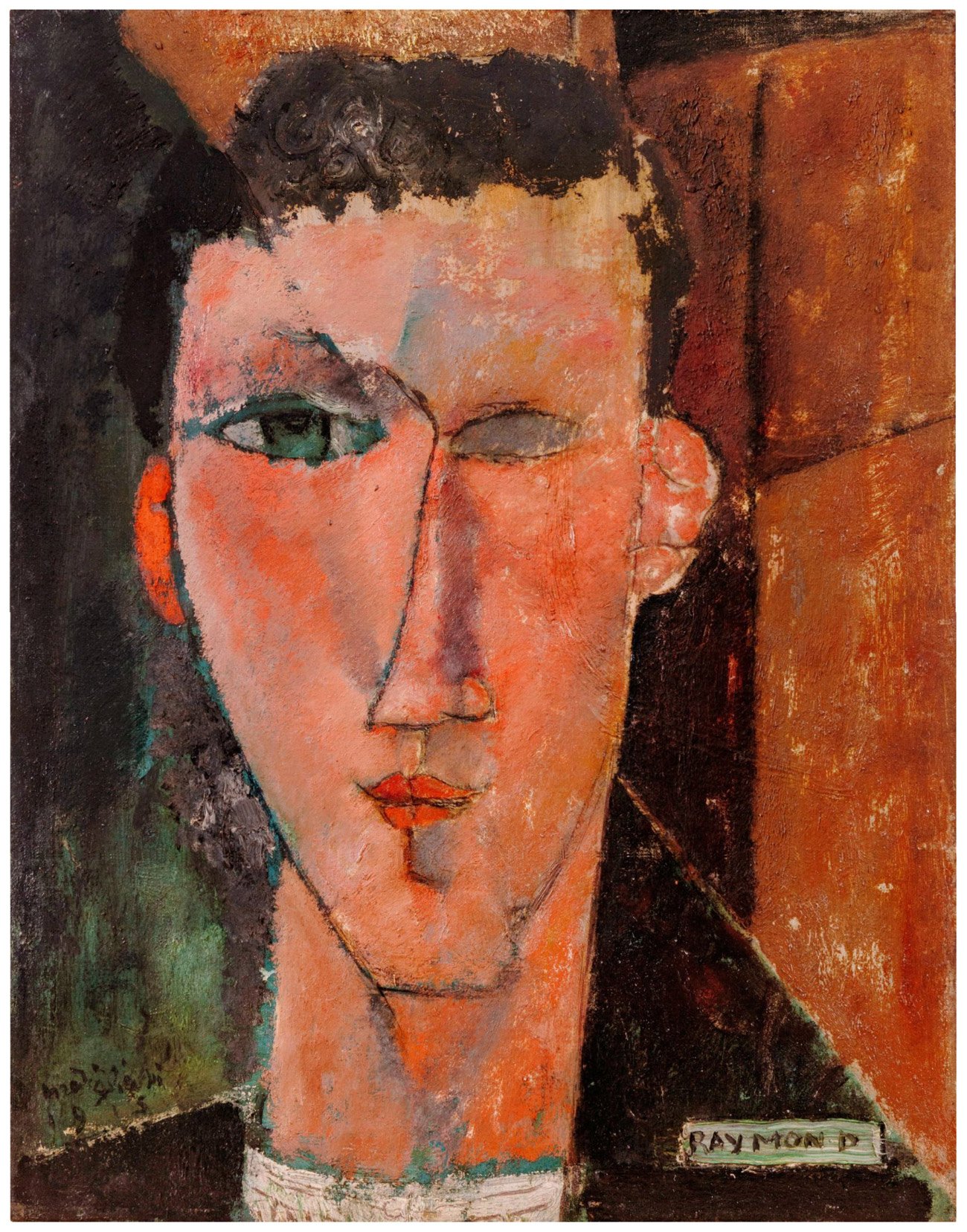
Identification
- Title
- English: Raymond - Raymonde.
Notes: Raymond (Ceroni; Sotheby's, 2025); Raymonde (Bernheim-Jeune, 1922). - Date
- 1915 ?
Notes: 1915, signed and dated (Sotheby's, 2025); 1916 (Pfannstiel, 1956, and the D'Atri papers). - Medium
- Oil on canvas
- Dimensions
- 36,7 x 28,7 cm
Notes: 37 x 29 ( Ceroni, Patani, Parisot); 36.7 × 28.7 cm (Sotheby's, 2025); 35.5 × 29 cm (D'Atri papers) - Signature
- Signed and dated "modigliani / 1915" lower left; "RAYMOND" in a white rectangle lower right
- Present location
- Private Collection?
Catalogue numbers
| Compiler | Number |
|---|---|
| Arthur Pfannstiel | no. 89 |
| Joseph Lanthemann | no. 70 |
| Ambrogio Ceroni | 1958/ no. 44 - 1970 / no. 56 |
| Jeanne Modigliani | YES |
| Christian Parisot | 12/1915 |
| Osvaldo Patani | no. 60 |
| Modigliani Project | ? |
| MR | YES |
| Modigliani Initiative/AMDC | ? |
Legal note on MR: This investigation has not had access to MR’s catalogue raisonné; all research here is based on open sources, publications and exhibitions. By no means has that catalogue been copied at any point. Modigliani Project and Modigliani Initiative are marked YES when the work is published or otherwise recorded by those projects, even if no catalogue number is assigned; otherwise the field is marked ?.
Provenance
- Paul Guillaume, Paris (acquired directly from the artist).
- Private collection, France (by descent from the above)
- Private collection, Europe (by 1958)
- Thence by descent to the present owner
- Sale Sotheby's Modernités
/ 24 October 2025 - Lot 107 - Sold for €10.6 million
Note at the auction:
This painting will be included in the Amedeo Modigliani Catalogue Raisonné by M. R., to be published in March 2026 by Yale U.Press. - Private Collection?
The sequence follows the published museum, sale, and catalogue record in this investigation. Gaps and uncertain transfers are marked as such.
Selected bibliography
Book-length publications are marked with a footnote giving a full citation. Exhibition catalogues appear in both this list and the exhibition list when this investigation recorded them in both places.
- George Waldemar, "Modigliani" in L'Amour de l'Art, October 1925, p. 384, illustrated.
- Pfannstiel, "catalogue presume" Modigliani. L'Art et la Vie. Preface de Louis Latourrettes, Seheur, Paris, 1929, p. 141
- Pfannstiel, Modigliani et son oeuvre, etude critique et catalogue raisonne, bibliotheque des arts, Paris, 1956 - no. 89 (dated in 1916)2
- Russoli, Amedeo Modigliani, Exhib. catalogue Palazzo Reale, Edizioni dell'ente manifestazioni Milanesi, Milano, 1958, pl. 9
- Ceroni, Amedeo Modigliani: Peintre; Suivi des Souvenirs de Lunia Czechowska, Edizioni del Milione, 1958 - no. 443
- Lanthemann, Modigliani, catalogue raisonné: sa vie, son oeuvre, son art, G. Condal, Barcelona, 1970 - no. 704
- Ceroni & Piccioni, Il dipinti di Modigliani, Rizzoli, Milano, 1970 - no. 565
- Mann, Modigliani, Thames and Hudson, London, 1980, p. 103 - no. 696
- André Parinaud, "Vive Modigliani" in Arts Magazine, 3 April 1981, pp. 6-9, illustrated
- Jacques Lassaigne, Tout Modigliani, La peinture, Paris, 1982, no. 56, p. 22, illustrated
- Catalogue National Museum Tokyo, 1985 no. 10
- Giorgio Cortenova, Modigliani, Florence, 1988, p. 13, illustrated
- Parisot, Catalogue Raisonee Modigliani, Graphis Arte, 1991 no. 12/19157
- Patani, Catalogo Generale, Leonardo, Milano, 1991-94 - no. 608
- MR, L'Ange au visage grave, Musée du Luxembourg, Paris, 2002, p. 319
- MR, Pinacothèque, Paris, Le Silence éternel: Modigliani-Hébuterne, 2008, p. 141, illustrated
- Soto Caba, Modigliani, The timeless face, Libsa, Madrid, 200710
- Fornaciari, Modigliani ebreo livornese. Storia familiale e formazione di un genio, Livorno, 2022, p. 20, illustrated.
- Exh. Cat., Paris, Musée de l'Orangerie, Modigliani, un peintre et son marchand, 2023-24, fig. 74, p. 114, illustrated.
Exhibitions
- Paris, Galerie Devambez, Peinture Moderne, 1920, no. 66
- Paris, Modigliani, Galerie Bernheim-Jeune, 1922 - no. 20 (probablement; titled Raymonde)
- Paris, Modigliani, Galerie Bing et Cie, 1925 - no. 32
- Milano, Mostra di Amedeo Modigliani, Curated by Franco Russoli, 1958 - no. 9
- Edinburgh, Modigliani, Royal Scottish Academy, 1963 - no. 11
- London, Modigliani, Tate Gallery, 1963 - no. 11
Notes
no. 291 in D'Atri papers as Raymond - 35.5 x 29 - dated 1916 - provenance in Paul Guillaume
This is one of those paintings that are extremely rare to see a new image.
Usually is said by experts that is Raymond Radiguet portrait, but the painting shows a grown up man, not a boy. The sitter was born in 1903 and this painting is dated by Modigliani in 1915 so the sitter was 12 years?, so this investigation records another person not Raymond Radiguet.
Biographers say he lived in Val de Marne (close to Paris) until 1917. This is a photo of Radiguet with Cocteau in 1923 (8 years later to the painting):
Where sources disagree, both readings are given. This is a working research page, not a catalogue raisonné.
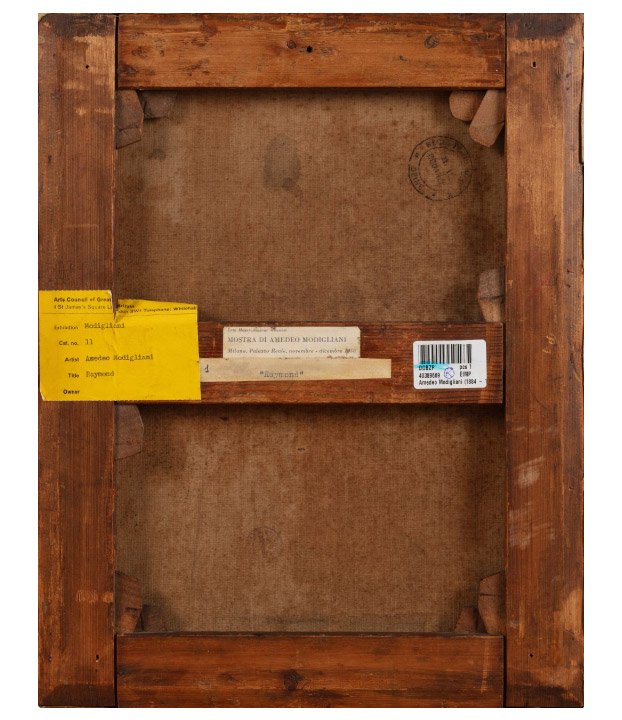
Complete back of the painting
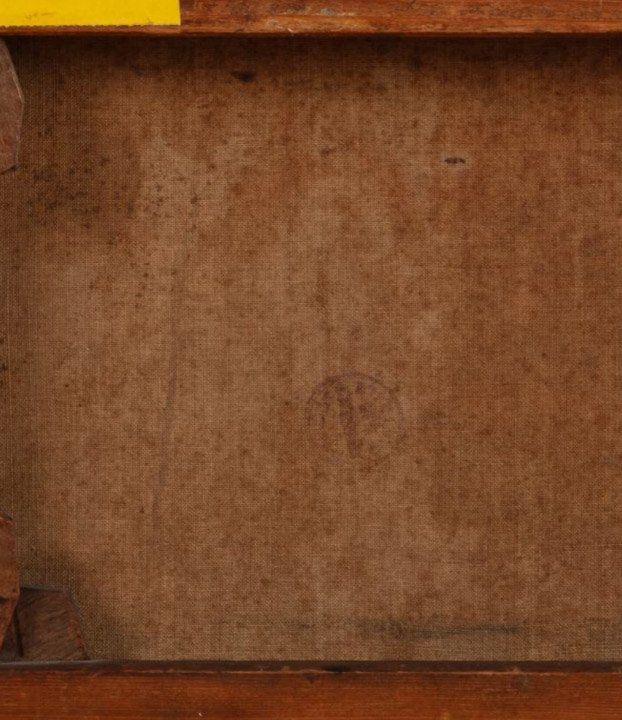
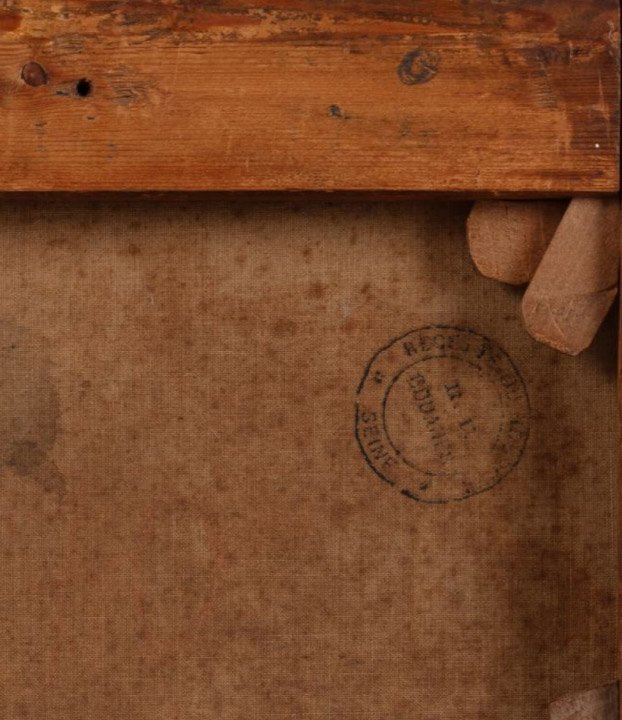 In the back of the painting two export stamps are visible.
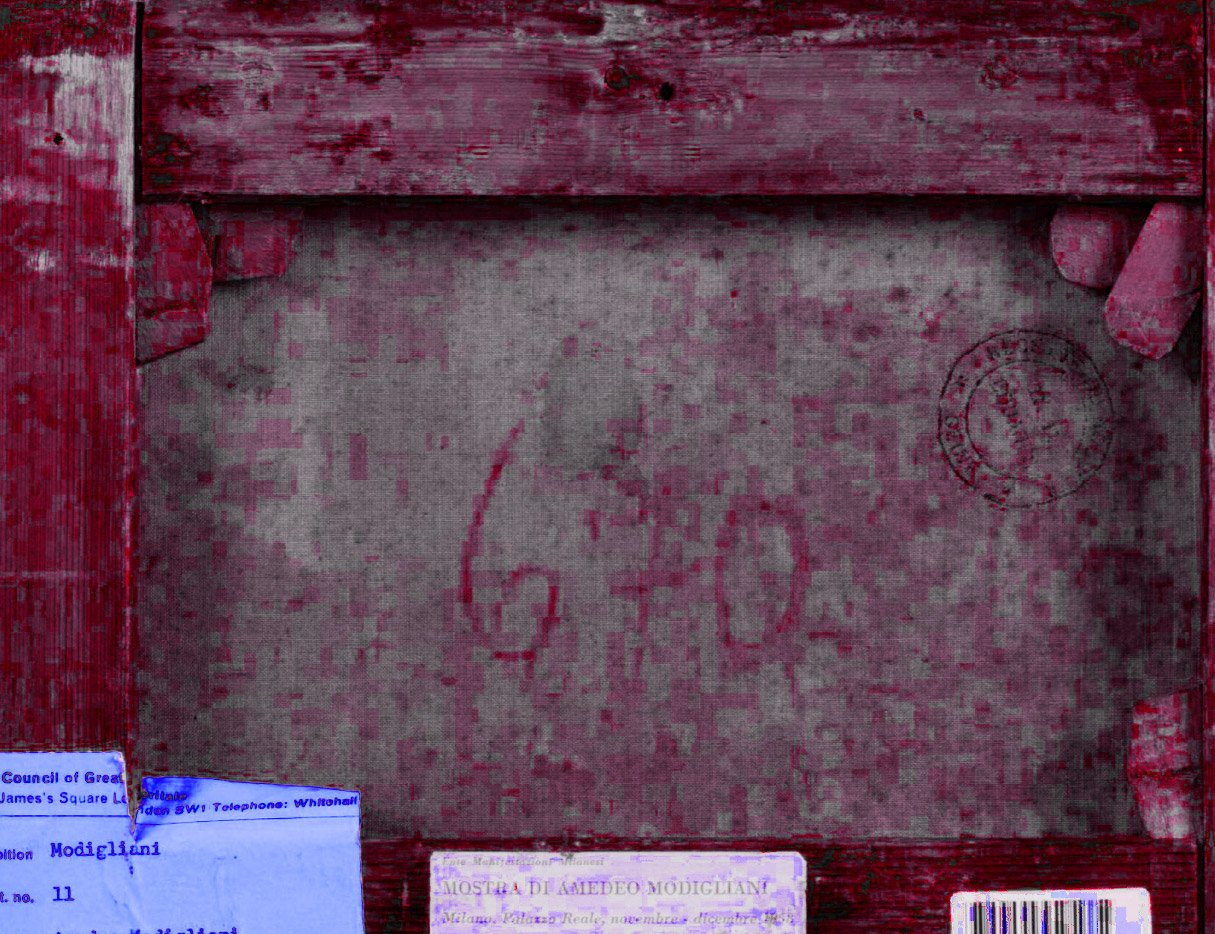 And in a digital infrared the number
"670" is visible.
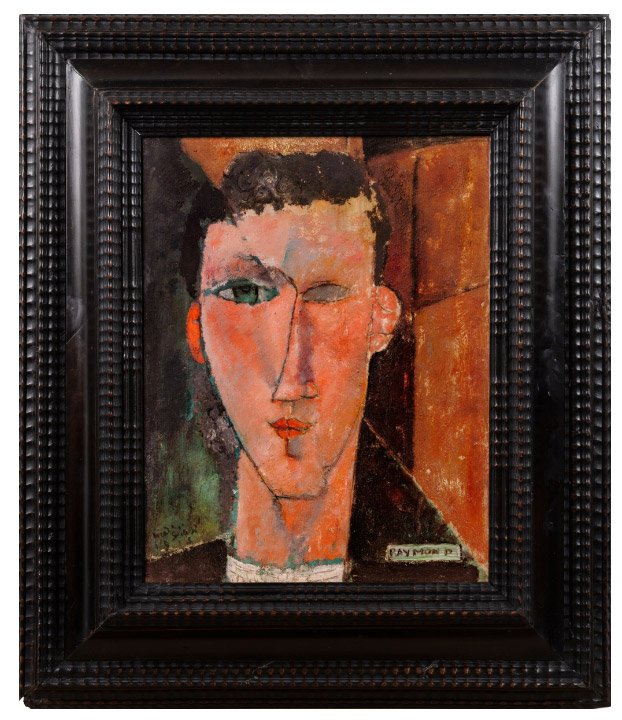 The painting framed for auction.


Introduction
Raymond is one of the smallest of the portraits Modigliani painted in 1915, and one of the most concentrated. A single head, set on a long neck and cut off just below the collar, fills a canvas barely larger than a sheet of writing paper. The name "RAYMOND" is painted in capitals at the lower right, and the signature and date at the lower left. The picture belonged first to Paul Guillaume and then, for more than half a century, to a private collection. In October 2025 it was sold at auction in Paris. Sotheby's announced afterwards that the portrait, "believed to depict the novelist Raymond Radiguet and held in the same private collection for over 65 years", had sold for "€10.6 million ($12.4 million) after a 10-minute bidding battle, more than doubling its estimate".
That identification, which goes back at least to Ceroni, is the most discussed question about the picture, and the Secret Modigliani page on the work rejects it. This essay first analyses the painting as an image: its format and composition, its line, colour and handling, and the way it builds a face out of planes. It then turns to the sitter, to the comparisons the picture invites among Modigliani's portraits of 1915, and to the documentary evidence, which, as the sale has made newly available, differs on several points from the Secret Modigliani page.
Composition and format
The canvas is upright and small. Sotheby's gives "36,7 x 28,7 cm; 14½ x 11¼ in.", a ratio of width to height of about 0.78. The reproduction on the Secret Modigliani page has the same proportion (0.785), as does the plate in Ceroni's catalogue. On so small a support Modigliani made no attempt at a bust or a half-length. The head occupies almost the whole height of the picture. The hair begins a little below the upper edge, and the chin falls at about four-fifths of the height; the neck then runs down to the lower edge, where a narrow strip of white collar and the dark shoulders of a jacket close the composition.
The head is not quite central. Its axis lies slightly to the left of the vertical centre line, and the face is turned very slightly towards the viewer's left, so that the right side of the face (on the viewer's right) is broader than the left. The asymmetry is reinforced by the ears: the ear on the viewer's right is large, pale and fully drawn, while the left ear is smaller and partly lost in shadow. The neck, very long in relation to the head, is the vertical spine of the picture; it is almost as wide as the face is at the cheekbones, so that the head seems to sit on a column rather than to taper into a throat.
Around this column the background is divided into large planes. On the left a dark area of violet, brown and green rises from the bottom edge to the top. On the right the wall is a warm red-brown, broken by a dark vertical band behind the right ear, a lighter salmon-coloured plane at the far right, and a diagonal edge that descends from the upper right towards the shoulder. Above the head a further brown plane closes the top of the picture. None of these shapes describes a recognisable room. They read as the angles of a wall or of a studio corner, but their main task is to set warm against cool on either side of the head and to supply diagonals that answer the strict verticals of the neck.
The two inscriptions mark the lower corners. The signature, small and in dark paint, is placed against the dark ground at the lower left beside the neck; the name "RAYMOND" sits in a pale rectangle at the lower right, partly over the dark shoulder. The Secret Modigliani page describes the arrangement as "Signed 'modigliani / 1915 ' bottom left and the text 'RAYMOND' in a white rectangle in bottom right", and Sotheby's as "signed Modigliani and dated 1915 (lower left); titled Raymond (lower right)". Like a label on a sculptor's plinth, the rectangle gives the picture a base.
Line
Line in Raymond is not an outline drawn round finished forms; it is a set of decisions laid over the colour. The most striking is the nose. A single dark stroke starts at the inner end of the left eyebrow, runs down the length of the face and turns at the tip into the short horizontal of the nostril. The right side of the nose is not drawn at all; it is given only by a change from the lit plane of the cheek to the shaded plane beside it. The effect is that of a carved ridge seen in raking light, and it turns the face into two unequal planes meeting at an edge.
The other lines are equally economical. The eyebrows are short, dark arcs, the left one joined to the line of the nose. The jaw is a long, slightly curved stroke on each side, meeting at the narrow chin. The mouth is made from two small red forms divided by a dark line, the upper lip slightly bowed. A thin vertical line runs from below the lower lip to the chin, a device that recurs, more emphatically, in Madam Pompadour (Ceroni no. 57). The ears are drawn in dark paint with a few curving strokes for the helix and the inner fold.
The Secret Modigliani page on the work illustrates a detail of the ear and observes that it is a "Detail of the ear where the drawing is clearly visible and is painted over the color (on top of the color)". This sequence, colour first and linear definition afterwards, can be seen in the reproduction elsewhere too: the line of the nose crosses the modelled flesh without interruption, and the outline of the jaw sits on top of the grey-green shadow beside it. The drawing thus works as a final articulation of a head that has already been built in paint.
Colour
The palette is limited and warm: orange-pink flesh, red-brown and maroon in the background, violet-black hair, and the dark blue-black of the jacket. Against these the picture sets a small number of cool notes. The forehead carries a patch of blue-grey on its central axis, as if the light fell on a ridge of bone. The shaded side of the face and the area beneath the nose are modelled with grey-green, and the dark area to the left of the neck is shot with greens. The white of the collar and of the inscription rectangle are the only near-whites in the picture.
The eyes are the decisive colour accents. The eye on the viewer's left has a blue-grey iris with a dark pupil and a dark upper lid. The other eye is filled with a flat, pale grey, without iris or pupil. The difference is so strong that it reads at once as a statement. Artprice's preview of the sale described "the asymmetrical gaze characteristic of his 'double‑gaze theory' — one eye turned toward the world, the other toward the model's inner self". The French Wikipedia article on the picture quotes Modigliani as saying "Avec l'un, vous regardez le monde, avec l'autre, vous vous regardez", but flags the quotation as needing a source ("réf. nécessaire"). I have not found the remark in a primary source and cite it here only as an interpretation in circulation. What the painting itself shows is a contrast between a seeing eye and a blank one, a device that Modigliani used often in 1915 and that is equally visible in the Pierrot in Copenhagen (Ceroni no. 52).
The lips are the only saturated red in the face. They pick up the red-brown of the wall at the right, while the violet-black of the hair echoes the dark plane at the left. The head thus gathers the two halves of the background into itself.
Facture
The paint is fairly thin over most of the surface but varied in texture. In the background at the right, the reproduction shows a granular, broken surface with small raised points and pale flecks, as though the paint had been dragged over the weave or over an earlier, dried layer. The dark area to the left is more fluid and mottled, with visible brushstrokes running in several directions. The flesh is laid in more smoothly, with soft transitions between orange, pink and grey-green, but the brushwork is still visible on the cheeks and neck. The hair is painted in short, curling strokes of violet-black over a lighter tone, and its lower edge breaks into a jagged fringe over the forehead.
This handling gives the small picture an unexpected physical presence. The face appears both modelled and flat: modelled in its gradations of warm and cool, flat in its frontal planes and its linear edges. The rough background behaves differently from the smooth flesh, and the difference helps to bring the head forward.
Figure and space
Space in Raymond is shallow. The head and neck are seen at close range and fill the picture, and the background planes are close behind them. There is no floor, no furniture and no horizon. The only suggestion of depth is the diagonal edge at the upper right and the darker band behind the right ear, which together imply a corner or a recess behind the sitter.
The figure is presented with the stillness typical of Modigliani's portraits of this year. The face is not animated by expression; the mouth is closed, and the eyes do not meet the viewer in any simple way, since only one of them can be said to look. The very long neck and the frontal placement give the head the character of a carved object. Sotheby's catalogue speaks of "geometric planes, bold lines, and a quiet intensity", and Artprice of "facial volumes, chiseled like stone". These are interpretations, but they describe accurately the way the face is divided into planes meeting at linear edges.
Iconography and sitter
The painting carries its sitter's first name, but nothing more. Ceroni's caption gives the location as "Raymond, Montecarlo, proprietà privata", and the accompanying note proposes an identification: "Stando alle testimonianze di Cocteau e Salmon, è pensabile che si tratti di Raymond Radiguet, l'autore di Le diable au corps". Ceroni adds that Radiguet, in the sketch for a story, refers to the Paris café la Rotonde and mentions Modigliani, and that, speaking in the first person, he describes his meeting with a girl named Alice, "per la quale si veda il n°69". Ceroni therefore offers the identification as a possibility ("è pensabile") resting on the testimony of Cocteau and Salmon, which I have not been able to consult.
The auction house accepted it with a qualification. Sotheby's video presentation calls the picture "a rare portrait of the young Raymond Radiguet", while the post-sale announcement says that it is "believed to depict" him. Artprice wrote that the picture "portrays the young Raymond Radiguet , future author of Le Diable au corps , captured with striking inner maturity despite his youth". The French Wikipedia article states, with a reference to Blondel, that the work "représenterait, à l'âge de 12 ans, le futur écrivain Raymond Radiguet".
The Secret Modigliani page on the work objects on grounds of age: "Usually is said by experts that is Raymond Radiguet portrait, but the painting shows a grown up man, not a boy". It notes that Radiguet "was born in 1903 and this painting is dated by Modigliani in 1915 so the sitter was 12 years?", and that biographers place him in the Val-de-Marne, near Paris, until 1917. It also dismisses a claim, found in secondary literature, that Radiguet shared Beatrice Hastings's affections with Modigliani and that Le Diable au corps reflects that situation.
The visual evidence can be weighed independently. The face is long and narrow, with a strong nose and jaw; the neck is long and thick; the shoulders are those of a jacketed adult. But Modigliani's stylisation in 1915 regularly lengthened heads and necks, so the proportions are not reliable evidence of age. On the other hand, nothing in the picture specifically suggests a child of twelve: there is no softness of feature and no indication of boyish dress. The question cannot be settled from the image. What can be said is that the identification rests on testimony reported by Ceroni and has not, in the sources I could consult, been supported by a document contemporary with the painting.
A further piece of evidence concerns the picture's early history rather than its sitter. The LaM teaching dossier for the 2016 exhibition Amedeo Modigliani, l'œil intérieur reproduces a photograph with the caption "Amedeo Modigliani dans son atelier vers 1915. Son accrochés sur les murs Raymond et un Portrait de Béatrice Hastings." ("Son" stands for Sont in the dossier.) The French Wikipedia article, by contrast, says that for a long time the picture was known only "par une photographie de l'appartement de Paul Guillaume, son premier propriétaire", citing an article in Connaissance des arts that I have not opened. Whether these refer to one photograph or two, and whether it shows Modigliani's studio or Guillaume's apartment, I cannot determine from the sources available.
Comparisons
Raymond belongs to a group of 1915 portraits in which Modigliani inscribed the sitter's name or a title on the canvas. Pierrot (Ceroni no. 52) carries its title in large capitals; Madam Pompadour (Ceroni no. 57) carries "Madam / Pompadour / 1915" in script; Antonia (Ceroni no. 59) has "ANTONIA" in a pale rectangle at the upper left; and The Pretty Housewife (Ceroni no. 60) has "LA JOLIE MENAGERE" across the top. In Raymond the inscription is in a rectangle like that of Antonia, but placed at the lower right, where it acts as a base. The name is part of the design, not a caption added to it.
The head itself is closest to Madam Pompadour. In both, the nose is given by a long line running down from the brow, the lips are divided by a line, and a vertical stroke runs from the lower lip to the chin. Tate Papers, no. 35 describes the Chicago picture as one of "the 'cubist' portraits that Modigliani painted in 1915", in which "the nose is flattened with exaggerated triangular nostrils and the lips are bisected with vertical and horizontal lines". The same vocabulary, in a less emphatic form, is present here.
The contrast between a seeing eye and a blank eye links Raymond to Pierrot, and the way the head is set against two strongly contrasted background zones recalls the portraits of Henri Laurens (Ceroni nos. 53–54), where coloured planes behind the head seem to refer to the sitter's world without describing it. Raymond is smaller than all of these, and the reduction in size intensifies the effect: with no hands, no torso and almost no setting, everything depends on the face.
Provenance and exhibitions
The Secret Modigliani page on the work gives a short provenance: "Paul Guillaume coll. Paris" and "Private coll. Monaco / MIlano?". Its notes add that the D'Atri papers list the picture as no. 291, "Raymond - 35.5 x 29 - dated 1916 - provenance in Paul Guillaume". Ceroni's caption places it in a private collection in Monte Carlo.
Sotheby's gives a fuller sequence: "Paul Guillaume, Paris (acquired directly from the artist)", "Private collection, France (by descent from the above)", "Private collection, Europe (by 1958)", and "Thence by descent to the present owner". The picture was offered as "Property from a Prestigious European Collection" in the Modernités sale on 24 October 2025, lot 107, with an estimate of 5,500,000–7,500,000 EUR. According to Sotheby's post-sale article, it sold for €10.6 million. Sotheby's also notes that the work "is the subject of a loan request for an exhibition dedicated to the artist, to be held at the Grimaldi Forum in Monaco in the summer of 2028".
The Secret Modigliani page lists five exhibitions: Galerie Bernheim-Jeune, Paris, 1922, no. 20, "titled Raymonde"; Galerie Bing et Cie, Paris, 1925, no. 32; Milan, Palazzo Reale, 1958, no. 9; and Edinburgh, Royal Scottish Academy, and London, Tate Gallery, 1963, no. 11. The Secret Modigliani page for the Milan exhibition confirms "9 Raymond". Sotheby's lists the same exhibitions and adds an earlier one: "Paris, Galerie Devambez, Peinture Moderne , 1920, no. 66".
Discrepancies
- Sitter. Ceroni, Sotheby's, Artprice and Wikipedia identify the sitter, with varying degrees of caution, as Raymond Radiguet; the Secret Modigliani page rejects the identification because Radiguet was twelve in 1915. The sources do not resolve the question.
Technical analysis
No technical study of Raymond has been published as far as I could find. Sotheby's offered a condition report only to registered users, and I could not open it. What follows is therefore based on the reproductions and, where stated, on comparative evidence from other works.
The reproductions suggest a thin paint layer over a canvas whose weave is visible in the background, particularly at the right. The small raised points and pale flecks in that area could be the tops of the weave catching the paint, or the texture of an earlier, dried layer beneath. The Secret Modigliani page's observation that the drawing of the ear lies "on top of the color" is consistent with a working sequence in which the head was painted first and then articulated in line.
As comparative evidence, the Tate-led technical study reported in The Burlington Magazine states that "Modigliani often reused canvases and, in our study, X-radiographs have shown changes that occurred during the painting process". Tate Papers, no. 35 (Anaïs Genty-Vincent et al.) describes several 1915 portraits painted over earlier images, including The Pretty Housewife (Ceroni no. 60). Whether Raymond was painted on a fresh or a reused canvas cannot be determined without an X-radiograph; the granular texture of the background is not, by itself, evidence of an underlying image.
Conclusion
Raymond is a small picture of great formal clarity. A long head on a column-like neck fills the canvas; a single line makes the nose and divides the face into two planes; one eye sees and the other is blank; warm and cool colours are set against each other on either side of the head, and the name in its pale rectangle gives the image a base. In its line, its planar construction and its inscription it belongs closely to the group of portraits Modigliani painted in 1915, and above all to Madam Pompadour.
The documentation has been considerably enlarged by the 2025 sale. Sotheby's catalogue adds a Paris exhibition of 1920, a more detailed provenance and new measurements, and confirms the 1915 inscription. It does not settle the identity of the sitter. The Radiguet identification goes back to the testimony cited by Ceroni, and the objection raised on the Secret Modigliani page, that Radiguet was a boy of twelve in 1915, has not been answered in the sources available to me. The painting itself, with its adult features, allows either reading only with difficulty.
Museum, auction and exhibition sources
- Sotheby's, Modernités, Paris, 24 October 2025, lot 107, Amedeo Modigliani, Raymond, https://www.sothebys.com/buy/c00813d0-3d06-4599-9eec-77eca05427d2/lots/0af2cdea-3738-4565-8c23-b50197443a29 (accessed 26 October 2026)
- Will Fenstermaker, Sotheby's article on the Paris sales of 24 October 2025, led by Elvire en buste, published on sothebys.com in the Impressionist & Modern Art articles section, 24 October 2025 (accessed 26 October 2026)
- Sotheby's, "Modigliani's 'Raymond': A Portrait of Genius and Fate", video page, https://www.sothebys.com/en/videos/modiglianis-raymond-a-portrait-of-genius-and-fate
- Thierry Brandt, "Two Modigliani Masterpieces at Sotheby's Paris: Raymond and Elvire en buste", Artprice, 20 October 2025, https://news.artprice.com/en/485/two-modigliani-masterpieces-at-sotheby-s-paris-raymond-and-elvire-en-buste
- LaM, Lille Métropole musée d'art moderne, Amedeo Modigliani, l'œil intérieur (27 February–5 June 2016), dossier pédagogique
- Wikipédia, "Portrait de Raymond", https://fr.wikipedia.org/wiki/Portrait_de_Raymond (background only; it cites Blondel and Connaissance des arts, which I have not consulted)
Technical literature (comparative)
- Annette King, Nancy Ireson, Simonetta Fraquelli and Joyce H. Townsend, "The Modigliani Technical Research Study: An introduction to Modigliani's materials and techniques", The Burlington Magazine, vol. 160, no. 1380 (March 2018) (comparative)
- Anaïs Genty-Vincent et al., "Works by Modigliani that have Paintings beneath the Visible Surface", Tate Papers, no. 35, https://www.tate.org.uk/research/tate-papers/35/works-by-modigliani-that-have-paintings-beneath-the-visible-surface (comparative)
Sources that could not be opened
Sotheby's condition report (available only to registered users); the Connaissance des arts article of 15 October 2025 cited by Wikipedia; Blondel's book cited by Wikipedia; the testimonies of Cocteau and Salmon cited by Ceroni; the Orangerie catalogue Modigliani, un peintre et son marchand (2023–24), fig. 74; the D'Atri papers. No technical report on the picture was found.
Cited but not independently consulted
Pfannstiel, catalogue présumé, 1929, p. 14; Pfannstiel, Modigliani et son œuvre, 1956, no. 89 (dated 1916); Russoli, Palazzo Reale exhibition catalogue, 1958, pl. 9; Ceroni, Amedeo Modigliani: Peintre, 1958, no. 44; Lanthemann, 1970, no. 70; Ceroni and Piccioni, I dipinti di Modigliani, 1970, no. 56; Mann, Modigliani, 1980, p. 103, no. 69; National Museum Tokyo catalogue, 1985, no. 10; Parisot, 1991, no. 12/1915; Patani, 1991–94, no. 60; MR, L'Ange au visage grave, 2002, p. 31; Soto Caba, 2007. Page and catalogue numbers are given without the footnote digits the page attaches to them. All are cited from the Secret Modigliani page on the work.
Footnotes
- Arthur Pfannstiel, Modigliani. L’Art et la Vie, preface by Louis Latourette, Paris, Seheur, 1929 (presumed catalogue).
- Arthur Pfannstiel, Modigliani et son œuvre, étude critique et catalogue raisonné, Paris, Bibliothèque des Arts, 1956.
- Ambrogio Ceroni, Amedeo Modigliani: Peintre; suivi des souvenirs de Lunia Czechowska, Milan, Edizioni del Milione, 1958.
- Joseph Lanthemann, Modigliani, catalogue raisonné: sa vie, son œuvre, son art, Barcelona, G. Condal, 1970.
- Ambrogio Ceroni and Leone Piccioni, I dipinti di Modigliani, Milan, Rizzoli, 1970.
- Carol Mann, Modigliani, London, Thames and Hudson, 1980.
- Christian Parisot, Catalogue raisonné Modigliani, Livorno, Graphis Arte, 1991.
- Osvaldo Patani, Amedeo Modigliani: catalogo generale, Milan, Leonardo, 1991–94.
- MR (cited here as MR), Modigliani: l’ange au visage grave, Paris, Musée du Luxembourg, 2002. Cited from the published exhibition catalogue only.
- Victoria Soto Caba, Modigliani: The Timeless Face, Madrid, Libsa, 2007.