Lola de Valence
Oil on paper mounted on wood? — 1915

Identification
- Title
- English: Lola de Valence.
Notes: Lola de Valence (The Metropolitan Museum of Art; Modigliani Initiative, AMDC 30); Portrait de femme (Pfannstiel 1929). - Date
- 1915
Notes: 1915 ( The Metropolitan Museum of Art; Ceroni 1965); 1914–15 (Pfannstiel 1929); 1916 (Perls Galleries 1958; Werner 1966). - Medium
- Oil on paper mounted on wood
Notes: Oil on paper, mounted on wood panel (The Metropolitan Museum of Art; Modigliani Initiative); oil on canvas (Pfannstiel; Ceroni). - Dimensions
- 52.1 x 33.7 cm
Notes: 52.1 × 33.7 cm (The Metropolitan Museum of Art; Modigliani Initiative); 51 × 33 cm (Pfannstiel; Ceroni). - Signature
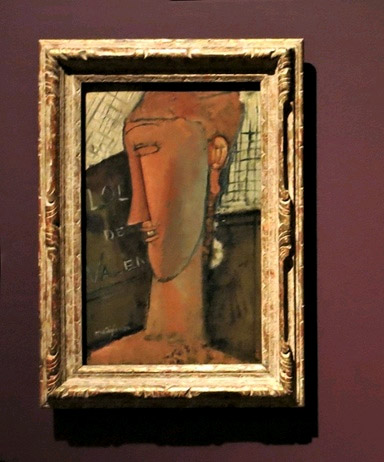
- Front, left center: "LOL[A]/ DE / VALEN[CE]; lower left: Modigliani" and a undefined stamp.
- Present location
- The Metropolitan Museum of Art, New York, 67.187.84, Bequest of Miss Adelaide Milton de Groot (1876–1967), 1967.
Catalogue numbers
| Compiler | Number |
|---|---|
| Arthur Pfannstiel | 1956 /no. 49 |
| Joseph Lanthemann | no. 43 |
| Ambrogio Ceroni | 1970 / no. 49 |
| Jeanne Modigliani | YES |
| Christian Parisot | 3/1915 |
| Osvaldo Patani | no. 54 |
| Modigliani Project | ? |
| MR | YES |
| Modigliani Initiative/ AMDC | AMDC 30 |
Legal note on MR: This investigation has not had access to MR’s catalogue raisonné; all research here is based on open sources, publications and exhibitions. By no means has that catalogue been copied at any point. Modigliani Project and Modigliani Initiative are marked YES when the work is published or otherwise recorded by those projects, even if no catalogue number is assigned; otherwise the field is marked ?.
Provenance
- Coll. Guillaume, Paris, 1929-1934
- G. le Niveau, 1938
- Valentine Gallery, New York, 1940 ( Stock no. 2044c, sold to de A. M. de Groot for $ 980/ January 1940)
- Milton de Groot Collection, New York (January, 1940)
- Loan to the Met Museum, NY in 1952.
- Bequest to Metropolitan museum of Art by Adelaide Milton de Groot, 1967
- Metropolitan Museum of Art, New York, no. Inv. 67.187.84
The sequence follows the published museum, sale, and catalogue record in this investigation. Gaps and uncertain transfers are marked as such.
Selected bibliography
Book-length publications are marked with a footnote giving a full citation. Exhibition catalogues appear in both this list and the exhibition list when this investigation recorded them in both places.
- Pfannstiel, catalogue presume, Paris, 1929, p.91
- Jedlicka. Modigliani, 1884–1920. Zürich, 1953, p. 82, pl. 11, as in the collection of Paul Guillaume.2
- San Lazzaro. Modigliani. Paris, 1953, fig. 3.3
- Pfannstiel, Modigliani et son œuvre, étude critique et catalogue raisonné, Bibliothèque des Arts, Paris, 1956, no. 494
- Modigliani Jeanne, Modigliani: Man and Myth. New York, 1958, p. 745
- Ceroni. Amedeo Modigliani: Dessins et sculptures, avec suite du catalogue illustré des peintures. Milan, 1965, p. 40, no. 161, ill., dates in 1915.
- Werner. Amedeo Modigliani. New York, 1966, fig. 21, dates it 1916.
- Ceroni. I dipinti di Modigliani. Milan, 1970, p. 90, no. 496
- Lanthemann, Modigliani, catalogue raisonné: sa vie, son œuvre, son art, Barcelona, 1970, no. 437
- Ceroni & Piccioni, I dipinti di Modigliani, Milan. 1972, no. 496
- Lanthemann. "Modigliani inconnu." Modigliani inconnu, suivi de précisions et documents inédits. Brescia, 1978, p. 197
- Modigliani Jeanne. Racconta Modigliani. Ed. Giorgio and Guido Guastalla. Livorno, 1984, p. 99
- Castieau-Barrielle, La vie et l'œuvre de Amedeo Modigliani, Editions ACR Paris, 1987, p. 1278
- Patani, Catalogo Generale, Leonardo ed. Milano 1991-9, no. 549
- Parisot. Modigliani: Catalogue raisonné. Ed. Giorgio and Guido Guastalla. Vol. 2,Peintures, dessins, aquarelles. Livorno, 1991, p. 276, no. 3/1915, ill. p. 63, erroneously lists it as still in a private collection.10
- Soto Caba, Modigliani, the timeless face, Libsa, 200711
- "Art of the Aegean Bronze Age": The Metropolitan Museum of Art Bulletin, v. 69, no. 4 (Spring, 2012)
- Fergonzi. "Modigliani: The Path from His Sculpture to 'Nu Couché'." Amedeo Modigliani: "Nu Couché". Ed. Robert Brown. New York, 2015, pp. 96–97
- Klein, Modigliani Unmasked, The jewish Museum, New York, 201712
- Cécile Girardeau in Modigliani: A Painter and His Art Dealer. Ed. Simonetta Fraquelli and Cécile Girardeau. Exh. cat., Musée de l'Orangerie. Paris, 2023, pp. 24, 152, fig. 54 (color).
- Julia May Boddewyn. The Valentine Gallery: The Forgotten Story of Valentine Dudensing, Matisse, Picasso, and the US Market for Modern Art (1926–1947). London, 2026, pp. 145, 255 n. 55.
Exhibitions
- Paris. Galerie d'Art Le Niveau. "La Femme dans l'art moderne," May 1–15, 1937, no. 41 ?.
- Paris. Galerie Le Niveau. "Exposition Modigliani," April 4–30, 1938, no. 7 (as "Lola de Valence," 1915).
- New York. Valentine Gallery. "12 Portraits by Modigliani and a Group of Modern French Paintings," January 8–27, 1940, no. 4.
- New York. The Metropolitan Museum of Art. "Modern European Paintings from New York Private Collections," June 22–September 30, 1956.
- New York. Perls Galleries. "Masterpieces from the Collection of Adelaide Milton de Groot," April 14–May 3, 1958, no. 26 (as "Lola de Valence," 1916).
- New York. The Metropolitan Museum of Art. "Paintings from Private Collections: Summer Loan Exhibition," July 7–September 7, 1959, no. 71.
- New York, Modigliani unmasked, Jewish Museum, 2017-18.
- Vienna. Albertina Museum. "Modigliani: The Primitivist Revolution," September 17, 2021–January 9, 2022, no. 79; Curated by MR.
- Paris. Musée de l'Orangerie. "Modigliani: A Painter and His Dealer," September 20, 2023–January 15, 2024, unnumbered cat. (fig. 54).
Notes
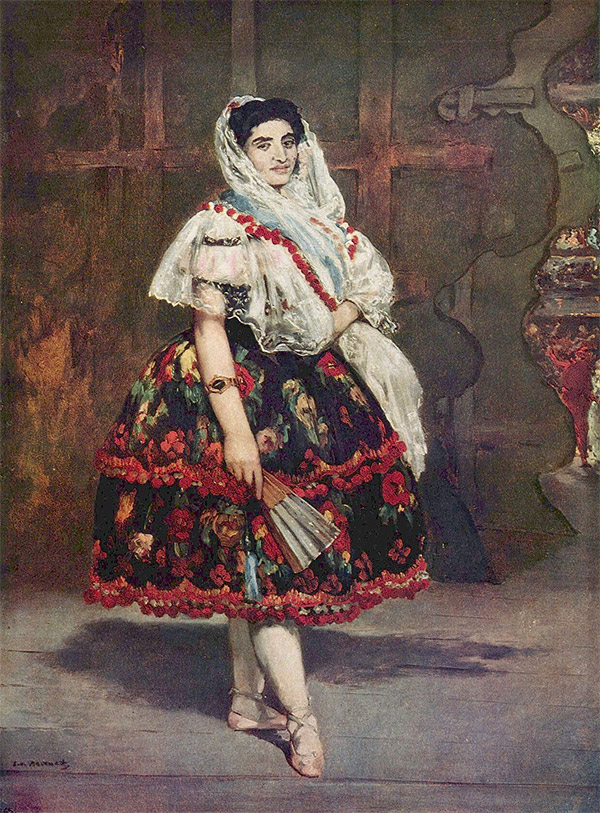
This work represents Lola de Valence, a famous dancer who had previously modeled for Edouard Manet.
Is probably some kind of joke based on Manet's Lola: Even the background of wood ( probably the back of the stage) is visible in a more ironic representation.
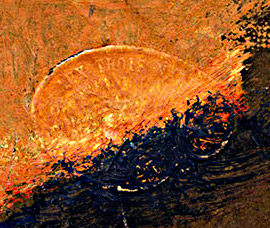
The work presents as Stamp rotated 180 º in the opposite side of the paper, The only extractable text say: LUX THOLE and the form of an artist palette? probably from a material seller or the paper maker watermark?
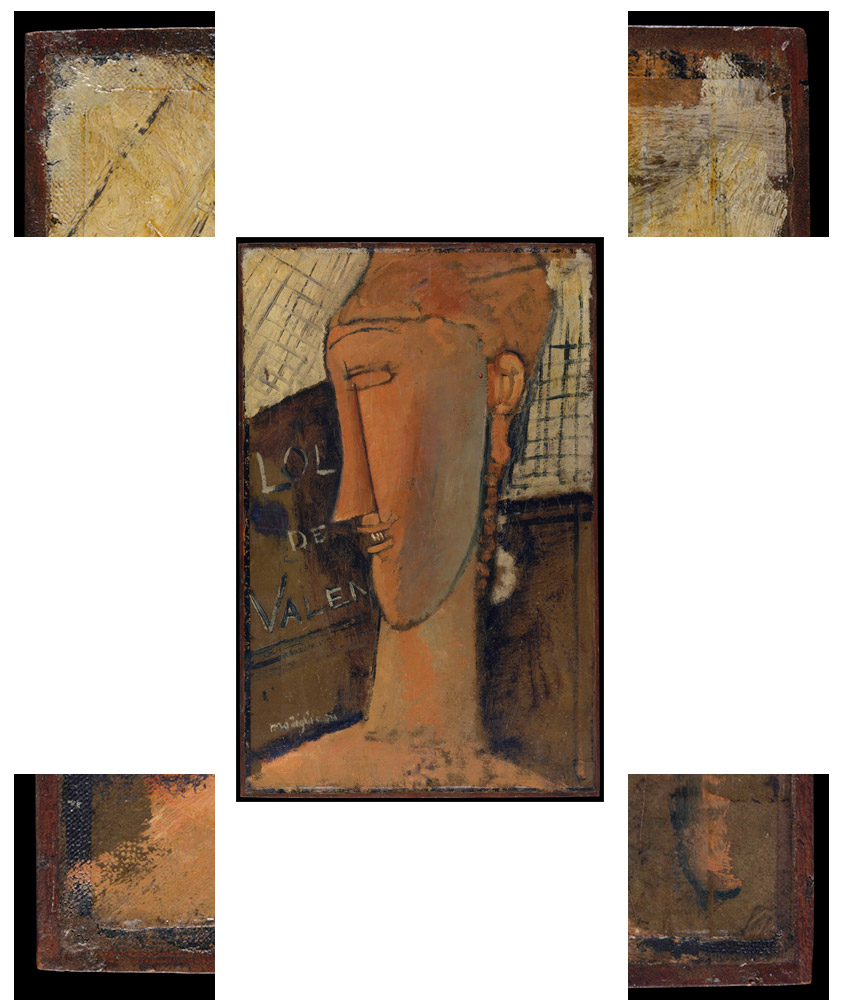
Corners:
The work present 4 clear holes in the corners made while painting, a classic way of Modigliani to paint was to mark the sides with a black line made with brush, pin to the wall or to a wood and then start to paint.
Many works by Modigliani present this method of painting that has been discovered recently (2017), the only publication that has given any interest to this feature is the recent Burlington magazine publications over the Tate gallery retrospectivebut with no in deep analysis of this feature, just came as an anecdotal point.
The Metropolitan Museum of Art, New York, confirms Lola de Valence (inv. 67.187.84), oil on paper mounted on wood panel, 52.1 × 33.7 cm, 1915, Bequest of Miss Adelaide Milton de Groot (1876–1967), 1967.
Where sources disagree, both readings are given. This is a working research page, not a catalogue raisonné.

Introduction
Lola de Valence is the most immediately recognisable of Ceroni's works of 1915. It shows a colossal female head in strict profile, facing left. Its nose drops from the forehead in a single wedge, and its eye is a closed slit. The letters "LOL", "DE" and "VALEN" are painted in large capitals in the background beside the face. Ceroni gives the caption "Lola de Valence, New York, proprietà Adelaide Milton de Groot". His note reads: "A sinistra, la grande scritta autografa LOL DE VALEN. Da considerare come un divertimento, probabile ricordo eseguito al ritorno da una serata al circo o al cafè-concerto" (On the left, the large autograph inscription LOL DE VALEN. To be considered a divertimento, probably a souvenir painted on returning from an evening at the circus or the café-concert).
The picture has been in The Metropolitan Museum of Art since the bequest of Adelaide Milton de Groot in 1967. The Met's online page could not be opened: it returned a browser verification page. The museum's open-access collection data (object 489642) gives the title, the date 1915, the medium "Oil on paper, mounted on wood panel" and the dimensions 52.1 × 33.7 cm.
The Modigliani Initiative (AMDC 30) publishes a full provenance, an exhibition history and a commentary. It also adds a note on the painted border. The Secret Modigliani page on the work reproduces detail images of the corners and of a stamp. This essay reads the picture against Manet's Lola de Valence, which, the Modigliani Initiative suggests, Modigliani may have seen at the Louvre in 1914. It also considers what the physical evidence on the paper tells us.
Composition and format
The support is a sheet of paper laid on a wood panel, 52.1 × 33.7 cm, an upright of about 1 : 1.55. The site's reproduction (ratio 0.651) and the Met's dimensions (0.647) agree. A dark border, reddish-brown to black, runs around all four sides. It is clearest along the left and bottom edges.
The head is enormous in relation to the field. Its top is cut by the upper edge, and the neck widens towards the bottom edge, which crops it. The profile occupies the centre and left of the picture. The forehead is a broad curve. From it the nose descends almost vertically to below the middle of the picture, a long, flat wedge with an angular tip. Below the nose the mouth is reduced to a few horizontal bars of light paint, like the teeth of a comb or stylised lips. The chin is a long rounded form that falls away into the neck. Behind the face, on the right, the ear is a small orange shell, and from it a vertical chain of beads or a plait of hair hangs down along the back of the jaw. A small red dot sits just in front of the ear.
The background is divided into rectangles. At the upper left and upper right are cream areas crossed by a grid of dark diagonal and orthogonal lines, like a lattice or caned screen. Below them, on both sides, are brown areas with horizontal lines, which the Secret Modigliani page reads as "the background of wood (probably the back of the stage)". On the left brown panel the letters stand one above another in cream paint: "LOL", "DE", "VALEN". The signature, "modigliani", is written in cream below them, in the lower left corner. The inscription is cut by the face, as if the head stood in front of a poster or sign. That is the visual joke Ceroni calls a "divertimento".
Line
The drawing is reduced to the essentials and is very sure. A single dark line runs from the top of the forehead down the front of the nose to its tip and turns back under it. A second, parallel line separates the nose from the cheek. Together they make the nose a long, flat plank seen edge-on. The eye is a horizontal dark slit with an arc above it for the lid, and a short horizontal line at the top joins the brow to the bridge of the nose. The contour of the chin and jaw is a long curve in dark paint that runs from the mouth round to the back of the neck.
The background lines are freer and thinner. The lattice in the cream areas is scratched in with a dry, dark brush, and its lines cross at irregular intervals. The letters are drawn with a loaded brush in a confident, slightly irregular capital. Their placement down the left edge creates a vertical counterpart to the profile.
Colour
The palette is limited and warm: orange and salmon for the face, cream for the lattice areas and the letters, browns from umber to dark chocolate for the background, and black and reddish-brown for the border. The face is painted in a flat orange with greyish-blue modelling on the cheek and jaw. The modelling is not tonal shading. It is a cooler plane laid beside the warm one, as in a sculpted head where light catches the different faces of a block. The ear and the plait of hair are a lighter, warmer orange, and the small red dot near the ear is the only pure red in the picture.
The cream areas at the top act as light behind the head. They frame the forehead and the back of the skull. Their lattice may read as a curtain or screen, or as the light of a theatre or café. Against them the orange head looks dark and solid. The lower half of the picture is darker and browner, and the cream letters and signature stand out from it with the effect of a painted sign.
Facture
The paint is thin and lean over most of the surface. The face is painted in smooth strokes that follow its planes. The lattice areas are brushed with a drier, broken touch through which the paper and panel show. The browns are applied in long horizontal strokes, especially at the bottom. In the corner details reproduced on the Secret Modigliani page, the edge of the support shows a coarse texture, apparently canvas-like, beneath the painted border at the lower left. It may be the texture of the paper or of a fabric used in mounting. I cannot tell from the photograph.
In each of the four corners there is a small round hole. The Secret Modigliani page interprets them as "4 clear holes in the corners made while painting". It explains that "a classic way of Modigliani to paint was to mark the sides with a black line made with brush, pin to the wall or to a wood and then start to paint". The physical evidence fits that reading. The holes are close to the corners, within the painted border, and the paint around them seems undisturbed in the details reproduced. This is discussed further in the technical section.
Figure and space
There is no space in the usual sense. The head is a flat form in front of a flat background, and the overlap of the face with the lettering is the only sign of depth. The lattice and the wooden panels are like the flats of a stage. The Secret Modigliani page links them to the setting of Manet's Lola de Valence, whose dancer stands in front of a painted backcloth behind the scenery. In the site's reproduction of Manet's picture, the dancer stands in the wings of a stage. Behind her is the wooden back of a flat and, at the right, what appears to be a glimpse of the auditorium.
Modigliani's figure is not a dancer in a costume but a head. Nothing of Manet's mantilla, flowered skirt and fan survives, except perhaps the long chain of beads or plait beside the ear. Manet's full-length figure in an illusionistic stage space is replaced by a mask seen in profile against flat panels. What links the two pictures is the name, painted into the image, and the stage setting suggested by the wooden flats.
Iconography and sitter
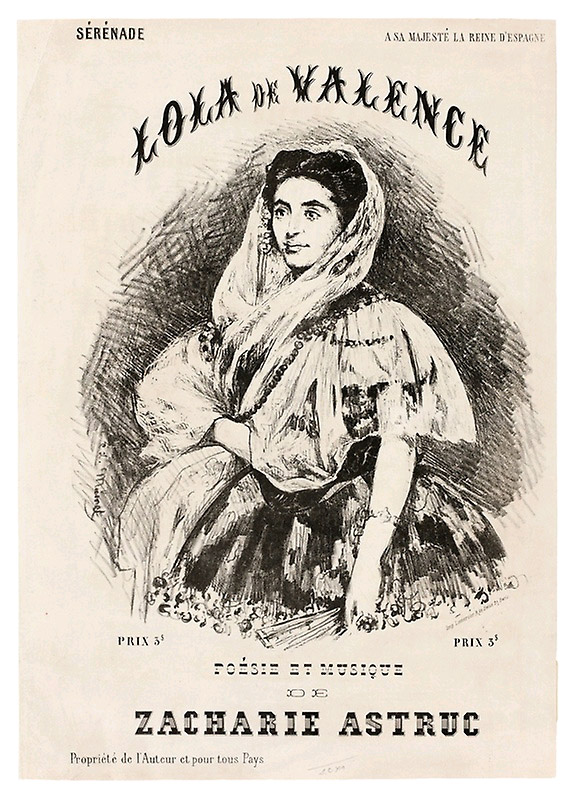
The Modigliani Initiative explains the subject: "Manet (1832–1883) portrayed the dancer Dolores Melea (dates unknown). Her nickname, 'Lola de Valencia,' became the title of Manet's painting, which famously inspired the poem of the same name by Charles Baudelaire (1821–1867)." It adds that Manet's painting was part of the bequest of Count Isaac de Camondo: "The Camondo collection went on public view at the Louvre in June 1914 and elicited much excitement". It also notes that Modigliani "was inspired by the simplified forms of African art that he had access to in the gallery of Paul Guillaume (1891–1934) and the residence of Frank Burty Haviland (1886–1971)".
The Jewish Museum's label for the 2017–18 exhibition Modigliani Unmasked sums up the iconography: "This portrait depicts the famous nineteenth-century Spanish dancer Lola de Valence, also memorialized by the poet Charles Baudelaire and the painter Édouard Manet. Modigliani's radical approach to portraiture is on display here: the dancer's face is essentially an African mask." The Secret Modigliani page describes the picture as "probably some kind of joke based on Manet's Lola".
Two readings are therefore possible, and they need not exclude each other. Ceroni's reading is biographical and anecdotal: a souvenir of a performance. The reading in the Modigliani Initiative and the Jewish Museum is art-historical: a response to Manet's picture newly on view at the Louvre, reinterpreted through African sculpture. Since Lola de Valence (Dolores Melea) was a dancer of the 1860s, the title cannot name the sitter. Whoever posed, if anyone did, Modigliani gave the face the name of a famous model of Manet's. This is a joke about painting as much as about the dancer.
Comparisons
Within this batch, the closest comparison is Ceroni no. 48, Head of a woman in profile, shown in 1958 as a "Portrait de style nègre". Its nose is a wedge of the same kind, though the head is turned in three-quarter view and the eyes are frontal. Lola de Valence takes the idea further, into a true profile, so that the whole face becomes a single plane. The Tête rouge (Ceroni no. 50) shows the frontal version of the mask. The Pompidou describes its mask features as "plus ou moins inspirée des masques Fang du Gabon" (more or less inspired by the Fang masks of Gabon).
Outside this batch, the inscription relates the picture to Modigliani's other experiments of these months with words and collage. In its commentary on AMDC 25, the Modigliani Initiative notes that one portrait of Hastings "incorporated newspaper collage" (Beatrice (Portrait de Béatrice Hastings), AMDC 6). The painted word, borrowed from Cubist painting and collage, places the image in the same world as the café posters and signs that Ceroni's "cafè-concerto" evokes.
Provenance and exhibitions
AMDC 30 gives the following provenance:
- Galerie Paul Guillaume, Paris (by 1929).
- By descent to Domenica Guillaume (1934), on Paul Guillaume's death.
- Valentine Gallery, New York (by 1940). AMDC 30 cites the Valentine Dudensing ledger books at the Museum of Modern Art Archives: "'January 1940,' no. 2044C". It adds that "Domenica Guillaume consigned this and a number of other works to the Valentine Gallery in New York".
- Adelaide Milton de Groot (January 1940).
- On loan to the Met (1952).
- The Met, by bequest (1967).
The Secret Modigliani page agrees and adds "G. le Niveau, 1938" and a price, "$ 980". a source in the archives for AA for the price.
The exhibitions given by both sources are:
- Paris, Galerie d'Art Le Niveau, La Femme dans l'art moderne, 1937, no. 41 (marked "?" on the Secret Modigliani page).
- Paris, Galerie Le Niveau, Exposition Modigliani, 1938, no. 7, as Lola de Valence, 1915.
- New York, Valentine Gallery, Twelve Portraits by Modigliani, 1940, no. 4.
- New York, The Metropolitan Museum of Art, 1956 and 1959.
- New York, Perls Galleries, de Groot collection, 1958, no. 26, dated 1916.
The Secret Modigliani page adds three more:
- New York, The Jewish Museum, Modigliani Unmasked, 2017–18 (given as 2018).
- Vienna, Albertina, Modigliani: The Primitivist Revolution, 2021–22, no. 79.
- Paris, Musée de l'Orangerie, Modigliani: A Painter and His Dealer, 2023–24.
The Jewish Museum's checklist confirms the loan to the 2017–18 exhibition. It lists Lola de Valence, 1915, "Oil on paper, mounted on wood, 20 1/2 × 13 1/4 in. (52.1 × 33.7 cm)", lent by the "Metropolitan Museum of Art, NY".
Discrepancies
- Support. Pfannstiel and Ceroni give oil on canvas. The Met and AMDC 30 give paper mounted on wood panel.
- Date. 1914–15 (Pfannstiel 1929, according to AMDC 30); 1915 (the Met; Le Niveau 1938; Ceroni 1965); 1916 (Perls 1958; Werner 1966, according to the page).
Technical analysis
No technical study devoted to this work has been published, as far as I can find. The Met's own page, which might include a conservation note, could not be opened. The physical evidence available comes from the documentation and from the detail images on the Secret Modigliani page.
Support and border. AMDC 30 notes that a "frame-like painted border around the composition, which is typically but not consistently black" is "a common feature found in several of the artist's paintings". It adds: "While this device was likely used for the sizing of the canvas in the absence of a wooden strainer, this work is on paper, so the purpose of the frame in this instance is unclear." It refers to the Burlington article by King, Ireson, Fraquelli and Townsend. That article reports that "a large number of canvases had painted borders" and suggests that "it is possible that he drew the size of the strainer as a guide and painted within the lines". It also states: "Several paintings have black outlines, like a painted frame". On a sheet of paper later laid on a panel, the border may have served the same purpose. It would have marked the size of the panel to which the sheet was to be fixed, which could explain the "Painted frame" mentioned by AMDC 30. This is a hypothesis.
Pinholes. The Burlington article states: "Some of the paintings in our study have pinholes in all four corners which suggests that, having cut pieces from a large roll, Modigliani could have painted these canvases pinned to the wall of the studio." Tate Papers, no. 35, examining Paul Alexandre in Front of a Window, found "push-pin holes at each corner". The authors write that "The area that would have been under the pin is painted and it can be seen that the pin was pressed in when the paint was still soft". They add that such holes "could also have been made by tacks that Modigliani used as spacers to stack wet paintings against one another". The four holes in Lola de Valence belong to this pattern. Whether the paint runs under the pinheads, as in the Tate study, would have to be checked on the object. The Secret Modigliani page states that the Burlington publications treated this feature only as "an anecdotal point". In fact, the Tate study devotes a figure (fig. 14) to it, so that description is not quite fair. These are comparative findings, not an examination of this work.
Stamp. The Secret Modigliani page reproduces a detail in which an oval impression is visible through the paint, and an enhanced version. It describes it as a stamp "rotated 180 º in the opposite side of the paper". It reads the only legible letters as "LUX THOLE (Toile?)", together with "the form of an artist palette". In the reproductions, a raised oval with letters at its upper edge can be seen. I can make out A colour merchant's stamp on the back of the paper is plausible. The palette shape recalls the partial canvas stamp "in the shape of a large artist's palette" that the Burlington article reports on the reverse of Bust of a young girl (1908; C10), which "remains unidentified". Any link between the two is speculative. AMDC 30 says "Reverse no longer visible", so the stamp can now be read only through the paint.
Conclusion
Lola de Valence is a small picture that shows clearly the turn Modigliani's painting took in 1915. The model of a famous Manet is turned into a mask in profile. The flat orange plane of the face is set in front of the flats of an imaginary stage, and the inscription that names her is cut by the head. Whether Ceroni was right to call it a divertimento, a souvenir of an evening at the café-concert, or whether it is a deliberate response to the Manet just hung in the Louvre, its humour and its seriousness are inseparable.
The documentation is good, thanks to the Modigliani Initiative and the Met. The Secret Modigliani page adds useful images of the physical evidence. The pinholes and the painted border suggest that the sheet was pinned up and painted within marked limits, as the technical literature describes for Modigliani's canvases. A technical study by the museum could confirm this and read the stamp.
Museum, auction and exhibition sources
- The Metropolitan Museum of Art, Open Access collection data, object 489642, Lola de Valence, 67.187.84, https://collectionapi.metmuseum.org/public/collection/v1/objects/489642 (title, date, medium, dimensions and credit line; the corresponding collection page, https://www.metmuseum.org/art/collection/search/489642, could not be opened)
- The Modigliani Initiative, Amedeo Modigliani Digital Catalogue, "Lola de Valence (AMDC 30)", https://catalogue.modigliani-initiative.org/catalogue/entry.php?id=30
- The Modigliani Initiative, Amedeo Modigliani Digital Catalogue, "Portrait of Beatrice Hastings, 1914 (AMDC 25)", https://catalogue.modigliani-initiative.org/catalogue/entry.php?id=25 (for the reference to the collage portrait, AMDC 6)
- The Jewish Museum, New York, Modigliani Unmasked, wall texts and object labels, https://thejewishmuseum.org/wp-content/uploads/2025/07/Modigliani_Unmasked_wall_texts_and_object_labels.pdf
- The Jewish Museum, New York, Modigliani Unmasked, 15 September 2017–4 February 2018, exhibition checklist, https://thejewishmuseum.org/wp-content/uploads/2025/07/Modigliani_Unmasked_checklist.pdf
- Centre Pompidou, Tête rouge, AM 4286 P, https://www.centrepompidou.fr/fr/ressources/oeuvre/cgzzRxy (comparative)
Technical literature (comparative)
- Annette King, Nancy Ireson, Simonetta Fraquelli and Joyce H. Townsend, "The Modigliani Technical Research Study: An introduction to Modigliani's materials and techniques", The Burlington Magazine, vol. 160, no. 1380 (March 2018), https://www.burlington.org.uk/archive/article/the-modigliani-technical-research-study-an-introduction-to-modiglianis-materials-and-techniques (comparative)
- Anaïs Genty-Vincent et al., "Works by Modigliani that have Paintings beneath the Visible Surface", Tate Papers, no. 35, https://www.tate.org.uk/research/tate-papers/35/works-by-modigliani-that-have-paintings-beneath-the-visible-surface (comparative)
Sources that could not be opened
The Met's collection page for the work (https://www.metmuseum.org/art/collection/search/489642) returned a browser verification page instead of content, both by direct fetch and by the fetch tool. Only the museum's open-access data could be used. The Albertina (2021–22) and Orangerie (2023–24) catalogues, and Boddewyn's book on the Valentine Gallery (2026), were not available. Neither was the Valentine Dudensing ledger at the MoMA Archives cited by AMDC 30.
Cited but not independently consulted
Pfannstiel, Modigliani. L'Art et la Vie, 1929, p. 9; Jedlicka, Modigliani, 1884–1920, 1953, p. 82, pl. 11; San Lazzaro, Modigliani, 1953, fig. 3; Pfannstiel, Modigliani et son œuvre, 1956, no. 49; Jeanne Modigliani, Modigliani: Man and Myth, 1958, p. 74; Ceroni, Amedeo Modigliani: Dessins et sculptures, 1965, p. 40, no. 161; Werner, Amedeo Modigliani, 1966, fig. 21; Ceroni, I dipinti di Modigliani, 1970, p. 90, no. 49 (also given as "Ceroni & Piccioni ... 1972, no. 49"); Lanthemann, 1970, no. 43; Lanthemann, Modigliani inconnu, 1978, p. 19; Jeanne Modigliani, Racconta Modigliani, 1984, p. 99; Castieau-Barrielle, 1987, p. 127; Patani, 1991–94, no. 54; Parisot, 1991, p. 276, no. 3/1915, ill. p. 63; Soto Caba, 2007; The Metropolitan Museum of Art Bulletin, v. 69, no. 4 (Spring 2012); Fergonzi, in Amedeo Modigliani: "Nu Couché", 2015, pp. 96–97; Klein, Modigliani Unmasked, 2017; Girardeau, in Modigliani: A Painter and His Art Dealer, 2023, pp. 24, 152, fig. 54; Boddewyn, The Valentine Gallery, 2026, pp. 145, 255 n. 55. Page and catalogue numbers are given without the footnote digits the page attaches to them, which on this page are separated by a space (for example "no. 49 4" is read as no. 49).Footnotes
- Arthur Pfannstiel, Modigliani. L’Art et la Vie, preface by Louis Latourette, Paris, Seheur, 1929 (presumed catalogue).
- Gotthard Jedlicka, Modigliani, 1884–1920, Zürich, E. Rentsch, 1953.
- Gualtieri di San Lazzaro, Modigliani, Paris, Éditions du Chêne, 1953.
- Arthur Pfannstiel, Modigliani et son œuvre, étude critique et catalogue raisonné, Paris, Bibliothèque des Arts, 1956.
- Jeanne Modigliani, Modigliani: Man and Myth, New York, Orion Press, 1958.
- Ambrogio Ceroni and Leone Piccioni, I dipinti di Modigliani, Milan, Rizzoli, 1970.
- Joseph Lanthemann, Modigliani, catalogue raisonné: sa vie, son œuvre, son art, Barcelona, G. Condal, 1970.
- Thérèse Castieau-Barrielle, La vie et l’œuvre de Amedeo Modigliani, Paris, ACR, 1987.
- Osvaldo Patani, Amedeo Modigliani: catalogo generale, Milan, Leonardo, 1991–94.
- Christian Parisot, Catalogue raisonné Modigliani, Livorno, Graphis Arte, 1991.
- Victoria Soto Caba, Modigliani: The Timeless Face, Madrid, Libsa, 2007.
- Mason Klein, Modigliani: Beyond the Myth, New York, The Jewish Museum / Yale University Press, 2004.