Frank Burty Haviland
Oil on cardboard — 1914 ?
Identification
- Title
- English: Frank Burty Haviland.
Notes: Frank Burty-Haviland (Martigny 1990); Ritratto di Frank Burty Havillard (Ceroni); Portrait of the Painter Frank Haviland (Peggy Guggenheim Collection, 1997); Portrait de Frank Burty Haviland (Sotheby's 2008, comparative figure) - Date
- 1914 ?
Notes: 1915 (Bern 1955); 1912 (Bernheim-Jeune 1931); c. 1914 (MoMA 1951); 1914 (P.Guggenheim; Martigny 1990; Sotheby's 2008); 1915? (d'Atri papers). - Medium
- Oil on cardboard
Notes: Oil on cardboard (Martigny 1990, "Huile sur carton"); oil on paper (Ceroni); oil on canvas (Sotheby's 2008, figure caption). - Dimensions
- 72.5 × 59.5 cm ? (Parisot)
Notes: 73 × 60 cm (Ceroni); 65 × 50 cm (Pfannstiel); 73 × 80 cm (Milan 1958). - Signature
- Unsigned
- Present location
- Gianni Mattioli Coll. Milano? on long-term loan to the Peggy Guggenheim Collection, Venice, from 1997? not contrasted by museum.
Catalogue numbers
| Compiler | Number |
|---|---|
| Arthur Pfannstiel | 1956 / no. 34 |
| Joseph Lanthemann | no. 47 |
| Ambrogio Ceroni | 1958 / no. 34 - 1970 / no. 44 |
| Jeanne Modigliani | YES |
| Christian Parisot | 6/1914 |
| Osvaldo Patani | no. 49 |
| Modigliani Project | YES |
| MR | YES |
| Modigliani Initiative/ AMDC | ? |
Legal note on MR: This investigation has not had access to MR’s catalogue raisonné; all research here is based on open sources, publications and exhibitions. By no means has that catalogue been copied at any point. Modigliani Project and Modigliani Initiative are marked YES when the work is published or otherwise recorded by those projects, even if no catalogue number is assigned; otherwise the field is marked ?.
Provenance
- Burty Haviland Coll. Paris?
- C. Zamaron Coll. Paris?
- Sale: Hotel Drouot 20/10/1926, Paris ?
- Adolphe Basler
- Coll. Paris (by 1929)
- Reinke Coll. Ueberlingen
- Marcel Bernheim, Paris (1931)
- Italico Brass, Venezia (1949)?
- Gianni Mattioli Coll. Milano
- Loan to Peggy Guggenheim Collection, Venice (until 2017?)
- Mattioli Coll. Milano?
The sequence follows the published museum, sale, and catalogue record in this investigation. Gaps and uncertain transfers are marked as such.
Selected bibliography
Book-length publications are marked with a footnote giving a full citation. Exhibition catalogues appear in both this list and the exhibition list when this investigation recorded them in both places.
- Pfannstiel, "catalogue presume" Modigliani. L'Art et la Vie. Preface by Louis Latourette, Seheur, Paris, 1929, p. 71
- Carrieri, 12 opere di Amedeo Modigliani, Ed. del Milione, Milano 1950, pl. 1
- Cahier d' Art, Paris, 1950, p. 175
- Scheiwiller, Arte Moderna Italiana no. 8 Amedeo Modigliani, U. Hoepli Ed. Milan, 1950 pl. 2
- T. Soby, Museum of Modern art, New York, catalogue exp. Modigliani, 1951, p.20
- Florence, Palazzo Strozzi 1953, pl. 12
- Marchiori, Milano, 1953
- T.Soby, New York, 1954, p. 16
- Lipchitz, New York, 1954, pl. 5
- Descargues, Modigliani, 1954, p1. l3
- Valsecchi, Amedeo Modigliani, Milano, 1955?, pl. 7
- Pfannstiel, Modigliani et son œuvre, étude critique et catalogue raisonné, Bibliothèque des Arts, Paris, 1956- no. 342
- Russoli,Catalogue de l’exposition de Palazzo Reale, Milan, 1958, p1. 8
- Russoli, Silvana Editoriale d’Arte Milano, 1958, p1.3
- Jeanne Modigliani, Modigliani: Man and Myth, Orion Press, New York, 1958, p. 75 (Just a general information, no explanation on both portraits)
- Ceroni, Amedeo Modigliani: Peintre; Suivi des Souvenirs de Lunia Czechowska, Edizioni del Milione, 1958- no. 344
- Roy, Modigliani, Skira, Lausanne, 1958, p. 37
- Werner, Amedeo Modigliani, 1968, p. 86
- C.Geza, Checoslovakia 1969, no. 9
- Ponente, Modigliani, Paris 1969, no. 10
- Lanthemann, Modigliani, catalogue raisonné: sa vie, son œuvre, son art, G. Condal, Barcelona, 1970 - no. 475
- Ceroni & Piccioni, I dipinti di Modigliani, Rizzoli, Milano, 1970 - no. 446
- Arno, Modigliani, New York 1972,p. 20
- Valsecchi, Arte moderna a Milano, Ed. Cariplo 1976, p. 114
- Diehl,1977, p. 23
- Mann, 1980, p. 95, no. 607
- Lassaigne, 1981, no. 44
- Castieau—Barrielle, Modigliani, ACR Ed. 1987, p. 1098
- Orion Press, Tokyo 1989, no. 7
- Catalogue de l’exposition à la Fondation Pierre Gianadda, Martigny 1990,p. 101, 11° 28
- Parisot, Catalogue Raisonné Modigliani, Graphis Arte, 1991 - no. 6/1914
- Patani, Catalogo Generale, Leonardo ed. Milano 1991-94 - no. 4910
- Parisot, Modigliani, Pierre Terrail, Paris, 1992, p. 5311
- Fraquelli / Rosenthal, Modigliani and His Models, London, 2006, p. 81 - no. 512
- Soto Caba, Modigliani, the timeless face, Libsa, 2007
- MART Museo di Arte Moderna e Contemporanea di Trento e Rovereto, Modigliani scultore, 2011
- Ireson, Fraquelli, Modigliani, London, Tate Modern, Skira Rizzoli, London, 2017, p. 10514
Exhibitions
- Paris, Galerie Bernheim Jeune, 1931 - no. 1 - dated in 1912
- Brussels,Palais des Beaux-Arts, 1950
- Amsterdam, Stadelijk Museum 1950
- Paris, Musée .National d ’Art Moderne 1950
- London, Tate Gallery 1950
- Cleveland, Museum of Art, Modigliani: Paintings, Drawings, Sculpture, 1951, p. 20
- New York, The Museum of Modern Art, Modigliani: Paintings, Drawings, Sculpture, 1951, p. 20
- Florence, Palazzo Strozzi 1953, pl. 12
- Bern, Modigliani Campigli Sironi, Kunsthalle Bern, 1955 - no. 5
- Milano, Palazzo Reale, 1958 - no. 8
- Torino, Galleria civica d'Arte Moderna, 1959
- Washington, The collection of Gianni Mattioli. Phillips collection, 1967
- Dallas, The collection of Gianni Mattioli. Dallas Museum of Art, 1967
- San Francisco, The collection of Gianni Mattioli. San Francisco Museum of Art, 1968
- Detroit, The collection of Gianni Mattioli. Detroit Institute of Arts, 1968
- Kansas, The collection of Gianni Mattioli. William R. Nelson Gallery, 1968
- Boston, The collection of Gianni Mattioli. Boston Museum of Fine Arts, 1969
- New York, The collection of Gianni Mattioli. Olivetti, 1969
- Tchécoslovaquie, 1969 - no. 9
- Kyoto, The collection of Gianni Mattioli, The National Museum of Modern Art - 1972 no. 70
- Tokyo, The collection of Gianni Mattioli, The National Museum of Modern Art - 1972 no. 70
- Liege, Musée Saint- Georges, 1980 - no. 11
- Martigny, Fondation Pierre Gianadda, Modigliani, 1990 - no. 28
- London, Modigliani and his models, Royal Academy of Arts, 2006 - no. 5
- Bonn, Amedeo Modigliani: Ein Mythos der Moderne, Bundesrepublik, 2009 - no. 32
- Trento, Modigliani scultore, MART Museo di Arte Moderna e Contemporanea di Trento e Rovereto, 2011
- London, Modigliani, Tate Modern, 2017-2018
Notes
As no. 269 in D’Atri papers - oil on cardboard - no size - unsigned - 1915? - provenance: Zamaron Coll. > Basler Coll. by 1929 > Reinke Coll. Uberlingen
Where sources disagree, both readings are given. This is a working research page, not a catalogue raisonné.




Introduction
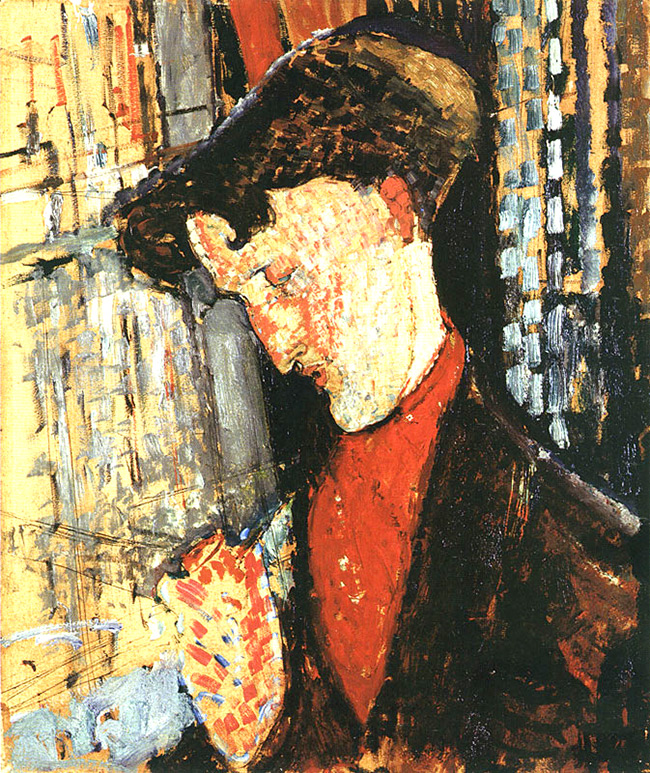
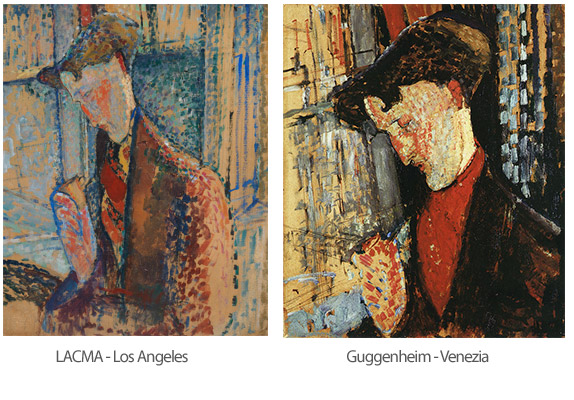
This is the second of Modigliani's two painted portraits of the painter and collector Frank Burty Haviland (1886–1971), and the larger and more resolved of the two. The first, Reverie, in Los Angeles (C43), shows Haviland seated in his studio, head bowed, in front of a window. Here the same pose is seen at closer range. The head fills the upper part of the support, the hand is raised to the chin, and the room is reduced to coloured bands. In a press release of 6 September 1997, announcing the long-term loan of twenty-six works from the Gianni Mattioli Collection to the Peggy Guggenheim Collection in Venice, the museum described the portrait as "among his first painting following a five-year period in wich he dedicated himself to sculpture" (the errors are in the original).
Ceroni treats the two Haviland portraits and the two Rivera portraits (C41, C42) as a group. His note on this work reads: "Come l'opera precedente, è reso con tecnica divisionista-puntinista. Le effigi di Havillard e quelle di Rivera sono uniche per la concezione pittorica nella vicenda di Modigliani" (like the previous work, it is painted with a divisionist-pointillist technique. The portraits of Haviland and those of Rivera are unique in conception in Modigliani's career). This essay asks what is unique in this work, how it differs from the Los Angeles study, and what the sources say about its date, medium and history.
Composition and format
The format is larger than Reverie (62.23 × 49.53 cm, according to LACMA), and the figure is larger within it.
The composition is built on a strong diagonal. The head enters from the upper left and bends down towards the centre; the crown of the head almost touches the top edge. The face is in three-quarter profile, turned down and to the left, the eyes closed or lowered. The hand rises from the lower left, its fingers curled under the chin. A red scarf or tie falls from under the chin to the lower edge, and the dark jacket fills the lower right. The background is divided into three vertical zones: a yellow and grey area at the left, an area of grey and red in the centre behind the head, and a column of white and blue dashes at the right, running from top to bottom.
Compared with Reverie, the composition has been tightened. The window, the chair and the corner of the room have disappeared, or have become bands of colour. The figure no longer sits in a room; it fills the picture. The diagonal is steeper, and the head, larger and more sharply bowed, dominates the whole.
Line
Line plays a smaller role than in Reverie. There is no visible blue contour around the hand, and the profile is defined mainly by the contrast between the pale face and the dark hair and background. A dark line runs along the nose and under the eye, and the mouth is drawn with a short red stroke. The dark outline of the jacket runs diagonally from the shoulder to the lower right, and a thin white line follows the edge of the jacket at the right.
At the lower left, a few thin dark lines are scratched or drawn across the yellow ground, apparently without describing anything. They may be underdrawing, or marks made with the brush handle. A pencil drawing at the Musée d'Art Moderne de la Ville de Paris, which the Secret Modigliani page reproduces as a sketch for this portrait and for Reverie, shows the same bowed head drawn with a long, continuous line. In the painting that line has been absorbed into the colour.
Colour
The colour is dominated by a strong contrast between warm and dark. The face is a pale cream, covered with small orange and red squares; the hair is dark brown, with lighter strokes on the crown. The scarf is a bright vermilion, the most saturated colour in the work. The hand is a pattern of red and orange squares on white, crossed by small blue marks. The jacket is a dark brown-black, with touches of red and green. The background mixes yellow ochre, grey, white and pale blue, with red verticals at the top centre.
The red of the scarf is placed at the centre of the composition and repeated in the hand, the face and the background, and it holds the work together. The complementary contrasts of Reverie (orange against blue, red against green) are less evident here. The palette is warmer and darker, and the effect is more intense. Ceroni's remark about the Rivera in Düsseldorf, "Bellissimo per l'intensità cromatica", could apply equally to this work.
Facture
The work is painted with the same range of techniques as Reverie, but each is pushed further. The face is built of small square touches of orange and red, laid on a pale ground in a regular pattern, like a mosaic. The hand is treated in the same way but with larger squares, so that it reads as a chequerboard. The column at the right is made of short white and blue dashes, laid one under another like stitches. In the background at the left, the paint is dragged in long vertical strokes, and the ground shows through. The hair and jacket are painted broadly, with a loaded brush.
The Secret Modigliani page reproduces a detail of the ear. In the detail, the ear is a small, irregular shape of dark red, set between the pale face and the dark hair, and painted with a few short strokes. The page does not explain the purpose of the detail. It shows that even such a small part of the face is not drawn but built of colour.
The square touches are the most distinctive feature of the work. They are not round dots, as in Neo-Impressionism, but small rectangles, laid in rows. They resemble the tesserae of a mosaic, or the squares of a textile. The result is a face and a hand that look woven rather than modelled. Ceroni's term "divisionista-puntinista" describes the technique, but not quite the effect, which is closer to decoration than to optical mixture.
Figure and space
The space is very shallow. The figure is pressed against the picture plane, and the background bands are flattened behind it. The only depth comes from the contrast between the pale head and the dark area at the right, and from the overlap of the hand and scarf. The figure is both close and remote. It is close because it fills the picture; it is remote because the bowed head and closed eyes turn it away from the viewer.
Compared with Reverie, the work is less descriptive and more concentrated. The bowed head and raised hand, which in Reverie belonged to a man in a room, here become a sign of thought itself. The figure is no longer in an interior; it is an interior.
Iconography and the sitter
The sitter is the same as in Reverie. According to the Musée d'Art Moderne de Céret, Frank Burty Haviland was born in Limoges on 16 October 1886, the son of Charles Haviland of the porcelain family; he settled in Paris in a studio at 70 rue Notre-Dame-des-Champs, moved to Céret in January 1910, and with the sculptor Manolo invited Picasso to Céret in 1911. The Bibliothèque nationale de France describes him as a "Peintre cubiste" who died in Perpignan in November 1971.
The importance of Haviland for Modigliani's return to painting is documented by Adolphe Basler, as quoted by Sotheby's in 2008: "Haviland lui prêta couleurs, pinceaux et toiles" (Haviland lent him colours, brushes and canvases). Basler continues: "Ce fut chez Haviland qu'il vit la plus belle collection de sculptures nègres" (It was at Haviland's that he saw the finest collection of African sculpture), and goes on to describe "L'ovale de la tête, le nez uniforme et géométrisé, transposé des fétiches de l'Afrique noire" (the oval of the head, the uniform, geometricised nose, transposed from the fetishes of black Africa) as the source of the "air très piquant" of Modigliani's portraits. (The terminology belongs to Basler's period.) In this portrait, Haviland's nose is long and straight, and the oval of the head is clearly marked, but the face remains individual. The work stands at the point where Modigliani's observation of a sitter begins to be shaped by the forms he had learned as a sculptor.
Comparisons
The closest comparison is Reverie (C43), discussed above. The two works share the pose, the sitter and, according to Basler and the Modigliani Initiative, probably the place and the materials. The Modigliani Initiative states that "Modigliani painted a second portrait of Burty Haviland, which is also on cardboard (Ceroni 44)". The Secret Modigliani page reproduces the two side by side. The order of the two is not documented, but LACMA's title (Study for the Portrait) and the greater resolution of the Mattioli work suggest that Reverie came first.
The Rivera portraits (C41, C42) offer a second comparison. They share the cardboard support, the mosaic-like touch and the large format. The São Paulo Rivera has the same bare ochre ground; the Düsseldorf Rivera has the same density of colour. The four works form a group, as Ceroni says.
A third comparison is with the portrait of Picasso sold at Sotheby's in Paris in 2008 (oil on cardboard, 43.2 × 26.7 cm, according to the Sotheby's lot details), which had belonged to Haviland. Its catalogue note reproduces this portrait as a comparative figure and quotes Basler on Haviland's studio. The Picasso portrait is smaller and its handling is different, but its provenance shows that Haviland owned works by Modigliani from this period.
Provenance and exhibitions
The Secret Modigliani page gives the following provenance: "Burty Haviland Coll. Paris?"; C. Zamaron Coll. Paris; a sale at the Hôtel Drouot on 20 October 1926; Adolphe Basler Coll. Paris (by 1929); Reinke Coll. Ueberlingen; Marcel Bernheim, Paris (1931); "Italico Brass, Venezia (1949)?"; Gianni Mattioli Coll. Milano; a loan to the Peggy Guggenheim Collection, Venice (until 2017); and "Mattioli Coll. Milano?". The d'Atri papers, as reported on the page, give "Zamaron Coll. > Basler Coll. by 1929 > Reinke Coll. Uberlingen".
The Peggy Guggenheim Collection's press release of 1997 confirms the loan, under the title Portrait of the Painter Frank Haviland (1914), and says that the Mattioli Collection was "formed between 1949 and 1953". The Museum of Modern Art's catalogue of 1951 lists the work as "Frank Burty Haviland. c. 1914", in the Collection Gianni Mattioli, Milan; the dimensions in inches are garbled in the scanned text available to me. The Sotheby's catalogue of 2008 also places it in the Mattioli Collection, "longtemps prêté à la Guggenheim Collection à Venise" (long lent to the Guggenheim Collection in Venice).
The Secret Modigliani page lists many exhibitions, beginning with Bernheim-Jeune, Paris, 1931, no. 1, "dated in 1912", and continuing with Brussels, Amsterdam, Paris and London (1950), Cleveland and New York (1951), Florence (1953), Bern (1955, no. 5), Milan (1958, no. 8), Turin (1959), the American tour of the Mattioli Collection (1967–69), Czechoslovakia (1969, no. 9), Kyoto and Tokyo (1972, no. 70), Liège (1980, no. 11), Martigny (1990, no. 28), London, Royal Academy (2006, no. 5), Bonn (2009, no. 32), Trento and Rovereto (2011) and London, Tate Modern (2017–18). The Secret Modigliani page on the Martigny exhibition confirms no. 28: "Frank Burty-Haviland, 1914, Huile sur carton, C. Mattioli, Milan".
Discrepancies.
- The 1926 sale. The Secret Modigliani page gives a sale at the Hôtel Drouot on 20 October 1926, after C. Zamaron. This is the same date as the sale in which Reverie (C43) was sold as lot 45, according to the Modigliani Initiative, which adds that "The buyer of both Modigliani paintings in the sale, 'M. Bucker,' was the Parisian art gallerist Jeanne Bucher". If this portrait was the other Modigliani in the sale, Jeanne Bucher should appear in its provenance, but she does not on the Secret Modigliani page. Either the second Modigliani in that sale was a different work, or the provenance of this portrait is incomplete.
- Date. 1912 (Bernheim-Jeune 1931), c. 1914 (MoMA 1951), 1914 (Peggy Guggenheim Collection, Martigny), 1915 (Bern 1955), 1915? (d'Atri papers).
- Present location. The Secret Modigliani page gives the loan to Venice as lasting "until 2017" and the present location as "Gianni Mattioli Coll. Milano?". I could not find a source to confirm the end of the loan.
- The Mattioli Collection. The 1997 press release states that the collection was "formed between 1949 and 1953", but also that "By 1943 Mattioli's collection was fully formed". The Secret Modigliani page gives a possible acquisition from Italico Brass in 1949, with a question mark.
Technical analysis
No published technical study of this work could be found or opened. No conservation report, X-ray or infrared image has been published, and the Secret Modigliani page gives none. The disagreement over the support (cardboard, paper or canvas) could easily be resolved by examination of the reverse.
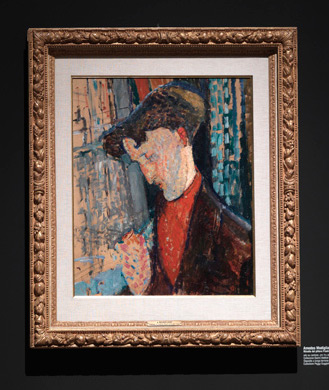
From the reproductions, the following can be said. The ground is a warm yellow, which shows through in the background at the left; it could be the colour of the board, as in Reverie, or a priming. The touches on the face and hand are small, square and sharply defined, which suggests a stiff paint applied with a flat brush. The column of dashes at the right has a raised edge, visible in the reproduction as highlights. The ear detail shows a dark red applied over the pale flesh and the dark hair, which suggests that the ear was painted after both. The image of the work framed at the MART exhibition of 2011, on the Secret Modigliani page, does not add technical information.
Comparative evidence comes from the Tate Papers, no. 35, which notes that in his early career Modigliani "painted on various kinds of support, from cardboard to canvas" and that he "also painted in other artists' studios, using their supplies in addition to or instead of his own". Basler's statement that Haviland lent Modigliani "couleurs, pinceaux et toiles" fits that description, and makes it likely that this work, like Reverie, was painted with Haviland's materials. The Burlington Magazine introduction to the Tate technical study of 2018 limited its analysis of supports to works on strainers, "so excluding those on board", which confirms that the boards of 1914–15 remain unstudied.
Conclusion
The Mattioli portrait is the more finished and the more original of the two Haviland portraits. From the bowed head and raised hand of Reverie, Modigliani made a close, dense image, built of small square touches of colour that make the face and hand look woven. The pose, the shallow space and the strong reds give the work an intensity unusual in his portraits.
The documentation is less secure than for Reverie. Its first owner, its medium, its date and its present location are uncertain, and its provenance raises a question about the Drouot sale of 20 October 1926. The work would repay technical study and a fresh look at its provenance, starting with the auctioneer's archives that the Modigliani Initiative has used for Reverie.
Museum, auction and exhibition sources
- Peggy Guggenheim Collection, press release "Masterpiece from the Gianni Mattioli Collection", 6 September 1997, https://www.guggenheim-venice.it/en/press/press-releases/masterpiece-from-the-gianni-mattioli-collection/
- Sotheby's, Paris, Impressionist and Modern Art, 2008, lot 11, Amedeo Modigliani, Portrait de Picasso, https://www.sothebys.com/en/auctions/ecatalogue/2008/impressionist-and-modern-art-pf8008/lot.11.html
- The Museum of Modern Art, New York, in collaboration with the Cleveland Museum of Art, Modigliani: Paintings, Drawings, Sculpture, introduction by James Thrall Soby (1951), https://assets.moma.org/documents/moma_catalogue_2916_300191634.pdf
- The Modigliani Initiative, Amedeo Modigliani Digital Catalogue, AMDC 28 (Reverie), https://catalogue.modigliani-initiative.org/catalogue/entry.php?id=28
- Los Angeles County Museum of Art, Reverie (Study for the Portrait of Frank Burty Haviland), https://collections.lacma.org/object/9246
- Musée d'Art Moderne de Céret, Frank Burty-Haviland Rétrospective, https://www.musee-ceret.com/evenement/frank-burty-haviland-retrospective/
- Bibliothèque nationale de France, authority file "Burty Haviland, Frank (1886-1971)", https://catalogue.bnf.fr/ark:/12148/cb16198363p
Technical literature (comparative)
- Anaïs Genty-Vincent et al., "Works by Modigliani that have Paintings beneath the Visible Surface", Tate Papers, no. 35, https://www.tate.org.uk/research/tate-papers/35/works-by-modigliani-that-have-paintings-beneath-the-visible-surface (comparative)
- Annette King, Nancy Ireson, Simonetta Fraquelli and Joyce H. Townsend, "The Modigliani Technical Research Study: An introduction to Modigliani's materials and techniques", The Burlington Magazine, vol. 160, no. 1380 (March 2018), https://www.burlington.org.uk/archive/article/the-modigliani-technical-research-study-an-introduction-to-modiglianis-materials-and-techniques (comparative)
Sources that could not be opened
No conservation or technical report on this work was found. The Mattioli Collection has no public online catalogue that I could find, and the end date of the Venice loan could not be verified. The catalogues of the Royal Academy (2006), Bonn (2009), MART (2011) and Tate Modern (2017) exhibitions were not available. The Metropolitan Museum of Art's Modern Art Index Project entry on Haviland (https://doi.org/10.57011/MLMO4009) was blocked by a browser check and timed out.
Cited but not independently consulted
Pfannstiel, Modigliani. L'Art et la Vie, 1929, p. 7; Carrieri, 12 opere di Amedeo Modigliani, 1950, pl. 1; Cahier d'Art (as given), 1950, p. 175; Scheiwiller, Amedeo Modigliani, 1950, pl. 2; Soby, 1951, p. 20; Florence, Palazzo Strozzi, 1953, pl. 12; Marchiori, 1953; Soby, 1954, p. 16; Lipchitz, 1954, pl. 5; Descargues, 1954, pl. 13; Valsecchi, 1955?, pl. 7; Pfannstiel, Modigliani et son œuvre, 1956, no. 34; Russoli, Milan exhibition catalogue, 1958, pl. 8, and Russoli, 1958, pl. 3; Jeanne Modigliani, Modigliani: Man and Myth, 1958, p. 75; Ceroni, Amedeo Modigliani peintre, 1958, no. 34; Roy, 1958, p. 37; Werner, 1968, p. 86; Geza, 1969, no. 9; Ponente, 1969, no. 10; Lanthemann, 1970, no. 47; Ceroni and Piccioni, 1970, no. 44; Arno, 1972, p. 20; Valsecchi, Arte moderna a Milano, 1976, p. 114; Diehl, 1977, p. 23; Mann, 1980, p. 95, no. 60; Lassaigne, 1981, no. 44; Castieau-Barrielle, 1987, p. 109; Tokyo, Orion Press, 1989, no. 7; Martigny, Fondation Pierre Gianadda, 1990, p. 101, no. 28; Parisot, 1991, no. 6/1914; Patani, 1991–94, no. 49; Parisot, 1992, p. 53; Fraquelli and Rosenthal, Modigliani and His Models, 2006, p. 81, no. 5; Soto Caba, 2007; MART, Modigliani scultore, 2011; Ireson and Fraquelli, Modigliani, 2017, p. 105. Page and catalogue numbers are given here without the footnote digits that the page attaches to them (for example "no. 342" is read as no. 34, footnote 2).Footnotes
- Arthur Pfannstiel, Modigliani. L’Art et la Vie, preface by Louis Latourette, Paris, Seheur, 1929 (presumed catalogue).
- Arthur Pfannstiel, Modigliani et son œuvre, étude critique et catalogue raisonné, Paris, Bibliothèque des Arts, 1956.
- Jeanne Modigliani, Modigliani: Man and Myth, New York, Orion Press, 1958.
- Ambrogio Ceroni, Amedeo Modigliani: Peintre; suivi des souvenirs de Lunia Czechowska, Milan, Edizioni del Milione, 1958.
- Joseph Lanthemann, Modigliani, catalogue raisonné: sa vie, son œuvre, son art, Barcelona, G. Condal, 1970.
- Ambrogio Ceroni and Leone Piccioni, I dipinti di Modigliani, Milan, Rizzoli, 1970.
- Carol Mann, Modigliani, London, Thames and Hudson, 1980.
- Thérèse Castieau-Barrielle, La vie et l’œuvre de Amedeo Modigliani, Paris, ACR, 1987.
- Christian Parisot, Catalogue raisonné Modigliani, Livorno, Graphis Arte, 1991.
- Osvaldo Patani, Amedeo Modigliani: catalogo generale, Milan, Leonardo, 1991–94.
- Christian Parisot, Modigliani, Paris, Pierre Terrail, 1992.
- Simonetta Fraquelli et al., Modigliani and His Models, London, Royal Academy of Arts, 2006.
- Victoria Soto Caba, Modigliani: The Timeless Face, Madrid, Libsa, 2007.
- Nancy Ireson and Simonetta Fraquelli, Modigliani, London, Tate Modern / Skira Rizzoli, 2017.