Rêverie
Oil and graphite on cardboard — 1914 ?
Identification
Title- English: Study for the portrait of Frank Burty Haviland; Frank Haviland
Notes: Reverie (Study for the Portrait of Frank Burty Haviland) (Los Angeles County Museum of Art, LACMA; Modigliani Initiative); Studio per il ritratto di Frank Burty Haivallard (Ceroni); Rêverie - Portrait de Monsieur Burty (Los Angeles 1929, according to the Modigliani Initiative); Frank Haviland (étude) (Ceroni 1958, according to the Modigliani Initiative)"
- Date
- 1914 ?
Notes: 1914 (LACMA; Modigliani Initiative); 1914–15 (Pfannstiel 1929 and 1956); c. 1914 (Ceroni 1958); 1915 (d'Atri papers ). - Medium
- Oil and graphite on cardboard
Notes: Oil and graphite on cardboard (LACMA; Modigliani Initiative); oil on paper (Ceroni). - Dimensions
- 62.23 × 49.53 cm
Notes: 62.23 × 49.53 cm (LACMA); 62.2 × 49.4 cm (Others); 61 × 50 cm (Ceroni); 65 × 50 cm (Pfannstiel and d'Atri papers) - Signature
- Unsigned
- Present location
- Los Angeles County Museum of Art, Mr. and Mrs. William Preston Harrison Collection, inv. 27.7.2a.
Catalogue numbers
| Compiler | Number |
|---|---|
| Arthur Pfannstiel | 1956 / no. 35 |
| Joseph Lanthemann | no. 48 |
| Ambrogio Ceroni | 1958 / no. 33 - 1970 / no. 43 |
| Jeanne Modigliani | YES |
| Christian Parisot | 5/1914 |
| Osvaldo Patani | no. 48 |
| Modigliani Project | YES |
| MR | YES |
| Modigliani Initiative/ AMDC | AMDC 28 |
Legal note on MR: This investigation has not had access to MR’s catalogue raisonné; all research here is based on open sources, publications and exhibitions. By no means has that catalogue been copied at any point. Modigliani Project and Modigliani Initiative are marked YES when the work is published or otherwise recorded by those projects, even if no catalogue number is assigned; otherwise the field is marked ?.
Provenance
- Burty Haviland Coll. Paris (1914)
- Galerie J. Bucher, Paris
- Sale Hotel Drouot, 2- 10-1926 - no. 21
- William Preston Harrison Coll. (Los Angeles, 1927, acquired from above)
- Mr. and Mrs. William Preston Harrison Collection Lent to LACMA (27.7.2)
- Los Angeles Museum of History, Science, and Art, as a gift from above (1927)
- Transfer to Los Angeles County Museum of Art (LACMA). Los Angeles, Calif. USA (1961)
The sequence follows the published museum, sale, and catalogue record in this investigation. Gaps and uncertain transfers are marked as such.
Selected bibliography
Book-length publications are marked with a footnote giving a full citation. Exhibition catalogues appear in both this list and the exhibition list when this investigation recorded them in both places.
- Pfannstiel, "catalogue presume" Modigliani. L'Art et la Vie. Preface by Louis Latourette, Seheur, Paris, 1929, p. 7
- Langsner, Jules. "Art news from Los Angeles." ArtNews (New York) 55, no. 3 (May 1956), ill. in b/w, p. 15, as Reverie.
- L.A.C.M. Bulletin of the Art Division, VI, no. 1, 1954 p. 16-17
- Descargues, Modigliani, 1954, pl. 24
- Art News, New York, May 1956, p. 15
- Pfannstiel, Modigliani et son œuvre, étude critique et catalogue raisonné, Bibliothèque des Arts, Paris, 1956 - no. 35
- Jeanne Modigliani, Modigliani: Man and Myth, Orion Press, New York, 1958, p. 753
- Ceroni, Amedeo Modigliani: Peintre; Suivi des Souvenirs de Lunia Czechowska, Edizioni del Milione, 1958 - no. 33
- Werner, Amedeo Modigliani, 1968, p. 86
- Diehl, Modigliani, Ed. Flamarion. 1969, p. 31
- Lanthemann, Modigliani, catalogue raisonné: sa vie, son œuvre, son art, Barcelona, 1970 - no. 48
- Ceroni & Piccioni, I dipinti di Modigliani, Rizzoli, Milano, 1970 - no. 43
- Hubbard, Modigliani and the painters of Montparnasse, Lamplight Publ. New York, 1975, p. 13, pl. 3 (size 61 x 50 cm)
- Guindertael, 1976, pl. III
- Hall, Modigliani, Oxford, 1979 - no. 17
- Musée de Art Moderne de la Ville de Paris, 1981, p. 111
- Tokyo, Modigliani, National Museum of Modern Art, 1985, no. 39
- Roy Modigliani, Paris, 1985, p.39
- Castieau-Barrielle, Modigliani, ACR Editions Paris 1987, p. 1087
- Diehl, Modigliani, Crown Publishers, New York, 1989, p. 33
- Royal Academy of Arts, Italian Art in the 20th Century: painting and Sculpture, 1900-1988, Prestel, London, 1989, p. 135
- Parisot, Catalogue Raisonné Modigliani, Graphis Arte, 1991 - no. 5/1914
- Patani, Catalogo Generale, Leonardo ed. Milano 1991-94 - no. 48
- Schmalenbach, Amedeo Modigliani, Prestel-Verlag, 1991 p. 69 - no. 2110
- Painting I: Materials, Techniques. Musashino University of Art Press, 2001.
- Wayne, Modigliani & the Artists of Montparnasse, Abrams-Albright-knox gallery, 2002, p. 8111
- Soto Caba, Modigliani, the timeless face, Libsa, 2007
Exhibitions
- Los Angeles, Preston Harrison Collection of Modern French Art, Los Angeles County Museum, 1929
- Los Angeles, Preston Harrison Collection, Los Angeles County Museum, 1956
- Chicago, Amedeo Modigliani, The Arts Club, 1959
- Milwaukee, Amedeo Modigliani, Milwaukee Arts center, 1959
- Cincinnati, Amedeo Modigliani, Cincinnati Arts Museum, 1959 - no. 3
- Boston, The arts club, 1961 - no. 3
- Los Angeles, Amedeo Modigliani, LACMA, 1961 - no. 3
- London, Modigliani, Tate Gallery, 1963 - no. 4
- Edinburgh, Modigliani, Royal academy, 1963 - no. 4
- Frankfurt, Steinernes Haas, 1963 - no. 6
- New York, Amedeo Modigliani; loan exhibition, Acquavella Galleries, Inc. 1971 - no. 4
- Tokyo, Modigliani exhibition, Daimaru, 1979, no. 3
- Osaka, Modigliani exhibition, Daimaru, 1979 - no. 3
- Paris, Modigliani, Musée de Art Moderne de la Ville de Paris, 1981 - no. 19
- Tokyo, Modigliani, National Museum of Modern Art, 1985 - no. 39
- London, Italian Art in the 20th Century: painting and Sculpture, 1900-1988, Royal Academy of Arts, 1989 - no. 59
- Munich, Italian Art, 1988, p. 59
- Düsseldorf , Amedeo Modigliani, Art Gallery of Nordrhein-Westfalen 1991 no. 14
- Zurich, Amedeo Modigliani, Kunsthaus , 1991 - no. 14
- Buffalo NY, Modigliani and the artists of Montparnasse, Albright-Knox Gallery, 2002-2003 - no. 4
- Fort Worth, Modigliani and the artists of Montparnasse, Kimbell art Museum, 2003 - no. 4
- Los Angeles, Modigliani and the artists of Montparnasse, Los Angeles County Museum of Art, 2003 - no. 4
Notes
As no. 270 in D’Atri papers - oil on cardboard 65 x 50 cm - unsigned - 1915 - Reference to sale Drouot 20/10/1926
The Los Angeles County Museum of Art (LACMA) confirms Reverie (Study for the Portrait of Frank Burty Haviland) (inv. 27.7.2a), oil and graphite on cardboard, 62.23 × 49.53 cm, 1914, Mr. and Mrs. William Preston Harrison Collection.
Where sources disagree, both readings are given. This is a working research page, not a catalogue raisonné.


Introduction
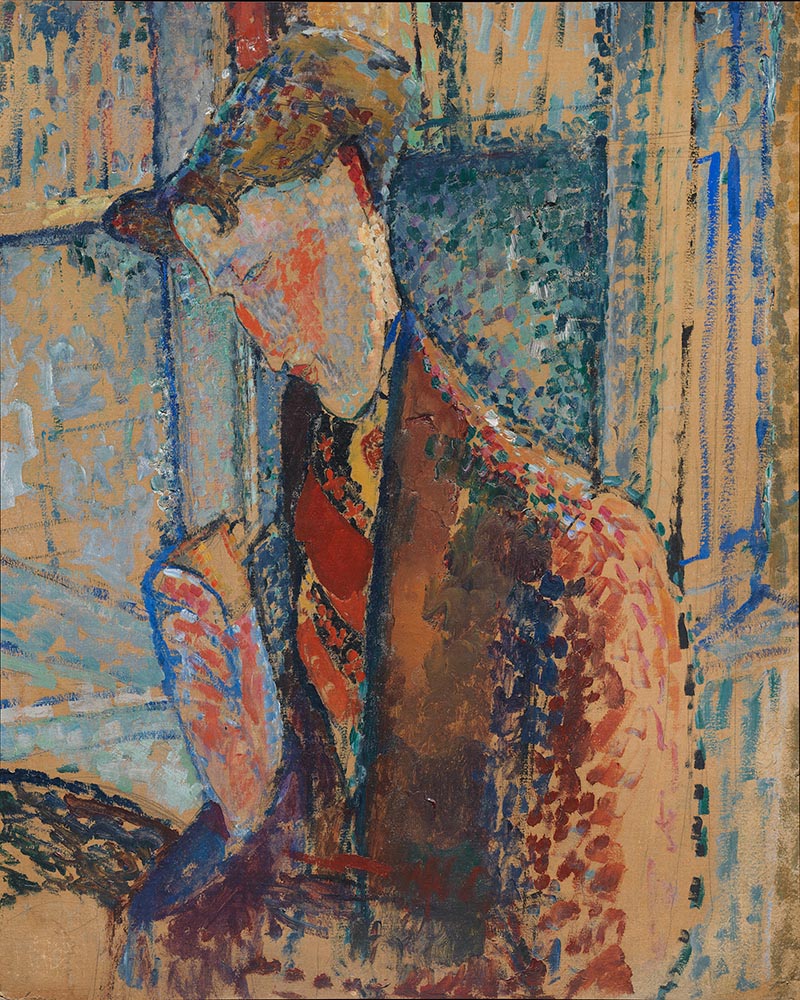
A young man sits in profile, facing left, his head bowed so steeply that his chin almost touches his collar. His right hand is raised to his face, the fingers curled under the chin or against the cheek. His eyes are lowered or closed. His hair, brown with touches of green and orange, is swept back and comes forward in a peak over the forehead. He wears a dark brown jacket over a red waistcoat or tie, and the shoulder that turns towards us is covered with small orange and red dabs. Behind him is a window or glazed door, divided into panes by blue and dark lines, with a pale blue-grey light beyond. A dark teal rectangle, built of tiny dots, frames the back of his head. At the far right, vertical strokes of bright blue and a column of dark dashes run down the edge.
LACMA calls it Reverie, with the subtitle Study for the Portrait of Frank Burty Haviland. The sitter is the painter and collector Frank Burty Haviland (1886–1971). According to the Musée d'Art Moderne de Céret, which organised a retrospective of his work in 2009–10, he was born in Limoges on 16 October 1886, the son of Charles Haviland of the porcelain family, and was "L'artiste américano-français" (the American-French artist) who brought Picasso and Braque to Céret. Ceroni's note, as transcribed by modigliani1909.com, describes him differently: "L'effigiato, inglese, viene ricordato come pittore, poeta e agiato collezionista d'arte. Si veda al n°44" (the sitter, an Englishman, is remembered as a painter, poet and wealthy art collector; see no. 44). "Inglese" is a mistake, but the rest of the description fits.
The Modigliani Initiative's digital catalogue, which assigns the work the number AMDC 28, places it at the start of Modigliani's return to painting: "It was in 1914 in the studio of Frank Burty Haviland (1886–1971) where Modigliani resumed painting after having worked as a sculptor for several years." If that is right, Reverie is one of the first paintings of Modigliani's mature career, made in the place where he began again.
Composition and format
The support measures 62.23 × 49.53 cm, according to LACMA. The proportions, about five to four, are almost the same as those of the São Paulo Rivera (C41). The reproduction on the Secret Modigliani page has a ratio of 0.80, in agreement with the stated dimensions.
The figure is placed diagonally. The head is high, to the left of centre, and bends down and to the left; the raised hand and forearm make a second diagonal at the lower left; the back and shoulder form a large rounded mass at the lower right. The axis of the figure therefore runs from the upper left to the lower right, and the bowed head is the point where the movement turns. This gives the composition a sense of falling, or of sinking into thought, which the title Reverie describes well.
The background is organised by verticals and horizontals. At the left, the window bars and the edge of the curtain make a frame within the frame. In the centre, the dark teal rectangle behind the head sets it off as a panel. At the right, the blue verticals close the composition. At the lower left there is a dark curved form, made of black and green hatching, which may be the back of a cane chair or a basket.
Line
Line is important but not dominant. The profile is drawn with a thin dark line from the forehead to the chin, which flattens the head against the background. The fingers and wrist are outlined in blue. Long blue lines run down the window frame and along the edge of the body. LACMA's description of the medium as "Oil and graphite on cardboard" means that there is also pencil, presumably as underdrawing. In the reproduction, faint pencil lines are visible in the background at the right and in the lower area, where the paint is thin.
A pencil drawing of Haviland's head, bowed in the same way, is in the collection of the Musée d'Art Moderne de la Ville de Paris, according to the Secret Modigliani page, and a drawing of Haviland in black crayon from the same museum was shown at Martigny in 1990 as no. 27 ("Frank Burty-Haviland, Crayon noir sur papier"), according to the Secret Modigliani page on that exhibition. The drawing, shows a very long head with a hooked nose and a pointed chin, drawn in quick, repeated lines. The painting is less caricatural, but keeps the bowed pose and the long profile.
Colour
The colour is bright and varied. Ochre is again present as the colour of the board, which shows through in many places, especially at the right and at the bottom. Over it, the background is painted in pale blues, greys and greens. The dark teal panel behind the head is built of small dots of blue-green and black. The face is pale, with touches of orange and pink on the cheek and green in the shadows. The jacket is brown and dark blue, the waistcoat red, and the shoulder is spotted with orange, red and pink. Strong blue accents mark the hand, the window and the right edge.
The use of complementary colours is more deliberate than in the Rivera portraits. Orange is set against blue in the hand and the shoulder, red against green in the waistcoat and the background. This is closer to the practice of the Neo-Impressionists, and it is the reason why Ceroni, in the note on the companion work (C44), says that both are painted "con tecnica divisionista-puntinista".
Facture
The paint is applied in several ways at once. In the teal panel and in the background at the left, it is laid in small round dots, close together. On the shoulder and in the hair, the dabs are larger, elongated and set in rows that follow the form. In the jacket and the lower part of the figure, the paint is thin and broad, with long strokes. At the right, the blue verticals are laid with a loaded brush in single strokes. Much of the board is left bare.
This mixture of techniques gives the work the look of an experiment. The dots are not used everywhere, and they are not used systematically, as Seurat would have done. They are one tool among several, chosen for particular areas. The contrast between dotted, dabbed and broad passages makes the surface vibrate, and the bare ochre board ties all of them together.
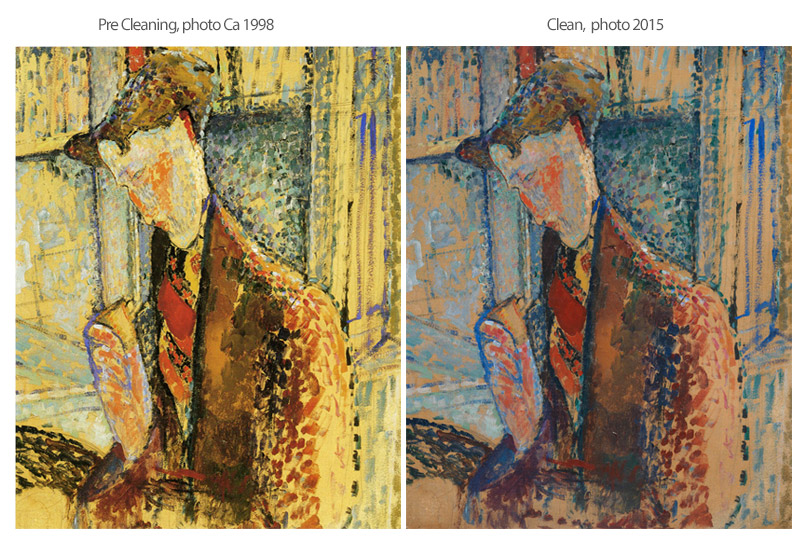
The Secret Modigliani page reproduces two images side by side, labelled "Pre Cleaning, photo Ca 1998" and "Clean, photo 2015". The earlier image is much yellower, the later one cooler and bluer. The labels imply that the work was cleaned between 1998 and 2015.
The difference between the two images could also be due, at least partly, to photography and colour reproduction. The more recent colours, which are also those of the LACMA photograph, should be taken as closer to the present state of the work.
Figure and space
Haviland is shown in a real interior, which is rare in Modigliani's portraits. The window behind him, with its panes and light, places him in a studio or a room on an upper floor. The Modigliani Initiative identifies the place: "Creation location: Paris, Burty Haviland studio: 3, rue Victor Schœlcher". The Sotheby's catalogue of 2008, quoting Adolphe Basler, says that Haviland lived "à côté de chez Picasso, rue Schoelcher" (next door to Picasso, in rue Schoelcher).
The figure is close to the picture plane and slightly cut by the lower edge. The space behind is shallow but clearly defined by the window. The bowed head and raised hand turn the sitter away from the viewer. He is absorbed in thought, and the viewer becomes a witness rather than an interlocutor. That inward quality, which the title Reverie names, is the most modern aspect of the work, and it anticipates the inward gaze of many later portraits by Modigliani.
Iconography and the sitter
Haviland was not only a sitter but a patron and, according to Basler, a supplier. The Modigliani Initiative paraphrases him: "According to Adolphe Basler (1878–1951), the Polish-born art critic, Burty Haviland loaned Modigliani the necessary supplies". Sotheby's quotes Basler's text in French, giving the reference as Basler, Modigliani, Paris, 1931, pp. 10–11: "Il alla chez Frank-Burty Haviland, peintre et collectionneur qui habitait à côté de chez Picasso, rue Schoelcher. Haviland lui prêta couleurs, pinceaux et toiles. Modigliani cherchait à transposer en peinture ce qu'il avait acquis comme sculpteur." (He went to Frank Burty Haviland, painter and collector, who lived next door to Picasso, rue Schoelcher. Haviland lent him colours, brushes and canvases. Modigliani was trying to transpose into painting what he had acquired as a sculptor.) The Modigliani Initiative cites Basler's article in Le Crapouillot of August 1927 for the same information.
Basler also says, in the passage quoted by Sotheby's, that it was "chez Haviland qu'il vit la plus belle collection de sculptures nègres" (at Haviland's that he saw the finest collection of African sculpture). The Modigliani Initiative confirms that Haviland "had an exceptional collection of African art". (The French term in Basler's text belongs to its period.) Basler then describes Modigliani's move towards "un type de formes aux lignes allongées, aux proportions exagérées avec goût" (a type of form with elongated lines, with proportions exaggerated with taste). In Reverie, that development has not yet happened. Haviland's head is long, but it is a natural head, observed from life, in a real room.
A further point is made by the Modigliani Initiative: the work "has a figure study by Burty Haviland on the reverse". The cardboard was therefore Haviland's own, used by him before or after Modigliani. This fits Basler's account and confirms that the portrait was made in Haviland's studio with his materials. I have not seen a reproduction of the reverse.
Comparisons
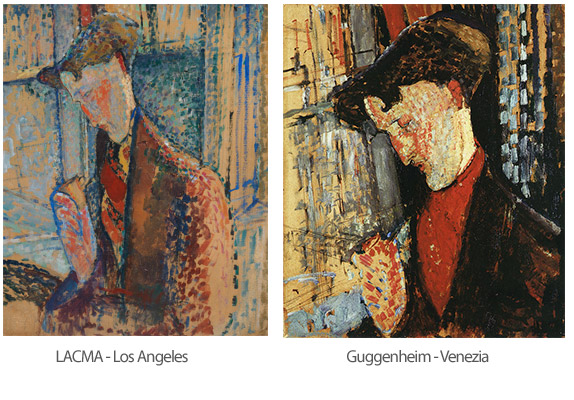
The companion work is the Mattioli portrait (C44), which shows Haviland in the same pose but closer, larger and painted more densely. In C44 the head fills more of the support, the hand is a pattern of red and white squares, and the background is reduced to vertical bands. Reverie is more spacious and more descriptive. LACMA's title, Study for the Portrait, suggests that it came first. The Modigliani Initiative, for its part, calls C44 "a second portrait of Burty Haviland, which is also on cardboard".
The Rivera portraits (C41, C42) are the other works in the group. With the São Paulo Rivera, Reverie shares the bare ochre board and the halo of small dabs; with the Düsseldorf Rivera, the crowded studio background. All four are on cardboard of similar format. Ceroni's remark that "Le effigi di Havillard e quelle di Rivera sono uniche per la concezione pittorica nella vicenda di Modigliani" holds for all of them.
Finally, the pencil drawing in Paris (Martigny 1990, no. 27) shows that the pose was studied on paper as well, and the 1981 exhibition at the Musée d'Art Moderne de la Ville de Paris, according to the Secret Modigliani page on that exhibition, showed the drawing (no. 140) and this painting (no. 19, "Study for Frank Burty-Haviland 1914").
Provenance and exhibitions
LACMA gives: "The artist (1884-1920); sold 1914 to Frank Burty Haviland; [sold in 1926 at Hôtel Drouot, Paris October 19, 1926, lot 45]; [to Galerie Jeanne Bucher]; sold in 1927 to Ada and William Preston Harrison; Estate of Ada and William Preston Harrison; given in 1927 to Los Angeles Museum of History, Science, and Art; transferred in 1961 to LACMA."
The Modigliani Initiative adds a step and changes the date: Frank Burty Haviland (1914); Jacques Darnetal, Paris (by 1926), identified as Jacques Bernheim (1900–1938), son of the dealer Georges Bernheim; the Hôtel Drouot sale of "October 20, 1926, lot 45", with a reference to the auctioneer's archives at the Institut national d'histoire de l'art; Galerie Jeanne Bucher (20 October 1926); Ada and William Preston Harrison (1927); and LACMA. It notes that "The buyer of both Modigliani paintings in the sale, 'M. Bucker,' was the Parisian art gallerist Jeanne Bucher".
The Secret Modigliani page gives: Burty Haviland (1914); Galerie J. Bucher; a sale at the Hôtel Drouot on "2- 10-1926 - no. 21"; William Preston Harrison (1927); a loan to LACMA; and a transfer in 1961. It also reports that the d'Atri papers refer to a "sale Drouot 20/10/1926".
The Modigliani Initiative lists two early exhibitions: Los Angeles, January 1929, no. 82, as "Rêverie - Portrait de Monsieur Burty", and Los Angeles, May 1956. The Secret Modigliani page adds, among others, Chicago, Milwaukee and Cincinnati (1959), Boston and Los Angeles (1961), London, Edinburgh and Frankfurt (1963), New York, Acquavella (1971), Tokyo and Osaka (1979), Paris (1981, no. 19), Tokyo (1985), London, Royal Academy (1989), Düsseldorf and Zurich (1991) and Buffalo, Fort Worth and Los Angeles (2002–03).
Discrepancies.
- Sale date and lot. LACMA gives 19 October 1926, lot 45; the Modigliani Initiative gives 20 October 1926, lot 45, citing the auctioneer's archives; the d'Atri papers, give 20 October 1926; the Secret Modigliani page gives "2-10-1926", no. 21. The 20 October date, supported by the archive, is the most likely.
- Seller. The Modigliani Initiative names Jacques Darnetal as the owner by 1926; LACMA and the Secret Modigliani page go directly from Haviland to the sale.
- Sequence. The Secret Modigliani page puts Galerie Bucher before the sale; LACMA and the Modigliani Initiative put the gallery after it, as the buyer.
- Nationality of the sitter. Ceroni calls Haviland "inglese"; the Céret museum calls him "américano-français", and the Bibliothèque nationale de France gives his country as France.
Technical analysis
No published technical study of this work could be found or opened. LACMA lists among its bibliography Painting I: Materials, Techniques (Musashino University of Art Press, 2001), which may discuss it; I could not consult it. LACMA's identification of graphite in the medium and the Modigliani Initiative's note of a figure study by Haviland on the reverse are the only technical observations available.
From the reproduction, several things can be said. The support is a warm ochre cardboard, left bare in many areas. The graphite underdrawing is visible in places. The paint is laid in at least three ways: dotted, dabbed and broad. The edges of the dots are sharp, which suggests a fairly stiff paint on a surface that did not absorb it quickly. The pre- and post-cleaning images on the Secret Modigliani page suggest that a yellowed varnish or surface layer may have been removed, but this is not confirmed by any published report.
Comparative evidence comes from the Tate Papers, no. 35, study of Modigliani's hidden paintings, which notes that he "also painted in other artists' studios, using their supplies in addition to or instead of his own". The Reverie, painted on Haviland's board in Haviland's studio, according to the Modigliani Initiative and Basler, is a clear example. The same study states that early in his career Modigliani worked on "various kinds of support, from cardboard to canvas".
The 2018 Burlington Magazine introduction to the Tate technical study excluded works "on board" from its analysis of canvas sizes, which confirms that the cardboard paintings of 1914–15 have not yet been studied systematically.
Examination of the reverse, with Haviland's figure study, would be particularly useful. It might show the brand or type of the board and help to establish whether Haviland or Modigliani used it first.
Conclusion
Reverie is a portrait of a friend at home, painted on the friend's own board, with the friend's colours, in the friend's studio. It shows Modigliani, at the moment of his return to painting in 1914, trying several techniques at once: graphite underdrawing, divisionist dots, larger dabs and broad strokes, all on bare ochre board. Its subject is not only Haviland's likeness but his mood. The bowed head, the hand to the face and the window light make it a picture of thought.
The documentation is unusually good. LACMA and the Modigliani Initiative give a provenance from 1914 to the present, and the Initiative's use of the auctioneer's archives corrects the sale date. The remaining discrepancies concern details: one day in the sale date, a lot number, a possible intermediary owner, and Ceroni's description of Haviland as English. The work deserves a technical study, which would also tell us about the figure study on its reverse.
Museum, auction and exhibition sources
- Los Angeles County Museum of Art, Reverie (Study for the Portrait of Frank Burty Haviland), 1914, inv. 27.7.2a, https://collections.lacma.org/object/9246
- The Modigliani Initiative, Amedeo Modigliani Digital Catalogue, "Reverie (Study for the Portrait of Frank Burty Haviland), 1914 (AMDC 28)", https://catalogue.modigliani-initiative.org/catalogue/entry.php?id=28 (accessed 26 October 2026)
- Sotheby's, Paris, Impressionist and Modern Art, 2008, lot 11, Amedeo Modigliani, Portrait de Picasso (catalogue note quoting Adolphe Basler), https://www.sothebys.com/en/auctions/ecatalogue/2008/impressionist-and-modern-art-pf8008/lot.11.html
- Musée d'Art Moderne de Céret, Frank Burty-Haviland Rétrospective (4 December 2009 – 28 May 2010), https://www.musee-ceret.com/evenement/frank-burty-haviland-retrospective/
- Bibliothèque nationale de France, authority file "Burty Haviland, Frank (1886-1971)", https://catalogue.bnf.fr/ark:/12148/cb16198363p
Technical literature (comparative)
- Anaïs Genty-Vincent et al., "Works by Modigliani that have Paintings beneath the Visible Surface", Tate Papers, no. 35, https://www.tate.org.uk/research/tate-papers/35/works-by-modigliani-that-have-paintings-beneath-the-visible-surface (comparative)
- Annette King, Nancy Ireson, Simonetta Fraquelli and Joyce H. Townsend, "The Modigliani Technical Research Study: An introduction to Modigliani's materials and techniques", The Burlington Magazine, vol. 160, no. 1380 (March 2018), https://www.burlington.org.uk/archive/article/the-modigliani-technical-research-study-an-introduction-to-modiglianis-materials-and-techniques (comparative)
Sources that could not be opened
The Metropolitan Museum of Art's Modern Art Index Project entry on Frank Burty Haviland by Anna Jozefacka (https://doi.org/10.57011/MLMO4009), cited by the Modigliani Initiative, was blocked by a browser check and timed out. Painting I: Materials, Techniques (Musashino University of Art Press, 2001) was not available. No image of the reverse was found.
Cited but not independently consulted
Pfannstiel, Modigliani. L'Art et la Vie, 1929, p. 7; Langsner, ArtNews, May 1956, p. 15; Los Angeles County Museum Bulletin of the Art Division, VI, no. 1, 1954, pp. 16–17; Descargues, 1954, pl. 24; Pfannstiel, Modigliani et son œuvre, 1956, no. 35; Jeanne Modigliani, Modigliani: Man and Myth, 1958, p. 75 (given on the page as "p. 753", read as p. 75 with footnote 3); Ceroni, Amedeo Modigliani peintre, 1958, no. 33; Werner, 1968, p. 86; Diehl, 1969, p. 31, and 1989, p. 33; Lanthemann, 1970, no. 48; Ceroni and Piccioni, 1970, no. 43; Hubbard, 1975, p. 13, pl. 3; Guindertael, 1976, pl. III; Hall, 1979, no. 17; Musée d'Art Moderne de la Ville de Paris, 1981, p. 111; Tokyo, 1985, no. 39; Roy, 1985, p. 39; Castieau-Barrielle, 1987, p. 108 (given as "p. 1087", read as p. 108 with footnote 7); Royal Academy of Arts, Italian Art in the 20th Century, 1989, p. 135; Parisot, 1991, no. 5/1914; Patani, 1991–94, no. 48; Schmalenbach, 1991, p. 69; the catalogues of the exhibitions listed above.Footnotes
- Arthur Pfannstiel, Modigliani. L’Art et la Vie, preface by Louis Latourette, Paris, Seheur, 1929 (presumed catalogue).
- Arthur Pfannstiel, Modigliani et son œuvre, étude critique et catalogue raisonné, Paris, Bibliothèque des Arts, 1956.
- Jeanne Modigliani, Modigliani: Man and Myth, New York, Orion Press, 1958.
- Ambrogio Ceroni, Amedeo Modigliani: Peintre; suivi des souvenirs de Lunia Czechowska, Milan, Edizioni del Milione, 1958.
- Joseph Lanthemann, Modigliani, catalogue raisonné: sa vie, son œuvre, son art, Barcelona, G. Condal, 1970.
- Ambrogio Ceroni and Leone Piccioni, I dipinti di Modigliani, Milan, Rizzoli, 1970.
- Thérèse Castieau-Barrielle, La vie et l’œuvre de Amedeo Modigliani, Paris, ACR, 1987.
- Christian Parisot, Catalogue raisonné Modigliani, Livorno, Graphis Arte, 1991.
- Osvaldo Patani, Amedeo Modigliani: catalogo generale, Milan, Leonardo, 1991–94.
- Werner Schmalenbach, Amedeo Modigliani, Munich, Prestel, 1990.
- Kenneth Wayne, Modigliani and the Artists of Montparnasse, New York, Abrams / Albright-Knox Art Gallery, 2002.
- Victoria Soto Caba, Modigliani: The Timeless Face, Madrid, Libsa, 2007.