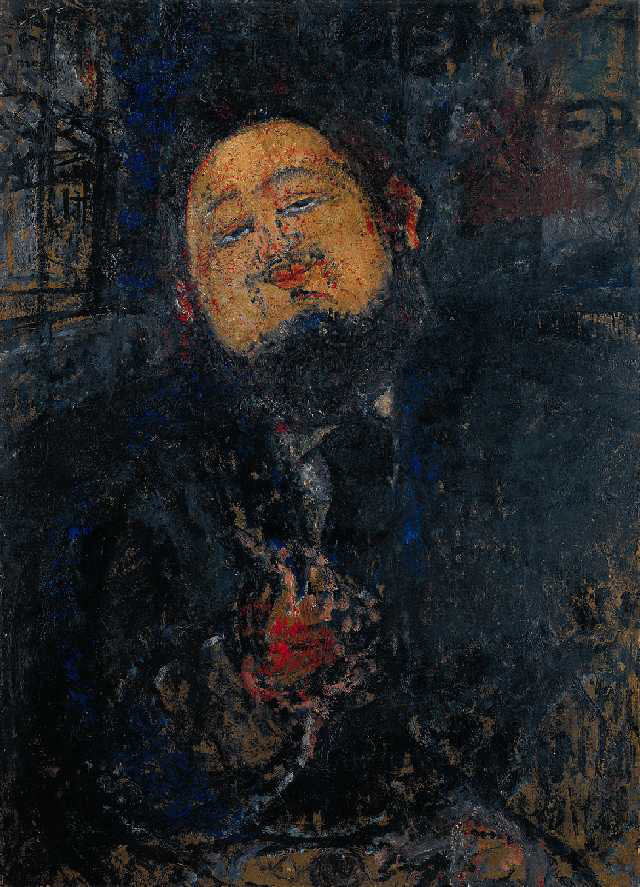
Portrait of Diego Rivera
Oil on cardboard — 1914 ?
Identification
- Title
- English: Diego Rivera portrait.
Notes: Ritratto di Diego Rivera (Ceroni); Portrait de Diego Rivera (Kunstsammlung Nordrhein-Westfalen online collection); Bildnis Diego Rivera / Portrait of Diego Rivera (Kunstsammlung Nordrhein-Westfalen website); Diego Rivera, peintre mexicain (d'Atri papers). - Date
- 1914 ?
Notes:1914 (Kunstsammlung Nordrhein-Westfalen; Ceroni); 1916 (dated by Diego Rivera in 1916); 1914–15 (d'Atri papers). - Medium
- Oil on cardboard.
Notes: Ceroni (oil on canvas). - Dimensions
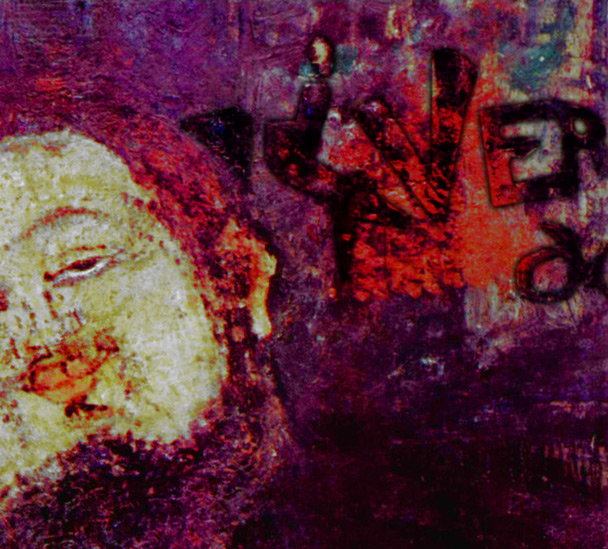
- 104 x 75.2 cm - (probably the piece was bigger since the text RIV is missing the ERA and the rest of the letter of the name of the sitter?)
Notes: 104 × 75.2 × 3.2 cm; frame 124.5 × 95.3 × 7.3 cm (Kunstsammlung Nordrhein-Westfalen); 104 × 75 cm (museum website); 100 × 81 cm (Ceroni); 103 × 75 cm (d'Atri papers) - Signature
- Signed "modigliani" and "SAVOIR" upper left (Kunstsammlung Nordrhein-Westfalen: "Bez. o.l."); also reads the letters "RIVER / die" upper right
- Present location
- Kunstsammlung Nordrhein-Westfalen, Düsseldorf (K20), inv. 0231, acquired 1985–86
Catalogue numbers
| Compiler | Number |
|---|---|
| Arthur Pfannstiel | 1956 / no. 29 |
| Joseph Lanthemann | no. 49 |
| Ambrogio Ceroni | no. 42 |
| Jeanne Modigliani | YES |
| Christian Parisot | 4/1914 |
| Osvaldo Patani | no. 47 |
| Modigliani Project | YES |
| MR | no. RP 50 Data not contrasted, source: Kunstsammlung Nordrhein-Westfalen, web page |
| Modigliani Initiative/ AMDC | ? |
Legal note on MR: This investigation has not had access to MR’s catalogue raisonné; all research here is based on open sources, publications and exhibitions. By no means has that catalogue been copied at any point. Modigliani Project and Modigliani Initiative are marked YES when the work is published or otherwise recorded by those projects, even if no catalogue number is assigned; otherwise the field is marked ?.
Provenance
- Jonas Netter, Paris, at least 1929 to1934
- Mme Wiberg, Stockholm
- Ildefonso Aguilar Vazquez, Mexico
- Private Collection, France
- Galerie Beyeler, Basel, 1978 - 1985
- Actual: Art Gallery of Nordrhein-Westfalen, Düsseldorf (1985/6?)
Note: Pfannstiel files this work have the next provenance: Netter > Gallery Pierre > van der Klip
The sequence follows the published museum, sale, and catalogue record in this investigation. Gaps and uncertain transfers are marked as such.
Selected bibliography
Book-length publications are marked with a footnote giving a full citation. Exhibition catalogues appear in both this list and the exhibition list when this investigation recorded them in both places.
- L. Lehel, Notre kind Dement, Paris, 1926, no. 44
- Pfannstiel, "catalogue presume" Modigliani. L'Art et la Vie. Preface by Louis Latourette, Seheur, Paris, 1929, p. 61
- German art and decoration, Darmstadt, Jan. 1931, p. 228
- Scheiwiller, Arte Moderna Italiana no. 8 Amedeo Modigliani, U. Hoepli Ed. Milan, 1950, pl. 3
- Jedlicka, Modigliani, E. Rentsch, Zürich, 1953, pl. 8
- Pfannstiel, Modigliani et son œuvre, étude critique et catalogue raisonné, Bibliothèque des Arts, Paris, 1956 - no. 292
- Ceroni, Amedeo Modigliani: Peintre; Suivi des Souvenirs de Lunia Czechowska, Edizioni del Milione, 1958 - no. 313
- Jeanne Modigliani, Modigliani senza leggenda, Florence, 1958, fig. 30
- Modigliani J., Modigliani sans légende, Gruend, Paris, 1961, fig. 304
- Lanthemann, Modigliani, catalogue raisonné: sa vie, son œuvre, son art, G. Condal, Barcelona, 1970 - no. 495
- Ceroni & Piccioni, I dipinti di Modigliani, Rizzoli, Milano, 1970 - no. 426
- Dalevèze, Modigliani, Lausanne 1971, pl. 13
- Mann, Modigliani, London 1980, p.997
- Hall, Modigliani, Oxford, 1984, pl.16
- Schmalenbach, images of the 20th Century. The Art Collection North Rhine-Westphalia, Düsseldorf, Munich 1986, p. 28-30, no. 98
- Thérèse Castieau-Barrielle, La vie et l'œuvre de Amedeo Modigliani, Paris 1987, p. 112, 132-1349
- Supplément, Supplement to: Gazette des Beaux-Arts, no. 1418, March 1987, p 14
- Haufe, Rivera, La historia y los mitos in: Goya, no. 207, p. 150-155, Madrid, 1988, p. 150
- Palazzo Grassi, Italian Art 1900-1945, Venice, 1989
- Celant /Gianelli, Memoria del Futuro, Arte Italiano desde las primeras vanguardias a la posguerra, 1990, p.130
- Rose, Modigliani - The pure bohemian, London 1990, p 114, Fig p.115
- Schmalenbach, Amedeo Modigliani, Prestel, Munich, 1990, p. 67 - no. 198
- Parisot, Catalogue Raisonné Modigliani, Graphis Arte, 1991 - no. 4/1914
- Patani, Catalogo Generale, Leonardo, Milano, 1991-94 - no. 4711
- Fukaya, Amedeo Modigliani, Tokyo 1992, p. 37
- Kruszynski, Amedeo Modigliani, Dortmund 1992, p. 19
- Butler, Modigliani, London 1994, p 56, col. p. 57
- Kruszynski, Amedeo Modigliani. Nudes and portraits, Munich 1996, p. 29-32, col. p. 28
- Schmalenbach, the desire for the image. A life with art, Berlin 1996, p. 40-538
- Amedeo Modigliani. Retratista del alma, in: Saber Ver, 16, Oct. / Nov. 1998, no. 25, p. 22
- Face to Face to Cyberspace, Fondation Beyeler, Riehen 1999, p. 12, Catalog no. 60
- The 20th Century in the art collection of North Rhine-Westphalia, Dusseldorf, ed. of the art collection of North Rhine-Westphalia, Düsseldorf,
- Ostfildern-Ruit 2000, p. 598f., Col. p. 45
- Schmalenbach, Modigliani, Complesso del Vittoriano, Rome 2006, p. 43-63, col. p. 508
- K. Wayne, Modigliani, en la decada de 1920, in: y su tiempo Modigliani, Exh. Museo Thyssen Bornemisza, Madrid 2008, Cat no. 49 with col. S. 9512
- Le Clézio, Modigliani and the mystery, in: Amedeo Modigliani - A
- Myth of modernity, ed. Christoph Vitali, book published at the Modigliani exhibition, Art and Exhibition Hall of the Federal Republic Germany, Bonn, Cologne, 2009, p. 115, Cat no. 30 with col. p. 94
- Soto Caba, Modigliani, The timeless face, Libsa, 2007
- Bonn, Amedeo Modigliani - A myth of modernity, ed. Christoph Vitali, book published on the occasion of the exhibition Modigliani, Art and Exhibition Hall the Federal Republic of Germany, Bonn 2009, no. 30 with col. p. 94
- Ireson, Fraquelli, Modigliani, London, Tate Modern, Skira Rizzoli, London, 2017, p. 10414
Exhibitions
- Venezia, Mostra retrospettiva di Modigliani – Curated by Lionello Venturi - Biennale di Venezia , Sala XII degli Appels d'Italie, 1930 - no. 15
- Brussels, Modigliani, Palais des Beaux-Arts, Brussels - no. 17
- Basel, Modigliani, Kunsthalle, 1934 - no. 9
- Paris, Amedeo Modigliani, Musée d'Art Moderne de la Ville de Paris, 1981 - no. 16
- Basel, Et Portrait Figures, Galerie Beyeler, 1982, col. p. 21 - no. 72
- Düsseldorf , Amedeo Modigliani, Art Gallery of Nordrhein-Westfalen 1991 - no. 13
- Zurich, Amedeo Modigliani, Kunsthaus , 1991 - no. 13
- Riehen, Face to Face to Cyberspace, Fondation Beyeler, 1999, no. 60
- Düsseldorf, Our 20th Century - Masterpieces from Picasso to Beuys' art collection North Rhine-Westphalia, 2000
- Century City. Art and Culture in the Modern Metropolis, ed. Iwona Blazwick
- London, Tate Modern,2001, p 287
- Lille , Mexique Europe. Allers - Retours. 1910 - 1960, Musée d'art moderne Lille Métropole, 2004, col. p. 32 - no. 24
- Madrid, Modigliani y su tiempo, Museo Nacional Thyssen Bornemisza, 2008
- Bonn, Amedeo Modigliani: Ein Mythos der Moderne, Bundesrepublik, 2009 - no. 30
- North Rhine-Westphalia Art Collection Catalogue p. 2 .2012
- London, Modigliani, Tate Modern, 2017-2018
Notes
As no. 17 in D’Atri papers dated 1914-15 - titled Diego Rivera, peintre mexicain, size 103 x 75 - Provenance in Netter 1933
There is a file at the MASP archive by the hand of Diego Rivera in the same page in machine the secretary of Rivera informs that there are 3 other portraits of Diego by Modigliani
1.- J. Netter Coll, Paris
2.- Galerie Pierre, Paris
3.- Van de Klip collection, Brussels
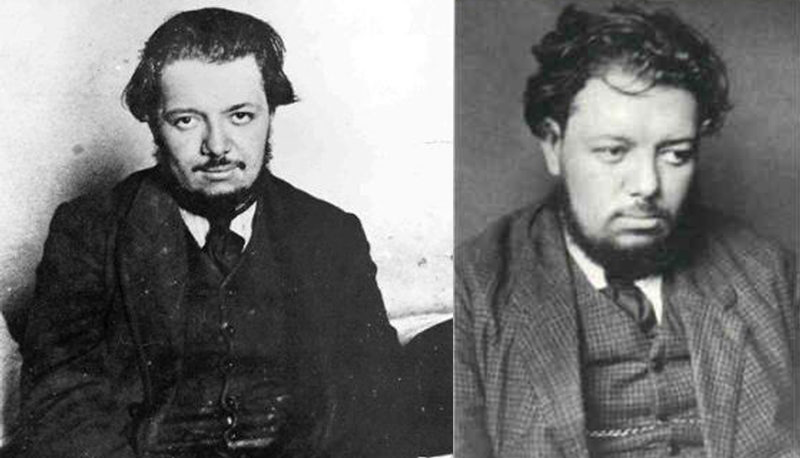
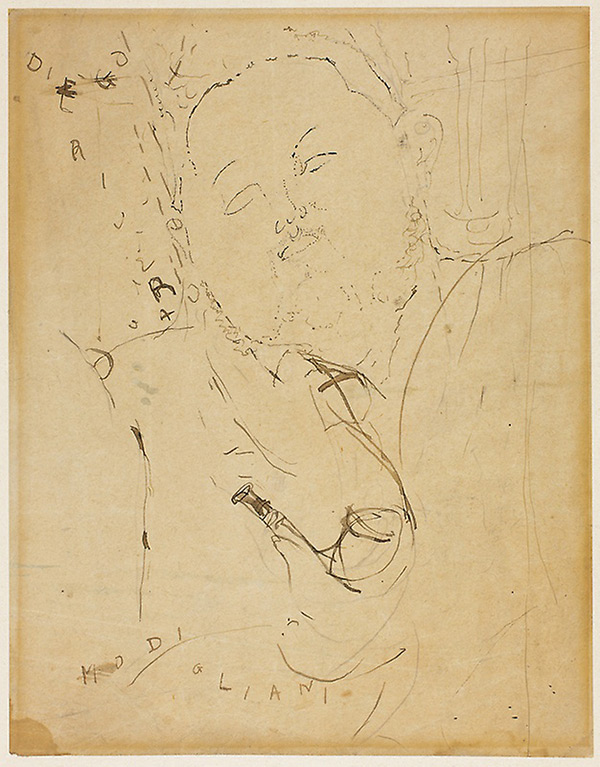
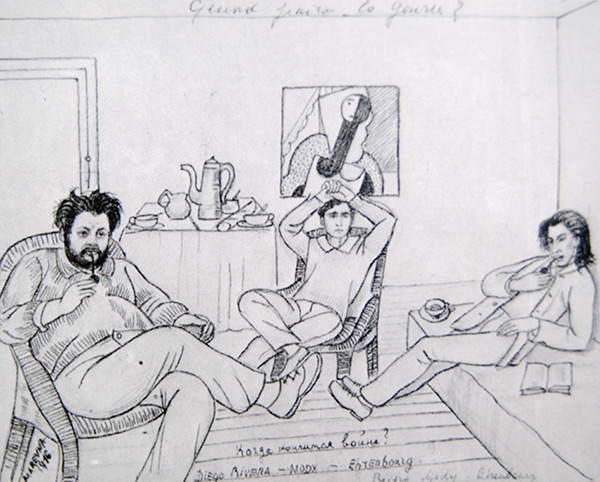
Photos of Diego Rivera from 1916 and 1919:
The Kunstsammlung Nordrhein-Westfalen, Düsseldorf, confirms Portrait of Diego Rivera (inv. 0231), oil on cardboard, 104 × 75 cm, dated 1914, acquired in 1986.
Where sources disagree, both readings are given. This is a working research page, not a catalogue raisonné.
Introduction
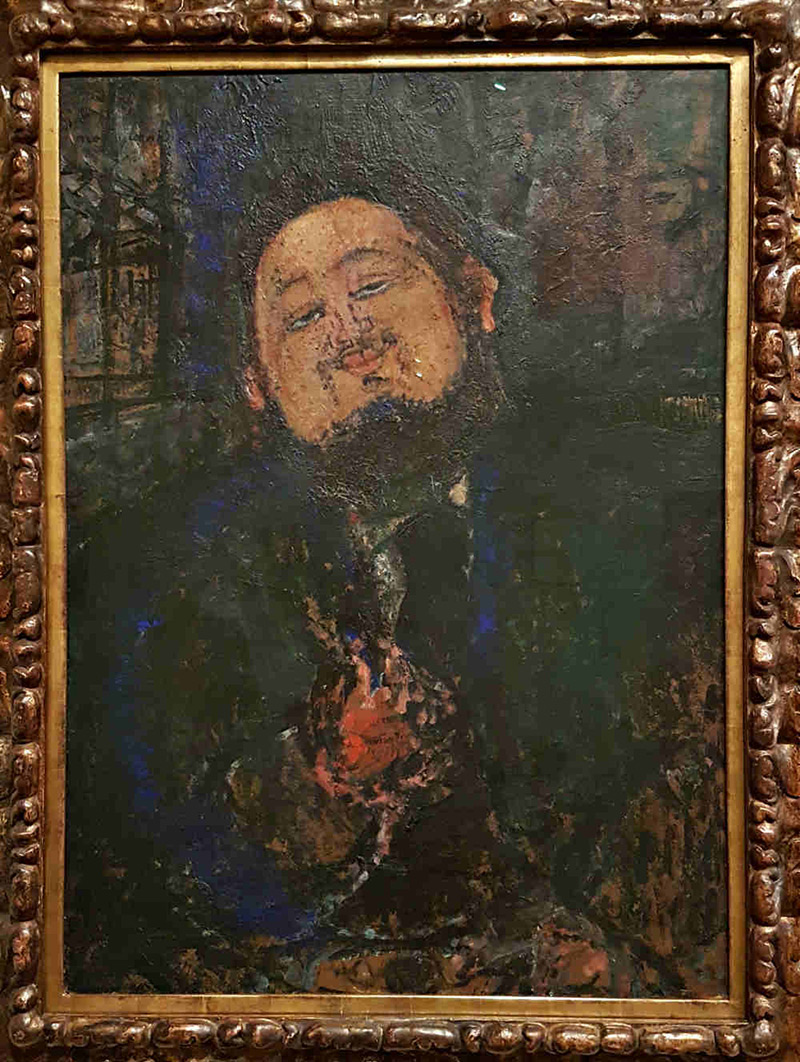
Diego Rivera's large, round head leans to the left and slightly back, as if he were settling into a chair. His eyes are almost closed, two pale slits under heavy lids. His lips, painted red, are pushed forward in something between a smile and a pout. A short dark beard runs into a black mass of hair, collar and coat. Below, the body is a huge dark form, blue-black, from which a few details emerge: a white collar, a grey-blue patch of shirt and, at the centre, a cluster of red that may be a hand, a pipe or a tie. The background is just as dark, but it is full of things. At the upper left there is a grid of ochre and black lines, like a window or a stack of frames. At the upper right letters appear in the paint, and among them a second, ghostly face.
This is the painting that Ceroni, called "Bellissimo per l'intensità cromatica. Si veda il n°41" (very beautiful for its chromatic intensity; see no. 41). It is the companion of the São Paulo portrait (C41), but it is finished, densely painted and much darker.
The Kunstsammlung Nordrhein-Westfalen, which has owned it since the opening of its new building in 1986, describes how Modigliani depicts Rivera's "voluminous body and round head ... in an open painting style marked by a subtle distribution of dabs of color". This essay examines that "open" style, the inscriptions, and the complicated history of the work, which the museum itself is now investigating.
Composition and format
The cardboard measures 104 × 75.2 cm, according to the museum's online collection. That makes it taller and narrower than the São Paulo version (about 100.5 × 81 cm), with proportions of roughly seven to five. The reproduction on the Secret Modigliani page has a width-to-height ratio of 0.72, matching the stated dimensions.
The head occupies the upper third. It is set left of centre and tilted, so that its axis runs diagonally from lower left to upper right. The body below is wider than the head by a factor of three and fills the whole lower part of the support. At the bottom edge there is a pale curved form, perhaps the edge of a table or the arm of a chair. The composition is pyramidal, but the pyramid is soft: its sides are the sloping shoulders, and its apex is the tilted head.
The Secret Modigliani page suggests that "probably the piece was bigger since the text RIV is missing the ERA and the rest of the letter of the name of the sitter". The argument is that the inscription at the upper right was once the full name "RIVERA" and has been cut by the right edge. The enhanced detail reproduced on the Secret Modigliani page shows letters that can be read as "iVER" with, below, a looping form that might be "d" or "&". The letters end at the right edge, but painters often let inscriptions run off the edge, as in many cubist works. Without an examination of the edges of the board, the question of trimming cannot be settled.
Line
There is much less drawing than in the São Paulo version. The forms are made by masses and patches, not by outlines. The clearest lines are those of the face: a dark contour on the left cheek, the curved upper lids of the eyes, the double line of the lips, and the edge of the nose, which is indicated by a shadow running down from the left eye. The ear on the right side of the head is outlined with a touch of red.
In the background the lines are straighter and more geometric. The grid at the upper left is made of vertical and horizontal strokes of black over ochre and grey. It recalls the window behind Paul Alexandre in C40, and the background grid of the LACMA Haviland study (C43). The letters at the upper right are drawn with a broad brush in black and red, with thick serifs. They introduce a different kind of line: typographic, flat and deliberately foreign to the soft modelling of the figure.
Colour
The dominant colours are dark blue, black and a deep warm brown. The museum's phrase about a "subtle distribution of dabs of color" is exact. In the coat, small touches of ultramarine or cobalt blue are scattered over the black, so that the dark mass shimmers. In the background the blue is mixed with violet and dark green. The face is a warm ochre-yellow, which stands out from the surrounding darkness like a lamp. It is spotted with red: on the cheeks, under the eyes, at the ear and in the lips. The red is the strongest accent in the picture and is repeated at the centre of the chest, in the cluster that may be a hand.
The colour is, as Ceroni says, intense; but it is not bright. The intensity comes from saturation within darkness: deep blues, deep reds and a warm yellow against near-black. It is very different from the cool, almost monochrome São Paulo version, and also from the bright, multicoloured dabs of the Haviland portraits.
Facture
The surface is covered with small, overlapping touches. In the face they are dense and fine, laid in many layers so that the flesh has a granular, almost encrusted texture. In the coat and background they are broader, with some thicker strokes and some thin, scraped passages where the brown or ochre of the board shows through. At the upper right, around the letters, the paint seems to have been laid in several stages, with the letters painted over a darker ground and then partly covered.
The museum calls this "an open painting style", and the German version of the museum's page speaks of "einer offenen, tupfenden Malweise" (an open, dabbing manner). Ceroni, writing of the companion work, used the word "divisionista", and in the Haviland portrait C44 he speaks of "tecnica divisionista-puntinista". As in C41, the dabs are not systematically complementary in colour. They break the surface and give it vibration, but the overall effect is tonal rather than optical.
There is a second face in the upper right corner, painted in a warm brown under the letters, with two eyes and a nose visible. It may be a picture hanging on the wall behind Rivera, or part of an earlier composition left partly visible. No published X-radiograph or infrared image is available to test the possibility of an earlier painting.
Figure and space
The space is shallow and crowded. Rivera's body comes forward to the picture plane and fills it. Behind him, the grid at the left and the letters and face at the right suggest a studio wall covered with canvases and papers. The figure is not separated from this background by an outline; the dark coat merges with the dark wall, and only the face, collar and red accents come forward. The effect is of a figure emerging from darkness, as in a night scene.
The head is the only modelled form, and its tilt gives the portrait its expression. Rivera seems relaxed, amused and a little superior. The closed eyes, which in the later portraits will become empty almonds, here look sleepy rather than masklike. The pose and expression are so similar to those of the São Paulo version that the two must reflect the same sittings, or the same idea of the sitter.
Iconography: the inscriptions
The museum reads the inscription at the upper left as "modigliani" and "SAVOIR". The Secret Modigliani page reads, in addition, "RIVER / die" at the upper right. The name is easy to explain: it is the sitter's surname, partly visible. "SAVOIR" (to know) is more puzzling. It may be a reference to Rivera's reputation as a talker and theorist; or it may be a word from a conversation or a poster in the studio. The word "SAVOIR" also appears in Modigliani's portrait of Picasso of 1915: the Secret Modigliani page on the 1990 Martigny exhibition labels the image of that work "Picasso, savoir".
Painted words in portraits were common in Paris in 1912–14, in the work of Picasso, Braque and Gris, and the inscriptions here are probably a sign that Modigliani knew those works and wanted to show it. But they are used differently. In cubist collage the letters stand for newspapers or posters. Here they name the sitter and attach an idea to him, like an emblem or motto.
Comparisons
The closest comparison is the São Paulo portrait (C41). Both works show the same pose, head tilt and expression, and both are on cardboard of about one metre in height. But they represent two different ways of working. São Paulo is drawn, open and almost monochrome, with most of the board left bare. Düsseldorf is fully painted, dark and coloured, with every part of the surface worked. If, as the titles suggest, São Paulo is the study and Düsseldorf the finished portrait, then the process was not one of filling in a drawing but of rethinking the whole surface.
A second comparison is with the Haviland portraits (C43, C44), which Ceroni places in the same group. In the Mattioli portrait (C44) the background is also crowded with patches that suggest objects, and the colour is built with separate touches. The difference is that Haviland's face is in profile and his body is slender, while Rivera's is frontal and massive.
A third comparison, with the portrait of Picasso of 1915, has been mentioned above. The word "SAVOIR" links the two works, and both sitters were painters active, like Modigliani, in Montparnasse.
Provenance and exhibitions
The museum's online collection gives a detailed provenance. "Little is known about the whereabouts of the painting ... after its creation in 1914." Then: Léopold Zborowski; Alden Brooks, Paris, who bought it "Presumably no earlier than 1918, but no later than January 1920"; the Paul Guillaume gallery, Paris, by 1923 at the latest; Jonas Netter, Paris, from 1929 "until at least 1934"; "temporary ownership of private collections from Stockholm Mexico"; Galerie Beyeler, Basel, from 1978; and the Kunstsammlung Nordrhein-Westfalen from 1985. The museum adds that research in 2009–12 could not fully clarify the ownership "during the National Socialist period (1933–1945)", and that it "commissioned a more in-depth investigation into the history of this work in 2025".
The Secret Modigliani page gives Jonas Netter (at least 1929 to 1934); Mme Wiberg, Stockholm; Ildefonso Aguilar Vazquez, Mexico; a private collection in France; Galerie Beyeler (1978–85); and the museum from 1985. It also reports that "Pfannstiel files" give Netter, Galerie Pierre and van der Klip.
The museum's list of exhibitions begins in 1991 (Zurich) and includes Riehen 1999, Düsseldorf 2000, Tate Modern 2001, Villeneuve-d'Ascq 2004–05, Madrid 2008, Bonn 2009, Tate Modern 2017–18, Düsseldorf 2018–19, the Albertina, Vienna, 2021–22, Düsseldorf 2019, and Stuttgart and Potsdam 2023–24. The Secret Modigliani page adds earlier exhibitions: Venice Biennale 1930 (no. 15); Brussels 1933 (no. 17); Basel 1934 (no. 9); Paris 1981 (no. 16); Basel, Beyeler, 1982 (no. 72); and Düsseldorf 1991 (no. 13). The 1981 Paris exhibition, according to the Secret Modigliani page on that exhibition, included "Diego Rivera 1914" as no. 16, which agrees.
Discrepancies.
- Early provenance. The museum names Zborowski, Alden Brooks and Paul Guillaume before Netter. The Secret Modigliani page does not mention them, and starts with Netter.
- Dimensions. The museum gives 104 × 75.2 cm; Ceroni 100 × 81 cm, which is closer to the São Paulo work; d'Atri 103 × 75 cm.
- Medium. Ceroni says canvas; the museum and the Secret Modigliani page say cardboard.
- Date. The museum and Ceroni give 1914 but dated by Diego Rivera in 1916, but Rivera's 1953 letter, as transcribed by Rojas G., refers to the São Paulo work.
- Inscription. The museum does not mention the letters at the upper right.
- Catalogue raisonné numbers. The museum's English page gives "Restellini #RP 51", not contrasted , since we have not seen that catalogue at any point.
Technical analysis
No technical study of this work has been published that I could find or open. The museum's online pages give dimensions, inscriptions and provenance, but no technical data. The remarks below are based on the reproduction and on comparative evidence.
The depth of 3.2 cm given by the museum suggests that the board is mounted on a backing or a stretcher; cardboard alone is a few millimetres thick. The surface, as reproduced, shows a granular texture in the face that may be due either to many layers of paint or to the texture of the board. The second face at the upper right is, as noted, either a picture on the wall or a trace of an earlier image. Infrared reflectography and X-radiography would settle the question.
Comparative evidence comes from the Tate Papers, no. 35, study of Modigliani's works with paintings beneath the visible surface. It notes that "During the early years of his career, Modigliani painted on various kinds of support, from cardboard to canvas", and that he "also painted in other artists' studios, using their supplies in addition to or instead of his own". Rivera's 1953 letter about the São Paulo portrait, as transcribed by Rojas Garcidueñas, says that Modigliani worked frequently in Rivera's studio. If the two portraits were painted there, the supports could have come from Rivera. The Tate Papers study also found several paintings by Modigliani with earlier compositions under them, which makes it plausible, though not proven, that the ghostly face here belongs to an earlier image.
The 2025 provenance research commissioned by the museum is not a technical study, but it may produce information about labels, stamps or inscriptions on the back of the board. None has been published.
Conclusion
The Düsseldorf portrait of Diego Rivera is one of the most painterly works Modigliani ever made. Its surface is dense, dark and full of colour, its space is crowded with objects and words, and its sitter is round, heavy and relaxed rather than elongated and still. Ceroni's phrase, "Bellissimo per l'intensità cromatica", is justified.
Its history is less clear than its quality. The museum's own provenance text has gaps and has prompted a new investigation; the Secret Modigliani page gives a different early sequence; and even the dimensions and date of acquisition vary. The inscriptions, especially "SAVOIR", remain unexplained. What the sources do agree on is that this is the finished painting of a sitter whom Modigliani portrayed several times in 1914, and that, with the São Paulo version and the two Haviland portraits, it marks a brief moment when he worked with a broken, divisionist touch before settling into the style of his mature portraits.
Museum, auction and exhibition sources
- Kunstsammlung Nordrhein-Westfalen, Düsseldorf, online collection, Portrait de Diego Rivera, 1914, inv. 0231, https://sammlung.kunstsammlung.de/en/works/104 (English) and https://sammlung.kunstsammlung.de/de/werke/104 (German)
- Kunstsammlung Nordrhein-Westfalen, Portrait of Diego Rivera, 1914, https://www.kunstsammlung.de/en/collection/work/bildnis-diego-rivera-1914-english-version, and Bildnis Diego Rivera, 1914, https://www.kunstsammlung.de/de/collection/work/bildnis-diego-rivera-1914
- Museu de Arte de São Paulo (MASP), Retrato de Diego Rivera, inv. MASP.00147 (for the companion work), https://masp.org.br/acervo/obra/retrato-de-diego-rivera
Technical literature (comparative)
- Anaïs Genty-Vincent, Simonetta Fraquelli, Annette King, Allison Langley, Jennifer Mass, Kim Muir, Mina Porell, Marie-Amélie Senot and Anya Shutova, "Works by Modigliani that have Paintings beneath the Visible Surface", Tate Papers, no. 35, https://www.tate.org.uk/research/tate-papers/35/works-by-modigliani-that-have-paintings-beneath-the-visible-surface (comparative)
Secondary transcription
- José Rojas Garcidueñas, "Diego Rivera por Modigliani", Anales del Instituto de Investigaciones Estéticas, vol. XII, no. 43 (1974), p. 131, https://doi.org/10.22201/iie.18703062e.1974.43.999
- "Catalogue de l'Oeuvre Peint de Modigliani di Ambrogio Ceroni", modigliani1909.com (web transcription of catalogue caption and notes, nos. 41, 42 and 44), https://www.modigliani1909.com/ceroni.html
Sources that could not be opened
No technical or conservation information for the work was found online. The 2025 provenance research commissioned by the museum has not been published. The catalogues of the 2017–18 Tate exhibition and the 2021–22 Albertina exhibition were not available.
Cited but not independently consulted
Lehel, 1926, no. 44 (title given on the page as "Notre kind Dement"); Pfannstiel, Modigliani. L'Art et la Vie, 1929, p. 6; "German art and decoration" (as given on the page), Darmstadt, January 1931, p. 228; Scheiwiller, 1950, pl. 3; Jedlicka, 1953, pl. 8; Pfannstiel, Modigliani et son œuvre, 1956, no. 29; Ceroni, Amedeo Modigliani peintre, 1958; Jeanne Modigliani, Modigliani senza leggenda, 1958, and Modigliani sans légende, 1961; Lanthemann, 1970, no. 49; Ceroni and Piccioni, 1970, no. 42; Dalevèze, 1971, pl. 13; Mann, 1980; Hall, 1984, pl. 16; Schmalenbach, 1986, pp. 28–30, and 1990; Castieau-Barrielle, 1987; Gazette des Beaux-Arts supplement, no. 1418, March 1987; Haufe, Goya, no. 207, 1988; Palazzo Grassi, 1989; Celant and Gianelli, 1990; Rose, 1990; Parisot, 1991, no. 4/1914; Patani, 1991–94, no. 47; Fukaya, 1992; Kruszynski, 1992 and 1996; Butler, 1994; Schmalenbach, 1996; Saber Ver, 1998; Face to Face to Cyberspace, 1999, no. 60; Rome, Vittoriano, 2006; Wayne, Madrid, 2008, no. 49; Le Clézio and Vitali, Bonn, 2009, no. 30; Soto Caba, 2007; Ireson and Fraquelli (eds), Modigliani, Tate, 2017.
Footnotes
- Arthur Pfannstiel, Modigliani. L’Art et la Vie, preface by Louis Latourette, Paris, Seheur, 1929 (presumed catalogue).
- Arthur Pfannstiel, Modigliani et son œuvre, étude critique et catalogue raisonné, Paris, Bibliothèque des Arts, 1956.
- Ambrogio Ceroni, Amedeo Modigliani: Peintre; suivi des souvenirs de Lunia Czechowska, Milan, Edizioni del Milione, 1958.
- Jeanne Modigliani, Modigliani sans légende, Paris, Gründ, 1961.
- Joseph Lanthemann, Modigliani, catalogue raisonné: sa vie, son œuvre, son art, Barcelona, G. Condal, 1970.
- Ambrogio Ceroni and Leone Piccioni, I dipinti di Modigliani, Milan, Rizzoli, 1970.
- Carol Mann, Modigliani, London, Thames and Hudson, 1980.
- Werner Schmalenbach, Amedeo Modigliani, Munich, Prestel, 1990.
- Thérèse Castieau-Barrielle, La vie et l’œuvre de Amedeo Modigliani, Paris, ACR, 1987.
- Christian Parisot, Catalogue raisonné Modigliani, Livorno, Graphis Arte, 1991.
- Osvaldo Patani, Amedeo Modigliani: catalogo generale, Milan, Leonardo, 1991–94.
- Kenneth Wayne, Modigliani and the Artists of Montparnasse, New York, Abrams / Albright-Knox Art Gallery, 2002.
- Victoria Soto Caba, Modigliani: The Timeless Face, Madrid, Libsa, 2007.
- Nancy Ireson and Simonetta Fraquelli, Modigliani, London, Tate Modern / Skira Rizzoli, 2017.