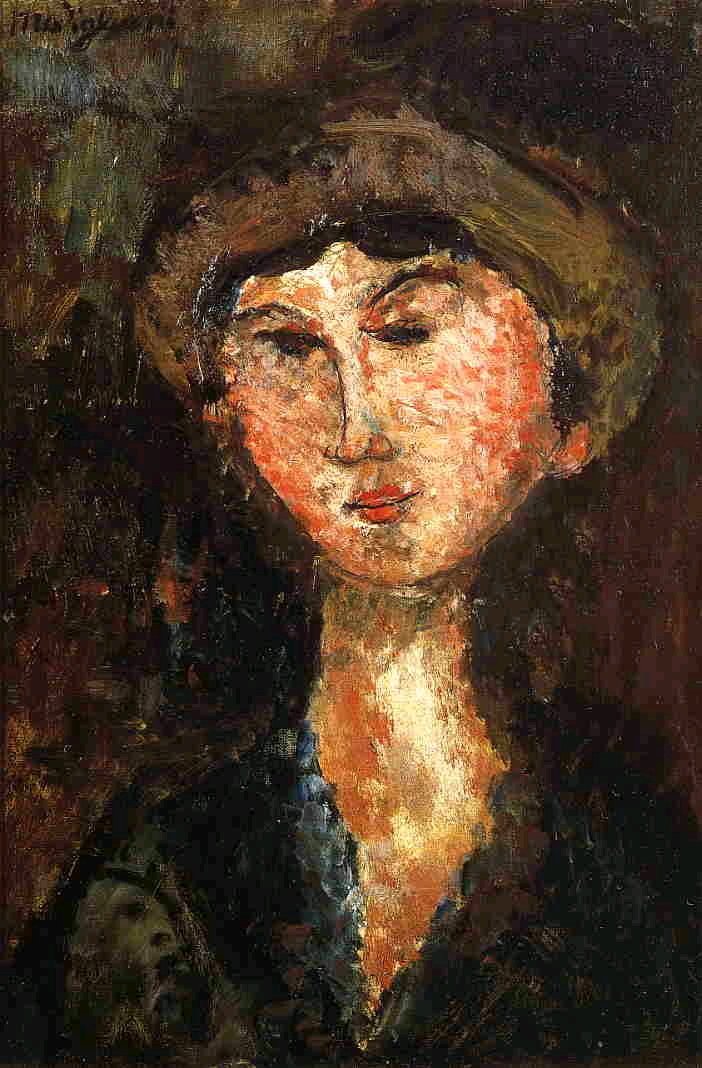
Beatrice Hastings with a hat
Oil on cardboard — 1914?
Identification
- Title
- English: Beatrice Hastings with hat - Mme. Hastings.
Notes: Beatrice Hastings con berretto (Ceron); Portrait of Beatrice Hastings / Portrait de Beatrice Hastings (High Museum of Art; Modigliani Initiative, AMDC 25, which also lists Beatrice Hastings au béret, Madame Hastings, Portrait de Mme Hastings and Portrait of Mrs. Hastings) - Date
- 1914?
Notes: 1914–15 (Pfannstiel and Ceroni); 1914 (High Museum of Art; AMDC 25); 1916 (O'Hana Gallery, London, 1953) (Ceroni / Pfannstiel 1914-15) - Medium
- Oil on cardboard or canvas?
Notes: Oil on cardboard ( Fels's L'Art vivant) ; oil on canvas (Pfannstiel, Ceroni and MR, High Museum of Art; AMDC 25). - Dimensions
- 55 x 46 cm ?
Notes: 55 × 45.5 cm (D'Atri papers); 58 × 37 cm (Ceroni and MR); 21 1/2 × 15 in. (54.6 × 38.1 cm), French standard size 10 Paysage (High Museum of Art; AMDC 25). - Signature
- "Modigliani " upper left
- Present location
- High Museum of Art, Atlanta. Doris and Shouky Shaheen Collection. (2019.150) - Link >
Catalogue numbers
| Compiler | Number |
|---|---|
| Arthur Pfannstiel | no. 32 |
| Joseph Lanthemann | no. 98 |
| Ambrogio Ceroni | no. 46 |
| Jeanne Modigliani | ? |
| Christian Parisot | ? |
| Osvaldo Patani | YES |
| Modigliani Project | ? |
| MR | YES |
| Modigliani Initiative/ AMDC | no. 25 |
Legal note on MR: This investigation has not had access to MR’s catalogue raisonné; all research here is based on open sources, publications and exhibitions. By no means has that catalogue been copied at any point. Modigliani Project and Modigliani Initiative are marked YES when the work is published or otherwise recorded by those projects, even if no catalogue number is assigned; otherwise the field is marked ?.
Provenance
- Paul Guillaume (1929 - Based on )
- Cailler Coll, Geneva (1954?)
- Private Collection? in process
The sequence follows the published museum, sale, and catalogue record in this investigation. Gaps and uncertain transfers are marked as such.
Selected bibliography
Book-length publications are marked with a footnote giving a full citation. Exhibition catalogues appear in both this list and the exhibition list when this investigation recorded them in both places.
- L'art vivant de 1900 à nos jours, 1914-1950, (no. 327) Ed. Pierre Cailler, Genève, 1954 (illustrated and as Oil on cardboard)
- Pfannstiel, Modigliani et son œuvre, étude critique et catalogue raisonné, Bibliothèque des Arts, Paris, 1956, no. 32 11
- Ceroni, Modigliani, E. il Milione, Milan 1958, no. 36 (incorrectly named as oil on canvas, 58 x 37 cm, private collection France)
- Lanthemann, Modigliani, catalogue raisonné: sa vie, son œuvre, son art, Barcelona, 1970, no. 98 23
- Ceroni & Piccioni, I dipinti di Modigliani, Milan. 1972, no. 46 34
- Parisot, Catalogue raisonné Modigliani, Graphis Arte, 1991 no. 1/1914 45
- Patani, Catalogo Generale, Leonardo ed. Milano 1991-94 56
- MR, L'Ange au visage grave, Musée du Luxembourg, Paris, 2002, p.178-179, no. 1 97
- Soto Caba, Modigliani, The timeless face, Libsa, 2007 68
Exhibitions
- Paris, Modigliani: l'Ange au visage grave, Musée du Luxembourg, 2002, no. 19
Notes
No additional notes in this investigation. Editorial marks such as “in process” have been omitted; disagreements between catalogues are left visible in the lists above.
Where sources disagree, both readings are given. This is a working research page, not a catalogue raisonné.
Introduction
Ceroni's no. 46 is a head-and-shoulders portrait of the English writer Beatrice Hastings wearing a soft, wide hat. It belongs to the first months of Modigliani's return to painting after he had largely given up sculpture. Ceroni gives it the caption "Beatrice Hastings con berretto, Parigi, proprietà privata" (Beatrice Hastings with a beret, Paris, private property) and adds no note. The Secret Modigliani page on the work treats the painting as an oil on cardboard of about 55 × 46 cm whose present owner is unknown. The most important finding of this essay is that the same picture is now in a public museum.
The High Museum of Art in Atlanta shows this Portrait of Beatrice Hastings (2019.150), an oil on canvas of 54.6 × 38.1 cm signed at the upper left. The Modigliani Initiative's digital catalogue (AMDC 25) gives Ceroni 1970, no. 46, among its references for this canvas. I compared the reproduction on the Secret Modigliani page with the museum's photograph. They show the same composition, stroke for stroke, with the same signature in the same place. The differences lie in colour and contrast and are those one expects between an older printed reproduction and a modern museum photograph.
The identification changes how the work should be described. The cardboard support and the 55 × 46 cm format given by the Secret Modigliani page cannot be reconciled with the museum's data. They also cannot be reconciled with the proportions of the page's own reproduction, as the section on discrepancies shows. What follows is a visual analysis based on both images, read against the museum's and the Modigliani Initiative's documentation. It also sets the picture beside the other Hastings portraits discussed in this series.
Composition and format
The High Museum gives the canvas as 21 1/2 × 15 inches. That is a narrow upright of roughly 1 : 1.43, and the Modigliani Initiative identifies it as the French standard 10 Paysage. In the reproduction on the Secret Modigliani page the width-to-height ratio is 0.657. In the museum's photograph it is 0.676. Both are close to the 0.698 implied by 38.1 × 54.6 cm, with small losses that may come from cropping or from the frame rebate. The image is set close to the edges. The crown of the hat comes within a tenth of the height of the top edge, and the figure is cut at the upper chest by the bottom edge.
The composition is built on a vertical axis that runs slightly to the right of centre. It starts at the crown of the hat, passes through the bridge of the nose and the small mouth, and continues down the long column of the neck into the V-shaped opening of a dark garment. The hat creates a broad horizontal ellipse across the upper third. Its brim is tilted, higher on the right than on the left, so the head seems turned a few degrees towards the viewer's right while the face itself stays frontal. Below the hat the oval of the face takes up most of the upper half of the canvas. The proportions are already Modigliani's: the face is long, the chin narrow, and the neck almost as long as the face. The garment's lapels form two dark diagonals that converge at the lower edge, an inverted triangle that echoes the downward taper of the face.
The signature sits in the upper left corner, in dark paint over a lighter passage of the background, and runs horizontally. It is a structural element as much as a mark of authorship. It counterweights the mass of the hat, which leans towards the right, and it marks the corner where the background is lightest.
Line
Line in this picture is mostly the edge of a stroke of colour rather than an independent contour. That is the main difference between this portrait and the more graphic heads of 1915, such as the Tête rouge (Ceroni no. 50) discussed later in this batch. The eyebrows are the clearest drawn elements. They are two thin dark arcs that continue down into the ridge of the nose, which is a single long stroke shaded on its right side. The eyes are narrow almond shapes under heavy lids, almost closed. The viewer's right eye is lower and more nearly shut than the left, a slight asymmetry that gives the face its absent, inward expression. The mouth is a small red bow with an upturned corner.
Elsewhere the drawing is achieved by contrast. The jaw is defined by the meeting of the pink and orange of the face with the dark hair and the shadow under the chin. The edges of the hat are the borders between its ochre band and the dark background. The outline of the neck dissolves in places into the surrounding brown. In the museum photograph a dark curved stroke is visible in the lower left, where the shoulder of the garment should be. In the Secret Modigliani page's reproduction the same area is a greenish patch that one could, with some imagination, read as a small face. I would not build anything on this. The museum's photograph is clearer and shows no figurative detail there.
Colour
The High Museum describes "the thick application of paint in short, choppy strokes" and "sensual orange-red coloring". These are the two keys to the picture's colour. The face is built from small separate touches of salmon pink, orange and vermilion laid over and beside cream and white highlights. The lights fall on the forehead, the cheekbone on the viewer's left and the bridge of the nose. The neck repeats the scheme in longer vertical strokes, with the palest cream down its centre. That streak of light is the brightest passage in the painting and leads the eye down to the opening of the dress.
The hat is painted in warm browns and greyish rose, with an ochre-olive band at the brim. Its colour links the hat to the background rather than to the face. The background is a dark mixture of browns, umbers and dull reds. A cooler passage of grey-green and ochre lies at the upper left behind the signature, and there are reddish strokes at the far left. A blue-grey band runs along the inner edge of the lapel on the viewer's left, the only cool accent close to the flesh. It acts as a foil for the orange of the neck.
The two reproductions differ markedly. The Secret Modigliani image is warmer and more saturated, with the flesh pushed towards orange and the background towards red-brown. The museum's photograph is cooler, the flesh more pink, the background closer to a dark olive-brown. Since only the museum photograph was made from the object with modern colour control, I take its colours as the more reliable. Neither replaces study of the canvas.
Facture
This is a densely painted picture, and the paint is the subject almost as much as the sitter. The face is built up in small, overlapping, roughly rectangular dabs, applied with a loaded brush and left unblended. In the museum photograph the dabs are clearly raised. The background is painted in larger, looser strokes, mostly vertical on the right and more broken on the left. In some places the paint is thin enough for the texture of the support to show. At the upper left, around the signature, the museum photograph shows a fine regular grain consistent with a canvas weave. This is an observation from a photograph, not an examination of the support, but it agrees with the museum's description.
The High's label links this way of painting to Modigliani's training. It says the strokes betray "Amedeo Modigliani's early association with the art of the Macchiaioli, a group of Italian artists who, like the French Impressionists, painted in colorful patches." This is a reasonable reading. The macchia, the patch of colour that builds form without a drawn outline, is what one sees in the face and neck. The Modigliani Initiative describes Hastings's portraits as spanning a range "from Pointillism to Cubism". This canvas sits towards the divisionist end of that range. The touches are not dots, but they are separate units of colour whose optical mixture produces the flesh.
Figure and space
There is no described setting. The figure occupies a shallow space against a dark, unmodulated ground. Depth is suggested only by the overlap of the hat over the background and by the warm-cool contrast between face and surroundings. The face projects because it is the lightest, warmest and most densely painted area. The hat and the dark garment form a frame around it. The figure is close to the picture plane and cut by the bottom edge, so the viewer stands at conversational distance, slightly below eye level. The broad brim seems to look down on us.
The expression is reserved. The lowered lids and the small closed mouth give the face a mask-like composure that Modigliani would develop much further in 1915. Here the mask is still softened by the warmth and irregularity of the paint. The sitter is individualised by the jagged dark fringe under the hat, the turn of the head and the asymmetry of the eyes.
Iconography and sitter
The Modigliani Initiative says that "Beatrice Hastings was the pen name of Emily Alice Haigh (1879–1943), the English poet and writer." It notes that she wrote for The New Age in London and that "In 1914 she moved to Paris as the journal's correspondent and met Modigliani soon after her arrival." It adds that the two "were romantically linked for approximately two years". Tate Papers, no. 35, describes her as "Modigliani's partner from mid-1914 to mid-1916". It also notes that she was "born in England, raised in South Africa" before relocating to Paris in 1914. The High Museum's label states that "Modigliani painted Hastings fourteen times during their two-year relationship."
The hat is the work's distinguishing attribute and gives it its titles in the literature: con berretto for Ceroni, au béret in one of the titles listed by the Modigliani Initiative. It is not a beret in the strict sense but a large soft hat whose crown sits high on the head. Modigliani painted Hastings in several headdresses and hairstyles in these two years. A hat of this kind was standard outdoor wear for a woman of her milieu, and nothing in the picture suggests a symbolic meaning. Its function is pictorial. It closes the composition at the top and gives the head a broad, dark halo.
Comparisons
The most useful comparison is with Ceroni no. 45, Beatrice Hastings at the piano. Ceroni believed that work, "per la concezione e la materia così densa" (for its conception and its very dense paint), to be the first of the Hastings portraits. The same density of paint is present here. The present canvas and no. 45 also share the dark ground and the warm flesh built up in separate strokes. The portrait at the piano is a full-length, narrow vertical on cardboard. The present work is a close-up bust on canvas, a format better suited to the study of the face.
Tate Papers, no. 35 provides a second, comparative point of reference. It discusses the X-radiograph of a figure under a later painting and compares it with Woman Seated in Front of a Fireplace (Beatrice Hastings) (1915, C58). The authors write: "both sitters wear their dark hair piled on top of their head, with a jagged fringe; both have oval-shaped faces with narrow pointed chins, have long necks". These features recur here: the jagged fringe below the hat, the oval face with a pointed chin and the long neck. They are features through which Hastings can be recognised across stylistically very different portraits.
The Tête rouge (Ceroni no. 50) of 1915 is painted in a similarly hot range of flesh colour. Its opposite approach shows how fast Modigliani's style changed in these months. In the Tête rouge the colour is laid in long streaks and enclosed by firm dark lines, and the face is constructed as a mask. Here the colour is broken into patches and the contour is left to emerge from them. A third comparison, also within this batch, is Woman seated with a glass (Ceroni no. 47). The Secret Modigliani page gives Hastings's name as one of that work's alternative titles. That picture is painted in a thin, drawn manner that Ceroni called "scarno di materiale" (sparse in material). The difference in handling is great, which argues that the two works were not made close in time.
Provenance and exhibitions
The Secret Modigliani page on the work gives the provenance as "Paul Guillaume(1929) Cailler Coll, Geneva (1954?) Private Collection? in process". The exhibition history it gives is the Musée du Luxembourg, Paris, Modigliani: l'Ange au visage grave, 2002, no. 19.
The Modigliani Initiative (AMDC 25) gives a fuller and partly different sequence:
- Likely the Svensk-Franska Konstgalleriet, Stockholm (possibly by 1926).
- Possibly Robert Gleizes, Paris (1926).
- Michel Couturier, Paris (by 1951). Couturier showed the painting at an exhibition at Shepheard's Hotel, Cairo, in January 1951, and it was reproduced in Arts no. 297, 9 Feb.1951, p. 3.
- Pierre Cailler, Geneva (by 1953). The painting was shown at the O'Hana Gallery, London, in 1953, as no. 16 and as Portrait de Mme Hastings, dated 1916.
- Private collection, Paris (by 1970).
- Stephen Hahn Gallery, New York (by 1982).
- Doris and Shouky Shaheen, Atlanta (1982).
- High Museum of Art, by gift (2019).
The same source reports that a photograph of the work in the Svensk-Franska gallery archives, at the Getty Research Institute, has on its verso the inscription "toile 10P". That would confirm both the canvas support and the 10 Paysage format. A High Museum press release of 2019 announced the Shaheens' gift of their collection. It called the "Portrait de Beatrice Hastings" (1914) "the High's first acquisition of the artist's work".
Discrepancies
- Dimensions. The page's 55 × 46 cm (d'Atri papers 55 × 45.5) corresponds to the French standard 10 Figure format, not to the museum's 54.6 × 38.1 cm (10 Paysage). A support of 55 × 46 cm would have a width-to-height ratio of 0.84. The page's own reproduction has a ratio of 0.657, closer to the 58 × 37 cm of Ceroni and MR (0.64) and to the museum's size (0.70). The height is the same in all three; the width of 46 cm is probably a confusion between the two standard 10 formats.
- Date. 1914 (High; AMDC 25), 1914–15 (Pfannstiel; Ceroni, according to the page) and 1916 (O'Hana Gallery, 1953, according to AMDC 25).
- Paul Guillaume. The page places the work with Paul Guillaume in 1929 based on D'Atri and others. AMDC 25 does not mention Guillaume. Its earliest likely owner is the Svensk-Franska Konstgalleriet.
- Fels and Cailler. The page cites L'art vivant de 1900 à nos jours, 1914-1950, Cailler, Geneva, 1954, no. 327. AMDC 25 cites Florent Fels, L'Art Vivant de 1900 à nos Jours: 1914–1950, Cailler, 1956, p. 107, as Madame Hastings. The year and the form of the reference differ.
- MR number. The bibliography reads "no. 1 97" for the Luxembourg catalogue of 2002. The page attaches footnote digits to catalogue numbers, and this probably reads as no. 19 with footnote 7. That would agree with the exhibition number, no. 19, but this is an inference.
Technical analysis
No technical study of this painting has been published, as far as I could find. Neither the High Museum's page nor the Modigliani Initiative refers to X-radiography, infrared imaging or pigment analysis. Everything said here about materials comes from the published documentation and from looking at photographs.
The documentary evidence for the support is clear: canvas, a standard 10 Paysage, with an inscription "toile 10P" on an early photograph (AMDC 25). That matters in the light of the technical literature. King, Ireson, Fraquelli and Townsend report that "Of seventy-six paintings, twenty-one were non-standard sizes, eleven were figure format, nine were paysage and thirty-five were marine". On that sample, a paysage canvas is a minority format for Modigliani's portraits. The same authors note that "Some of the paintings in our study have pinholes in all four corners which suggests that, having cut pieces from a large roll, Modigliani could have painted these canvases pinned to the wall of the studio." A standard-size canvas makes it more likely that this picture was painted on a ready-made stretched support, though only an examination of the tacking margins and the stretcher could confirm it. This is comparative evidence and not a finding about this work.
On colour, the conservation study of The Cellist and the portrait of Brancusi published in the International Journal of Conservation Science mentions analyses of the Portrait of Beatrice Hastings at the Art Institute of Chicago. There, "striking touches of emerald green paint were applied around the edges of the face, in the hollows of the neck, and under the shadow of the hat to increase the contrast and give additional volume to the forms". The present canvas has small cool green-grey and blue-grey touches in comparable places: under the hat, at the edge of the lapel and in the background behind the signature. Whether they contain emerald green is unknown. The parallel shows which questions an examination should ask, but it says nothing about this canvas's pigments.
Tate Papers, no. 35 shows that several of Modigliani's paintings of 1915–17 lie over earlier compositions, including one figure of a woman resembling Hastings. The thickness of the paint and the brownish, broken background here would make an X-radiograph worthwhile. Nothing at present suggests that there is anything underneath.
Conclusion
Beatrice Hastings with a hat is one of the most painterly of Modigliani's portraits of 1914–15. The face is built in patches of warm colour, and the structure of the head comes from the paint rather than from the drawn line. Its composition already shows the features that would define the later portraits: the vertical axis, the long neck, the narrow chin and the lowered lids. Its handling still belongs to the experimental phase that the High Museum relates to the Macchiaioli and the Modigliani Initiative situates "from Pointillism to Cubism".
The most important result of this study is documentary rather than visual. The work that the Secret Modigliani page presents as an oil on cardboard of 55 × 46 cm in an unknown private collection is, on the evidence of the images and of the published provenance, the canvas of 54.6 × 38.1 cm given to the High Museum of Art in Atlanta in 2019. The cardboard support and the 46 cm width are not supported by any other source. The proportions of the page's own reproduction contradict that width. The page should be revised to reflect the museum's data, and its bibliography should be checked for the numbers it shares with the page on Ceroni no. 45.
Museum, auction and exhibition sources
- High Museum of Art, Atlanta, Portrait of Beatrice Hastings (Portrait de Beatrice Hastings), 2019.150, https://high.org/collection/portrait-of-beatrice-hastings-portrait-de-beatrice-hastings/ (text and photograph: https://dlc.services/iiif-img/16/6/37181_1764957884572/full/692,1024/0/default.jpg)
- High Museum of Art, press release on the gift of the Doris and Shouky Shaheen collection (27 August 2019), https://high.org/press-release/atlantans-doris-and-shouky-shaheen-donate-their-impressionist-paintings-collection-to-high-museum-of-art/
- The Modigliani Initiative, Amedeo Modigliani Digital Catalogue, "Portrait of Beatrice Hastings, 1914 (AMDC 25)", https://catalogue.modigliani-initiative.org/catalogue/entry.php?id=25
Technical literature (comparative)
- Annette King, Nancy Ireson, Simonetta Fraquelli and Joyce H. Townsend, "The Modigliani Technical Research Study: An introduction to Modigliani's materials and techniques", The Burlington Magazine, vol. 160, no. 1380 (March 2018), https://www.burlington.org.uk/archive/article/the-modigliani-technical-research-study-an-introduction-to-modiglianis-materials-and-techniques (comparative)
- Anaïs Genty-Vincent et al., "Works by Modigliani that have Paintings beneath the Visible Surface", Tate Papers, no. 35, https://www.tate.org.uk/research/tate-papers/35/works-by-modigliani-that-have-paintings-beneath-the-visible-surface (comparative)
- Greta García, David Juanes and Rafael Romero, "Image Study and Material Characterization of the Two-Sided Painting The Cellist and Portrait of Brancusi by Amedeo Modigliani", International Journal of Conservation Science, vol. 14, no. 3 (2023), pp. 1233–48, DOI: 10.36868/IJCS.2023.03.30, https://ijcs.ro/public/IJCS-23-81_Garcia.pdf (comparative)
Sources that could not be opened
No technical report on the work was found. The two books cited by AMDC 25 for Hastings's biography (Buckley and Fraquelli in Modigliani Up Close, Barnes Foundation, 2022, p. 64, and Brunner in Modigliani and his Models, Royal Academy, 2006, p. 150) were not available. Neither were the O'Hana Gallery catalogue of 1953, the Cairo exhibition of 1951 and the 1951 issue of Arts. The Svensk-Franska gallery photograph at the Getty Research Institute is known only from AMDC 25's description.
Cited but not independently consulted
L'art vivant de 1900 à nos jours, 1914-1950, Pierre Cailler, Geneva, 1954, no. 327; Pfannstiel, Modigliani et son œuvre, 1956, no. 32; Ceroni, Amedeo Modigliani peintre, 1958, no. 36; Lanthemann, 1970, no. 98; Ceroni and Piccioni, I dipinti di Modigliani, 1970 (given as 1972 in the bibliography), no. 46; Parisot, 1991, no. 1/1914; Patani, 1991–94; MR, Modigliani: l'ange au visage grave, Musée du Luxembourg, 2002, pp. 178–179, no. 19 (read as "no. 1 97"); Soto Caba, Modigliani: The Timeless Face, 2007. Page and catalogue numbers are given without the footnote digits the page attaches to them (for example "no. 32 11" is read as no. 32).
Footnotes
- Arthur Pfannstiel, Modigliani et son œuvre, étude critique et catalogue raisonné, Paris, Bibliothèque des Arts, 1956.
- Ambrogio Ceroni, Amedeo Modigliani: Peintre; suivi des souvenirs de Lunia Czechowska, Milan, Edizioni del Milione, 1958.
- Joseph Lanthemann, Modigliani, catalogue raisonné: sa vie, son œuvre, son art, Barcelona, G. Condal, 1970.
- Ambrogio Ceroni and Leone Piccioni, I dipinti di Modigliani, Milan, Rizzoli, 1970.
- Christian Parisot, Catalogue raisonné Modigliani, Livorno, Graphis Arte, 1991.
- Osvaldo Patani, Amedeo Modigliani: catalogo generale, Milan, Leonardo, 1991–94.
- MR (cited here as MR), Modigliani: l’ange au visage grave, Paris, Musée du Luxembourg, 2002. Cited from the published exhibition catalogue only.
- Victoria Soto Caba, Modigliani: The Timeless Face, Madrid, Libsa, 2007.
Secret Modigliani investigation files — documentary compilation. This is a working research page, not a catalogue raisonné.